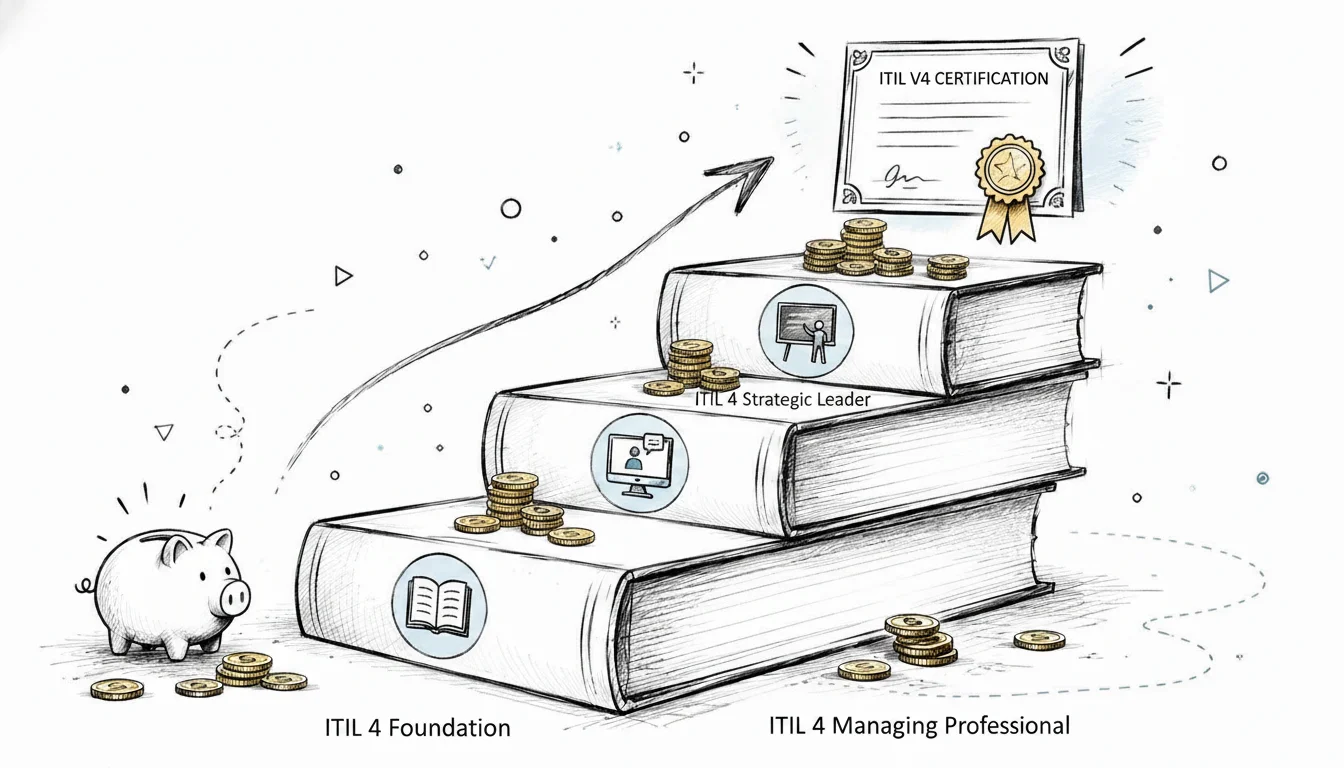
ITIL V4 Training and Certification Cost: A 2026 Guide
ITIL 4 Foundation Training and Certification Costs: A Current Guide
An ITIL 4 Foundation package typically costs $800 to $1,200 for self-paced learning and $1,500 to $2,500 for instructor-led training (verify current pricing on the vendor site). This price usually covers a bundle, not just the exam fee. This bundling is precisely why budgeting can be confusing.
Many IT professionals looking for ITIL pricing face the same challenge. You want a clear number, but every provider offers a different package, format, and list of inclusions. One page makes it seem affordable; another makes it look like a major corporate training purchase. Both perspectives can be accurate.
The core challenge is that ITIL 4 training and certification costs aren't a single line item. They represent a series of decisions. Your chosen training format, your need for structured learning, the chance of needing a retake, and your long-term certification goals all change the total investment.
If you're wondering if this certification fits your career budget, start by asking a practical question: Can your current role, target role, or market realistically support this expense? If you're comparing salaries across regions before committing to certifications, this breakdown of IT salaries in Latam helps put training costs into context.
If you already know ITIL is relevant to your path, review the MindMesh Academy ITIL prep page alongside official and accredited provider options. This allows you to compare preparation support separately from training bundles.
Understanding ITIL 4 Foundation Certification Pricing
The first budgeting mistake people make is treating ITIL like a cheap, exam-only certification. It isn't. If you're shopping for ITIL 4 Foundation, you're typically buying a training package that includes exam access, not just a voucher.
This changes how you should approach the purchase. You're not just asking, "What does the test cost?" You're asking, "What will I spend to get trained, sit the exam, and reduce my chance of paying twice?"
Your starting budget for ITIL 4 Foundation
For most professionals, a realistic starting budget looks like this:
- Self-paced Foundation plan: Expect roughly $800 to $1,200.
- Instructor-led Foundation plan: Expect roughly $1,500 to $2,500.
These figures are the most useful planning numbers because they reflect what people actually buy. They also match the reality that Foundation pricing is usually bundled.
If a price looks unusually low, check what's missing before you get excited. The cheapest option often strips out support, practice materials, or flexibility.
Why prices seem inconsistent
ITIL pricing can appear messy because providers package the same end goal in different ways. One bundle might include structured learning and exam access. Another may add practice exams or live coaching. Still another might target enterprise buyers and price accordingly.
This is why two candidates pursuing the same Foundation certification can spend vastly different amounts and still both make rational decisions. Someone with strong self-study habits can keep costs lower. Someone who needs a class schedule, instructor interaction, and stronger exam confidence will usually pay more – and often should.
Deconstructing the Total ITIL 4 Certification Cost
The clearest way to budget for ITIL is to think in components, not single numbers. You aren't buying one thing. You're buying a package with several moving parts, and each affects the final bill.
Practical rule: Budget for the full learning path to the exam, not just the exam itself.
PeopleCert's own listing makes this clear. ITIL 4 Foundation pricing is structured around a paid learning package rather than a simple exam-only purchase. A self-paced option is listed at US$937.00, discounted from US$1,338.00, VAT included (verify current pricing on the vendor site). Independent market guides also place Foundation bundles around $690 for self-study, $865 to $2,600 for self-study or on-demand preparation, and $1,995 to $4,500 for live training in major markets like the U.S. (Source: PeopleCert ITIL 4 Foundation pricing).
What you're actually paying for
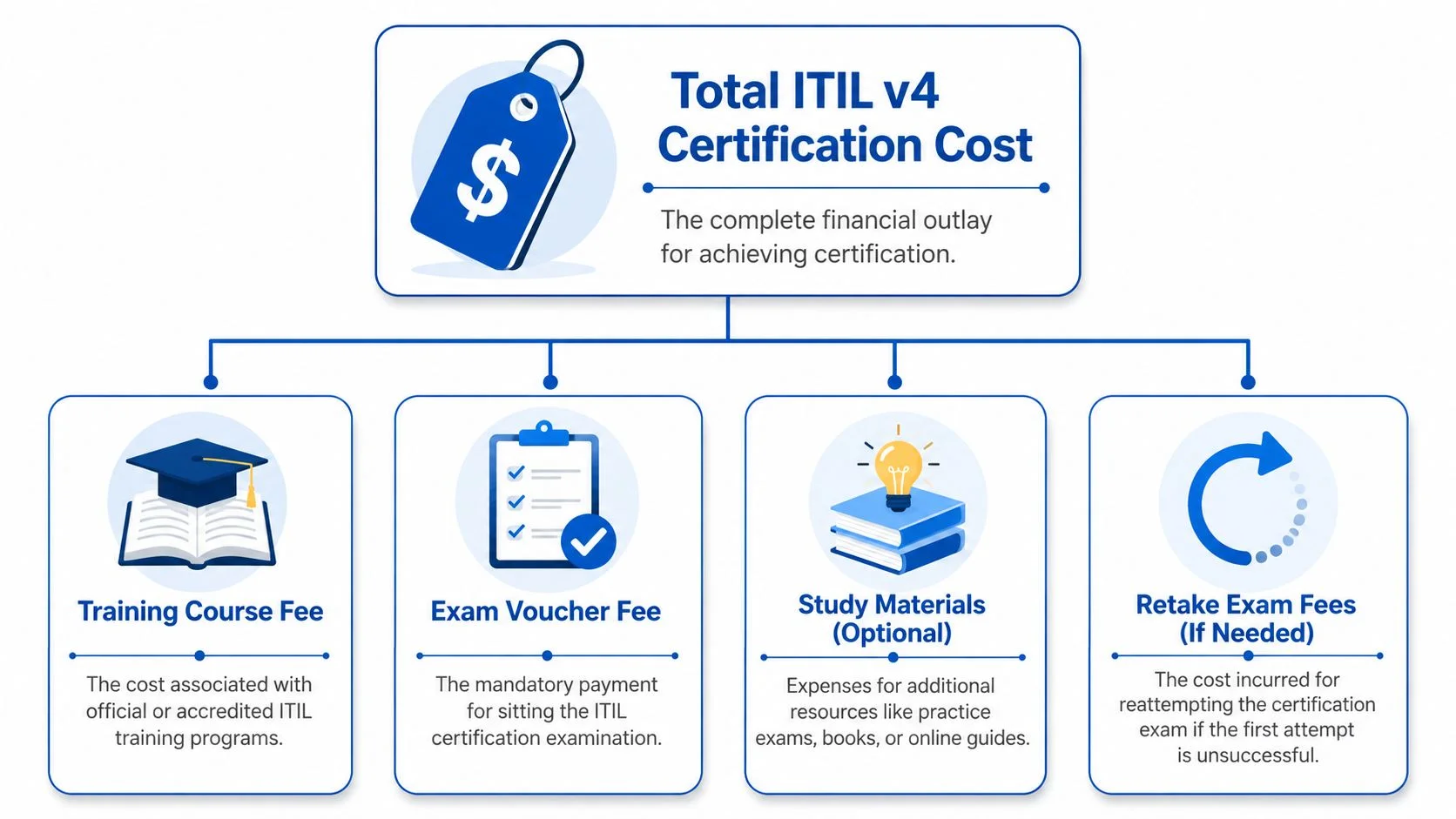
A typical Foundation bundle usually includes these cost components:
- Training delivery: Self-paced content, on-demand lessons, or live classes.
- Exam voucher: The right to sit the certification exam.
- Official materials: Often bundled digital resources or guided learning content.
- Practice support: Mock exams, quizzes, or review tools.
- Retake protection: Sometimes included, sometimes sold separately.
- Instructor access: Available in live or premium formats.
Some providers show one all-inclusive price. Others make the package appear modular, even though the total still lands in the same range.
How to evaluate provider offers
When you compare offers, don't just ask, "How much is this?" Ask these instead:
- Does the package include the exam?
- Is the training self-paced, on-demand, or live?
- Are practice exams included or sold separately?
- What happens if I fail?
- Is support available when I get stuck?
A lower sticker price can still be the more expensive choice if it leaves you underprepared and forces a retake.
Comparing Training Models and Their Price Ranges
Your training format is the biggest cost factor you control. Not the certification name. Not the syllabus. The format.
Independent guidance suggests self-study or on-demand preparation costs around $865 to $2,600, while live instructor-led training typically runs about $1,995 to $4,500. This spread exists because live delivery adds structure, instructor time, cohort interaction, and often richer bundled support (Source: New Horizons ITIL certification cost guide).
ITIL 4 Foundation training models compared
| Training Model | Typical Cost Range | Best For | Pros | Cons |
|---|---|---|---|---|
| Self-Paced Online | $865 to $2,600 | Independent learners with discipline | Flexible schedule, lower cost ceiling, easy to fit around work | Easier to procrastinate, less direct support |
| Live Virtual Classroom | $1,995 to $4,500 | Professionals who want structure without travel | Real-time instruction, scheduled accountability, Q&A access | Higher cost, fixed class times |
| In-Person Classroom | Premium end of live | Teams or learners who value immersion | Strong focus, live interaction, fewer distractions | Highest friction and often highest overall spend |
Which option for different buyers
If you're paying out of pocket, self-paced is usually the sensible default. It's the only model that consistently gives you a shot at keeping your Foundation budget near the lower end, provided you already study well on your own.
If you've failed vendor exams before, or you know you won't stick to a solo study plan after work, consider live virtual training. Spending more upfront can be cheaper than buying a second attempt later.
If your company is sponsoring a team and wants consistency, discussion, and shared language across service management work, instructor-led training makes more sense. This is especially true if your team is also reviewing process tooling and service workflows. If you're trying to evaluate help desk options for business, ITIL training often proves more effective when staff can immediately connect the framework to live service desk decisions.
For candidates comparing multiple learning routes, it also helps to view ITIL in the context of broader professional development options. Browsing the full list of MindMesh Academy certifications can help you decide whether ITIL should come first or sit behind another certification with a lower cash requirement.
Choose the model that matches your study behavior, not the one that sounds most ambitious. Many people waste money buying live training they never fully use.
The Cost of Advancing Beyond the Foundation Level
Foundation is the entry ticket. The more significant expense begins when you decide ITIL will be a long-term specialization, not a one-time credential.
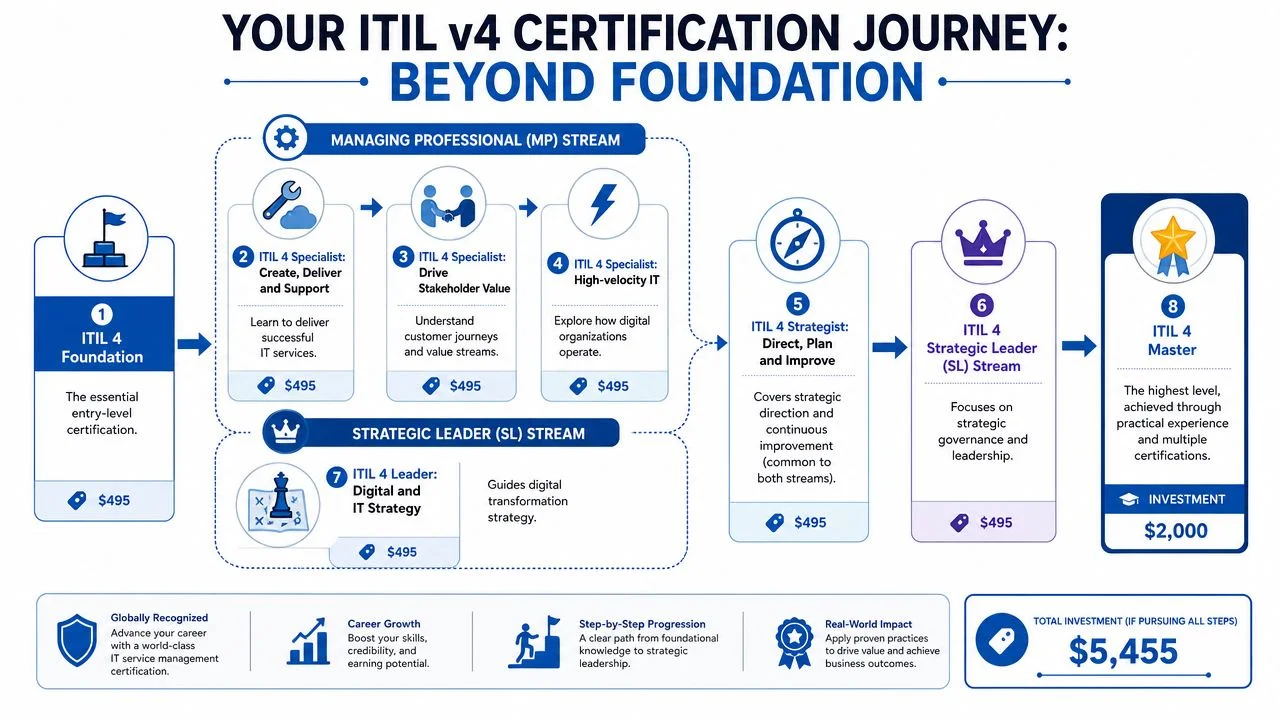
ITIL 4 now offers three main designation paths: Managing Professional (MP), Strategic Leader (SL), and Practice Manager (PM). This modular design is important because advanced certification spending compounds across multiple paid modules instead of one single follow-up exam (Source: CIO on ITIL certification paths).
Why advanced ITIL gets expensive fast
One current pricing breakdown cited by CIO says each advanced module bundle often costs $1,800 to $2,800. Total Managing Professional path spending can reach $7,200 to $11,200 across the required modules (verify current pricing on the vendor site).
That's not a casual purchase. That's a planned professional development program.
How to budget for an advanced path
Use a staged model instead of trying to fund the full path at once.
- Stage one: Fund Foundation and complete it.
- Stage two: Decide whether ITIL is directly tied to your role, promotion target, or employer roadmap.
- Stage three: Choose one advanced path, not all possible paths.
- Stage four: Spread modules across review cycles, reimbursement windows, or annual learning budgets.
People often misinterpret the path. They see Foundation as a small career upgrade and assume the rest of the path works the same way. It doesn't. Advanced ITIL is closer to a multi-step specialization track than a simple add-on.
My recommendation on advanced spending
Don't chase MP, SL, or PM just because you liked Foundation. Pursue them when one of these is true:
- Your role already uses ITIL language.
- Your employer funds at least part of the path.
- You're targeting service management leadership.
- You need ITIL credibility for consulting or governance-heavy work.
If none of those apply, stop at Foundation for now. There's no prize for buying advanced modules before your job market rewards them.
Hidden Costs and Budgeting Factors
It's common to budget for the visible part of ITIL and ignore the part below the waterline. That's where surprises happen.
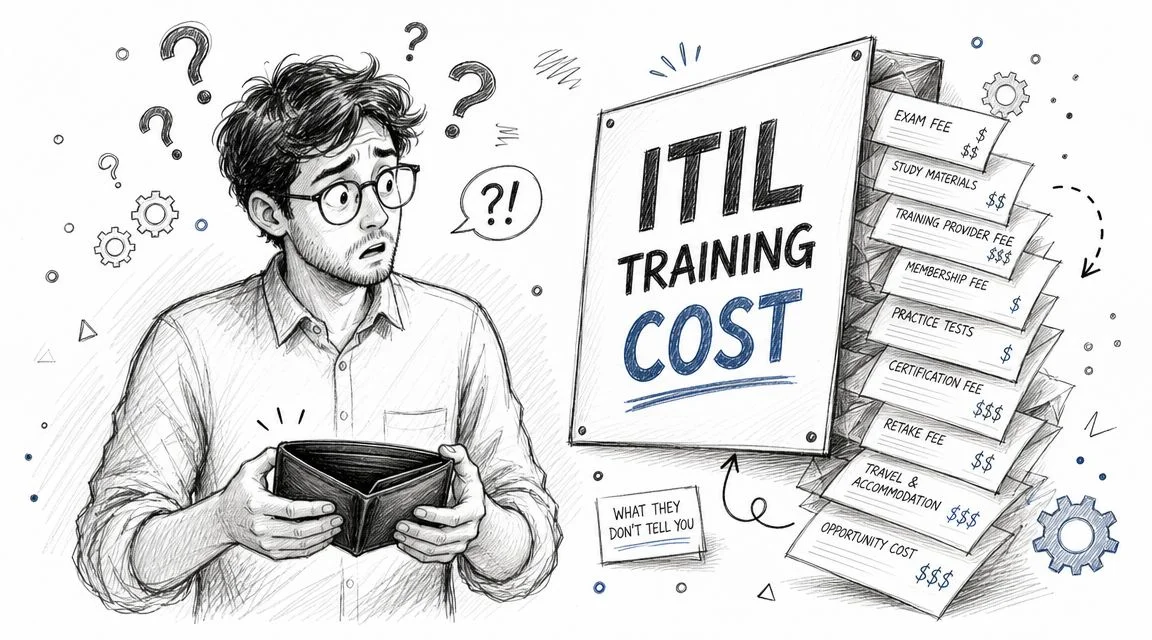
The first hidden cost is lifecycle maintenance. ITIL certifications must be renewed every three years. PeopleCert allows renewal either by retaking the latest exam or through its CPD program. This means your first purchase is not the end of the spend.
The iceberg most buyers don't price in
Your upfront course fee is the visible tip. Underneath it sit the costs that subtly alter your total expected investment.
- Renewal planning: You'll need a repeatable way to keep the certification active.
- Retake risk: Failing once can turn a reasonable budget into a frustrating one.
- Time cost: Live classes and renewal activities take hours away from work or personal time.
- Employer policy friction: Reimbursement rules can limit what counts as an approved expense.
A certification budget isn't complete until you ask, "What will this cost me to keep active?"
Build your budget as an expected-cost model
Use a simple personal worksheet with four lines:
- Initial package cost
- Optional support or practice purchases
- Possible retake exposure
- Renewal path every three years
This framework is far more useful than obsessing over the lowest advertised package online.
If you're buying from a provider with terms around access windows, transfers, or refunds, read them before paying. A surprising number of candidates only check policy details after a scheduling issue appears. Take a minute to understand our refund process or the equivalent policy wherever you purchase.
A short explainer can help if you're still sorting out what should count as "real" certification cost:
Smart Ways to Reduce Your ITIL Certification Cost
You usually can't make ITIL cheap. You can make it efficient. That's the right target.
The biggest savings don't come from hunting the rock-bottom sticker price. They come from avoiding bad-fit training, preventable retakes, and unnecessary path escalation.
Start with a personal cap
Set a maximum budget before you browse providers. For most individual buyers, that means deciding whether you're a self-paced buyer or an instructor-led buyer before you start shopping. If you blur that line, you'll drift upward quickly.
Then separate your budget into buckets:
- Must-have spend: Course and exam access.
- Risk-control spend: Practice tests, structured review, retake protection if offered.
- Future spend: Renewal and any advanced module ambition.
This approach works better than reacting emotionally to sales pages.
The savings moves that actually matter
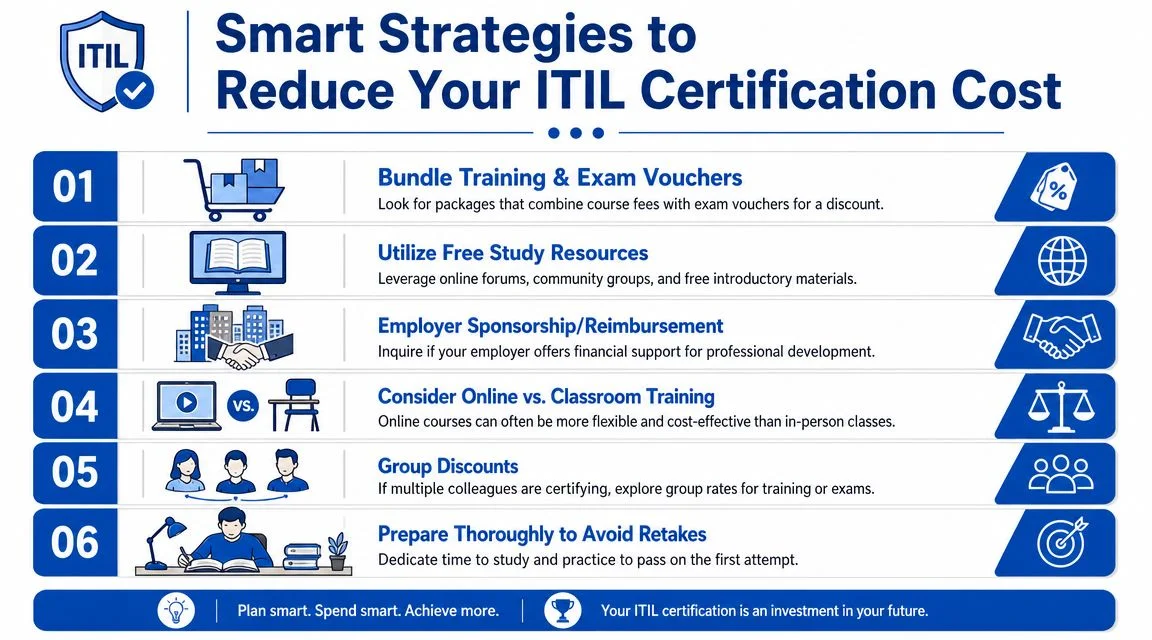
- Ask your employer first: If your role touches service delivery, support operations, governance, or process improvement, frame ITIL as job-relevant training, not personal enrichment.
- Buy bundles on purpose: A bundle that includes the exam and solid preparation is usually smarter than a bare-minimum purchase plus panic spending later.
- Prepare to pass once: The cheapest certification journey is the one without a retake.
- Delay advanced modules: Buy your next ITIL step only when you have a role-based reason.
- Compare learning platforms by what they include: Good preparation tools can lower risk, even when they don't replace accredited training.
If you're comparing preparation platforms alongside accredited training providers, one option is MindMesh Academy, which offers ITIL-focused study guides, practice exams, and flashcards. This kind of preparation can make sense for candidates who want extra reinforcement before using an official bundle or sitting the exam.
Think like a buyer, not like a student
Many professionals buy ITIL training the same way they buy books. That's the wrong mindset. You're buying an outcome under budget constraints.
Use the same discipline companies use when they buy learning systems. If you've ever looked into understanding LMS pricing, you already know the cheapest plan often leaves out the support and features that reduce downstream cost. ITIL training works the same way.
My direct recommendation is simple:
- If you're self-funded and disciplined, choose self-paced.
- If you're self-funded and inconsistent, pay for structure once instead of paying for failure later.
- If your employer is paying, optimize for support and completion, not minimum price.
Frequently Asked Questions About ITIL 4 Costs
Can I take the ITIL exam without buying training?
Treat ITIL 4 Foundation as a bundled purchase, not an exam-only transaction. That's the practical reality for most buyers. If you shop as though you're only looking for a standalone test fee, you'll misread the market and underbudget.
How much does it cost to renew an ITIL certification?
The exact total depends on how you renew, because the renewal route can be either retaking the latest exam or using PeopleCert's CPD pathway. What matters for budgeting is the policy itself. Your certification must be renewed every three years, so renewal should sit in your plan from day one, not as an afterthought.
Are there discounts for students or unemployed candidates?
Sometimes providers run promotions or package deals, but don't build your whole plan around finding a special discount category. Build around total value. A lower price with weak preparation can still cost more if you need another attempt or more study support later.
Is ITIL pricing different in countries like the UK, India, or Australia?
Yes, market pricing varies by region and provider format. The important point isn't chasing a universal global number. It's comparing like-for-like packages in your own market, with the same delivery model and inclusions. Regional spread matters, but package structure matters more.
Should I budget only for Foundation right now?
Usually, yes. Budget for Foundation first unless your employer has already mapped an advanced path for you. Foundation is the decision point. After that, use your job trajectory to decide whether advanced ITIL is justified.
Buy the certification that matches your next career move, not the one that flatters your ego.
What's the smartest budgeting mistake to avoid?
Underestimating the all-in cost. People fixate on the exam and forget the bundle, the retake risk, and the renewal obligation. The smarter approach is to set a full expected-investment budget before you purchase anything.
If you're preparing for ITIL and want a cleaner way to study before you commit more money, MindMesh Academy is worth a look. Our ITIL 4 Foundation practice exam can help you build a realistic study plan and avoid spending blindly.

Written by
Alvin Varughese
Founder, MindMesh Academy
Alvin Varughese is the founder of MindMesh Academy and an enterprise architecture leader. An electrical engineer by training, he moved from factory automation in South Africa to cloud architecture at GE Appliances and Humana (Fortune 50), and holds 20 professional certifications including AWS Solutions Architect Professional, Azure DevOps Engineer Expert, and Microsoft Agentic AI Business Solutions Architect. He built MindMesh Academy after interviewing too many highly certified candidates who couldn't answer basic questions: the goal is prep that makes you better at the job, not just able to pass the exam.