Your Guide to an ITIL Foundation Course Online in 2026
An ITIL Foundation course online is your first step into the world's most recognized framework for managing IT services. It’s all about learning the essential language and concepts that help deliver consistent, high-quality technology support, making it a cornerstone certification for anyone in tech today.
Why an Online ITIL Foundation Course Matters Now
Technology isn't just a department anymore; it's woven into every part of a business. But when teams like software development, cybersecurity, and user support all speak different languages and work in their own bubbles, delivering a smooth customer experience can feel chaotic. This is exactly where taking an ITIL Foundation course online makes a huge difference.
Think of ITIL as the official playbook for an organization's entire technology operation. Just like a professional kitchen relies on a set of standardized recipes to make sure every dish is perfect, IT teams need a common framework to deliver reliable and effective services. An online course is simply the most flexible way to learn this universal language.
A Common Language for Diverse Teams
Without a shared framework, you get classic disconnects. A software developer might see a new feature launch as a smashing success, but the help desk team sees it as the reason their phones are suddenly ringing off the hook with support calls. That gap creates friction, wastes time, and ultimately frustrates the end-users.
ITIL bridges that gap by providing a common vocabulary and a set of shared processes. When you complete an ITIL Foundation course, you're showing that you understand core concepts like:
- Value Co-creation: How IT and the business must work together to get results.
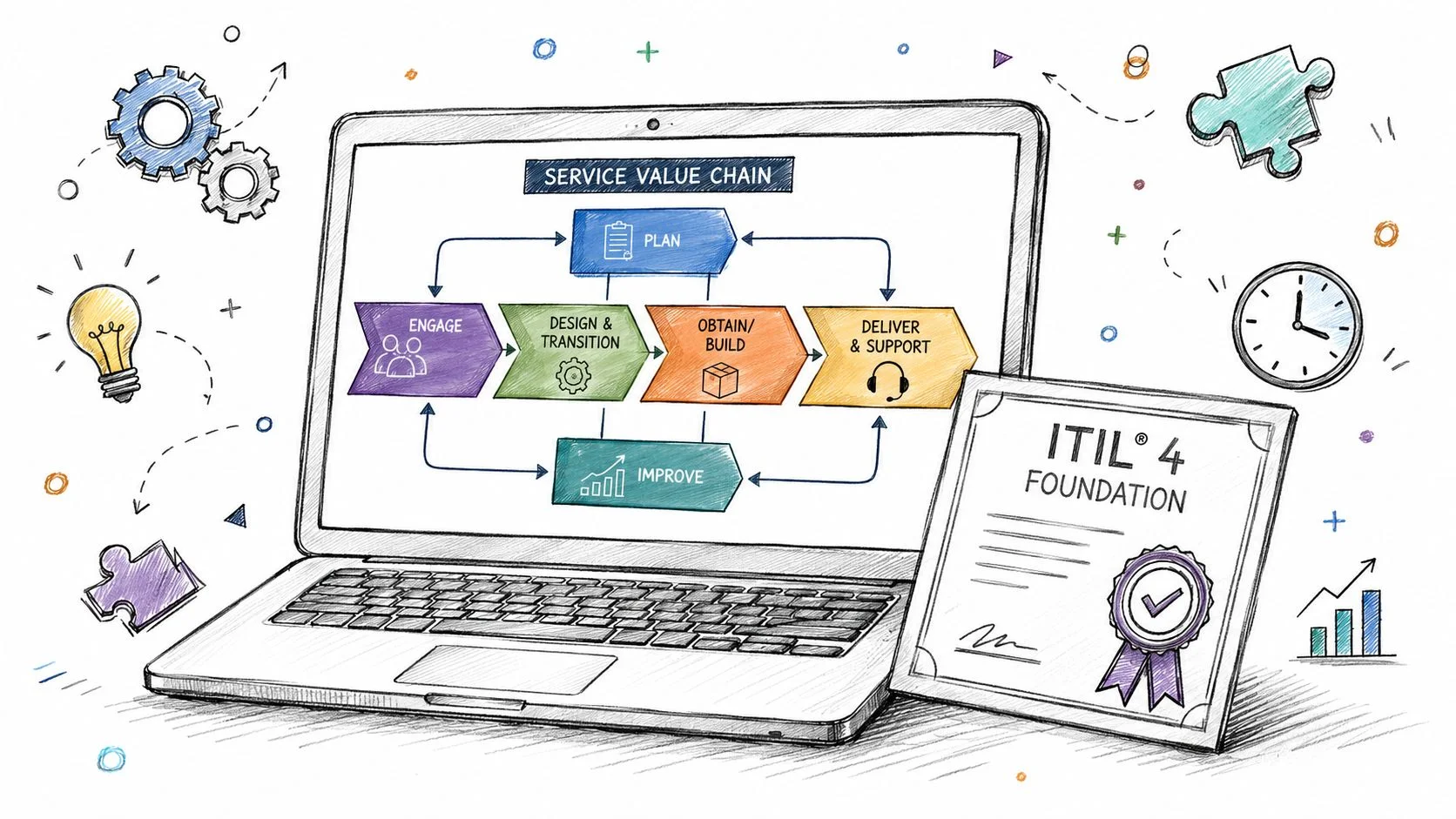
- The Service Value Chain: The key steps needed to turn a demand into something valuable for the customer.
- The Guiding Principles: Core philosophies that help you make smart service management decisions every day.
This shared knowledge gets everyone pulling in the same direction: delivering technology that actually helps the business and its customers succeed.
Who Benefits from an ITIL Course
The principles you learn in an ITIL Foundation course online aren't just for service managers. This certification is a great move for a wide range of professionals who want to improve how technology delivers value. For anyone looking to prepare for professional certifications and build a more strategic career path, it's a fundamental building block.
An ITIL certification is your entry ticket to a globally recognized system. It proves to employers that you know how to connect day-to-day technical tasks to real business outcomes, moving you beyond just fixing problems to providing strategic value.
This certification is especially useful for:
- Help Desk Analysts: Get a clear, structured way to handle incidents and service requests far more efficiently.
- Project Managers: See how your projects fit into the bigger service picture, which helps improve how new services are integrated and rolled out.
- Business Leaders: Finally gain real visibility into how technology investments are creating tangible business value.
- Career Changers: Earn a foundational, industry-respected credential that opens doors to dozens of different roles in the tech world.
Decoding the ITIL 4 Syllabus and Exam Format
When you first look at an ITIL Foundation course online, it might seem like you're learning a whole new language. But don't worry—the curriculum is designed to be incredibly logical. The goal isn't just to teach you a list of terms; it's to give you a solid framework for understanding how modern IT services are actually built, managed, and improved.
The syllabus is built on two key pillars: the Four Dimensions of Service Management and the ITIL Service Value System (SVS). Think of the Four Dimensions as the essential ingredients you need for any successful service: Organizations and People, Information and Technology, Partners and Suppliers, and Value Streams and Processes. You simply can't deliver value without considering all four.
The Service Value System in Action
If the Four Dimensions are your ingredients, then the Service Value System (SVS) is the recipe that shows you how to combine them to create something valuable for your customers.
The heart of the SVS is the Service Value Chain, a flexible model with six activities that guide a service from a simple idea to a fully supported product. These activities are: Plan, Improve, Engage, Design & Transition, Obtain/Build, and Deliver & Support.
Let's see how this works with a real-world example. Imagine your company wants to launch a new mobile app.
- Plan: First, the team defines the app's vision and creates a roadmap for its development and launch.
- Engage: They talk to key stakeholders—customers, marketing, and sales—to truly understand what the app needs to do.
- Design & Transition: The app is designed, built, and tested in a safe, controlled environment before going live.
- Obtain/Build: Developers get to work writing the code, and the company procures any necessary third-party services or software.
- Deliver & Support: The app is finally launched! A support team is in place, ready to help users with any questions or problems.
- Improve: The work isn't done. The team continuously collects user feedback and data to make the app even better in future updates.
This is why professionals from all corners of IT find the framework so useful.
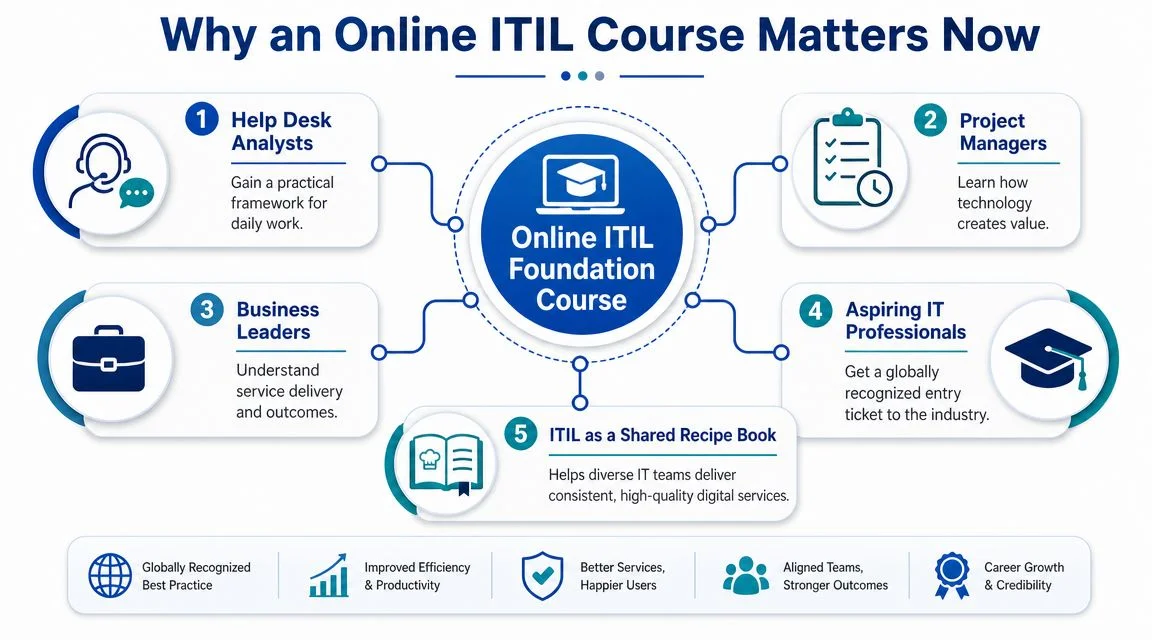
As you can see, ITIL isn't just for the help desk anymore. It’s a shared language that helps project managers, developers, and business leaders work together to deliver great services.
How the ITIL Foundation Exam Works
So, how do you prove you've mastered these concepts? That's where the ITIL 4 Foundation exam comes in. It’s a straightforward, multiple-choice test designed to confirm you have a solid grasp of the ITIL framework and can apply its principles.
The key to passing isn't rote memorization; it's genuine comprehension. The exam focuses on the why behind the framework, making sure you can think critically about service management challenges you'll face in the real world.
Any good ITIL Foundation course online will thoroughly prepare you for the exam, but having a great ITIL certification study guide on hand is always a smart move. To get your certification, you first need to know what you're up against on exam day.
Here's a quick look at the official PeopleCert exam structure.
ITIL 4 Foundation Exam Structure at a Glance
This table breaks down exactly what to expect from the exam, so you can walk in feeling prepared and confident.
| Exam Feature | Details |
|---|---|
| Question Format | 40 multiple-choice questions |
| Time Limit | 60 minutes (or 75 for non-native English speakers) |
| Passing Score | 65% (26 correct answers out of 40) |
| Exam Type | Closed-book (no notes allowed) |
With a clear understanding of both the syllabus and the exam, you're well-equipped to begin your training and master the fundamentals of modern IT service management.
Choosing the Right Online ITIL Course Format
Picking an ITIL Foundation course online isn't as simple as just clicking the first link you see. The best choice for you really hinges on how you learn, what your schedule looks like, and what you want to get out of the certification. Let's break down the main options so you can make a smart investment in your career.
You'll generally find three types of courses: self-paced, live virtual classes, and some that blend both. Each one takes you down a different road to getting certified, with its own set of pros and cons that can make or break your experience.
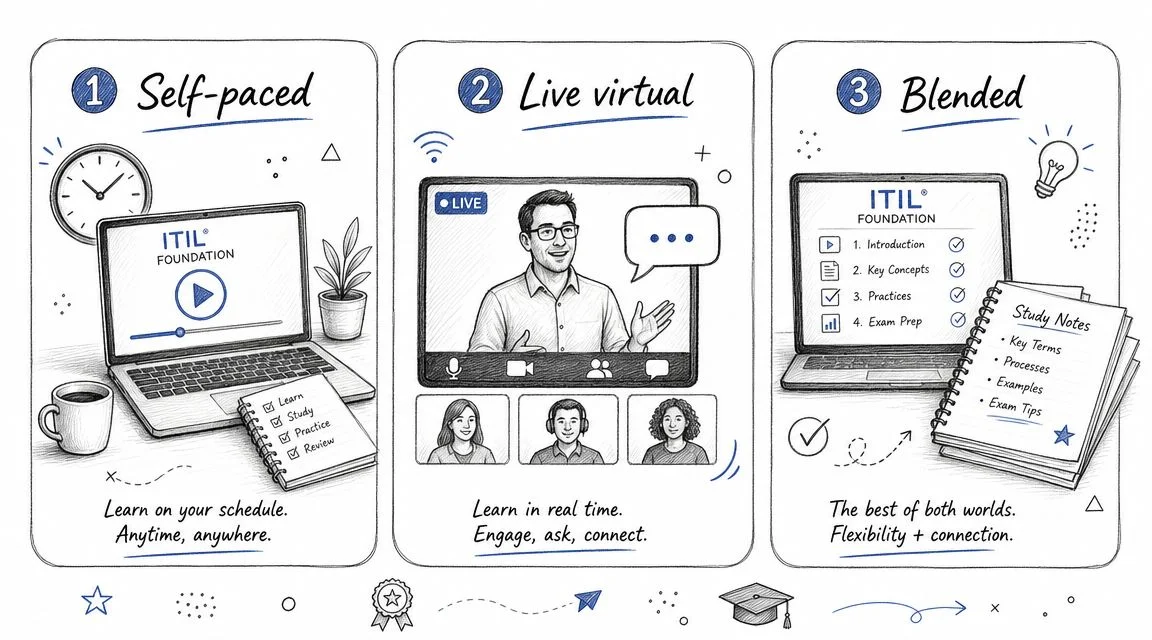
Flexible Self-Paced Learning
If you’re a busy professional or a parent trying to fit studying into an already packed schedule, self-paced courses are a lifesaver. They offer total flexibility. You can hit the books early in the morning, on your lunch break, or late at night—whenever you find a quiet moment. This format puts you in the driver's seat.
The trade-off, of course, is that you have to be your own motivator. Without a set schedule or an instructor keeping you on track, it’s incredibly easy to let your studies slide. Success here comes down to good old-fashioned self-discipline and time management.
Interactive Live Virtual Classes
Live virtual classes are designed to feel like a real classroom, just without the commute. An expert instructor leads scheduled sessions, giving you a structured learning environment and the chance to ask questions in the moment. This format is perfect if you feed off the energy of a group and need that accountability to stay engaged.
On the other hand, you lose flexibility. You have to show up at specific times, which can be tough if your work or home life is unpredictable. Think of it like registering for a college course—attendance is part of the deal.
The online training market for ITIL has matured significantly, offering a range of structured, time-bound programs. This means you aren't just buying access to materials; you're often enrolling in a complete certification pathway with built-in exam readiness.
This shift is clear when you look at how providers bundle their courses. Many now offer ITIL 4 Foundation in short, intensive packages that cover everything from the training itself to the exam voucher. For example, some companies provide a 3-day instructor-led course that includes the exam for $1,995. At the same time, you might find a university-affiliated program offering a condensed 12-hour live virtual bootcamp for as little as $650.
This variety means you can choose between a comprehensive, corporate-style training or a shorter, academic-style bootcamp, depending on your budget and how you prefer to learn. You can discover more about these ITIL training options to see the full scope of what's available.
Understanding the Costs and What's Included
When you start shopping for an ITIL Foundation course online, the first thing you'll notice is the massive price range. It can be confusing. Why does one provider charge $650 while another asks for nearly $2,000? The secret is to look past the sticker price and figure out what’s actually inside the box.
Think of it this way: you’re not just buying a course; you’re investing in a complete toolkit to get you certified. The total cost is really a combination of the training materials, the official exam voucher from PeopleCert, and any extras like practice exams or instructor support.
What Drives the Price Differences
That price gap, which can be more than $1,300, usually comes down to the training format and what’s bundled in. A premium, live instructor-led course from a provider like New Horizons might run you $1,995, while a self-paced university program could be closer to $650. The difference is the level of support and resources you get.
The best value isn’t always the cheapest option. It’s the one that gives you a complete package for a single price. A solid, all-in-one course will typically include:
- Accredited Course Materials: The official curriculum that PeopleCert has signed off on.
- The Exam Voucher: This is your ticket to the official certification exam, and it’s not cheap.
- Practice Exams: Absolutely essential for checking your knowledge and getting comfortable with the test format.
- Instructor Support: The ability to ask an expert when you get stuck on a concept.
- Exam Retake Insurance: Some providers include a "second chance" voucher, which is a fantastic safety net.
The Smartest Way to Buy Your Course
I see a lot of people make the same mistake: they try to piece everything together separately, thinking they’ll save a few bucks. It almost never works out that way. In fact, just buying the standalone ITIL 4 exam voucher can cost you around $669—nearly as much as some entire course bundles!
The most cost-effective path is almost always to buy a bundled package. Training providers get a discount on exam vouchers and pass that savings on to you. They roll the course, exam, and crucial study resources into one price, giving you a much better deal than if you bought everything piecemeal.
Going with a bundle saves you money and a lot of headaches. You won’t have to worry about hidden fees or missing resources right before your exam. When you're ready to get serious, you'll want to Access premium tech exam preparation that includes all these essentials from the start. A good package is designed to give you everything you need to pass on your first try.
Passing the ITIL Foundation exam isn't about luck—it’s about having a smart, strategic approach. A good study plan takes the mountain of information you need to learn and breaks it down into manageable steps. So, forget the last-minute cramming sessions. We're going to build a solid process using proven techniques that will have you walking into that exam feeling prepared and confident.
The right plan provides a clear roadmap and timeline, whether you're on a two-week "get it done" sprint or taking a more measured four-week pace. The secret is consistency and using study methods that actually help you remember the material long-term, not just for a few hours.
Your Week-by-Week Game Plan
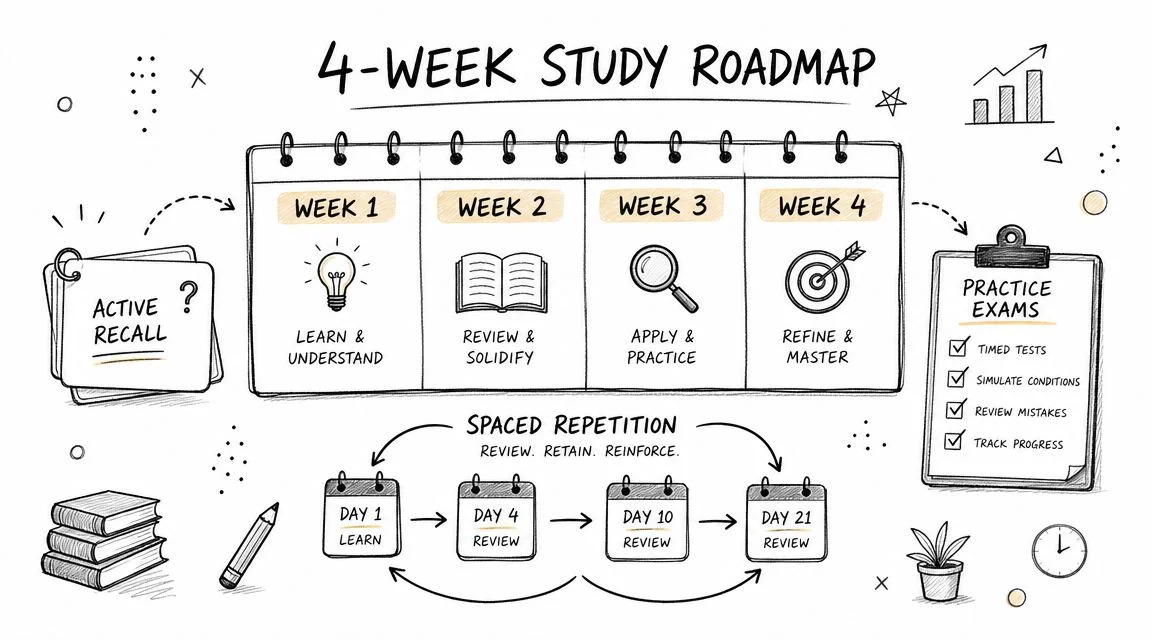
A structured schedule is your best defense against feeling overwhelmed. This timeline is flexible—you can easily condense it to two weeks if you have more time to dedicate each day, or stretch it to four if you're balancing work and other commitments.
-
Week 1: Laying the Foundation Your first week is all about mastering the absolute core of ITIL 4. Concentrate on getting a deep understanding of the Four Dimensions of Service Management and the ITIL Guiding Principles. The goal isn't just to memorize the lists; it's to start thinking about how these concepts show up in real-world IT departments.
-
Week 2: Connecting the Dots With the fundamentals in place, it’s time to focus on the engine of ITIL: the Service Value System (SVS) and its operational heart, the Service Value Chain. Use your course materials to trace the path of value from the first customer request all the way to delivery. This is where you’ll see how all the individual pieces of the framework start working together.
-
Week 3: Practices and the First Reality Check This week, you'll dive into some of the most critical ITIL practices, like Incident Management, Change Enablement, and the Service Desk. Toward the end of the week, it's time to take your first full-length practice exam. Don't worry about the score; the real value here is in diagnosing your weak spots. Where did you hesitate? What questions left you stumped?
-
Week 4: Sharpen, Review, and Reinforce The final week is for targeted review. Take the feedback from your practice test and drill down into the areas that gave you trouble. This is the time to use smart study techniques to lock in that knowledge for good. A few days before your actual test, take one more practice exam to build your confidence and get comfortable with the timing.
How to Study Smarter, Not Harder
Here’s the thing: passively reading your notes over and over is one of the least effective ways to learn. To truly master the material, you need to engage with it actively. Two of the most powerful, research-backed methods for this are Spaced Repetition and Active Recall.
Spaced Repetition is the practice of reviewing information at increasing intervals. This technique interrupts the "forgetting curve," forcing your brain to strengthen the neural pathways associated with a memory. It's far more effective than cramming information all at once.
So, instead of rereading a chapter five times in one night, you review it once, then again a day later, then maybe three days after that. It actually feels more difficult than cramming, but that's a sign it's working. You're building stronger, more durable knowledge.
Combine this with Active Recall. This is the secret sauce. After you study the Service Value Chain, close the book and try to draw it from memory. Make your own flashcards (digital or physical) or try explaining a concept like "Change Enablement" out loud to a colleague. The act of retrieving the information from your brain is what truly cements it for the exam.
Practice exams are your ultimate active recall tool. They force you to simulate the real test environment, training your brain to quickly pull up the right information under pressure. This is why a good ITIL Foundation course online that includes multiple high-quality practice exams gives you a serious competitive edge.
Using Your Certification for Career Growth
Passing your ITIL Foundation course online feels great, but that's just the starting line. The real win comes when you actively use that certification to steer your career. Think of it less as a final exam and more as a key to unlocking new doors.
This certificate does more than just bulk up your resume; it proves you speak the universal language of modern IT service management. This common ground is exactly what hiring managers look for when filling senior roles and specialized positions.
Turning Knowledge into Opportunity
One of the smartest benefits of getting your ITIL certification is how it complements your other professional goals. Many accredited courses offer Professional Development Units (PDUs), which are crucial for maintaining other high-value credentials, like the Project Management Professional (PMP) from PMI.
This is a perfect example of how ITIL has become a cornerstone of professional upskilling. For instance, it's common for an online ITIL course to provide 18 to 22 PDUs. This means you're investing in a credential that actively supports your other certifications—a fantastic two-for-one value. You can learn more about how ITIL and project management intersect on YouTube.
Your ITIL Foundation certification is the first step on a clear and structured career ladder. It qualifies you to pursue advanced certifications that unlock senior roles in service delivery, continuous improvement, and digital strategy.
Charting Your Next Steps with ITIL
So, you have your Foundation certificate in hand. What's next? The most logical path is to explore the ITIL Managing Professional (MP) designation. This is where you start building on your foundational knowledge with practical, role-specific skills. It's designed for people who are actually in the trenches managing IT projects, teams, and workflows.
The Managing Professional stream is broken down into four key specializations:
- Create, Deliver, and Support: This module is all about the practical side of getting services out the door, covering everything from design and build to delivery and ongoing support.
- Drive Stakeholder Value: Here, you'll master the art of building strong relationships with customers, users, and suppliers to ensure everyone is working toward a common goal.
- High-velocity IT: This specialization focuses on the skills needed to thrive in fast-paced, Agile, and automated environments, which is essential in today's tech world.
- Direct, Plan, and Improve: This gives you the strategic toolkit to build a learning, improving IT organization that can adapt and grow.
Each of these advanced certifications deepens your expertise, making you a far more valuable asset to any organization and setting you on a clear trajectory toward leadership.
Of course. Here is the rewritten section, designed to sound completely human-written and natural.
Your Top Questions About Online ITIL Courses, Answered
Getting into ITIL certification brings up a lot of questions. Let's clear up some of the most common ones I hear from professionals looking to get certified.
How Hard Is the ITIL 4 Foundation Exam?
This is probably the number one question people ask, and for good reason. No one wants to walk into an exam unprepared.
The short answer is that the exam is designed to be an entry-level certification, so it's challenging but definitely not impossible. The key is how you study. A solid training course will teach you to understand the core concepts, not just cram a bunch of terms. With that foundation, you’ll be in a great position to pass, even if you’re brand new to IT service management.
Can I Just Take the Exam Without a Course?
Technically, you can. PeopleCert, the organization that runs ITIL, will let you buy an exam voucher on your own. But I almost never recommend going this route.
Think of it this way: the accredited courses are built specifically around the official syllabus. They give you the structure, context, and expert insights that you just won't get from reading a book alone. Trying to self-study is a gamble that could cost you more time and money if you have to retake the exam.
While your ITIL 4 Foundation certificate itself never expires, PeopleCert requires you to renew it every three years to stay on their official Successful Candidates Register.
Keeping your certification active is straightforward. You have two main options:
- Log Continuing Professional Development (CPD) points: Show you're staying active in the field by taking part in relevant professional activities.
- Pass another ITIL exam: Earning any other ITIL certification within that three-year window automatically renews your Foundation status.
This process simply ensures that your skills and knowledge remain current with the latest industry practices.
Ready to build your ITIL expertise? Mindmesh Academy offers curated materials and expert guidance to help you master the concepts and pass your exam with confidence. Start your ITIL journey today.

Written by
Alvin Varughese
Founder, MindMesh Academy
Alvin Varughese is the founder of MindMesh Academy and an enterprise architecture leader. An electrical engineer by training, he moved from factory automation in South Africa to cloud architecture at GE Appliances and Humana (Fortune 50), and holds 20 professional certifications including AWS Solutions Architect Professional, Azure DevOps Engineer Expert, and Microsoft Agentic AI Business Solutions Architect. He built MindMesh Academy after interviewing too many highly certified candidates who couldn't answer basic questions: the goal is prep that makes you better at the job, not just able to pass the exam.