ITIL Certification Exam Study Plan for Foundation
ITIL Certification Exam Study Plan for Foundation
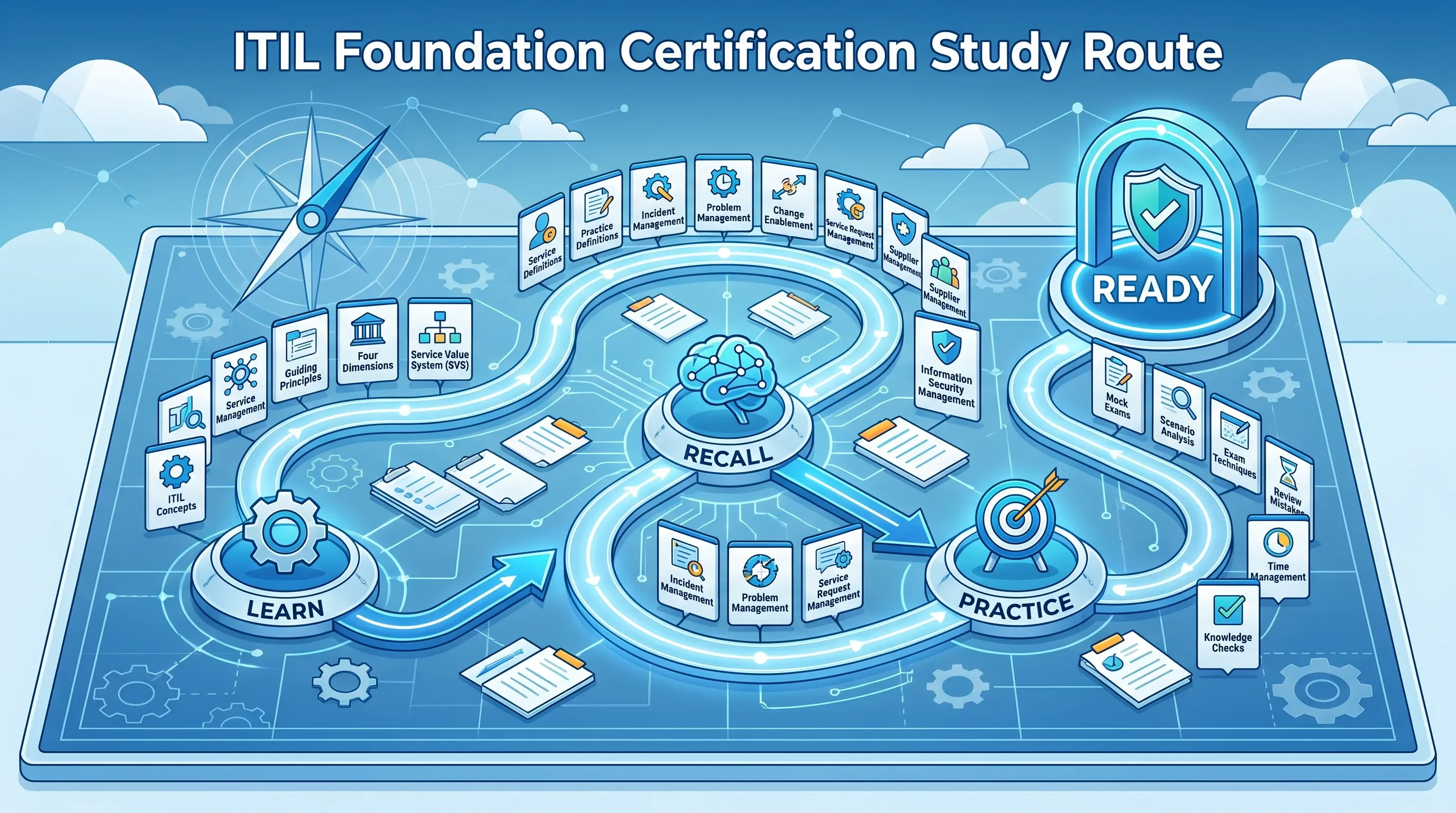
To prepare for the ITIL 4 Foundation certification exam, your study plan needs a weekly rhythm: learn official concepts, recall them without notes, and answer exam-style questions with explanations. If you can commit 45 to 60 minutes on weekdays and a longer weekend session, a 4-week plan is realistic for many candidates. Only shorten this if you already work in IT service management.
If you're looking for an ITIL Foundation exam plan, remember to keep the scope narrow. Foundation isn't about becoming a full ITIL consultant. Instead, it proves you understand the core language of ITIL 4: the Service Value System, its guiding principles, the four dimensions of service management, the service value chain, and key ITIL practices. You'll need to apply these concepts in basic scenarios, like identifying the correct guiding principle for a given problem.
ITIL Foundation Exam Facts Your Study Plan Should Use
The official exam structure directly influences your study strategy. PeopleCert, the certification body, outlines the ITIL 4 Foundation exam details on their certification page. The exam consists of multiple-choice questions, has a 60-minute time limit, and requires a passing score of 26 out of 40.
| Exam detail | What it means for your study plan |
|---|---|
| 40 multiple-choice questions | Practice reading short scenarios quickly and eliminating wrong answers. |
| 60 minutes | Aim to answer most practice questions in 60 to 75 seconds so you have review time. |
| 26 correct answers needed to pass | Don't treat 65% as your practice target. Build a buffer before exam day. |
| Closed book | Use recall drills and flashcards, not just rereading. |
| Foundation-level scope | Focus on definitions, relationships between concepts, and simple application questions. |
A strong study plan must include timed practice, consistent definition recall, and a thorough review of why incorrect answers are wrong. Simply reading a guide once and taking a single mock exam at the end will leave you with too many blind spots.
Choose an ITIL Foundation Study Timeline Based on Your Starting Point
Most candidates don't need an intense boot camp schedule for ITIL Foundation, but consistency is crucial. Choose a timeline that fits your background and calendar, then guard those study blocks.
| Timeline | Best for | Weekly study time | Main risk |
|---|---|---|---|
| 2 weeks | Candidates with ITSM, service desk, operations, or project delivery experience | 8 to 10 hours | Rushing through weak concepts and overtrusting work experience. |
| 3 weeks | IT professionals who know service delivery but are new to ITIL 4 terminology | 5 to 7 hours | Confusing familiar workplace language with ITIL exam wording. |
| 4 weeks | Busy learners, career changers, or candidates studying around work | 4 to 5 hours | Losing momentum if sessions are too far apart. |
| 6 weeks | Beginners with little IT or service management exposure | 2 to 3 hours | Forgetting early topics unless flashcards and review are regularly scheduled. |
If you're unsure, aim for 4 weeks. This gives you enough time to revisit concepts through spaced practice without extending preparation so long that you lose recall of earlier topics.
Before Day 1: Set Your Baseline and Calendar
Start with the official ITIL 4 Foundation exam objectives, not just random notes. Your goal is to identify which topics the exam covers and which ones you already understand. If you need the content organized specifically around the Foundation scope, consider using a structured study guide as your roadmap.
Before your first study session, take a short diagnostic quiz without notes. Don't focus on the score yet. Instead, mark each question as one of three types: knew it, guessed it, or missed it. This baseline shows if your first week needs to emphasize vocabulary, the Service Value System, or practice-level questions.
Next, schedule your study blocks. A typical 4-week calendar might include four 45-minute sessions during the week and one 90-minute session on the weekend. Crucially, add dedicated review days to your calendar before you begin. Review is what transforms familiar terms into reliable exam recall.
Week 1: Learn ITIL 4 Vocabulary and the Service Value System
Week 1 is about establishing your foundational language in ITIL 4. If the core terms remain fuzzy, every subsequent topic becomes more challenging because the exam often tests small differences in meaning.
First, focus on basic definitions: service management, value, outcome, output, cost, risk, utility, warranty, organization, service provider, service consumer, and stakeholder. Don't simply copy definitions. After each term, write a one-sentence example from a service you're familiar with—perhaps a help desk, cloud platform, payroll system, or customer support portal.
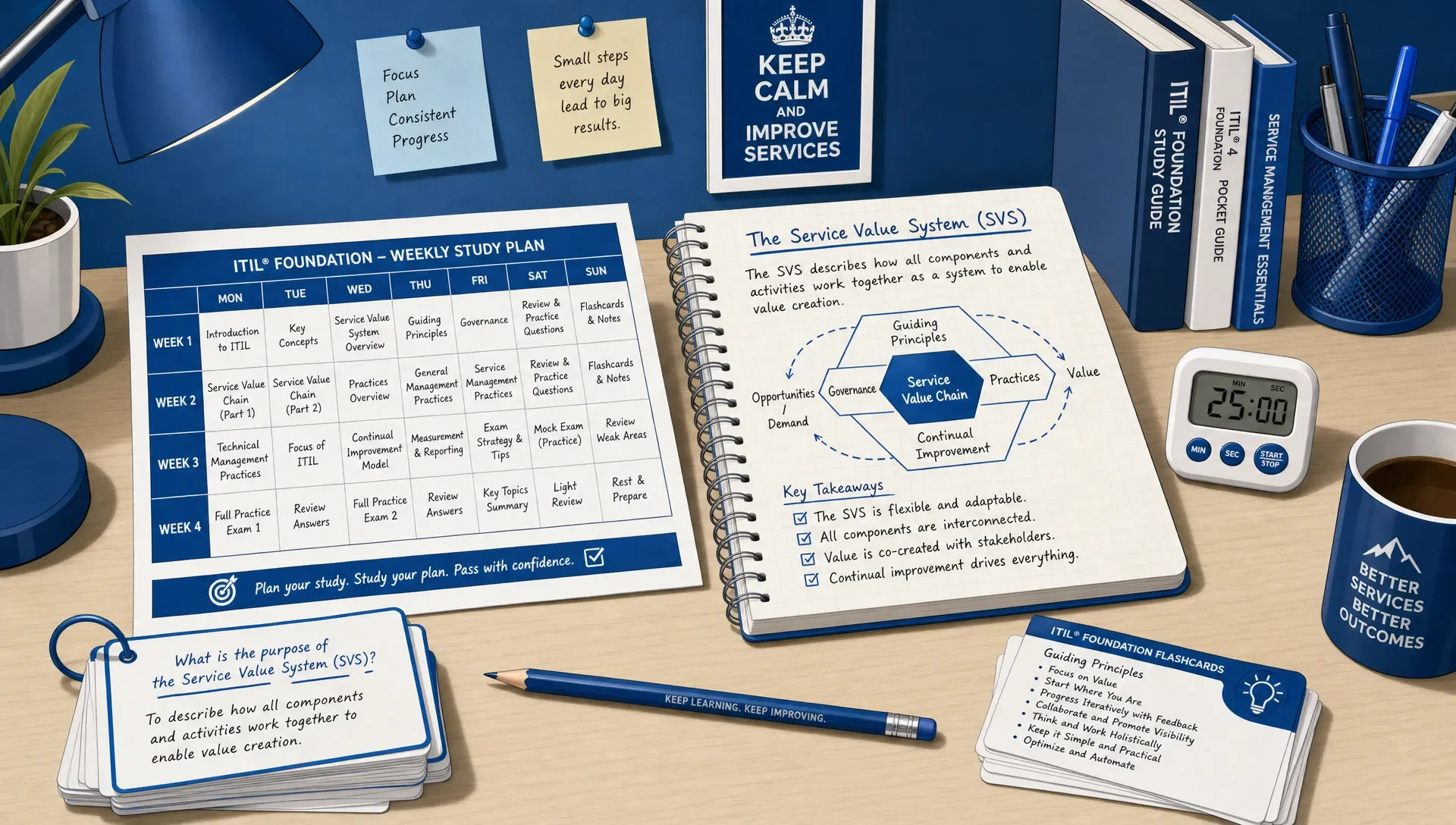
Once the vocabulary feels stable, move to the Service Value System. You should be able to explain how opportunity or demand enters the system and how value emerges through the interaction of guiding principles, governance, the service value chain, practices, and continual improvement.
By the end of Week 1, you should be able to close your notes and answer these prompts aloud: What is value? What is a service? What does the Service Value System include? And why does continual improvement apply across the system?
Week 2: Connect Guiding Principles, Four Dimensions and the Value Chain
Week 2 is often when candidates start memorizing lists. While this works for a few questions, it fails when the exam asks which principle best fits a scenario. Study these concepts as decision tools, not just isolated labels.
For the seven guiding principles, create one flashcard for the definition and another for a practical scenario. Focus on value, for instance, should prompt you to ask whether an activity genuinely helps the customer, user, or another stakeholder achieve value. Start where you are should lead you to look for existing resources, data, and capabilities before redesigning everything from scratch.
The four dimensions of service management need the same treatment. Organizations and people, information and technology, partners and suppliers, and value streams and processes are not merely four random headings. They remind you to examine service management from multiple angles before making decisions.
For the service value chain, learn each activity by its purpose and how it interacts with the others. The activities—Plan, Improve, Engage, Design and Transition, Obtain/Build, and Deliver and Support—can appear in questions asking you to identify what's happening in a service scenario.
Week 3: Use Practice Questions to Fix Weak Spots
Week 3 isn't for taking practice tests blindly. Instead, use questions as a diagnostic tool. An effective practice session reveals whether you missed a definition, misread a scenario, or failed to connect two ITIL concepts.
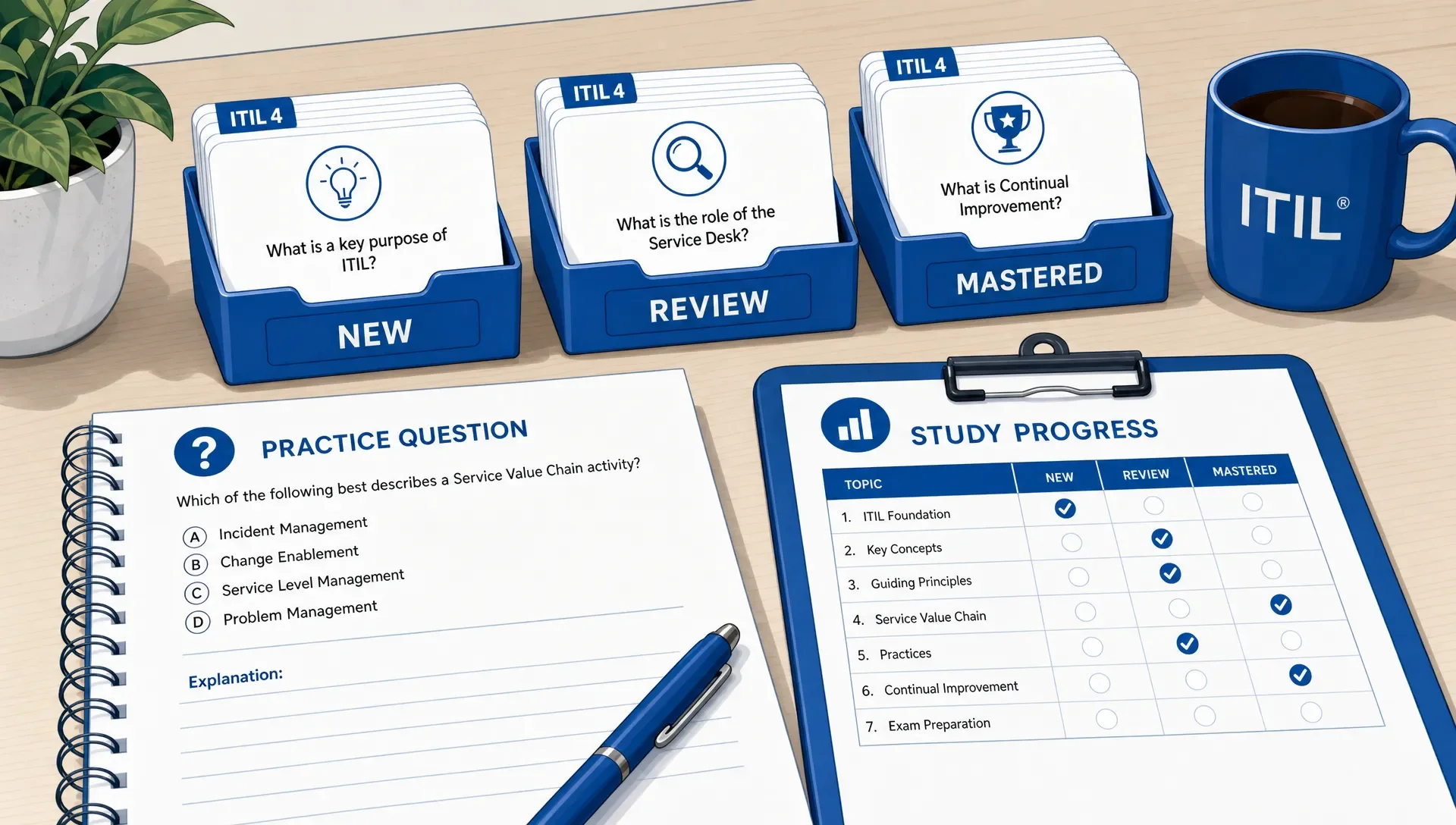
Start with topic-based question sets, then move into mixed sets. MindMesh Academy's ITIL 4 Foundation practice exams, for instance, combine practice questions, detailed explanations, flashcards, and readiness tracking into a single workflow. When you review explanations, rewrite the reason in your own words. If you can't explain why the correct answer is correct, you haven't finished reviewing that question.
Keep a small mistake log. It doesn't need to be fancy; it just needs to be honest.
| Mistake type | What it looks like | How to fix it |
|---|---|---|
| Definition gap | You confuse utility and warranty or outcome and output. | Add two contrast flashcards and review them for three days. |
| Scenario mismatch | You know a principle but choose the wrong one for the situation. | Write the clue words that pointed to the correct principle. |
| List memorization only | You can name the value chain activities but not apply them. | Create one real-world example for each activity. |
| Speed problem | You run out of time on mixed sets. | Practice 10-question timed blocks, then review pacing. |
| Overthinking | You change correct answers without evidence. | Require a specific reason before changing an answer. |
If you need more guidance on question quality and review technique, the MindMesh article on ITIL Foundation practice questions explains how to use practice items for understanding instead of rote memorization.
Final Week: Prove You Can Pass Under Exam Conditions
The final week should feel different from the first three. Now, you're no longer learning every topic from scratch. You're testing your ability to perform under exam conditions and making final repairs to any weak areas.
Take at least two timed, full-length practice exams or mixed sets during this final week. Review every missed question on the same day. Waiting until later makes it easier to forget why you chose the wrong answer.
Use readiness targets that give you a margin above the official pass mark. These aren't guarantees, but they serve as practical instructor benchmarks for confidence.
| Readiness check | Recommended target before exam day | What to do if you're below target |
|---|---|---|
| Timed practice score | Around 75% to 80% on more than one mixed set | Review the weakest two topic areas before taking another full set. |
| Time management | Finish with several minutes left for review | Practice shorter timed blocks and stop rereading every question twice. |
| Confidence tracking | Few guesses on core concepts | Convert guessed questions into flashcards. |
| Explanation quality | You can explain missed questions without copying the explanation | Restudy the concept, then answer a similar question. |
| Topic balance | No major objective area is consistently weak | Use targeted practice instead of taking another random mock exam. |
In the last 24 hours, don't cram new material. Instead, review flashcards, skim your error log, retake a few missed-question variants, and prioritize sleep. A tired candidate who studied one extra hour often performs worse than a rested candidate who can read carefully.
A Daily ITIL Foundation Study Routine That Builds Recall
A daily routine often outperforms long, irregular study sessions. Practice testing and spaced review work because they force your brain to retrieve information over time. As shown in Roediger and Karpicke's 2006 paper, retrieval practice improved long-term retention compared with repeated studying. A 2006 review by Cepeda et al. also supports spacing study sessions across time instead of massing all practice together.
Use this 45-minute routine on regular study days:
| Time | Activity | Goal |
|---|---|---|
| 5 minutes | Recall yesterday's main ideas without notes | Strengthen memory before rereading. |
| 15 minutes | Study one exam objective or concept cluster | Keep the session focused. |
| 10 minutes | Review flashcards | Reinforce definitions and contrasts. |
| 10 minutes | Answer practice questions | Apply the concept in exam wording. |
| 5 minutes | Update your mistake log | Decide what to review tomorrow. |
On weekend sessions, expand the practice question block and add a timed mixed set. Don't turn every long session into passive reading. If you aren't actively answering, explaining, or recalling, you're probably not studying as efficiently as you think.
What to Memorize for the ITIL Foundation Exam
You do need to memorize certain elements for ITIL Foundation, but memorization alone isn't enough. Clearly separate what you must recall exactly from what you need to understand in context.
| Topic area | Memorize | Understand in context |
|---|---|---|
| Key concepts | Definitions such as value, service, utility, warranty, cost, and risk | How a service provider and service consumer co-create value. |
| Guiding principles | Names and core meaning of each principle | Which principle fits a scenario and why another one does not. |
| Four dimensions | The four dimension names | How ignoring one dimension can weaken a service decision. |
| Service Value System | Main components | How demand and opportunity move toward value. |
| Service value chain | Activity names and purposes | How activities combine rather than operate as a fixed sequence. |
| ITIL practices | Required practice purposes and selected key terms | What a practice contributes to service management. |
| Continual improvement | Model steps and improvement concepts | How improvement applies across services, practices, and value streams. |
When a topic seems like pure memorization, turn it into a contrast. Utility versus warranty, outcome versus output, incident management versus problem management, and change enablement versus release management are all common areas where candidates often lose easy marks.
How to Review Wrong Answers Without Wasting Time
Reviewing wrong answers is precisely where your score improves. Simply reading the explanation is far too passive. Instead, use a three-pass review technique.
First, identify the tested concept. Write the objective area next to the missed question, such as guiding principles, service value chain, or key definitions. Second, identify the clue you missed. This might be a phrase about stakeholder value, existing resources, risk, service restoration, or supplier involvement. Third, write the shortest possible rule that would help you answer a similar question next time.
For example, if you chose problem management when the question described restoring normal service as quickly as possible, your rule might be: Incident management focuses on restoring service; problem management focuses on causes and future prevention. That rule is much more useful than copying a paragraph from a guide.
Common ITIL Foundation Study Plan Mistakes
The biggest study plan mistake is treating ITIL Foundation as a simple vocabulary quiz. While vocabulary matters, the exam also asks you to select the best concept for a given situation. Make sure to build application practice into every week.
Another common mistake is mixing older ITIL lifecycle language with ITIL 4 concepts. If your workplace still uses older terms, pay close attention. The exam expects ITIL 4 wording, especially for the Service Value System, value streams, practices, and guiding principles.
Candidates also delay practicing under time pressure. Timed practice does more than just test speed. It reveals whether you can read precisely even when you're uncomfortable. If you only practice untimed questions, the real exam can feel harder than the material actually is.
Finally, avoid using brain dumps. They train memorization without true understanding, can be inaccurate, and don't build the decision-making skills needed for scenario questions. Always use practice questions with explanations and thoroughly review your reasoning.
How to Use MindMesh Academy During This Study Plan
MindMesh Academy is most effective when you use it as a connected workflow, not just a last-minute question bank. Start with study guides organized by exam objectives so you know what each session is meant to cover. Then, use practice questions with explanations to test your understanding, not just to score yourself.
Flashcards with spaced repetition are especially useful during Weeks 1 and 2, when definitions and concept contrasts matter most. In Weeks 3 and 4, adaptive, weakness-based practice can help you focus more time on the topics that keep costing you marks. MindMesh Academy's mastery, readiness, and topic progress tracking features offer a clearer view of whether you're genuinely improving or simply repeating familiar questions.
This matters because ITIL Foundation preparation can feel deceptively easy. Many terms sound familiar. However, the real test is whether you can pick the best ITIL answer when two choices seem plausible.
Frequently Asked Questions
How long should I study for the ITIL Foundation exam? Most candidates should plan for 3 to 4 weeks of steady study. If you already work in IT service management, you might manage it in 2 weeks. For those new to IT concepts, allow closer to 6 weeks, ensuring regular flashcard review.
Is the ITIL Foundation exam hard for beginners? The ITIL Foundation exam is manageable for beginners, especially if they learn the vocabulary early and practice applying concepts to scenarios. Beginners typically struggle most with similar-sounding terms and selecting the best guiding principle for a given situation.
Can I pass ITIL Foundation by only taking practice tests? Practice tests are helpful, but they shouldn't be your only resource. If you don't understand why an answer is correct, your score can drop when the wording changes. Always pair practice questions with objective-based study and flashcards.
What practice test score should I reach before booking the exam? The official passing score is 26 out of 40 (65%). However, a safer readiness target is around 75% to 80% on more than one timed, mixed practice set. Crucially, also check that your weak areas are shrinking, rather than just relying on a single good score.
Do I need to memorize every ITIL practice in detail? Focus on the Foundation syllabus scope. You need to know the purpose of required practices and their key concepts, but you don't need advanced implementation details. Study each practice's purpose, the problem it solves, and how it supports value creation.
What should I do the day before the ITIL Foundation exam? Review your flashcards, skim your mistake log, and answer a small number of previously missed questions. Avoid learning brand-new material late at night. Your priority is accurate recall and careful reading on exam day.
Build Your ITIL Foundation Exam Workflow
A study plan only works if you use it consistently. Set your timeline, take a baseline quiz, study one objective at a time, review with flashcards, and use timed practice to prove your readiness before exam day.
Ready to put this ITIL Foundation study plan into action? MindMesh Academy provides a complete prep path, offering objective-based practice questions with detailed explanations, spaced flashcards, and readiness tracking. Start building a strong foundation for the exam today with our ITIL 4 Foundation practice exam.

Written by
Alvin Varughese
Founder, MindMesh Academy
Alvin Varughese is the founder of MindMesh Academy and an enterprise architecture leader. An electrical engineer by training, he moved from factory automation in South Africa to cloud architecture at GE Appliances and Humana (Fortune 50), and holds 20 professional certifications including AWS Solutions Architect Professional, Azure DevOps Engineer Expert, and Microsoft Agentic AI Business Solutions Architect. He built MindMesh Academy after interviewing too many highly certified candidates who couldn't answer basic questions: the goal is prep that makes you better at the job, not just able to pass the exam.