
ITIL and ServiceNow: The Ultimate 2026 Guide
ITIL and ServiceNow: The Blueprint Meets the Toolbox
You're probably in one of two places right now. You're studying for an ITIL exam or a ServiceNow certification and wondering why the material seems to talk past itself. One side gives you principles, practices, and service value concepts. The other gives you forms, workflows, tables, and platform features. The missing piece is how they fit together on the job.
I explain it to junior admins this way: ITIL is the blueprint. ServiceNow is the toolbox. If you have a blueprint but no tools, you know what should be built but can't build it. If you have a full toolbox but no blueprint, you can keep drilling, cutting, and wiring, but you may end up with a mess that doesn't serve the business.
That's why people who understand both usually stand out. They don't just close tickets. They understand why an incident becomes a problem, why a fix should move through change control, and why the CMDB matters when a major service goes down. If you need a quick grounding in the broader discipline around this topic, this IT service management guide gives useful context before you get deeper into frameworks and platforms.
The Blueprint and the Toolbox
A lot of confusion starts with a bad assumption. People think ITIL and ServiceNow are competing choices. They aren't. One is a management framework. The other is a platform used to put that framework into action.
When teams have a blueprint but no toolbox
I've seen teams with sensible process documents, clean RACI charts, and thoughtful service review meetings. On paper, everything looked mature. In practice, incident notes lived in one system, change approvals happened over email, and knowledge articles were scattered across shared drives.
The result wasn't a lack of intelligence. It was a lack of execution. Good intent doesn't scale when people have to stitch the work together manually.
Practical rule: If your process depends on memory, inboxes, and heroics, you don't have an operating model. You have a workaround.
When teams have a toolbox but no blueprint
The opposite problem happens just as often. A company buys ServiceNow and calls it an ITIL implementation. That's like buying power tools and announcing the house is finished.
You can create incident forms, approval flows, and service catalog items all day long. But if nobody agrees on what counts as a standard change, when to raise a problem, or how service ownership is defined, the platform becomes a very expensive filing cabinet.
For certification candidates, this distinction matters. Exams tend to test the logic behind service management. Workplaces test whether you can apply that logic in an actual platform. The synergy between ITIL and ServiceNow is where both worlds meet.
Understanding the ITIL Framework
ITIL often gets introduced in a way that makes it sound heavier than it is. People hear “framework” and picture rigid rules, giant binders, and process police. In reality, ITIL is a shared way to think about delivering and improving IT services.
It gives teams common language: Incident, Problem, Change, Service Value, Improvement. Without that language, every team invents its own definitions and hands work off poorly.
Why ITIL still matters
ITIL has history, which explains why so many organizations still use its vocabulary. The UK government's Central Computer and Telecommunications Agency first developed the framework in 1986. It was renamed Information Technology Infrastructure Library in 1989. ITIL v3 remained the current version from 2007 until ITIL 4 was released in 2019, shifting the approach toward a more flexible, agile model for modern IT environments, according to ServiceNow's overview of ITIL.
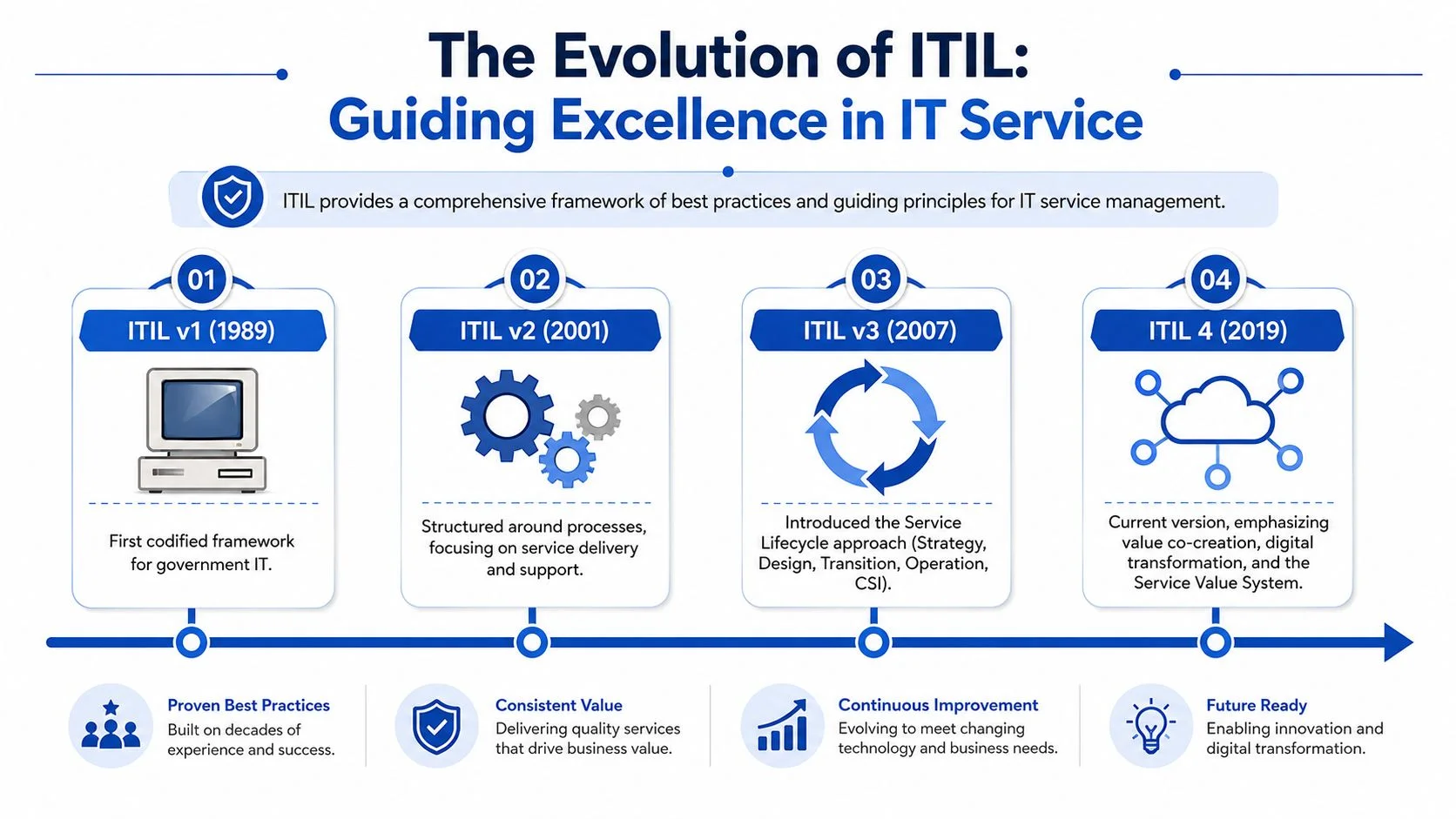
That evolution matters. Earlier versions often felt process-heavy. ITIL 4 speaks more naturally to the current environment, where cloud platforms, agile delivery, automation, and cross-functional teams are normal.
How to think about ITIL 4
For a junior analyst, I'd simplify ITIL 4 into three practical ideas:
- Focus on value: Work isn't finished because a ticket changed status. It's finished when the service outcome helps the user or business.
- Connect work end to end: Incidents, requests, changes, knowledge, and configuration information aren't separate islands. They connect.
- Improve continuously: Mature teams don't just restore service. They learn from patterns and tighten the system.
That's why ITIL 4 fits modern operations better than people expect. It doesn't ask you to worship process. It asks you to manage services in a way that helps the organization move faster without losing control.
Where students usually get stuck
Many readers confuse practices with mandatory sequences. ITIL 4 doesn't say every organization must run the exact same workflow. It gives guidance for structuring service work so teams can adapt it intelligently.
Change management is a good example. The principle matters everywhere, but the implementation can differ depending on risk, governance, and speed. If you want a plain-English companion piece on that topic, RiverAxe's explanation of smooth tech transitions is a helpful read.
For exam prep, this is why memorization alone isn't enough. You need to understand why a given practice exists and what problem it solves. If you're formalizing that study path, ITIL certification training can help you organize the concepts into something that sticks beyond test day.
ITIL gives you the logic for good service management. It doesn't replace judgment. It sharpens it.
Introducing the ServiceNow Platform
ServiceNow gets undersold all the time. People call it a ticketing tool because incidents are the first thing they see. That's like calling a smartphone a flashlight because it has one.
ServiceNow is better understood as a cloud platform for digital workflows. It gives organizations a structured way to manage records, automate tasks, route approvals, enforce ownership, and connect teams through a shared data model.
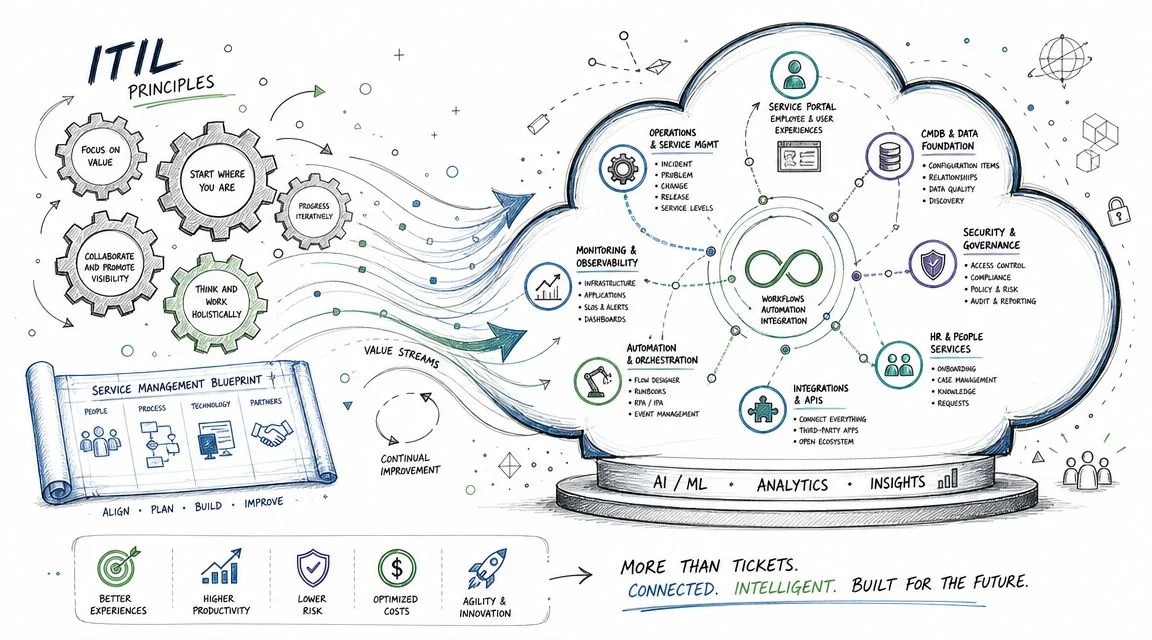
What ServiceNow really does
At the practical level, ServiceNow helps teams stop passing work through disconnected tools. Instead of one place for tickets, another for approvals, another for asset details, and another for knowledge, the platform can tie those pieces together.
That's why admins and implementers spend so much time on things like:
- Tables and relationships: The platform stores records in structured ways so teams can connect incidents, changes, users, services, and configuration items.
- Workflow automation: Repetitive handoffs can be triggered automatically instead of manually chased.
- Role-based access: Different teams see and do what matches their responsibilities.
- Reporting and dashboards: Managers can review service work in one place rather than hunting across systems.
Why it matters beyond the service desk
A mature ServiceNow environment usually reaches beyond IT support. Organizations also use it for employee workflows, customer operations, security work, and internal service delivery.
That breadth is one reason the platform can feel overwhelming to newcomers. My advice is simple: Start with the core platform behaviors first. Learn how records move, how approvals work, how forms and related lists connect, and how automation reduces friction.
A practical example of how companies think about AI and customer workflows on the platform appears in Applied's piece on cutting churn using ServiceNow AI. You don't need to memorize that example for certification, but it helps you see that ServiceNow isn't limited to incident queues.
For hands-on learners, the fastest progress usually comes from tying platform concepts to actual admin tasks. That's where expert resources for ServiceNow admins become useful, especially when you're trying to turn abstract platform terminology into job-ready knowledge.
Connecting ITIL and ServiceNow
This is the point where the blueprint meets the toolbox.
ServiceNow aligns so well with ITIL because the platform can represent the relationships that ITIL expects teams to manage. It doesn't just store tickets. It structures service work in a way that supports governance, traceability, and improvement.
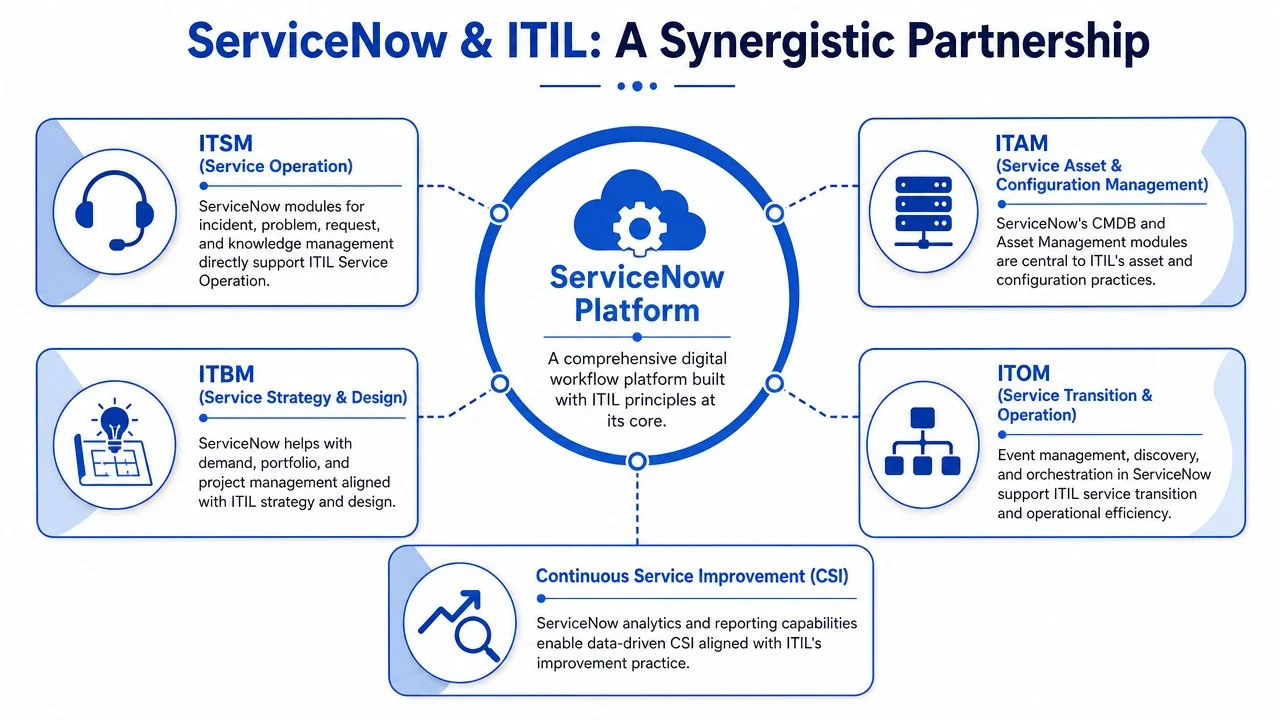
The technical connection that people miss
From a governance perspective, ServiceNow treats ITIL as a data-model and workflow problem. Incident, problem, and change records live in distinct tables, but they need to stay linked to service and configuration context to support root-cause analysis and controlled remediation, as explained in this ServiceNow ITIL governance guide.
That sounds abstract until you see it in action.
A user reports an outage. The service desk opens an incident. Similar incidents keep appearing, so the team promotes the recurring issue into a problem record. Engineering identifies a fix, but the fix shouldn't go directly into production as an undocumented action. It should move through change control, with CAB review enforcing risk control.
That chain is pure ITIL logic. ServiceNow makes it operational.
What this looks like at work
A healthy setup often follows a pattern like this:
- Incident captures the disruption and restores service as quickly as possible.
- Problem captures the underlying cause when the issue repeats or needs deeper analysis.
- Change carries the approved fix into the production environment under governance.
- Configuration data adds context so teams know what service or component is affected.
When those pieces stay disconnected, teams investigate the same issue repeatedly. When they stay linked, handoffs get cleaner and reporting becomes more credible.
Here's a short explainer if you want to hear the relationship described visually and conversationally:
If you can explain why an incident becomes a problem and why a fix becomes a change, you already understand more about ITIL and ServiceNow than many entry-level candidates.
Why this helps with certification
Certification exams often separate theory from screens. Work doesn't. The candidate who understands relationships between records, approvals, ownership, and configuration context tends to perform better in both places.
That's also why “learning the module names” isn't enough. You need to understand the service-management intent behind the module.
Mapping ITIL Practices to ServiceNow Modules
The easiest way to make ITIL and ServiceNow practical is to map common ITIL practices to the parts of the platform where you'll see them every day. Doing so clears up a lot of certification confusion. Terms stop floating around as theory and become actions in a system.
A working map you can remember
| ITIL 4 Practice | ServiceNow Module/Application | Core Function |
|---|---|---|
| Incident Management | Incident Management | Log, prioritize, assign, and resolve service disruptions |
| Problem Management | Problem Management | Analyze recurring issues and track root-cause work |
| Change Enablement | Change Management | Assess, approve, schedule, and implement controlled changes |
| Request Management | Service Catalog / Request Management | Fulfill standard user requests through structured workflows |
| Knowledge Management | Knowledge Management | Capture and reuse support knowledge |
| Service Configuration Management | CMDB | Maintain service and configuration context for operational decisions |
That table helps, but the primary value appears when these modules work together instead of acting like separate departments.
Think in value streams, not app menus
ServiceNow's ITIL 4 implementation works best when practices are mapped into end-to-end value streams. A common “restore critical service” flow can connect incident management, problem management, change enablement, and knowledge management, with connected records and automation across the platform, as described in this ITIL 4 operating model for ServiceNow.
That's the shift many newer practitioners need to make. Don't think, “Which module am I in?” Think, “What outcome is the service team trying to deliver?”
For example:
- An outage starts in Incident Management.
- A pattern gets escalated in Problem Management.
- The approved fix moves through Change Management.
- The workaround or resolution steps land in Knowledge Management.
That entire chain supports one business outcome: Service restoration.
What exam questions are really testing
When a question asks about incident versus problem, it's usually testing purpose, not button clicks. When a platform task asks you to configure approvals, relationships, or states, it's testing whether you understand how service work should move.
A mature ServiceNow implementation doesn't mimic the org chart. It supports the flow of value across teams.
If you remember the table and the value-stream mindset together, you'll answer exam questions more confidently and configure real workflows more intelligently.
Implementation Best Practices and Common Pitfalls
Most failed ITSM implementations don't fail because the platform is weak or because the team never heard of ITIL. They fail because people import messy habits into a powerful system and expect the tool to rescue them.
What experienced teams do well
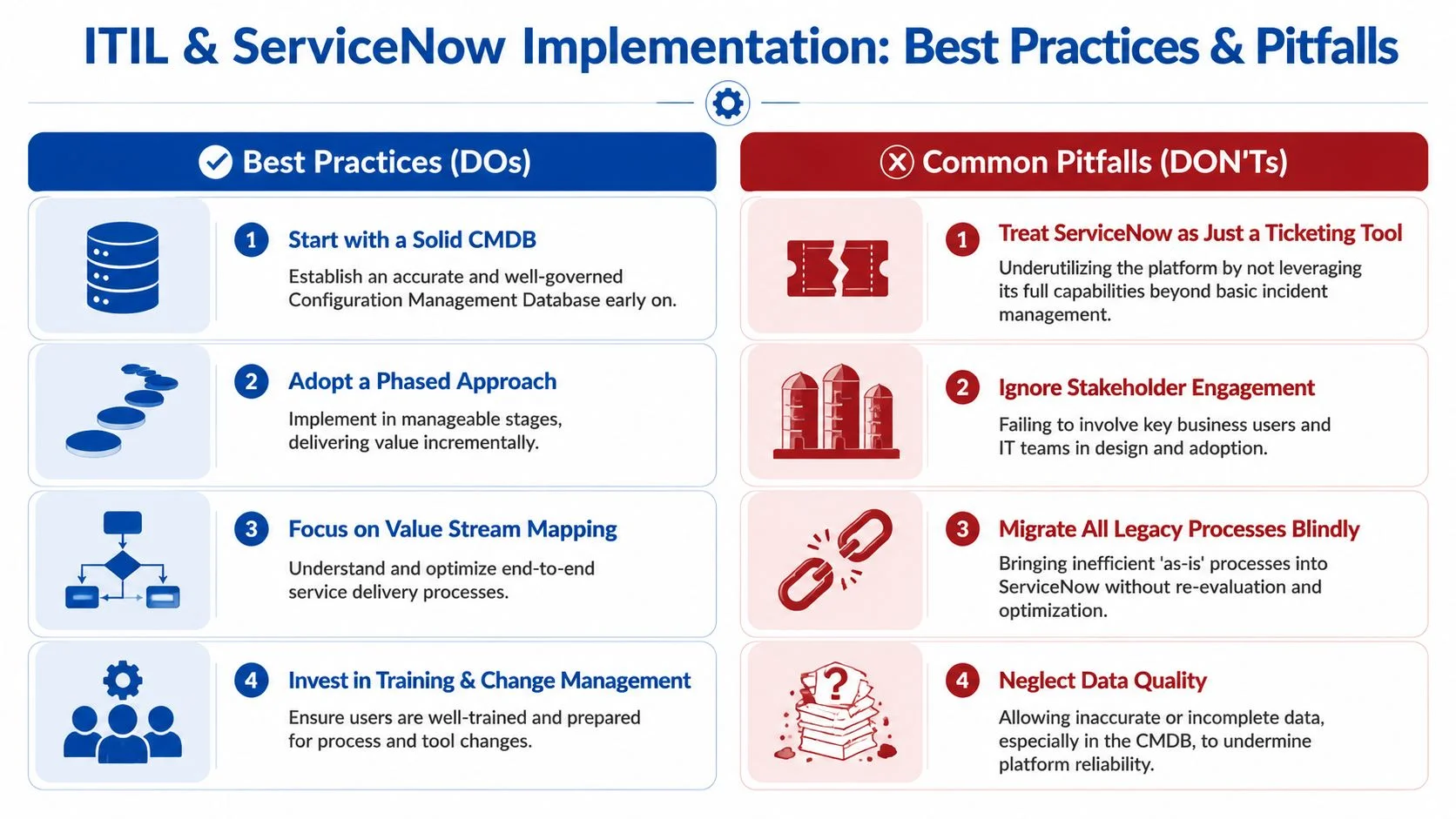
The strongest teams I've worked with usually share a few habits:
- They treat the CMDB seriously. If service and configuration context are sloppy, incident routing, impact analysis, and change decisions all get weaker.
- They implement in phases. Teams learn faster when they stabilize a few processes well instead of launching every module at once.
- They simplify before they automate. Automating a bad process only makes bad work happen faster.
- They define ownership early. Every important service needs a clear operational home.
Where teams trip themselves up
The common mistakes are predictable:
- Over-customization: Teams rebuild every legacy quirk instead of using the platform in a clean, supportable way.
- Tool-first thinking: They configure forms and fields before agreeing on process intent.
- Weak adoption planning: The service desk, approvers, engineers, and managers never get aligned on how the new workflow should work.
- Bad data discipline: Duplicate records, stale ownership, and unreliable CI relationships poison trust in the platform.
Manager's note: If users stop trusting the data, they stop trusting the process. After that, they work around the platform.
The advanced pitfall most guides skip
A major challenge sits outside the classic service desk boundary. ITIL processes inside ServiceNow often have to interact with engineering tools like Jira or Azure DevOps. Independent analysis notes that integrating those tools can accelerate MTTR and improve customer experience, but the bigger issue is operating design across teams, not just connector setup, as discussed in this analysis of ServiceNow integration with Jira and Azure DevOps.
That point is easy to underestimate.
If a bug is tracked in Jira, the production change is managed in ServiceNow, and the customer-facing incident sits with the support team, somebody has to own the handoffs. If nobody does, records drift apart, statuses disagree, and users get vague updates.
A few practical guardrails help:
- Name process owners, not just tool admins. Someone should own the workflow that crosses teams.
- Decide the system of record. Don't let the same decision live in two places without rules.
- Map status translations. “In progress” in one tool may not mean the same thing in another.
- Review integrations like processes. A connector isn't success. Reliable handoff behavior is.
That's the contrarian lesson many candidates need. The hardest part of ITIL and ServiceNow often isn't learning the framework or navigating the platform. It's designing the seams between teams.
Why This Matters for Your IT Career
If you want to move beyond entry-level support work, this knowledge matters a lot. Employers don't just want people who can recite ITIL terms or click through ServiceNow forms. They want professionals who understand why the workflow exists, how the data connects, and where service quality breaks down.
What hiring managers usually notice
A junior candidate might say, “I know Incident Management.” A stronger candidate says, “I know when an issue should stay an incident, when it should become a problem, and why the fix should move through change control.” That answer sounds different because it reflects operational judgment.
The same goes for ServiceNow roles. A basic admin can create fields and notifications. A more valuable professional can explain how platform design affects risk control, service restoration, reporting quality, and cross-team accountability.
Why certifications work better together
For many people, the smart combination is an ITIL certification plus a ServiceNow certification path. ITIL 4 Foundation gives you the language and service-management logic. ServiceNow certifications such as CSA or role-focused specialist paths help you apply that logic in an enterprise platform.
That pairing is useful because it closes a gap that many candidates leave open. They either know the framework but can't use the tool, or they know the tool but can't explain the operating model behind it.
If you're building that combined path, getting certified can structure your preparation across both tracks instead of treating them as unrelated subjects.
How this changes your day-to-day work
Understanding ITIL and ServiceNow together improves more than exam scores. It changes how you work:
- You escalate smarter: You know when repeated incidents signal a deeper problem.
- You communicate better: You can explain risk, approvals, and service impact in business language.
- You design cleaner workflows: You stop adding fields and start improving outcomes.
- You become more promotable: Managers trust people who understand both process and platform.
The people who grow fastest in ITSM aren't the ones who memorize the most terms. They're the ones who can connect service logic to operational execution.
That's the payoff. You become the person who can translate between framework, platform, and business need. In modern IT, that's a durable skill.
MindMesh Academy offers certification prep with study materials designed to help learners understand concepts as well as exam objectives. If you're building a career path that combines ITIL principles with ServiceNow platform skills, test your readiness with our ServiceNow Certified System Administrator practice exam.

Written by
Alvin Varughese
Founder, MindMesh Academy
Alvin Varughese is the founder of MindMesh Academy and an enterprise architecture leader. An electrical engineer by training, he moved from factory automation in South Africa to cloud architecture at GE Appliances and Humana (Fortune 50), and holds 20 professional certifications including AWS Solutions Architect Professional, Azure DevOps Engineer Expert, and Microsoft Agentic AI Business Solutions Architect. He built MindMesh Academy after interviewing too many highly certified candidates who couldn't answer basic questions: the goal is prep that makes you better at the job, not just able to pass the exam.