How to Pick Exam Prep Courses That Match the Exam
How to Pick Exam Prep Courses That Match the Exam
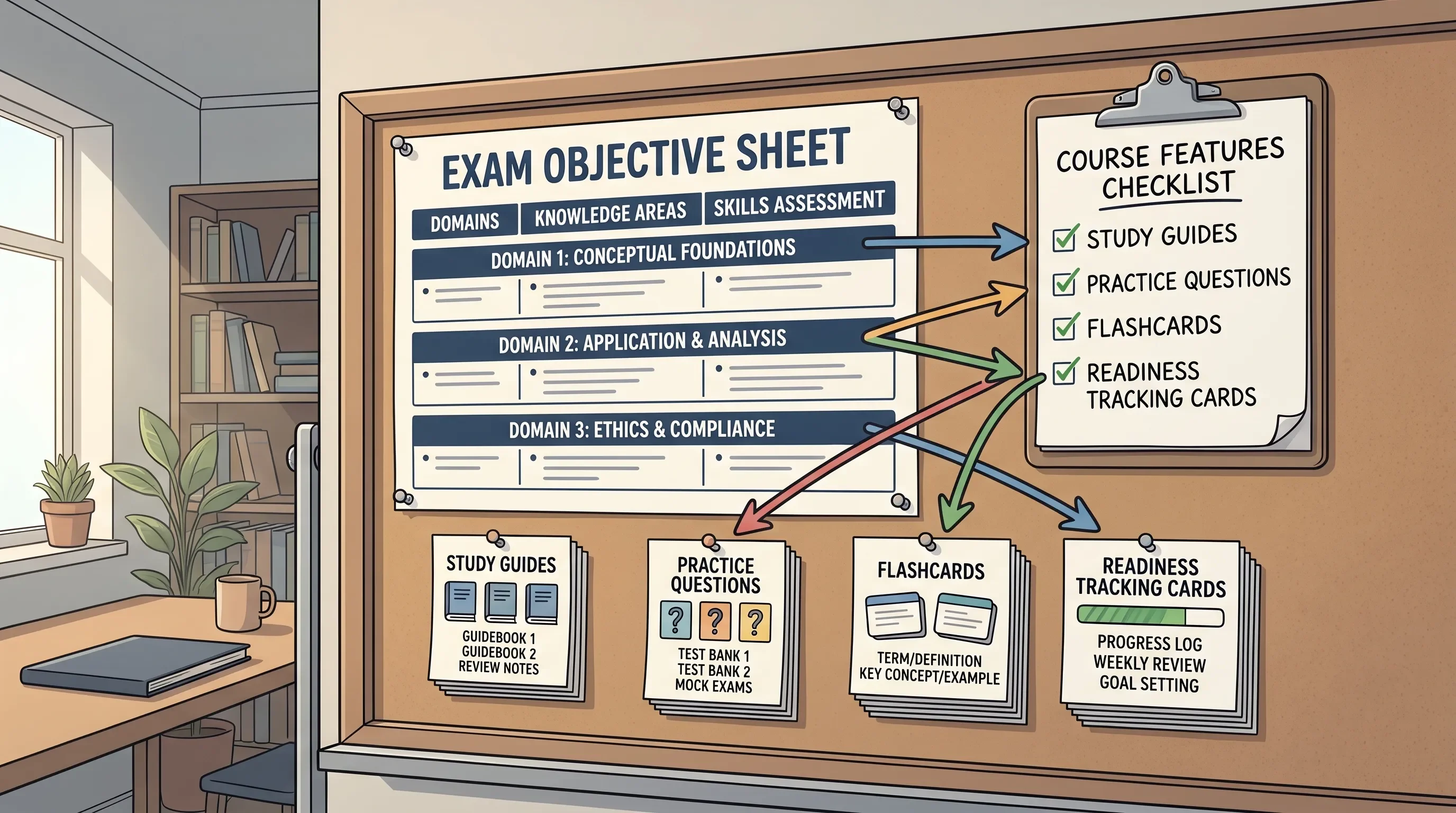
The right exam prep course should directly align with the certification you're pursuing. This means it needs to cover current objectives, reflect domain weights, use accurate question formats, and test the reasoning level the vendor expects. Before you pay for any course, open the official exam guide and use it as your checklist. If a course can't show where its lessons, quizzes, and practice tests connect to those objectives, it's likely teaching the subject broadly rather than preparing you for that specific exam.
A good course also helps you pinpoint weak areas quickly. Look for objective-based study guides, practice questions with clear explanations, spaced repetition, performance-style practice where relevant, and readiness tracking. These features matter because certification exams rarely reward memorizing definitions alone. They test whether you can apply concepts effectively under time pressure.
Start With the Current Official Exam Objectives
Every serious course evaluation begins with the vendor's exam page, not a course sales page. Certification providers publish exactly what they expect you to know. These documents are often called exam guides, skills measured pages, domains, or exam content outlines. This official blueprint tells you the exam's scope, percentage weighting for each section, and sometimes the task level required.
For cloud exams, AWS publishes official certification pages and exam guides, such as the AWS Certified Cloud Practitioner page. Microsoft Learn lists skills measured for exams like Azure Fundamentals. CompTIA provides exam objective documents from certification pages like Security+. Cisco lists topic areas for exams such as CCNA, and PMI publishes guidance for the PMP exam.
Once you have the official outline, compare it against the course. Don't stop at matching words. A course section titled "Networking Basics" may or may not cover the exact routing, subnetting, wireless, security, and troubleshooting objectives required for a networking exam.
| What the official exam guide shows | What the course should prove | Red flag |
|---|---|---|
| Domain names and percentages | Lessons and quizzes grouped by domain | Course uses vague modules with no objective map |
| Task statements or skills measured | Practice items tied to specific tasks | Questions test trivia instead of application |
| Exam format and time limit | Timed practice and pacing guidance | Only untimed review questions are included |
| Current exam version | Recent content updates or version alignment | Course references a retired exam code |
| Recommended experience level | Prerequisite review or clear assumptions | Course jumps into advanced tasks without foundation |
If an exam blueprint states one domain makes up 30% of the exam, your prep shouldn't spend only 5% of its time on that area. Matching the exam means matching emphasis, not just covering a long list of topics.
Match the Course to the Exam's Question Style
Many learners pick exam prep courses based on content volume: the number of hours, lessons, or size of the question bank. This is understandable, but it misses a more important issue. The course must train the same thinking patterns the exam uses.
A fundamentals exam might ask you to identify services, concepts, or business benefits. A security exam could require scenario analysis, risk tradeoffs, or performance-based tasks. A project management exam might test judgment in a stakeholder conflict, not just your ability to define a term. A networking exam could expect command interpretation, topology reasoning, or troubleshooting logic.
This means a course full of recall-only questions can still leave you unprepared. You might know the vocabulary but freeze when the exam asks what you should do next in a realistic scenario.
Look at a sample lesson and several sample questions before committing. Strong alignment looks like this:
- Questions use the same level of detail and decision-making as the exam.
- Explanations tell you why the correct option works and why the distractors are wrong.
- Practice is organized by objective, so you can trace mistakes back to the blueprint.
- Timed practice is available, so pacing becomes part of your preparation.
- Scenario and performance-style formats appear when the real exam uses them.
If you're preparing for a cloud fundamentals exam, for example, a course should help you understand both concepts and service selection. A resource like the AWS Certified Cloud Practitioner practice exam is most useful when you use it to test exam-style reasoning, not just to collect a score.
Check Whether Lessons Teach Objectives, Not Just Topics
The difference between a topic-based course and an exam-matched course is subtle yet important. A topic-based course teaches "identity and access management." An exam-matched course teaches the specific identity and access management tasks the exam measures, at the depth the exam expects.
This matters because certification exams have boundaries. You don't need to learn everything about Azure, AWS, Cisco networking, ITIL, or cybersecurity to pass a specific exam. You need to master the slice of knowledge defined by the exam objectives.
When reviewing a course outline, ask whether each module answers three questions: what objective does this lesson support, what skill should I be able to perform after it, and how will I prove I can do it? If the course can't answer those questions, you'll have a harder time knowing if you're progressing toward exam readiness.
For example, a learner starting with Microsoft cloud fundamentals should prioritize skills measured by that exam rather than getting pulled into advanced architecture topics too early. An objective-based resource such as an AZ-900 Microsoft Azure Fundamentals study guide helps keep the study path tied to the actual certification scope.
Compare Exam Prep Course Formats Before You Choose
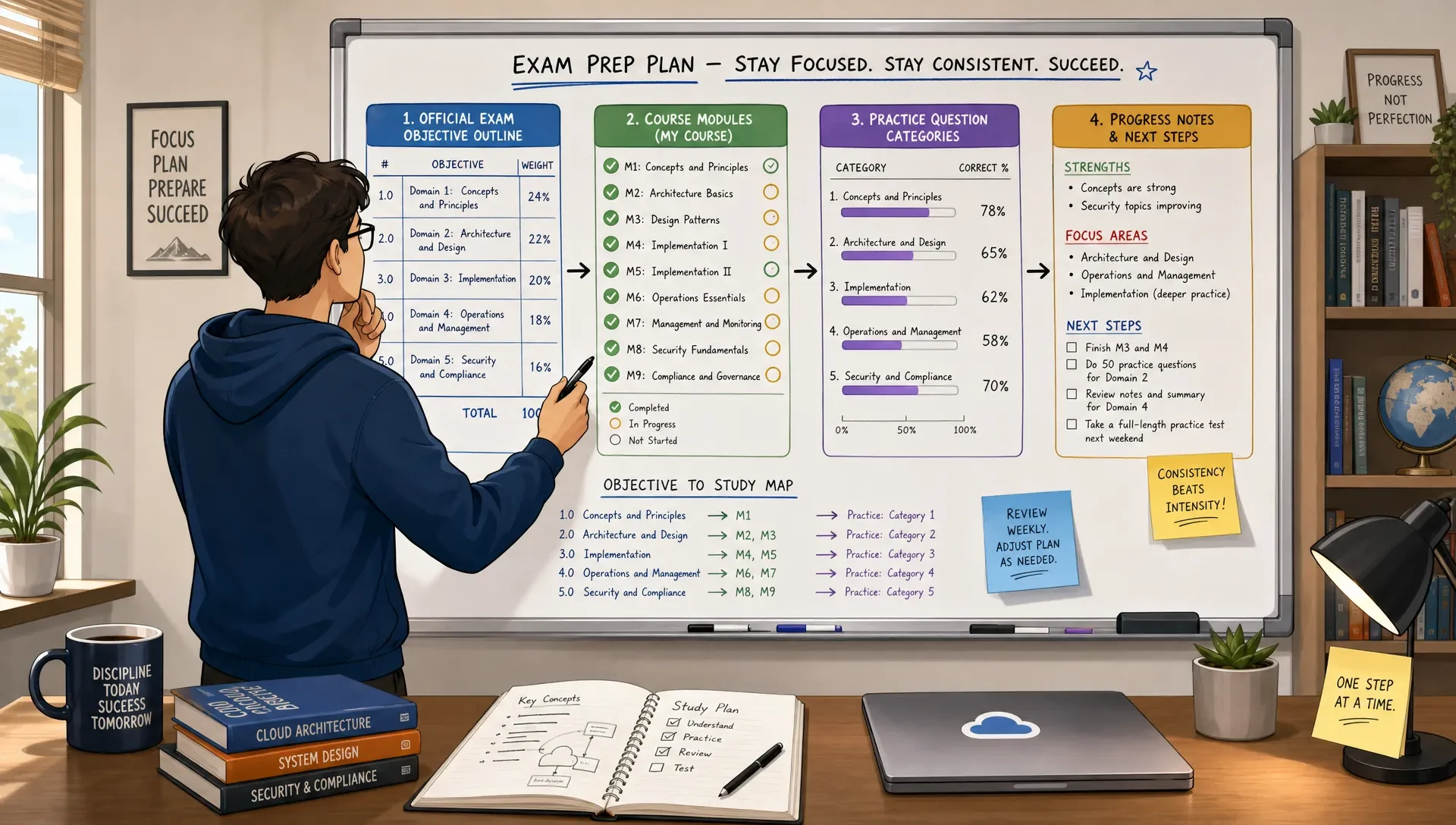
No single format is enough on its own. Videos explain ideas well, but they don't test recall. Practice tests reveal gaps, but they can lead to memorization if explanations are weak. Flashcards are great for retention, but they won't fully prepare you for scenario judgment.
The best fit depends on where you are in your learning process. If you're new to the topic, you need structured explanations. If you've studied before, you might need diagnostic practice and targeted review. If you're close to test day, you need help with pacing, weakness repair, and readiness checks.
| Course component | Best use | What to verify |
|---|---|---|
| Objective-based study guide | Building core understanding | Maps to the current exam blueprint |
| Practice questions | Testing application and recall | Includes clear explanations and objective tags |
| Flashcards | Retaining terms, commands, formulas, and concepts | Uses spaced repetition or scheduled review |
| Timed practice tests | Building pacing and exam stamina | Reflects the exam's timing and difficulty style |
| Performance-style questions | Preparing for task-based exams | Matches the type of hands-on reasoning the exam uses |
| Progress dashboard or topic tracking | Deciding what to study next | Shows strengths and weak areas by exam domain |
When a course combines these elements into a connected workflow, studying becomes more efficient. You learn a concept, test it, review missed explanations, reinforce it with flashcards, and then revisit it through adaptive practice.
MindMesh Academy is built around this connected approach, with study guides tied to exam objectives, practice questions with explanations, flashcards using spaced repetition, adaptive weakness-based practice, and mastery and readiness tracking across many certification paths. The important point isn't that a course has more materials. It's that each material has a clear job in your study plan.
Use Practice Questions to Audit Course Quality
Practice questions are one of the fastest ways to tell whether a course matches the exam. Don't judge only by quantity. A question bank with thousands of shallow items can be less useful than a smaller set of carefully written scenario questions with strong explanations.
Start by taking a small sample set before you finish the course. Your goal isn't to score high immediately. Your goal is to inspect the question design. Good questions should force you to use the same clues, constraints, and elimination logic you'll need on test day.
After each question, the explanation should do more than repeat the correct answer. It should teach the concept, connect it to the objective, and make the wrong answers useful. Distractors matter because they reveal misconceptions. If an explanation doesn't help you avoid the same mistake next time, the practice item isn't doing its job.
This is especially important for exams involving security, troubleshooting, or architecture decisions. For instance, if you're working toward Security+, a CompTIA Security+ practice exam should help you identify why one control, response, or risk treatment fits a scenario better than another.
A good review process also prevents false confidence. If you only check your score, you might miss timing problems, lucky guesses, or repeated mistakes in one domain. For a deeper method, use a structured approach like this guide on how to review an exam practice test the right way.
Look for Learning Science, Not Passive Coverage
A course that "covers everything" can still be weak if it encourages passive watching. Passing a certification exam requires retrieval, discrimination, and transfer. In plain English, you need to pull information from memory, choose between similar options, and apply knowledge to a new situation.
Research published in Science found that retrieval practice can produce strong long-term retention benefits. The Institute of Education Sciences also recommends techniques such as spacing learning over time and using practice questions to improve learning. For certification prep, that means a course should make you actively recall information throughout the study plan, not just read it once.
Flashcards are useful when they reappear at the right intervals. Short quizzes are useful when they expose weak areas. Mixed practice is useful when it forces you to choose among concepts instead of answering one isolated topic at a time.
Passive coverage feels productive because you can finish many videos quickly. Active learning feels slower because mistakes become visible. But visible mistakes are exactly what you need before the real exam.
Make Sure the Course Fits Your Timeline and Starting Level
An exam prep course can be well designed and still be the wrong fit for your situation. A beginner needs a different path than someone renewing skills or validating work experience. Before choosing, estimate your starting level and time available.
If you're new to the field, avoid courses that are mostly practice tests with thin explanations. You'll need structured lessons and objective-level study. If you already work in the technology, avoid courses that spend too much time on basics without giving you diagnostic shortcuts. You'll need practice that finds blind spots.
Your timeline also matters. If your exam is months away, prioritize spacing, topic tracking, and gradual mastery. If your exam is soon, prioritize diagnostic testing, high-yield review, timed sets, and explanations. Don't cram every resource you can find into the final week. More resources can create more noise.
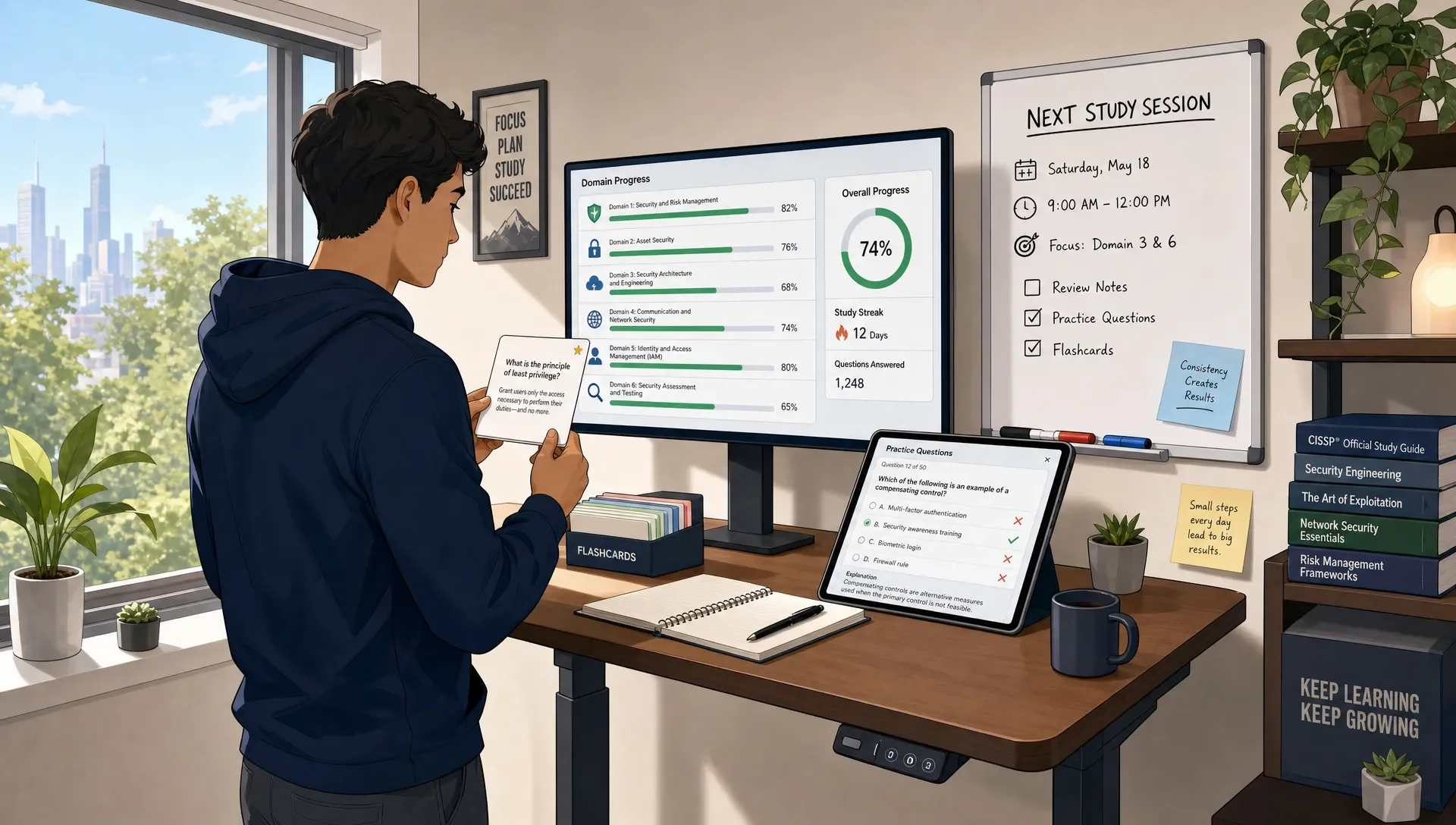
A practical way to evaluate fit is to ask, "What will this course tell me after my first study session?" If the answer is only "you watched 20% of the content," that's not enough. Better signals include which objectives you've mastered, which topics need review, how your timing looks, and whether your confidence matches your accuracy.
Ask These Questions Before You Enroll
Before you pick a course, run through a short decision checklist. This helps you avoid buying based only on ratings, length, or marketing language.
- Does the course identify the exact exam version or current objective set?
- Can you see how modules map to exam domains and weights?
- Are practice questions written at the same reasoning level as the real exam?
- Do explanations teach both correct and incorrect answer choices?
- Does the course include spaced review, flashcards, or another retention system?
- Can you track progress by topic or objective instead of only by course completion?
- Are timed practice options included for pacing?
- Does the course help you decide when you're ready to schedule the exam?
If a course passes most of these checks, it's more likely to match the exam. If it fails several, you may still learn useful information, but you'll need extra work to translate that learning into exam performance.
Common Course Mismatches That Waste Study Time
The most common mismatch is overbreadth. A course teaches far beyond the exam scope, so learners spend hours on interesting material that won't be tested. This is especially common in cloud and cybersecurity, where the professional field is much larger than any single certification.
The second mismatch is underdepth. The course lists the right topics but only defines terms. Then the real exam asks you to apply those terms in a scenario. If practice questions are too easy, your score may look better than your readiness.
The third mismatch is outdated alignment. Certification exams change. Domains shift, services are renamed, and question styles evolve. A course doesn't need to chase every minor product update, but it should clearly align with the current exam version and official objectives.
The fourth mismatch is weak feedback. If you finish a quiz and only see "correct" or "incorrect," you haven't learned much. Strong feedback turns every question into instruction. It shows the logic, the misconception, and the objective you should revisit.
Frequently Asked Questions
How do I know if an exam prep course matches the real exam? Compare the course outline with the official exam objectives. Then inspect sample questions for difficulty, scenario style, explanations, domain tagging, and timed practice. A matching course should make the connection between lessons, questions, and exam objectives obvious.
Are longer exam prep courses better? Not always. A longer course may offer useful depth, but it can also include off-scope material. Choose the course that best matches the current exam blueprint, teaches at the right level, and provides practice data you can act on.
Should I choose a course with practice tests or a study guide first? If you're new to the topic, start with a structured study guide and use practice questions early for diagnosis. If you already know the material, start with practice questions to find weak areas, then use the study guide for targeted review.
How many practice questions should a good course include? There isn't one perfect number. Quality matters more than volume. Look for questions that mirror the exam's reasoning level, include explanations, cover all domains, and help you identify repeated mistakes.
What if a course teaches the right topics but the questions feel too easy? Treat that as a warning sign. Easy questions can help with vocabulary, but they may not prepare you for scenario-based decision-making. Add more exam-style practice before relying on your scores.
When should I switch exam prep courses? Switch if the course is outdated, doesn't map to objectives, lacks explanations, avoids timed practice, or repeatedly leaves you unable to answer official-style sample questions. If the issue is only a few weak topics, targeted supplementation may be enough.
Build Your Prep Around the Exam, Not Around the Course
The course is a tool. The exam blueprint is the target. When you evaluate exam prep courses through that lens, your decision gets much easier: choose the resource that teaches the right objectives, tests the right thinking, and gives you clear feedback on your readiness.
Ready to find a study workflow built around certification objectives, practice explanations, spaced repetition, weakness-based review, and readiness tracking? Visit MindMesh Academy to explore our certification paths. Compare your progress against exam domains and focus your study time where it will truly move your score.

Written by
Alvin Varughese
Founder, MindMesh Academy
Alvin Varughese is the founder of MindMesh Academy and an enterprise architecture leader. An electrical engineer by training, he moved from factory automation in South Africa to cloud architecture at GE Appliances and Humana (Fortune 50), and holds 20 professional certifications including AWS Solutions Architect Professional, Azure DevOps Engineer Expert, and Microsoft Agentic AI Business Solutions Architect. He built MindMesh Academy after interviewing too many highly certified candidates who couldn't answer basic questions: the goal is prep that makes you better at the job, not just able to pass the exam.