
How to Become a Penetration Tester: 2026 Roadmap
How to Become a Penetration Tester: A Practical Path
Most advice on how to become a penetration tester often starts with flashy exploit demos, Kali Linux, or a list of hacking tools. This approach misses the essential foundation.
Penetration testing is rarely a role you enter cold. It's a specialization built on a strong foundation of systems knowledge. If you don't understand how networks route traffic, how Linux permissions work, how Windows authentication behaves, or how web apps handle sessions, you won't know whether a finding is meaningful, exploitable, or just noise. You'll know how to click tools, but not how to test.
That's the unspoken rule in this field. The fastest path is rarely “learn hacking first.” It's “build a serious IT base, then pivot into offensive work.” That sounds slower, but it usually saves time because you stop fighting fundamentals every step of the way.
The Unspoken Prerequisite to Becoming a Pentester
Advice that positions pentesting as a first IT job often overlooks a critical factor. Effective pentesters typically gain experience after spending significant time working with operating systems, networks, identity, and user issues in live environments.
CompTIA states that penetration testing is not an entry-level role and often calls for prior IT or cybersecurity experience (CompTIA's penetration tester career guidance). That tracks with what teams need. They are not hiring someone to run tools and paste output into a report. They are hiring someone who can tell the difference between a noisy misconfiguration, a dead-end weakness, and a finding that creates actual business risk.
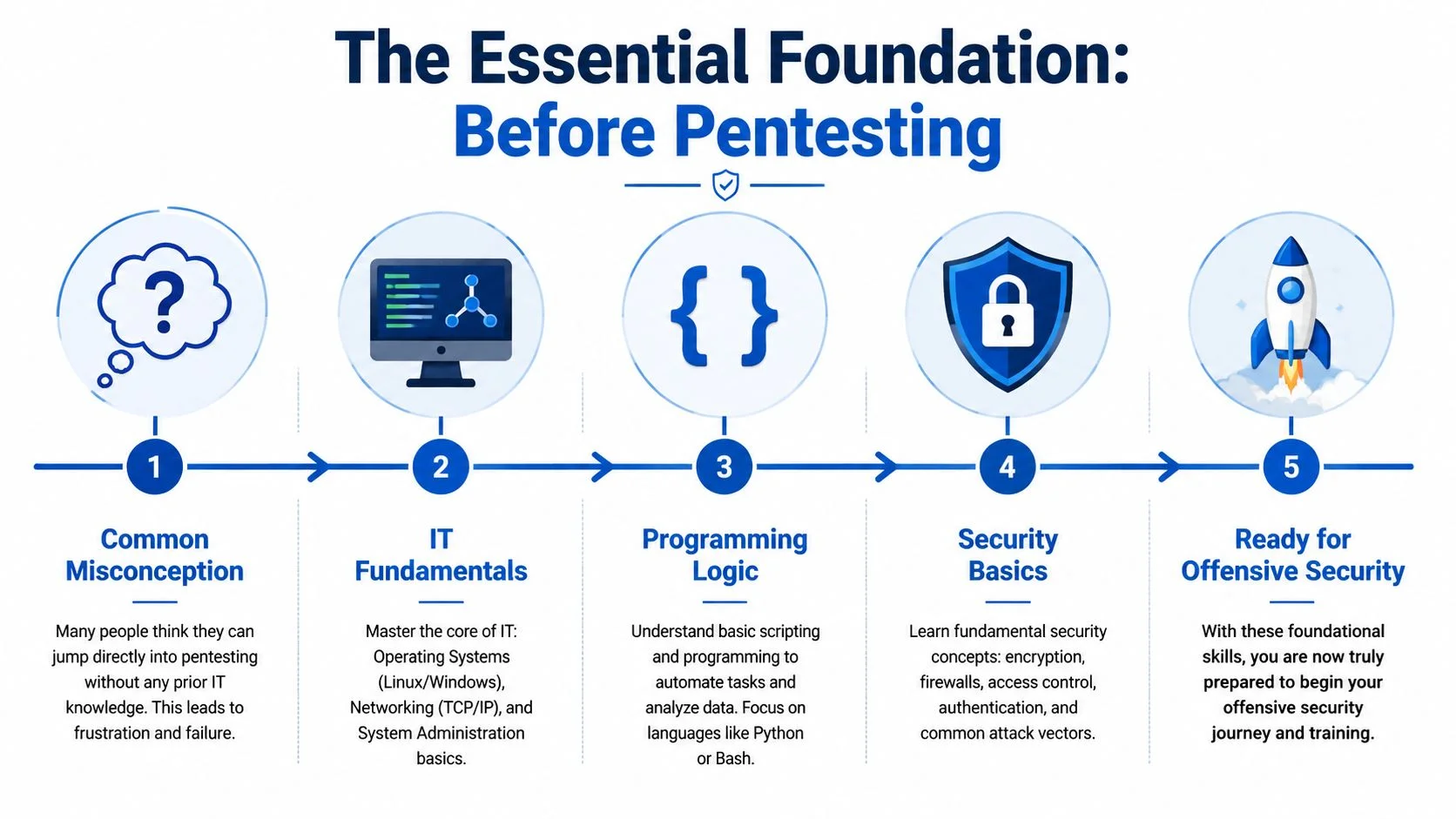
What a real foundation looks like
A valuable starting point is any role that requires understanding how systems function under normal conditions and during failures.
- Support and endpoint work builds pattern recognition fast. You see broken profiles, bad permissions, failed updates, weak local admin practices, and the gap between policy and reality.
- System administration teaches service management, logging, patch cycles, authentication, file permissions, scheduled tasks, and configuration mistakes that later show up as attack paths.
- Network support or engineering gives you working knowledge of routing, VLANs, DNS, NAT, firewalls, and the reasons traffic does not go where the diagram says it should.
- SOC or blue-team work sharpens your understanding of attacker behavior, weak detections, and what defenders notice during an intrusion.
If you are still early in IT, start broad. A grounded resource like the CompTIA A Core 1 study guide helps fill in the basics many aspiring pentesters skip, especially around hardware, operating systems, troubleshooting, and support workflows.
Consider this practical test I use: If you cannot explain how a Windows host joins a domain, how DNS resolution works on a normal network, or why a web app sets a session cookie a certain way, you are still building foundation. That is normal. It just means the next step is more systems work, not more exploit videos.
Why people get stuck
I often observe a recurring pattern of struggle. A beginner finishes a few labs, learns the names of popular tools, and starts applying for pentest roles. Then the interview shifts from tools to fundamentals. Explain the difference between NTLM and Kerberos. Walk through how a reverse shell reaches the attacker. Describe what a 403 versus a 401 might mean during web testing. Many candidates stall because they trained for demos, not for reasoning.
This gap also becomes apparent on the job. A weak foundation makes every assessment slower. Enumeration takes longer because service banners mean less. False positives pile up because the tester cannot validate what the scanner found. Reporting gets worse because the tester can show impact in a lab but cannot explain what the issue means in the client's environment.
Analysts cited in Cybersecurity Ventures' summary of CyberSeek data describe a workforce that usually comes into penetration testing with meaningful technical grounding, whether through degrees, prior roles, or both (Cybersecurity Ventures summary of penetration testing statistics). The takeaway is simple. The field rewards people who already know how technology works before they start trying to break it.
That is not gatekeeping. It is the shortest route that holds up once the hand-holding stops.
Building Your Offensive Security Skillset
Once your foundation is solid, your learning should stop being random. Don't collect tools. Build a working model of how attacks happen.

Imperva describes penetration testing as a stage-based process: define scope, perform reconnaissance, scan for vulnerabilities, exploit, maintain access, and report. It also warns about a common beginner mistake: focusing on tools before understanding attack mechanics (Imperva's penetration testing overview). That warning is dead on.
Learn the environment from the attacker's side
A pentester studies networking differently than a network administrator, focusing on distinct questions. Where are trust boundaries weak? Which services expose useful metadata? How does traffic flow reveal segmentation mistakes? Where can authentication be relayed, reused, or bypassed?
That means you need comfort with:
- TCP/IP behavior so scans and service responses mean something
- DNS and HTTP because web and API testing falls apart without them
- Windows and Linux command line use because GUI dependence slows you down
- Authentication flows including sessions, tokens, and access control logic
If networking still feels patchy, go back and tighten it. A structured resource like Mindmesh Academy's CCNA guide is useful because it reinforces the protocol and infrastructure concepts that show up constantly during reconnaissance and internal testing.
Scripting matters more than another tool
You don't need to be a software engineer, but you do need to automate repetitive tasks and read code comfortably.
Python, Bash, and sometimes PowerShell are enough to carry a junior tester a long way. Scripting helps you:
- rename and clean output
- parse scan results
- transform wordlists
- fuzz simple inputs
- test assumptions quickly
- avoid wasting time on manual repetition
A lot of newcomers avoid this because they think “I'm not a programmer.” That mindset holds people back. In pentesting, scripting is just a tool.
A tester who understands why a script works will outperform a tester who only knows how to run it.
Study vulnerabilities by class, not by hype
Instead of chasing trending exploits, learn vulnerability classes in a structured order.
A practical sequence looks like this:
| Area | What to understand first | Why it matters |
|---|---|---|
| Web security | Authentication, sessions, input handling, access control | Web apps are everywhere, and weak logic often beats flashy exploits |
| Network exposure | Service enumeration, protocol behavior, segmentation | Good testing starts with accurate mapping |
| Privilege issues | Misconfigurations, credential misuse, local escalation paths | Initial access often isn't the hard part |
| Post-exploitation thinking | What data matters, where trust extends, how access expands | Findings become meaningful when you show impact |
The goal isn't to memorize exploit chains. It's to understand why a weakness exists, what conditions make it exploitable, and what evidence proves risk without causing damage.
Follow a professional workflow
Effective testers approach tasks in phases, even in lab settings. A clear structure helps maintain discipline:
- Scope the target. Know what's in bounds and what success looks like.
- Enumerate carefully. Gather information before you touch exploitation.
- Validate exposure. Separate scanner output from real attack paths.
- Exploit with intent. Don't fire payloads blindly.
- Document as you go. Screenshots, commands, notes, dead ends.
- Report for action. Explain what matters, not just what broke.
That last point gets neglected. Clients don't pay for screenshots of shells. They pay for clear findings, reproducible evidence, and remediation they can act on.
From Theory to Practice with Labs and Certs
Theory gives you vocabulary. Practice gives you judgment. If you want to know how to become a penetration tester in a way that survives interviews and client work, you need both.
The practical path, as Wiz explains, starts with networking, Linux, and scripting, then moves into legal practice through CTFs, home labs, and vulnerable applications. Wiz also notes that employers value demonstrated capability through writeups and bug bounty participation, not just credentials (Wiz guide to becoming a penetration tester).
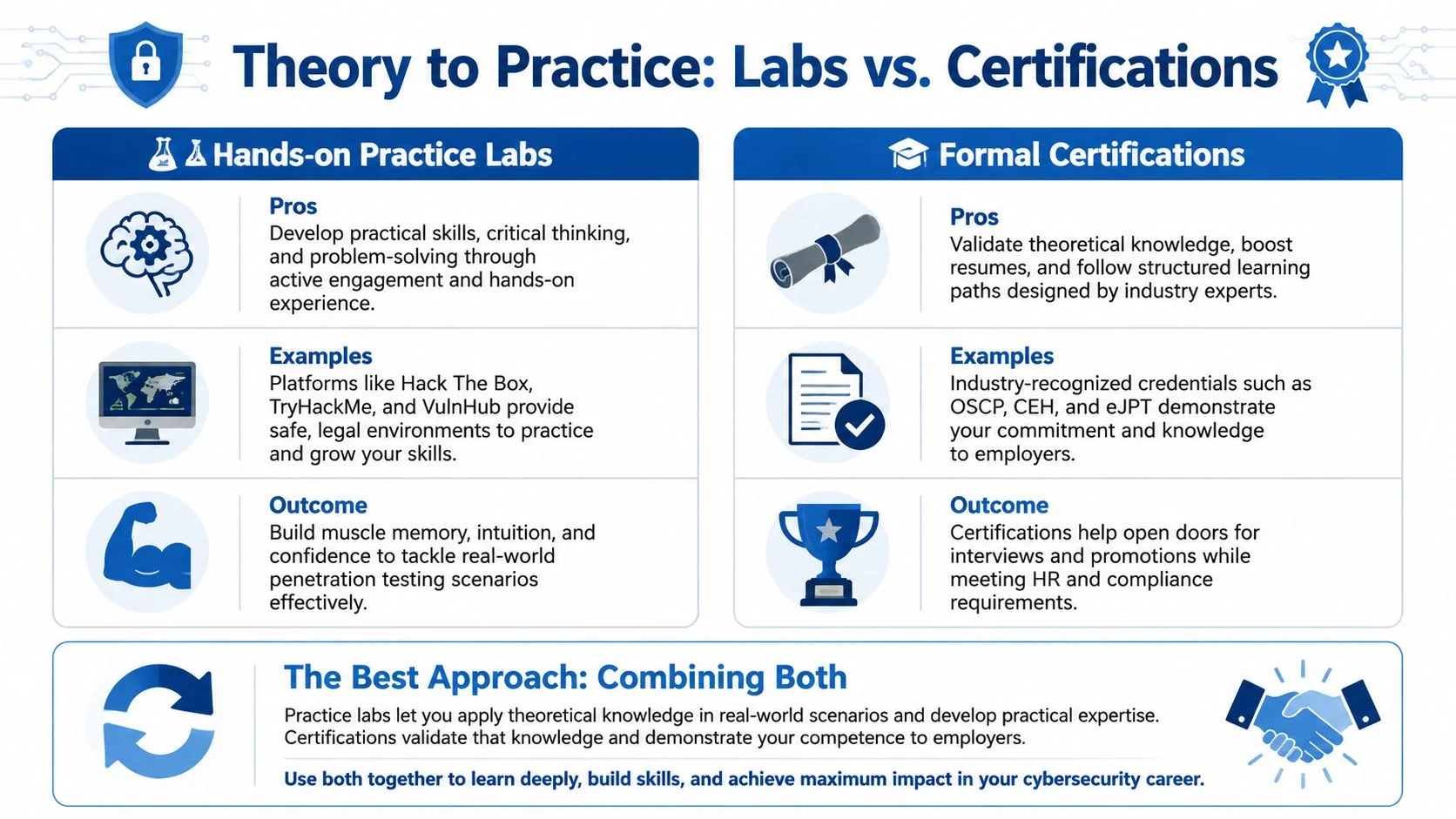
Labs and certs do different jobs
Many debate the value of labs versus certifications, as if they were interchangeable. They are not.
| Option | What it gives you | Where it falls short |
|---|---|---|
| Hands-on labs | Repetition, troubleshooting, pattern recognition, confidence under uncertainty | It's easy to drift without structure or overfit to platform style |
| Certifications | A defined syllabus, deadlines, resume signal, a way to prove baseline commitment | Some candidates study for the exam instead of the work |
| Home lab work | Freedom to break and rebuild systems, deeper admin understanding | Setup can consume time if you love tinkering more than learning |
| Bug bounty participation | Real targets, real constraints, real reporting practice | It can be discouraging early if your fundamentals are weak |
The best junior candidates usually combine all four in some proportion.
Here's a useful walkthrough to pair with your planning:
How to choose your first lab platform
Different platforms develop distinct skills.
TryHackMe is beneficial when you need structured guidance. It helps people who are learning Linux, networking, and web basics in context.
Hack The Box becomes more valuable when you can already enumerate independently and you want to build persistence, creativity, and comfort with ambiguity.
VulnHub is useful if you like offline lab work and want full control over the environment.
Deliberately vulnerable applications are ideal when your weak spot is web testing. They let you focus on request flow, authentication, session handling, and business logic without the noise of full network compromise.
Field note: If every exercise feels impossible, the problem usually isn't talent. It's that you skipped a layer of fundamentals.
How to think about certifications
A certification should match your stage, not your ego.
For early-career learners, the right cert is usually the one that forces disciplined study while staying close to practical work. For mid-level candidates, the right cert is the one that validates applied methodology and reporting under pressure.
Some certifications are known for broad recognition. Others are known for practical rigor. Some are useful because HR teams understand them. Others are useful because practitioners respect the exam style. Don't collect logos. Pick the one that fits the role you're targeting and the skills you need to sharpen.
A simple decision filter helps:
- If you need structure, choose a certification with a defined learning path.
- If you need practical proof, favor exams that require hands-on problem solving.
- If you're changing careers, pair one certification with visible lab work so you don't look purely theoretical.
- If your resume is light, use the cert as the baseline and the portfolio as the differentiator.
One option for mapping study paths across IT and cybersecurity credentials is browsing professional certification programs. That kind of catalog is useful when you're trying to sequence foundational certs before moving into offensive-specialty material.
What actually builds skill
The most effective study loop follows a simple pattern:
- Learn one concept.
- Practice it in a safe lab.
- Write down what happened.
- Repeat it without the walkthrough.
- Explain it in plain language.
That last step matters. If you can't explain why a flaw existed and how you verified impact, you haven't really learned it.
A junior tester who completes fewer labs but documents them well is often more employable than someone who speed-runs boxes and remembers none of the reasoning.
Showcasing Your Pentesting Abilities
A hiring manager can't see your thought process from a certification badge alone. They need evidence that you can approach a target methodically, test safely, and communicate what you found.
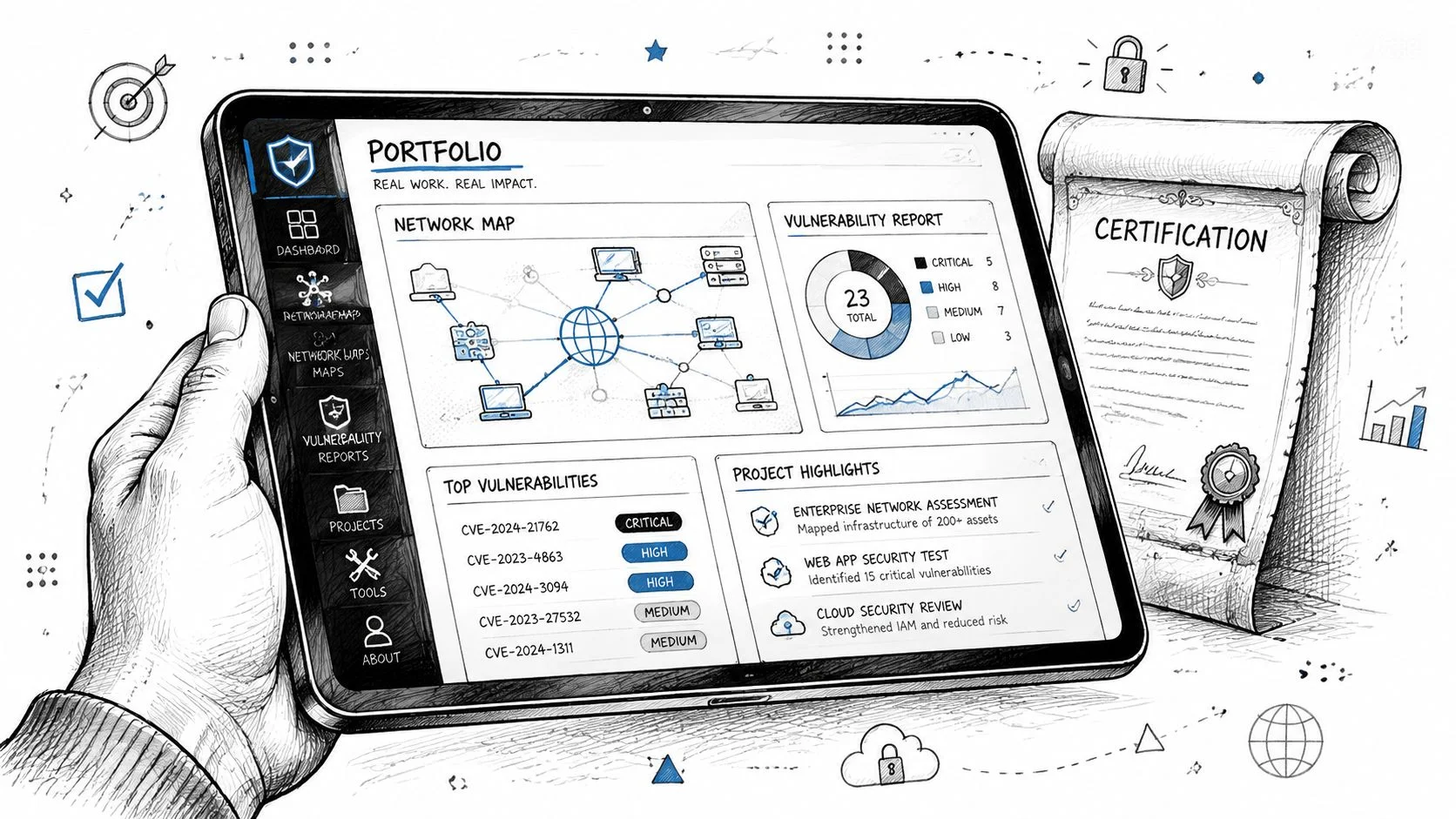
A strong portfolio doesn't need to be flashy. It needs to feel credible. Think of it as a case file collection that answers three silent interview questions: Can this person work systematically? Can they write clearly? Can they separate signal from noise?
What a believable portfolio looks like
Take a hypothetical candidate named Maya. She doesn't try to look like a veteran red teamer. She publishes three kinds of work.
First, she writes short walkthroughs of retired lab machines. Not giant novels. Just enough to show enumeration, pivot points, mistakes, and final lessons. She removes anything that feels copy-pasted from public solutions.
Second, she uploads a small GitHub repository with scripts she uses. One organizes output. Another cleans scan results into a readable format. None of them break new ground. That's fine. The point is to show working habits.
Third, she keeps a notes page where she explains concepts in plain English: Authentication flaws, file permission mistakes, bad assumptions in access control. Interviewers read that and see someone who understands, not someone who memorized.
What to publish and what to leave out
Use your portfolio to show methodology, not recklessness.
Good portfolio pieces include:
- Writeups with reasoning that show how you enumerated, tested assumptions, and validated findings
- Tooling you built or adapted even if it's small
- Sanitized reports from legal practice environments that demonstrate structure and clarity
- Bug bounty acknowledgments if you've received them and can share them responsibly
Avoid these mistakes:
- Publishing active target details or anything that violates rules of engagement
- Dumping screenshots without explanation
- Using public exploits you don't understand
- Padding your profile with every CTF you ever touched
Your portfolio should read like a professional record, not a trophy shelf.
How to turn practice into proof
A valuable format for each portfolio entry includes:
- Target summary. What kind of system or challenge was it.
- Enumeration path. What did you observe first.
- Key decision point. Why did you test that path instead of another.
- Finding and impact. What weakness mattered.
- Remediation thinking. How would you fix it.
- Lesson learned. What changed in your approach afterward.
That last item is underrated. Juniors who can explain how they corrected a mistake come across as trainable and honest.
If you're still early, start small. One careful writeup is better than ten shallow ones. One usable script is better than a repo full of abandoned files. Employers don't need proof that you've done everything. They need proof that you can do the work carefully.
Applying for Penetration Testing Roles and Interviews
Hiring managers are usually not searching for a future movie hacker. They are searching for someone they can trust on a client network without constant supervision.
That changes how you should approach the job market. A junior candidate stands out by showing judgment, discipline, and a real technical foundation. Penetration testing is rarely a first step in IT, so your application should make that clear in a good way. Show the foundation you built first, then show how you applied it to offensive work.
Build your resume around proof, not tool names
A resume that says Burp Suite, Nmap, Metasploit, and Kali tells me you have installed the usual tools. It does not tell me whether you can scope a test, verify a finding, or write something a client can act on.
A stronger resume ties each skill to work you did:
- IT experience in support, systems, networking, cloud, or security operations
- Lab work with a short note on what you tested and what you learned
- Projects or scripts that show automation, troubleshooting, or reporting ability
- Certifications that support the story, instead of carrying it by themselves
If you came from help desk, sysadmin, SOC, or network administration, use that. I would rather interview a candidate who understands Active Directory, patching, permissions, routing, and log analysis than someone who only knows CTF shortcuts. Good pentesters spend a lot of time recognizing how real environments are built and where they fail under pressure.
Expect interviews to test your process
Effective interviews focus less on trivia memorization and more on clear thinking under pressure.
You may get asked how you would start an internal assessment, how you separate a scan result from a validated finding, what goes into a client report, or what you would do if you discovered something out of scope. The strongest candidates answer in sequence. They start with authorization and scope. They explain enumeration, validation, note-taking, impact, and communication. They know when to stop.
That matters because interviewers are screening for risk. A junior tester can be taught new techniques. Poor judgment is harder to fix.
One habit helps a lot. Explain why you made each decision, not just what command you would run. In real consulting work, that is the difference between someone who follows a checklist and someone who can handle a messy environment.
Apply for roles that match the way people actually enter this field
Many candidates spend months applying solely for pure pentester roles without a clear support structure. This is often a misstep.
Your first break may come through roles like:
- Junior penetration tester
- Security analyst with validation or assessment duties
- Consulting roles with supervised testing
- Internal security roles that mix hardening, review work, and limited offensive testing
Those jobs often lead to stronger growth than a title alone would suggest. If the team has mature reporting, code review, senior oversight, and clear test methodology, you will learn faster there than in a place that wants a one-person attack team on day one.
It also helps to read job descriptions above your current level. A posting like Senior Security Engineer at Certik shows what deeper offensive roles expect over time: stronger technical depth, better communication, more ownership, and usually some specialization.
Be realistic about the market
The offensive security job market is appealing, and compensation can be substantial, yet entry remains competitive. As noted earlier, long-term demand for security work is healthy. Junior pentesting roles are still competitive because many applicants try to skip the years of IT groundwork that make good testers useful.
Treat that as a signal, not a reason to quit.
If you are not getting traction, the answer is usually one of three things. Your resume reads like a tool list. Your portfolio does not show clear thinking. Or your background does not yet show enough operating system, network, and enterprise experience to make a hiring manager comfortable.
Fix the gap you have. That is how candidates start getting interviews.
Your First Job and Beyond in Ethical Hacking
Your first job teaches something labs can't. Professional penetration testing is less about “getting a shell” and more about working safely, within scope, and in a way other people can trust.
That trust starts with ethics. Authorization isn't paperwork you rush through before the fun part. It's the boundary that makes the work legitimate. Scope, timing, test constraints, handling of sensitive data, and disclosure procedures all matter because your reputation depends on them. A talented tester who ignores boundaries doesn't stay employable for long.
What growth looks like after the first role
Early in your career, breadth matters. Later, specialization starts to matter more.
You may find yourself drawn to:
- Web application testing, where logic flaws and access control issues dominate
- Internal infrastructure assessments, where identity, trust relationships, and misconfiguration become central
- Cloud security testing, where modern environments demand different enumeration habits
- Red teaming, where stealth, objectives, and operational discipline matter more than broad vulnerability coverage
If you want to see how employers frame more advanced offensive roles, a posting like Senior Security Engineer at Certik is useful because it shows the level of depth, responsibility, and specialization expected beyond the junior stage.
The long-term pattern is straightforward. Build fundamentals. Learn to test professionally. Write better reports. Develop one or two deeper specialties. Keep your ethics clean. That's how a pentesting career compounds.
If you're building your foundation and preparing for security work, strengthen your knowledge. Get ready to prove your skills and confidence with a CompTIA Security+ practice exam from MindMesh Academy.

Written by
Alvin Varughese
Founder, MindMesh Academy
Alvin Varughese is the founder of MindMesh Academy and an enterprise architecture leader. An electrical engineer by training, he moved from factory automation in South Africa to cloud architecture at GE Appliances and Humana (Fortune 50), and holds 20 professional certifications including AWS Solutions Architect Professional, Azure DevOps Engineer Expert, and Microsoft Agentic AI Business Solutions Architect. He built MindMesh Academy after interviewing too many highly certified candidates who couldn't answer basic questions: the goal is prep that makes you better at the job, not just able to pass the exam.