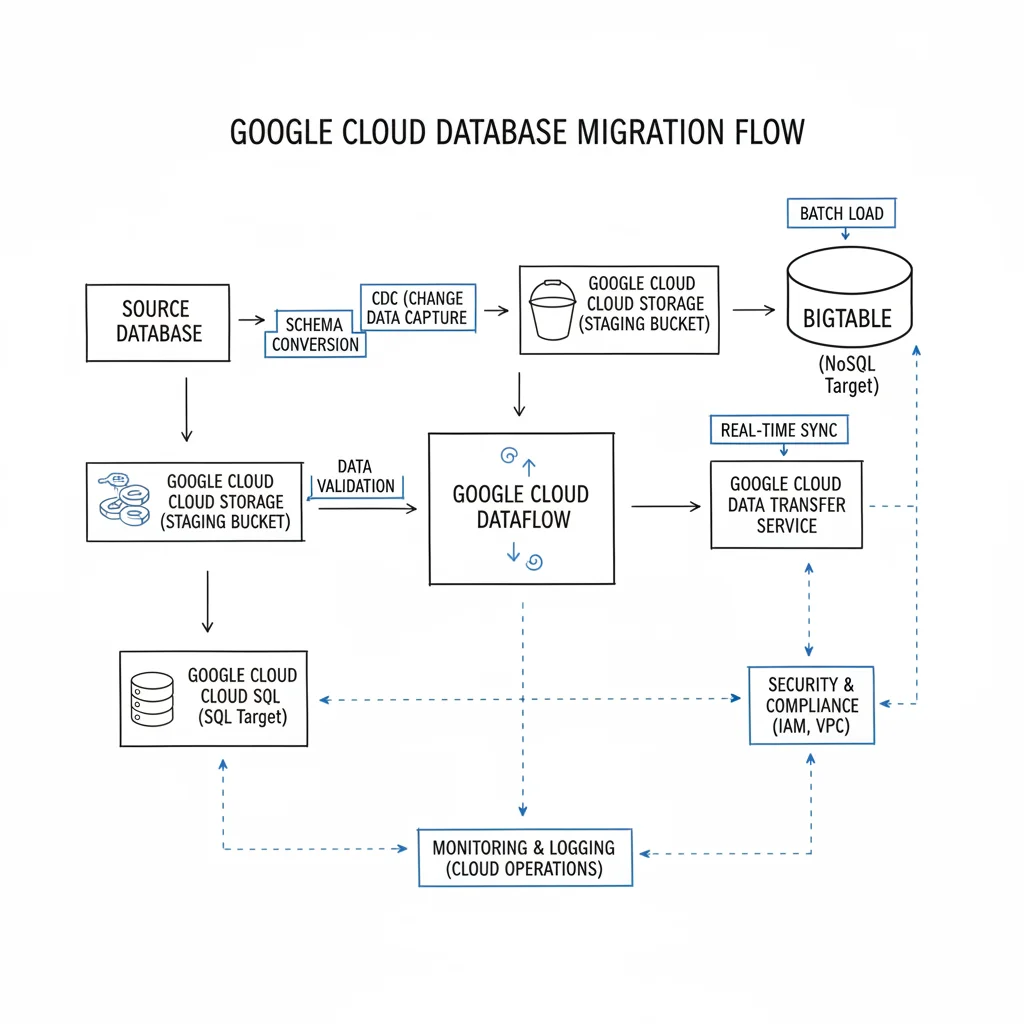
Google Cloud Professional Database Engineer: The 2026 Guide
Google Cloud Professional Database Engineer: A Strategic Study Guide
You're probably in one of three situations right now.
Perhaps you already work with databases and feel your Google Cloud knowledge is strong, but you question if it's strong enough for a professional-level certification. Or maybe you've been using Cloud SQL, Spanner, Firestore, or BigQuery in pieces, and now you want a structured way to connect those tools into one coherent architecture mindset. Or your manager mentioned "Professional Database Engineer" in a career conversation, and now you're trying to figure out if this exam matches your experience or just your ambition.
That uncertainty is completely normal. I've mentored people through this certification path, and the biggest mistake I see is candidates treating it like a memorization contest. It isn't. The Google Cloud Professional Database Engineer exam rewards judgment. You need to look at a workload, identify its constraints, and choose the database design that best fits performance, reliability, security, and cost.
A better study strategy starts with one question: Can you explain why a design is right, not just what button to click?
Understanding the Professional Database Engineer Certification
Imagine you're on call for a critical customer-facing app. Orders are backing up, latency is climbing, and the engineering lead needs an answer fast. Should you tune indexes, add read capacity, change the replication approach, or admit the workload belongs on a different database service entirely? That is the kind of judgment this certification aims to test.
The Professional Database Engineer certification sits at the senior, production-focused end of Google Cloud certifications. It targets individuals who can design, build, run, and troubleshoot database systems on Google Cloud with real-world constraints in mind. Google recommends prior database and cloud experience before attempting it, which aligns with what I observe in practice. Candidates who perform best typically already have firsthand experience from migrations, incidents, capacity surprises, or security reviews.
This framing is important because your study strategy should align with the job the exam models. A strong plan doesn't begin with flashcards and service definitions. It starts with mental models. You need to understand why Spanner suits one workload, why Cloud SQL fits another, and why Firestore or Bigtable might solve a scaling problem while introducing different consistency or access-pattern trade-offs.
Who this certification fits
This exam is a strong match if you already make architecture decisions, even if your title isn't explicitly "database engineer."
It tends to fit professionals who regularly perform tasks such as:
- Choosing database services based on workload shape. You compare transactional and analytical needs, data models, latency targets, consistency expectations, and growth patterns.
- Running production databases. You deal with backups, maintenance windows, replication, failover planning, and performance tuning.
- Translating requirements into designs. You collaborate with application teams, security stakeholders, and platform engineers, then transform those constraints into schemas, instance choices, and operational plans.
- Handling change safely. You plan migrations, schema changes, access modifications, and rollout steps without introducing unnecessary risk.
If you are still building basic SQL fluency or learning how Google Cloud services fit together, the exam can feel like trying to solve traffic flow before learning road signs. It's possible, but less efficient.
What the exam truly measures
A common misunderstanding trips up otherwise capable candidates. They assume a database certification mainly tests query syntax or product trivia. This one leans much harder on decision-making.
The exam asks whether you can look at a business requirement and map it to the right technical choice under pressure. This includes availability targets, recovery expectations, security boundaries, migration paths, operational overhead, and cost awareness. Query tuning still matters, but it's part of a larger system-design picture.
I usually tell mentees to treat this exam like a case-study interview in multiple-choice format. Each question presents a small production story. Your job is to identify the constraint that matters most.
Why this section matters for your preparation
If you misinterpret the level of the certification, you will build an ineffective study plan. That's the fastest route to wasted effort. People often over-study product details they can memorize and under-study the reasoning patterns they need to apply.
This guide uses a different approach. It mirrors how strong engineers learn. We will focus on pattern recognition, comparison, retrieval practice, and hands-on reinforcement so you can explain your choices, not just recognize service names. That same mindset shows up across good IT certification exam prep, but it matters even more here because this exam rewards applied judgment.
Treat the certification as evidence that you can make sound database decisions on Google Cloud. Once you see it that way, the rest of your preparation becomes much clearer.
Decoding the Exam Domains and Objectives
The fastest way to study poorly is to treat all topics as equal. They aren't. The exam domains tell you where Google expects more of your attention, and your study plan should reflect that weighting.
Here is the domain map for the current exam blueprint:
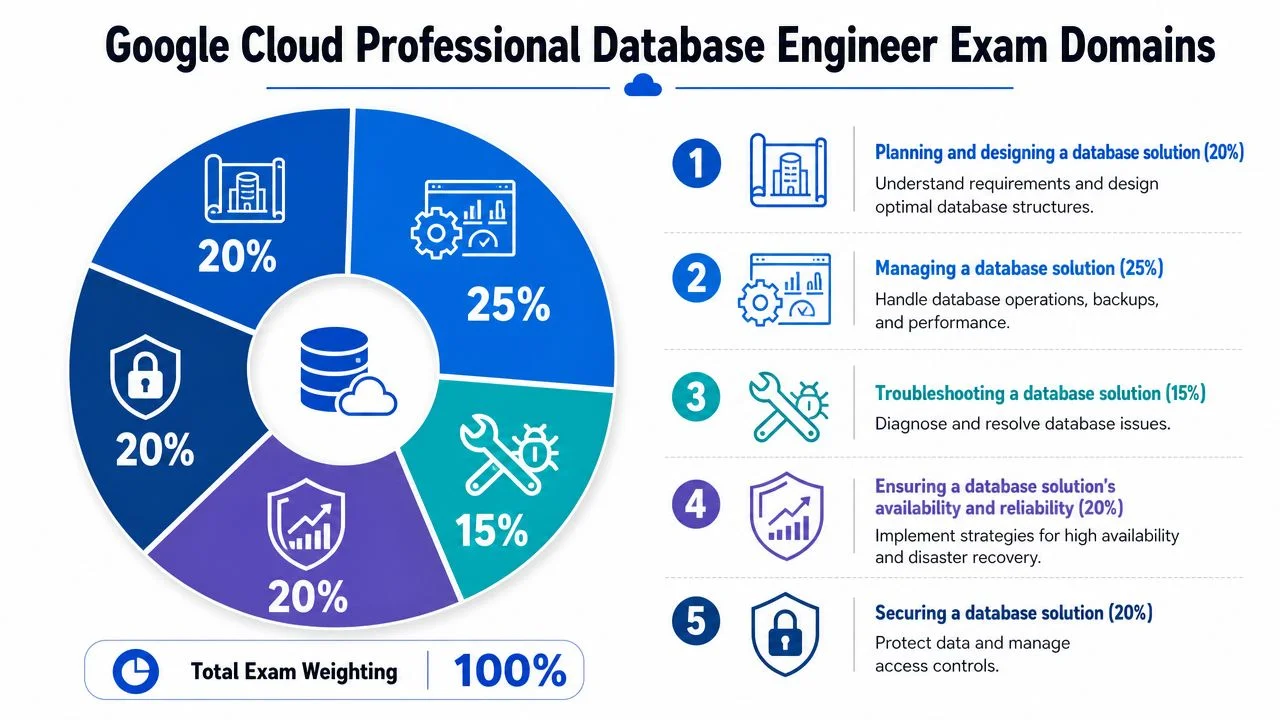
Domain weighting at a glance
| Exam Domain | Weighting | Key Focus Areas |
|---|---|---|
| Planning and designing a database solution | 20% | Requirements analysis, database selection, schema direction, scalability and performance trade-offs |
| Managing a database solution | 25% | Day-to-day operations, backups, maintenance, observability, lifecycle management |
| Troubleshooting a database solution | 15% | Root-cause analysis, performance bottlenecks, connectivity issues, query and workload diagnosis |
| Ensuring a database solution's availability and reliability | 20% | High availability, replication strategy, disaster recovery thinking, resilience planning |
| Securing a database solution | 20% | IAM, access boundaries, encryption, compliance-aware design |
How to interpret the blueprint
The percentages highlight where mistakes are most impactful. Managing a database solution is the heaviest domain, so candidates who only study service selection often underperform. They know what Spanner or Cloud SQL does, but they can't reason through backup behavior, operational monitoring, or ongoing maintenance decisions.
Planning and designing is where many scenario questions begin. You'll receive a business requirement and need to infer the correct database pattern. This means understanding application behavior, not just product definitions.
Troubleshooting has a smaller weighting, but it can be deceptively difficult. These questions often require you to differentiate symptoms from causes. High latency, replication lag, query slowness, and capacity stress can appear similar from the outside.
A practical reading of each domain
Planning and designing a database solution asks if you can translate requirements into architecture. If the application needs relational transactions, the solution space differs from a mobile app with flexible document structures. If traffic patterns are global, your choice changes again.
Managing a database solution verifies whether you understand how real systems are kept healthy. Candidates often lose points here because they skip the “boring” topics. Don't. Databases thrive or fail based on operations.
Most exam misses don't happen because someone never heard of a service. They happen because the candidate picked a technically possible answer instead of the most operationally sound one.
Troubleshooting a database solution is less about memorizing error conditions and more about structured thinking. Start with the workload pattern, then isolate resource pressure, then inspect schema, indexing, query shape, replication, and access path.
Ensuring availability and reliability is where architectural maturity is evident. You need to think in terms of failure modes. What happens if a zone fails, a region degrades, or an operator restores the wrong state?
Securing a database solution isn't a secondary topic. It's an integral part of the design itself. Secure access, encryption choices, and data boundaries affect architecture from the outset.
How to use the domains in study
Don't just “cover” each domain. Rate your current proficiency in each one as strong, partial, or weak.
Then study in this order:
- Weak but high-weight domains first
- Strong but high-weight domains second
- Low-weight cleanup topics last
This order might feel less comfortable than revisiting favorite topics, but it's how experienced candidates close knowledge gaps fastest.
Core Skills for the Exam
At a high level, the role behind this certification is broader than many candidates expect. Credly describes it as aimed at practitioners with two years of Google Cloud experience and five years of overall database and IT experience, stating the role involves designing, creating, managing, migrating, and troubleshooting Google Cloud databases for application data storage and retrieval. It also emphasizes translating requirements into scalable, cost-effective database designs across relational and NoSQL systems, as detailed in the Google Cloud badge overview on Credly.
This means your actual job on the exam is to match workload patterns to service behavior.
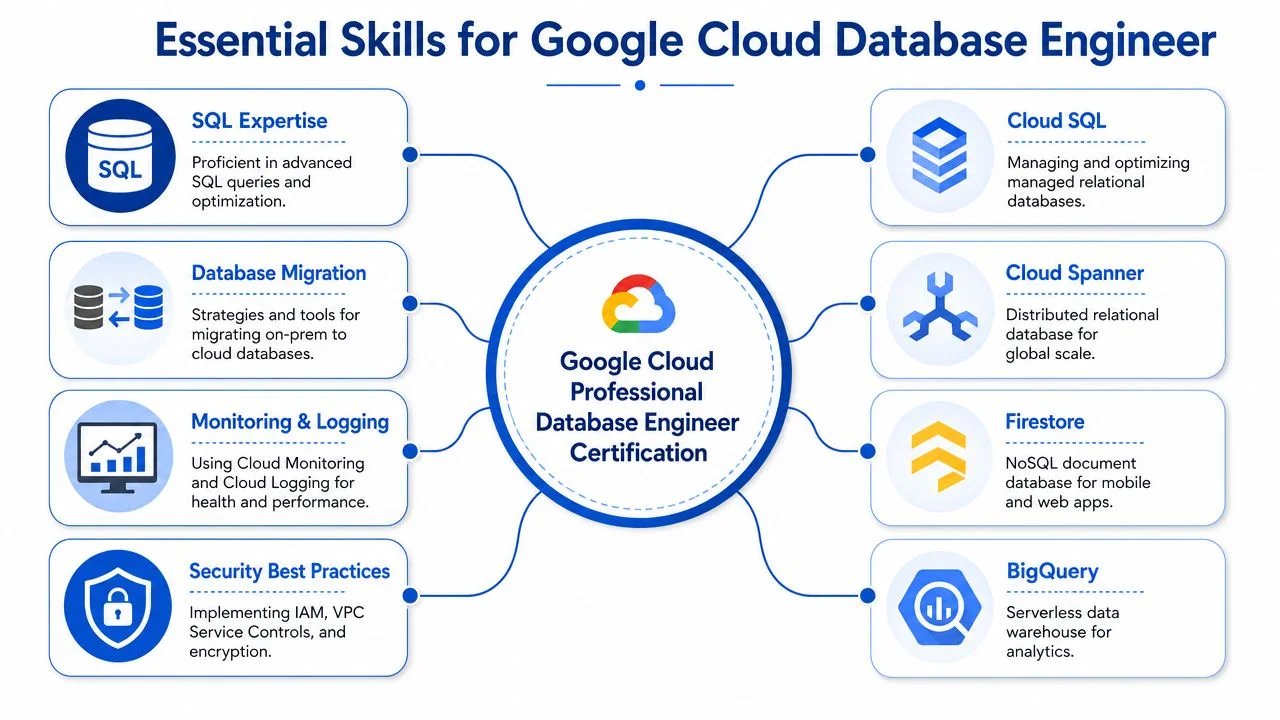
Build a service selection mindset
Candidates often ask for a product list. That's helpful, but insufficient. You need a mental decision tree.
Start with the workload:
- Transactional relational workload: Consider Cloud SQL or Spanner, depending on scale and distribution needs.
- Document-centric app workload: Think about Firestore when flexible document structures and app-centric access patterns fit.
- Wide-column or very high-throughput operational data: Think about Bigtable-style patterns.
- Analytical querying: Think about BigQuery for warehouse-style analytics.
- Low-latency caching: Think about Memorystore as a complement, not a primary system of record.
The exam doesn't reward tool fandom. It rewards fit.
The skills that separate passing from almost passing
A strong candidate can explain trade-offs in plain language.
Relational systems and transactional design
You should know when a managed relational service is sufficient and when distributed relational design is the better solution. This includes schema thinking, indexing logic, failover awareness, and maintenance implications.
A common exam pattern: two answers are technically valid, but only one minimizes operational burden while meeting business constraints.
NoSQL design and access patterns
For Firestore or Bigtable-style questions, the challenge isn't naming the service. It's understanding the access pattern. If you don't know how the application reads and writes data, you can't choose well.
Your study notes should answer questions like:
- What query patterns does this workload need?
- Is the schema fixed or evolving?
- Does the app prioritize consistency, scale, or flexibility?
- What issues might arise six months after launch?
This short explainer offers a quick refresher on service relationships before a deeper study session:
Migration and modernization
Migration questions often test restraint. The correct answer usually isn't “move everything at once.” It's choosing an approach that protects application continuity, data integrity, and rollback options.
Security and operational visibility
You need to connect IAM, encryption, logging, and monitoring to the database lifecycle. Security isn't just about blocking access. It's about making safe operations the default.
A good database design on this exam is rarely the most clever one. It's the one an operations team can run safely at scale.
If you're comparing this path with adjacent data roles, MindMesh Academy's AWS Data Engineer Associate study guide offers a useful contrast by highlighting where database platform decisions differ from pipeline-first thinking.
Your 12-Week Strategic Study Plan
Candidates often fail this exam not due to insufficient effort, but because they studied in a way that felt productive but didn't stick. They reread documentation, highlighted pages, and watched videos passively. Then the scenario questions arrived, and recall collapsed.
A better system uses active recall, spaced repetition, and regular hands-on practice. In simple terms, this means you repeatedly force your brain to retrieve what it knows, and you revisit topics before they fade. That sounds basic, but it profoundly changes how you retain architecture decisions.
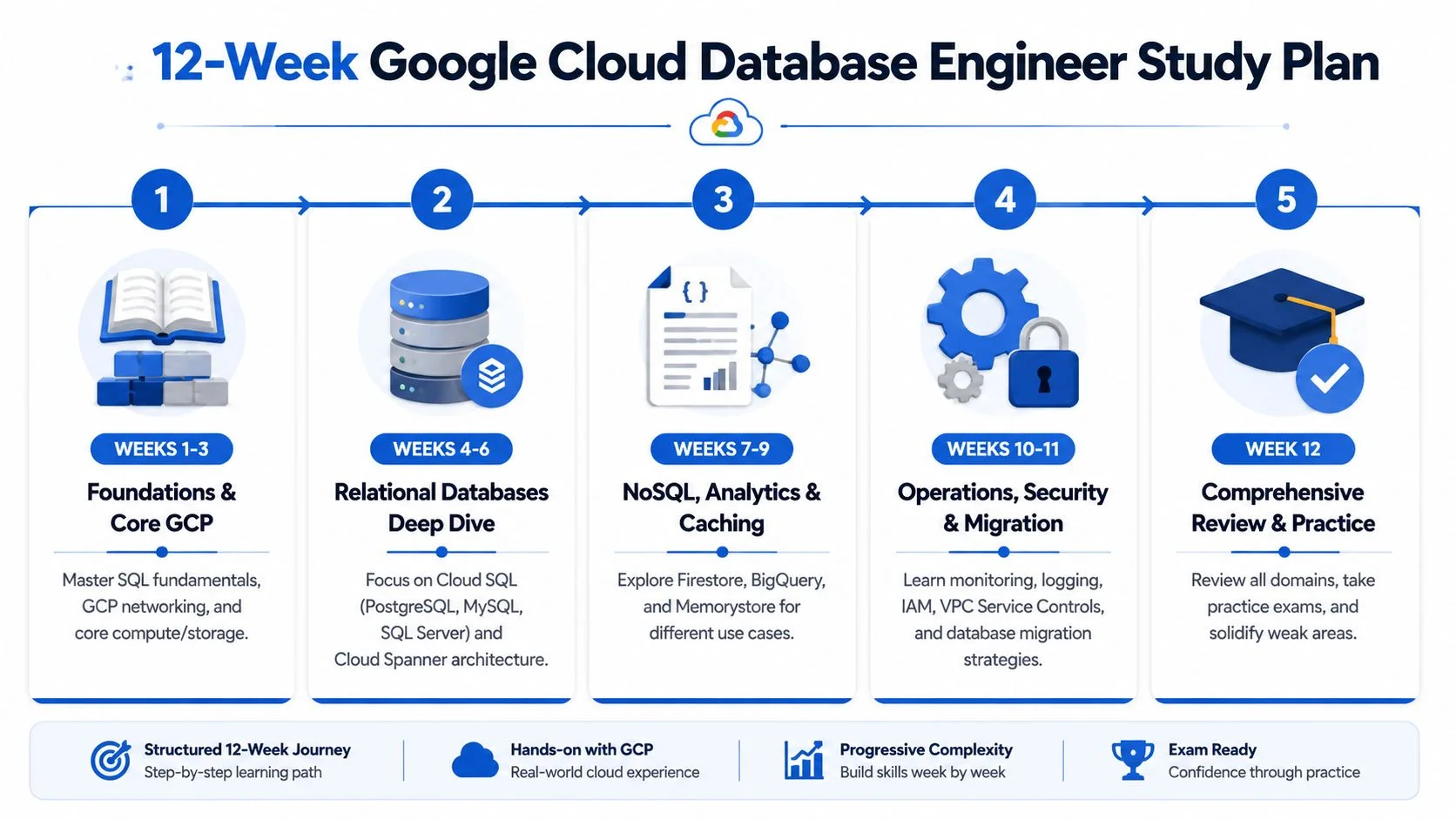
Weeks 1 to 3
These first weeks build foundations, but not beginner concepts. Focus on the core ideas that support later judgment.
-
Week 1
Rebuild your mental map of database categories: relational, document, wide-column, analytical, cache. For each one, note when you'd use it and when you wouldn't. -
Week 2
Review core Google Cloud concepts that indirectly affect databases. IAM behavior, networking basics, regional considerations, and service boundaries matter because the exam situates databases within cloud architecture. -
Week 3
Start retrieval practice. Close your notes and explain, from memory, how you'd choose between major database options for three different workloads.
Weeks 4 to 6
This phase is where many candidates make significant progress.
Focusing on Relational Services
Spend serious time on Cloud SQL and Spanner. Don't just list features. Compare them by operational expectations, scale assumptions, and failure handling.
Create your own comparison sheet with prompts like:
| Prompt | Your answer |
|---|---|
| Best fit for conventional application transactions | |
| Best fit when scaling and distribution needs become central | |
| Typical operational concerns | |
| Availability and maintenance considerations |
Use active recall every session
At the end of every study block, answer from memory:
- What workload was I studying?
- What service fit it best?
- What trade-off made that choice correct?
- What tempting wrong answer might appear on the exam?
That last question is important. Training yourself to spot distractors is part of the job.
Weeks 7 to 9
This phase broadens your service judgment.
NoSQL, analytics, and caching
Study Firestore, BigQuery, Bigtable-style thinking, and Memorystore as parts of an application ecosystem rather than isolated tools. Ask what each service is optimizing for.
A good exercise is to take a familiar system, such as an e-commerce app, and decompose it:
- Transactions and orders: relational core
- Product browsing metadata: perhaps document-friendly patterns
- Analytics and reporting: warehouse-style querying
- Hot session data or repeated reads: cache layer
This kind of decomposition trains the exact reasoning the exam rewards.
Memory tip: If you can't explain a service choice out loud in under a minute, you probably don't understand it well enough yet.
Weeks 10 to 11
These weeks should feel operational.
Security, migration, and troubleshooting drills
Work through scenario prompts where something goes wrong. A migration stalls. Latency rises. Access is too broad. Backup expectations don't match recovery needs.
Don't answer immediately. First, classify the problem:
- Design issue
- Operations issue
- Security issue
- Migration issue
- Performance issue
This classification step reduces impulsive guessing.
Week 12
Week 12 is for integration, not panic.
Conduct mixed review sessions that combine domains. A realistic question rarely belongs to only one topic. A design choice affects security. A scaling choice affects reliability. A migration path affects downtime risk.
Use this checklist for the final stretch:
- Review weak notes only: skip full rereads unless a concept is still fuzzy.
- Redo missed questions: study why your wrong answer felt attractive.
- Run short recall drills: service selection, failure modes, security choices.
- Practice under time pressure: not to chase speed, but to reduce hesitation.
The purpose of a strategic plan isn't rigidity. It's about reducing wasted effort. If you have limited weekly study time, a science-based approach matters more, not less.
Mastering Hands-On Labs and Practice Questions
One candidate I mentored followed a pattern I've seen many times. He could describe database services very clearly in conversation, but whenever I gave him a scenario question, he picked the answer that sounded familiar instead of the answer suitable for production.
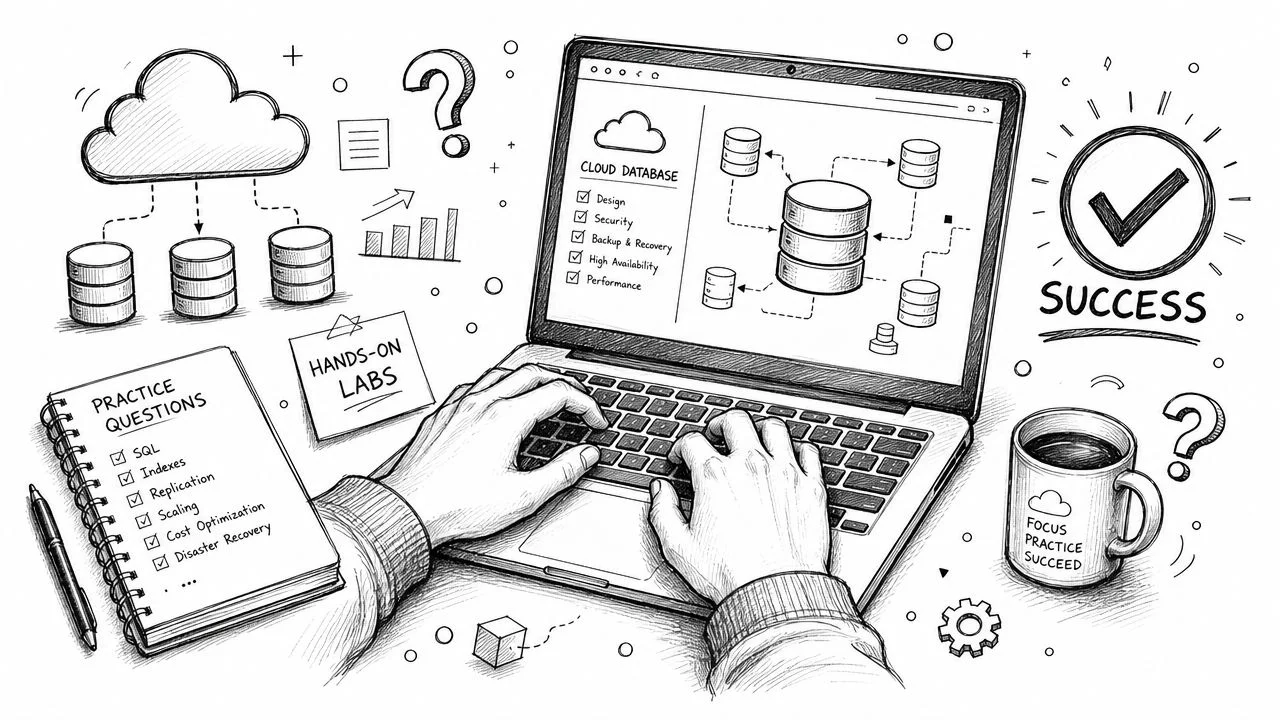
The fix wasn't more reading. It was labs.
Why labs change your judgment
Hands-on work forces you to notice details that reading might gloss over. Provisioning choices, permission boundaries, backup options, monitoring views, and failure behaviors become real once you've interacted with them.
You don't need a giant project. You do need repetition with intent.
Try labs that make you do things like:
- Provision and inspect: create a database service, then examine its configuration choices and defaults.
- Secure and connect: work through IAM, service accounts, and access patterns.
- Observe behavior: use Cloud Monitoring and Cloud Logging to see what healthy and unhealthy looks like.
- Simulate change: test backup, restore, scaling adjustments, or migration-style movement in a safe environment.
How to use practice questions properly
Many candidates misuse practice questions. They check whether they got the answer right, then move on. That leaves most of the learning behind.
After every question, ask:
- Why was the correct answer better?
- Which keyword changed the decision?
- Which wrong option was plausible?
- Was my mistake about service knowledge, architecture, or reading comprehension?
That post-question analysis matters more than the score itself.
The three question types to expect
Straight service recognition
These are the easiest. You identify the best-fit service for a clear workload. They test your baseline understanding.
Scenario trade-off questions
These are harder. Several answers might work, but one best matches the specified requirements. These questions punish shallow studying.
Operational troubleshooting questions
These test whether you can diagnose before acting. If you rush to a fix without understanding the problem category, you'll fall for distractors.
Don't ask, “What tool do I remember?” Ask, “What constraint is the question forcing me to honor?”
If you want more timed question exposure in a parallel certification style, MindMesh Academy's AWS Data Engineer Associate practice exam is a good example of how structured practice can sharpen weak areas through repetition and review discipline.
Exam Logistics and Test-Day Strategy
You are 40 minutes into the exam. A long scenario question mentions replication, maintenance windows, failover, encryption, and cost. Your pulse jumps because three answers look plausible. That moment highlights why test-day strategy matters. This exam rewards calm filtering under pressure, not just topic coverage.
As noted earlier in the article, the exam gives you limited time for a sizable set of multiple-choice and multiple-select questions. Treat it like a design review with a clock running. You are not trying to prove that you know everything about databases. You are trying to identify the best answer that fits the stated constraints with the least risk.
A useful mental model is triage. In an outage, experienced engineers stabilize first, then investigate edge cases. Use the same approach here. Secure the questions you can answer cleanly, then return to the ones that need slower reasoning.
Before exam day
Your final 24 hours should reduce noise, not add more. New material often creates the illusion of progress while making recall less reliable the next morning.
Pick an exam slot that matches your actual concentration pattern. If your sharpest work usually happens early, do not schedule a late session because it looked convenient. Small choices like that affect performance more than candidates expect.
Keep your preparation simple:
- Confirm the practical details: ID, appointment time, test center route or remote testing setup.
- Reduce environmental surprises: stable internet, quiet room, cleared desk, working webcam if applicable.
- Review lightly: decision rules, weak spots, and service comparisons you already studied.
- Protect sleep: recall and reading accuracy drop quickly when you are tired.
If exam stress tends to affect your job search too, it helps to have a plan for what comes after the result. This guide on how to write an impactful tech CV is useful once you are ready to present the certification effectively.
During the exam
Start with control, not speed. Read the actual question first, then scan the scenario for the constraints that drive the choice. In database questions, one phrase often decides the whole answer: lowest operational overhead, strict consistency, regional resilience, minimal downtime, or cost control.
Use a two-pass method.
On the first pass, answer clear questions quickly. For unclear ones, eliminate options that obviously break a requirement, choose a provisional answer if you can narrow it down, then mark it for review. That keeps one difficult item from consuming the time needed for four easier ones.
A few habits help:
- Read for constraints, not volume: long questions often contain only one or two crucial details.
- Translate vague pressure into architecture terms: “must stay available” may imply failover design, replication choice, or managed service selection.
- Watch for operational burden: the best answer is often the one that meets the requirement with less maintenance work.
- Be careful with extreme wording: options that sound absolute are easier to eliminate when the scenario allows trade-offs.
When you are unsure
Uncertainty is normal here. Professional-level exams are designed to give you more than one technically possible option. Your job is to choose the one a careful senior engineer would defend in a review.
Ask three questions:
- Which option satisfies the stated requirement most directly?
- Which option adds the least unnecessary complexity?
- Which option creates the fewest hidden operational problems later?
That last question matters significantly in database work. An answer can be technically valid and still be the wrong choice if it adds avoidable migration risk, backup complexity, scaling friction, or recovery overhead.
Save a few minutes at the end for marked questions. Fresh eyes often catch the single word you missed the first time. Sometimes the difference between passing and missing the mark isn't raw knowledge. It is reading discipline, pacing, and the willingness to choose the most defensible answer instead of the most familiar one.
Advancing Your Career with the Certification
A common career moment looks like this: You are the person everyone trusts to keep databases running, but in architecture meetings, someone else decides which service to use, how to balance cost against recovery goals, or whether a migration plan is too risky. This certification helps close that gap because it trains the kind of judgment those meetings require.
The Google Cloud Professional Database Engineer certification aligns well with roles where database choices directly affect reliability, scalability, security, and delivery speed. This includes positions such as Cloud Database Engineer, Senior Database Administrator, Data Architect, and platform engineering roles with ownership of data systems.
Hiring managers usually aren't looking for someone who knows only one engine in isolation. They want an engineer who can start with an unclear set of requirements, ask better questions, and transform that ambiguity into a design the team can run in production. That is the core career value here.
What changes after you earn it
The certification can strengthen your case for broader ownership because it signals that you understand databases as part of a larger system, not as a collection of admin tasks.
In practice, that often means growth in three directions:
- More design influence: you can recommend services and explain the trade-offs behind the choice.
- Broader technical range: you can compare relational, NoSQL, analytical, and caching options based on workload needs.
- Stronger operational judgment: you plan for backup, failover, security, and recovery before problems show up in production.
That shift matters. Teams trust senior engineers to make decisions that hold up under pressure, not just complete tickets.
Turn the certification into visible evidence
Passing the exam is useful. Showing what it changed in your work is what gets interviews.
Treat the certification like a signal amplifier, not a substitute for experience. If your resume or portfolio still reads like a maintenance log, recruiters may miss the level you are operating at.
A better approach is to present your work the way a reviewer or hiring panel would evaluate it:
- State the business problem: what risk, bottleneck, or growth target influenced the database decision.
- Explain the trade-off: why the chosen service fit better than the alternatives.
- Show operational ownership: migration planning, backup strategy, access control, cost awareness, and incident prevention all demonstrate maturity.
If your resume still sounds like a task list, this guide on how to write an impactful tech CV can help you present technical work in a way hiring teams recognize.
The deeper payoff
The long-term benefit is not the badge itself. It is the change in how you think.
Good preparation for this exam forces you to connect product knowledge with decision-making. You stop looking at Cloud SQL, Spanner, AlloyDB, Bigtable, Firestore, and Memorystore as separate items to memorize. You start seeing them as tools with different failure modes, scaling patterns, consistency models, and operational costs.
That is why a strategic study framework matters more than a topic checklist. MindMesh Academy's learning-science approach points in the right direction here. Spaced repetition, active recall, and scenario-based practice help you build durable judgment, which is what senior database work demands.
Over time, that mindset carries into design reviews, promotion conversations, and interviews. You become the engineer who can explain not only what will work, but why it is the right choice for this system, this team, and this stage of growth.
Ready to explore other certification paths and solidify your knowledge? Visit MindMesh Academy's full list of IT certifications to find your next step.

Written by
Alvin Varughese
Founder, MindMesh Academy
Alvin Varughese is the founder of MindMesh Academy and an enterprise architecture leader. An electrical engineer by training, he moved from factory automation in South Africa to cloud architecture at GE Appliances and Humana (Fortune 50), and holds 20 professional certifications including AWS Solutions Architect Professional, Azure DevOps Engineer Expert, and Microsoft Agentic AI Business Solutions Architect. He built MindMesh Academy after interviewing too many highly certified candidates who couldn't answer basic questions: the goal is prep that makes you better at the job, not just able to pass the exam.