8 Essential Examples of Project Charter Document for 2026
8 Essential Examples of Project Charter Documents for IT Professionals in 2026
Launching a major IT project without a clear project charter is like starting a complex enterprise cloud migration without an architecture, budget, or stakeholder agreement. This document formally authorizes the project, gives the project manager authority, and aligns every stakeholder on a single vision. Most IT leaders know they need one, but building a charter that actually works is difficult. Vague definitions lead to scope creep, wasted budget, and constant conflict. A strong charter guides decisions from the start to the final delivery.
This guide avoids theory to focus on practice. We analyze eight different examples of project charter document templates designed for specific IT scenarios. These include PMI-aligned frameworks, hybrid cloud migration plans, and ServiceNow implementations. We also look at how to handle resource allocation and risk management within these documents to prevent project failure.
For each example, we'll provide:
- Strategic Analysis: Analysis of why each section works for specific IT projects and how it prevents common failures.
- Actionable Takeaways: Practical tactics you can apply to your current projects immediately to improve results.
- Certification Relevance: Information on how these documents relate to certifications like the PMP, AWS, ITIL, or Azure.
If you are studying for the PMP, preparing for the AWS Solutions Architect exam, or leading a corporate IT initiative, these examples help you build documents that secure buy-in and minimize risk. You will learn to start projects with clarity. Establishing a predictable path to success begins with a strong start on day one. High-quality documentation prevents the misunderstandings that derail technical teams. By using these templates, you can ensure that your resources, timeline, and objectives are transparent to every team member. Effective charters bridge the gap between technical requirements and executive expectations.
1. PMI Standard Project Charter Template
The Project Management Institute (PMI) project charter template serves as the primary standard for practitioners worldwide. It aligns with the principles found in the PMBOK® Guide. This document is a fundamental example of a project charter, acting as the formal framework for starting projects in a way that is structured and repeatable across global industries. It officially authorizes the existence of a project and gives the project manager the specific authority required to apply organizational resources to project tasks.

Strategic Analysis for IT Professionals
IT organizations and Project Management Offices (PMOs) rely on the PMI template because it is thorough and widely accepted. It forces teams to evaluate all critical elements before starting work. This includes defining a clear purpose, setting measurable objectives, and identifying high-level requirements. It also requires a list of potential risks and key stakeholders. For an IT department inside a structured PMO, using this template creates a consistent starting point for all new work. It improves overall governance by providing a clear audit trail of who authorized the project and why.
The structured layout helps prevent scope creep by setting firm boundaries and success criteria early in the process. For IT professionals working toward PMP certification, learning this document is a core skill. You can find more detail on these principles in the Project Management Professional Study Guide.
Reflection Prompt: How might a well-defined project purpose in a PMI charter help mitigate common challenges in a multi-vendor IT integration project?
When to Use This Template
- Large-Scale Enterprise IT Projects: Use this for major work like consolidating data centers or upgrading ERP systems such as SAP or Oracle. It is also useful for multi-phase software rollouts that need formal authorization and clear boundaries.
- Government & Highly Regulated Initiatives: The formal nature of the template meets the documentation and compliance needs of the public sector.
- PMP Certification Preparation: Using this template on actual IT projects is beneficial practice for candidates. It reinforces the core principles of the PMBOK Guide in a practical setting rather than just as a theory.
Actionable Takeaways
To use the PMI template correctly in an IT context, connect your project objectives to the strategic goals and business value of the organization. Organize a formal meeting to get the charter approved by stakeholders and the project sponsor. This builds a shared understanding and secures a physical or digital signature. Keep the document high-level and short, usually between 2 and 5 pages (confirm organizational standards for document length). Do not confuse the charter with a project plan. The charter is the authority that allows you to create that plan; it does not replace the schedule or the budget.
2. Agile Project Charter Template
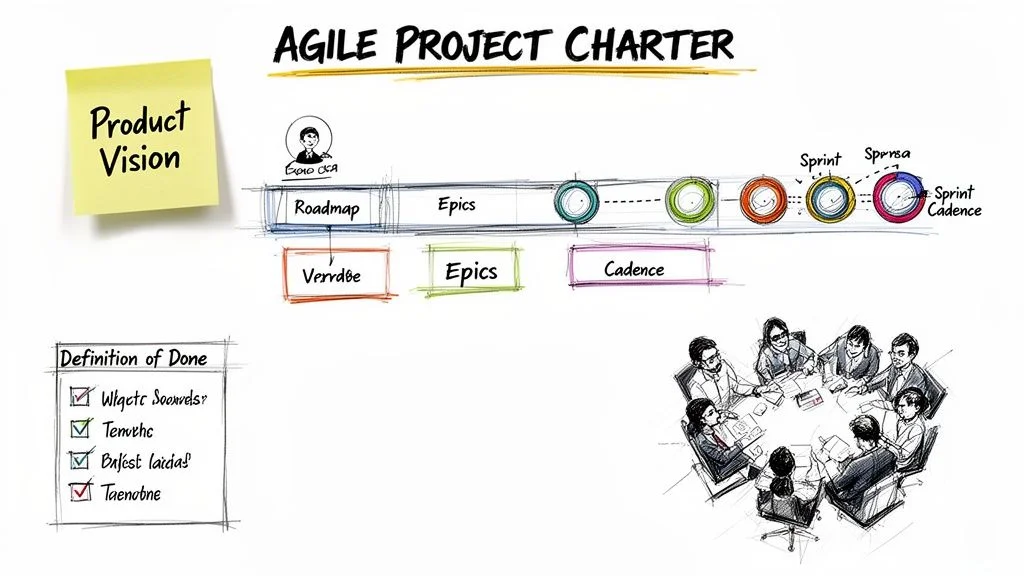
An agile project charter is a flexible document built for iterative development. Unlike traditional charters that fix every detail of the scope early on, this version focuses on a shared product vision and collaborative team goals. It is a vital entry among examples of project charter document for tech environments because it provides direction without removing the adaptability required by agile principles. It sets the stage for autonomous teams and continuous feedback. This document formally authorizes the team to begin work within a framework that expects and welcomes change.
Strategic Analysis for IT Professionals
The strength of the agile charter comes from its focus on the "what" and "why." It highlights the desired business outcomes and the product vision instead of dictating a rigid "how." It sets high-level boundaries and success metrics. This allows the Scrum team or other agile groups to find the best technical solutions through iterative sprints and feedback cycles. This approach is standard for IT projects where requirements shift, such as building a new mobile application or a cloud-native tool.
Popularized by frameworks like Scrum and SAFe, this template emphasizes a clear vision and identifies the Product Owner. It gives that person the authority to manage and prioritize the work backlog. Keeping the document to one or two pages makes it a useful reference for the team. It encourages collaboration instead of becoming a source of paperwork. This matches the Agile Manifesto, which prefers working software over documentation. Managing these charters is a foundational skill for those seeking the Certified Scrum Product Owner (CSPO) credential.
Reflection Prompt: How does an agile charter's focus on "what" and "why" allow for better adaptation to unforeseen technical challenges during software development?
When to Use This Template
- Software and App Development: This is the preferred choice for projects where user feedback directly influences the final product. Examples include developing a mobile banking application or building a custom internal developer portal.
- Cloud Migration Projects (Iterative): When migrating applications to cloud environments like AWS or Azure, an agile charter helps teams handle technical hurdles. It allows the team to improve cloud resource use iteratively and respond to business needs.
- Digital Transformation Initiatives: This template is useful for large-scale IT changes where the path forward is not fully defined. It supports an exploratory process, allowing the organization to learn and adjust as they implement new systems.
Actionable Takeaways
When creating an agile charter, focus on the product vision and business outcomes. Avoid creating a long list of specific features. Set up agile roles early, especially the Product Owner. Clearly state their authority over the backlog. Use high-level needs like epics or user stories to build the initial backlog instead of fixed requirements. Review the charter with the Scrum team and stakeholders to ensure everyone understands the goals. This should happen before the first sprint planning session. Treat the charter as a guide that can change as the team learns more through empirical data and backlog maturity.
3. IT Infrastructure Project Charter Template
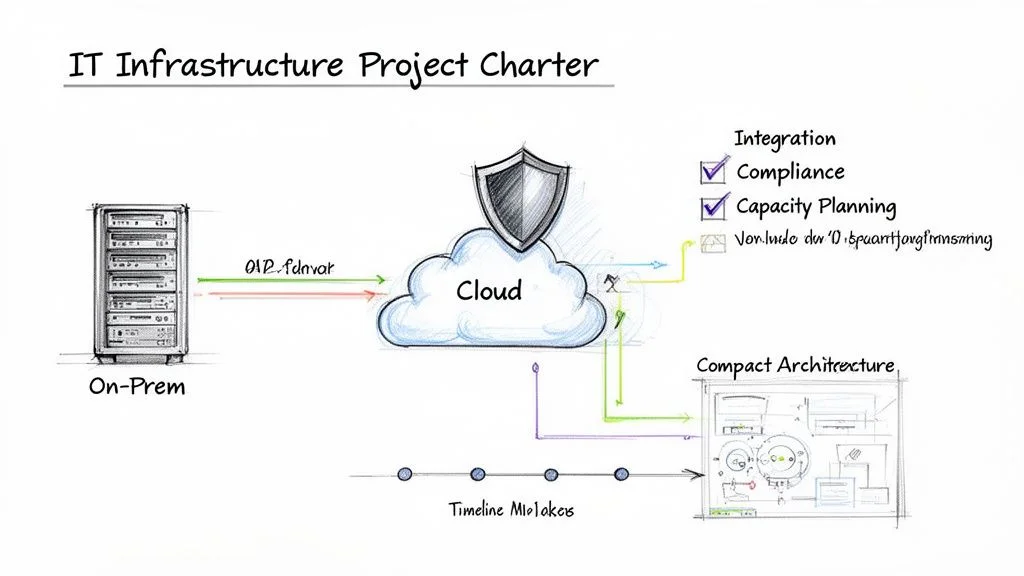
Technology projects like cloud migrations, extensive network upgrades, or enterprise-wide systems implementations require a specialized charter. This document addresses unique technical requirements from the start. It is a vital example among examples of project charter document because it goes beyond standard project management elements. It includes system integrations, security compliance, disaster recovery planning, and infrastructure dependencies. Technical teams write this document to ensure that architects, security analysts, and operations staff are aligned before a single server is provisioned or a configuration change is made. Having everyone agree on the scope early prevents technical drift as the project moves forward.
Strategic Analysis for IT Professionals
The primary value of an IT infrastructure charter is its focus on risk mitigation in high-stakes environments. A misconfigured firewall, a failed data center migration, or poor capacity planning leads to immediate operational and financial damage. This template follows best practices from ITIL, the AWS Well-Architected Framework, and the Microsoft Azure Cloud Adoption Framework (CAF). It requires teams to document technical details early in the process. This involves mapping system interdependencies and defining security requirements like GDPR, HIPAA, and PCI DSS. Teams must also define non-functional requirements such as uptime, performance, scalability, and maintainability. These factors determine if a system can handle real-world traffic and peak user loads without failing.
For IT professionals working with cloud platforms or studying for certifications like CompTIA Infrastructure+, AWS Certified Solutions Architect, or Azure Administrator, this document is a practical application of core concepts. It translates theoretical knowledge about architecture and security into an actionable, approved plan. By addressing technical factors in the charter, organizations avoid expensive rework and minimize service disruptions. This creates a secure IT environment that supports business goals without unexpected downtime.
Reflection Prompt: How can involving security teams from the initial drafting of an IT infrastructure charter reduce compliance risks later in the project lifecycle?
When to Use This Template
- Cloud Migration Projects: Essential for moving on-premise applications and data to AWS, Azure, or Google Cloud. These initiatives focus heavily on architecture, cost control, and security to ensure a successful transition.
- Network & Security Upgrades: Useful for enterprise firewall rollouts, Software-Defined Wide Area Network (SD-WAN) implementations, or establishing a Zero Trust architecture. These changes have a wide impact on organizational connectivity and safety.
- Major System Implementations: Use this for deploying core platforms like a new ERP system, CRM (such as Salesforce), or large-scale data warehouses. These projects involve complex integration points and specific data flows.
Actionable Takeaways
To make this charter effective, involve infrastructure architects, network engineers, and security teams in the first draft. Their specialized input is the foundation of the project. Document all system dependencies and integration points using diagrams like architectural layouts or network topology maps. These visuals explain technical relationships to both technical and non-technical stakeholders. The charter must include specific sections for disaster recovery, data backup strategies, and environment planning for development, test, and production stages. This upfront planning prevents these elements from becoming an afterthought and ensures the system remains resilient during operations. This approach protects the organization from long-term technical debt and stability issues.
4. ServiceNow Implementation Project Charter Template
A ServiceNow implementation is often much more than a software deployment. It represents a strategic overhaul of IT service delivery and enterprise workflows. This specialized charter is tailored for introducing the ServiceNow platform, covering modules such as ITSM, ITOM, CSM, or enterprise service management. As a critical entry among examples of project charter document, it focuses on the challenges of platform migration, process re-engineering, and the organizational change management inherent in large-scale projects. It formally defines the goals of transitioning from legacy systems to a unified, modern service platform.
Strategic Analysis for IT Professionals
The strength of this template lies in its focus on desired business outcomes rather than just technical features. A successful ServiceNow project is primarily measured by improved service levels, reduced resolution times, and better user satisfaction. The charter requires a direct conversation around defining clear ITSM or enterprise process improvements as the primary objectives. It places heavy emphasis on planning discovery workshops with IT stakeholders and business users to map current-state processes and design optimized future-state workflows. This helps prevent misalignment and rework later in the project.
ServiceNow implementations frequently involve migrating data from multiple outdated systems. Consequently, this charter prioritizes data integrity and quality. It includes sections for identifying potential data quality issues, planning for data cleansing, and defining migration strategies before any data transfer begins. This approach addresses one of the most common failure points in enterprise platform rollouts. It also formalizes the need for strong executive sponsorship. Support from leadership is essential for driving the necessary adoption of new processes and cultural shifts across the organization.
Reflection Prompt: Why is defining clear ITSM process improvements as primary objectives in a ServiceNow charter more effective than simply listing the modules to be deployed?
When to Use This Template
- Enterprise ITSM Migrations: This works for organizations transitioning from a fragmented collection of legacy helpdesk tools to a single ServiceNow ITSM platform for improved service delivery.
- ITOM and Cloud Management Deployments: This is appropriate for projects focused on IT Operations Management for infrastructure monitoring, event management, or implementing cloud management services through the ServiceNow platform.
- Phased Module Rollouts: Use this for large-scale programs where different ServiceNow modules, such as ITSM first, then ITBM, then SecOps, are implemented in distinct phases over an extended timeline.
Actionable Takeaways
To make this charter highly effective, ensure that a detailed training curriculum is defined as a key deliverable. Plans should be tailored for different user roles, such as IT technicians, managers, end-users, and system administrators. Establish strong, visible executive sponsorship early to champion the changes in workflow, process, and organizational culture. Finally, explicitly build post-implementation optimization and continuous improvement phases directly into the charter's high-level timeline and budget. Acknowledging that the platform will require refinement and enhancement 6–12 months after go-live sets realistic expectations and secures resources for long-term success.
5. Hybrid Cloud Migration Project Charter Template
A Hybrid Cloud Migration Project Charter handles the transition of organizational workloads to environments that mix local hardware with public services like AWS or Azure. This document is a necessary example for technical leads because it addresses specific hurdles like workload prioritization, security posture, and FinOps cost control. It establishes a formal framework to manage the technical, financial, and operational risks of a large-scale platform change. By defining these parameters early, the project team can avoid the common pitfalls of cloud sprawl and unplanned downtime. This charter ensures that every stakeholder understands how data moves between environments and who maintains control over specific assets during each phase of the transition.
Strategic Analysis for IT Professionals
The strength of this template lies in its focus on technical cloud requirements. It avoids generic scope statements to focus on workload assessments, network connectivity planning—including VPNs, AWS Direct Connect, and Azure ExpressRoute—and governance models for multi-cloud environments. The structure often aligns with established vendor frameworks like the AWS Migration Acceleration Program (MAP) or the Azure Migration Program. Following these industry standards provides a clear path for the migration team while maintaining compatibility with vendor-specific tools.
IT professionals preparing for cloud certifications find practical value in using this charter. It forces a close look at topics found in AWS and Azure exams, such as building a Cloud Center of Excellence (CoE), setting up compliance controls, and managing cloud expenses. This document connects high-level business goals to technical execution. It helps prevent expensive errors while ensuring the migration meets its intended financial and operational targets. Using the charter allows engineers to visualize how identity and access management (IAM) policies or VPC configurations translate into specific business value.
Reflection Prompt: In a hybrid cloud migration, how does a charter help establish clear FinOps practices to prevent unforeseen budget overruns?
When to Use This Template
- Enterprise Data Center Consolidation: Use this when shrinking or removing local data center footprints by moving legacy applications to AWS, Azure, or other providers. It helps track which systems stay on-site and which move to the cloud.
- Multi-Cloud Strategy Implementation: Use this when a business adopts services from several providers—like AWS for compute and Azure for PaaS—to avoid vendor lock-in. It provides a single source of truth for diverse cloud assets.
- Projects with Strict Compliance Needs: Use this for finance, healthcare, or government projects where PCI DSS, HIPAA, or FedRAMP require detailed security and data handling documentation from the start.
Actionable Takeaways
To use this template effectively, start with a workload assessment using tools like AWS Migration Evaluator or Azure Migrate. This data replaces guesswork and informs your strategy. Define FinOps practices and assign accountability for spending before the migration starts. The charter should list specific roles for monitoring and reporting costs to prevent budget overruns. Treat the charter as a living document. As assessments reveal new risks or dependencies, update the document and get stakeholder approval to keep everyone aligned. This iterative approach ensures that the document remains relevant as you discover the actual state of your legacy infrastructure. Regularly reviewing the charter prevents the project from drifting away from its initial business objectives during the execution phase.
6. Compliance and Security Implementation Project Charter Template
For projects focused on cybersecurity, regulatory compliance, and the security of digital assets, a specialized charter is necessary. A Compliance and Security Implementation Project Charter serves as a dedicated document for initiatives like achieving ISO 27001 certification, implementing a Data Loss Prevention (DLP) solution, or deploying a Zero Trust architecture across the enterprise. This is a vital example of project charter document because it places a non-negotiable emphasis on risk management, technical controls, auditability, and legal obligations from the very start of the project.
This document formally initiates projects where success is not just about being on time or under budget. Instead, success depends on meeting strict security standards, passing audits, and demonstrating due diligence. This charter authorizes the project manager to coordinate with specialized teams in IT security, legal departments, risk management, and internal audit to ensure all technical objectives meet regulatory demands.
Strategic Analysis for IT Professionals
The strength of this template comes from its focus on proactive risk mitigation and governance. Standard charters might treat risks as a minor section, but here, a risk assessment drives the entire project. It requires the organization to connect specific technical controls, such as a firewall rule or multi-factor authentication, directly to mandated compliance requirements. You might map a specific configuration to a NIST CSF control or a GDPR principle. This creates an explicit trail that is useful during rigorous certification processes like SOC 2 Type II or ISO 27001 audits.
For IT and security teams managing shifting regulatory requirements, this charter provides a single source of truth. It aligns technical implementation work with legal and regulatory obligations. When building a Compliance and Security Implementation Project Charter, managing integrated risk through platforms like the ServiceNow IRM and GRC modules helps track controls, evidence, and audit readiness. This structure ensures that security is the foundational purpose and driver of the project, rather than an afterthought or a secondary addition.
Reflection Prompt: How can mapping specific technical controls to compliance requirements within a charter improve audit readiness for certifications like ISO 27001?
When to Use This Template
- Certification and Audit Projects: This template is required for initiatives aimed at achieving or maintaining ISO 27001, SOC 2, HIPAA, GDPR, PCI DSS, or FedRAMP compliance. In these cases, showing due diligence and control effectiveness is the primary goal.
- Security Framework Adoption: Use this for implementing frameworks like the NIST Cybersecurity Framework, establishing a Zero Trust security model, or deploying Security Information and Event Management (SIEM) systems across an enterprise.
- Critical Infrastructure Protection: Use this when upgrading security for systems such as Industrial Control Systems (ICS), core financial platforms, or national infrastructure. In these areas, the impact of a security breach is severe and far-reaching.
Actionable Takeaways
To use this charter effectively, start with a security risk assessment and a gap analysis against the target compliance framework, such as NIST or ISO 27001. This assessment should shape the project scope, objectives, and deliverables. You must clearly define the roles and responsibilities of stakeholders like the Chief Information Security Officer (CISO), legal counsel, data privacy officers, and internal audit. Their oversight is necessary for the project to succeed. Plan for continuous compliance from the beginning. You can do this by building ongoing monitoring, reporting mechanisms, and security awareness training into the project's high-level milestones and budget. By doing so, the project ensures the organization remains compliant long after the initial implementation phase concludes.
7. Digital Transformation Capability Program Charter Template
A digital transformation program charter differs from a standard project charter. While a project focuses on one deliverable, a program charter coordinates multiple related projects over a multi-year timeline. This document is one of the more strategic examples of project charter document because it manages a portfolio of initiatives designed to change how a business functions through technology. The foundation for this charter is a Digital Transformation Strategy, which defines the long-term vision, business objectives, and the intended future state of the organization.
This charter converts that strategy into a practical framework. It defines the governance structure, secures long-term funding, and grants the executive authority required to manage tech upgrades, process changes, and organizational shifts. Real-world applications include a bank transitioning to an API-first architecture, a manufacturer adopting Industry 4.0 protocols, or a healthcare provider initiating a large-scale move to a cloud-based Electronic Health Record (EHR) system.
Strategic Analysis for IT Professionals
The strength of a program charter is its ability to keep different projects aligned with the main strategy. While one team might focus on a CRM rollout, another may migrate data to a public cloud. The program charter ensures these efforts work together toward a broader goal, such as a unified omnichannel customer experience or better operational efficiency. It prevents departments from working in isolation and ensures that resources go to the projects with the highest impact on the overall transformation.
This document sets up an executive governance structure, often featuring a steering committee with leaders from both business units and the IT department. This group provides oversight, clears hurdles, and decides on priorities and resource allocation. For IT professionals pursuing leadership roles like CIO, CTO, or Head of Digital Transformation, being able to create and manage this type of charter is a major advantage. It shows you can think about technology at a portfolio and strategy level rather than just a task level.
Reflection Prompt: How does a digital transformation program charter prevent individual projects from becoming siloed efforts, disconnected from the overarching strategic vision?
When to Use This Template
- Enterprise-Wide Change Initiatives: Use this for large transformations, such as applying Industry 4.0 across all factory operations, creating a "smart city" data platform, or shifting a government agency to a digital-only service model.
- Multi-Year Strategic Programs: Use this when an initiative lasts several years and involves many dependent projects that must finish to build a new business capability.
- High-Stakes Business Model Shifts: Use this to guide programs that change how a company makes money or delivers value, like a physical retailer moving toward a primary digital commerce model.
Actionable Takeaways
To make a program charter work, divide the long-term vision into logical phases. Each phase should have its own specific project charter. This makes a large program easier to handle and allows the team to achieve early wins that build support for the rest of the work. You should focus on active change management and clear communication to keep the organization informed as the technology changes.
Establish a set schedule for program reviews, such as a quarterly meeting. Use these sessions to check progress against key performance indicators (KPIs) and update the roadmap based on new business needs or technology updates. This ensures the executive team remains committed to the goals. The program charter should be treated as a living document that guides the transformation rather than a set of rigid rules that cannot be changed.
8. ITIL Service Transition Project Charter Template
For projects specifically focused on introducing, modifying, or retiring an IT service, the ITIL Service Transition Project Charter Template provides a specialized and effective framework. This document is a critical project charter example because it aligns project goals with IT Service Management (ITSM) best practices, specifically the ITIL v4 framework. It formally authorizes projects that manage the transition of new or changed services into the live operational environment. This ensures they consistently meet user expectations and business objectives with minimal disruption.
This charter emphasizes elements like change enablement, release management, knowledge transfer, and thorough service readiness validation. It ensures that a project isn't considered "done" simply when the technology is built or deployed. Instead, the project is only complete when the service is fully operational, adequately supported, and clearly delivering value to the business. This approach ensures that the transition phase receives the same level of attention as the initial development phase.
Strategic Analysis for IT Professionals
The core power of this template comes from its service-centric viewpoint. Unlike a generic project charter that might focus only on delivering a technical product, the ITIL charter forces a view of the entire service lifecycle. It ensures that operational readiness is a primary, explicit project objective, not an afterthought. This includes detailed planning for support team training, documenting thorough knowledge base articles, establishing monitoring and alerting mechanisms, and clearly defining service level agreements (SLAs) and operational level agreements (OLAs).
This structured approach is essential for preventing common pitfalls like failed "go-lives." In these cases, a new system might be technically functional but causes widespread trouble due to poor user training, inadequate support, or unforeseen performance issues in a production environment. For IT professionals working in IT operations, service delivery, or pursuing ITIL certifications, understanding and applying this document is fundamental for ensuring smooth service introduction and continuous service improvement. More details on this can be found in resources like the ITIL 4 Foundation Study Guide.
Reflection Prompt: How does explicitly defining service readiness criteria in an ITIL charter help prevent "failed go-lives" where new systems technically work but cause operational chaos?
When to Use This Template
- Major Enterprise Software Upgrades: Perfect for large-scale transitions like moving to a new version of SAP, Oracle, Salesforce, or Microsoft Dynamics, where service continuity and minimal business disruption are the highest priorities.
- Infrastructure Cutovers: Ideal for network upgrades, data center migrations, or cloud connectivity changes where the focus is on a smooth transition with zero unplanned downtime and clear fallback plans.
- New Service Implementations: Use for rolling out entirely new IT services, such as a new HR or payroll system, a new collaboration platform, or an internal developer tool, to ensure the support structure, processes, and documentation are ready from day one.
Actionable Takeaways
To use this template successfully, define clear, specific, and measurable service readiness criteria before the transition begins. Establish an active Change Advisory Board (CAB) with the explicit authority to approve or deny the go-live based on these predefined criteria and a thorough risk assessment. Your project plan must include thorough testing at the system, integration, and user acceptance (UAT) levels to validate functionality and performance. Finally, schedule service desk and support team training well in advance. Create detailed knowledge articles and establish monitoring dashboards with clear alert thresholds before the new service is live in production. This proactive, service-centric approach ensures a smooth and successful transition from project completion to live operations.
Comparison of 8 Project Charter Templates
| Template | Implementation Complexity | Resource Requirements | Expected Outcomes | Ideal Use Cases | Key Advantages | Limitations |
|---|---|---|---|---|---|---|
| PMI Standard Project Charter Template | Medium–High. It involves a formal, structured process that demands thorough planning and documentation before the project begins. | You will need trained project managers and executive sponsors. It also requires detailed documentation and support from a central Project Management Office (PMO). | This results in formal project authorization and a clear scope. It provides defined milestones and a transparent budget allocation for the project timeline. | Best for large enterprise projects like ERP rollouts or data center construction. Project managers often use this template for PMP exam preparation. | This is a globally recognized, thorough framework. It ensures strong stakeholder alignment and reduces ambiguity throughout the project lifecycle. | The process can be lengthy and requires significant upfront detail. It is often too bureaucratic for highly iterative or fast-moving projects. |
| Agile Project Charter Template | Low–Medium. This template uses a lightweight approach that focuses on iterative cycles rather than long-term fixed plans. | Needs cross-functional teams and a product owner who has the authority to make decisions regarding the project backlog and priorities. | Provides a vision-driven roadmap and supports iterative delivery. It keeps the team aligned on immediate goals while allowing for an adaptable scope. | Best for software startups, mobile application development, and teams using Scrum or SAFe for product delivery. | This structure is flexible and encourages constant feedback. It helps teams ship products faster and gives them more control over their daily work. | It lacks the formal authority of traditional charters. There is a risk of scope drift if the product owner does not manage the backlog strictly. |
| IT Infrastructure Project Charter Template | High. Managing complex technical dependencies and integrating various hardware and software systems across the organization is necessary. | Requires infrastructure architects, security specialists, and dedicated testing environments. You will likely need to engage with specialist vendors for specific technical assets. | Results in a defined architecture and clear integration plans. It establishes compliance baselines and capacity targets while providing a plan for risk mitigation. | Ideal for cloud migrations, data center modernization, and network or security upgrades. It fits well with large-scale platform deployments. | It explicitly includes security requirements and compliance checks. This reduces technical risks and aligns closely with ITIL operational standards. | The language is often highly technical. This can make it difficult for non-IT stakeholders to understand project goals without careful communication. |
| ServiceNow Implementation Project Charter Template | High. This involves platform-specific configuration and complex integrations with existing business systems and various data sources. | Needs ServiceNow specialists and data migration teams. It also requires change management resources to help employees adapt to the new system. | You get configured modules and an integrated CMDB. It ensures successful data migration, high user adoption, and measurable process improvements. | Used for enterprise ITSM migrations and ITOM or CMDB implementations. It also works for HR or CSM rollouts on the platform. | This template aligns with the specific nuances of the ServiceNow platform. This reduces implementation risks and supports long-term process transformation. | Requires deep platform expertise which is often expensive. Organizations must plan for ongoing costs related to licenses and consultant support. |
| Hybrid Cloud Migration Project Charter Template | Very High. Managing multi-platform complexity requires a detailed strategy for both on-premises and cloud-based environments. | Needs cloud architects and FinOps specialists. The team must use specific migration tools and work closely with network, security, and governance teams. | Expect a prioritized list of workloads for migration and specific cost management strategies. It builds a strong hybrid architecture with a clear security posture. | Best for data center consolidation, legacy application modernization, and multi-cloud strategies. It is particularly useful for regulated industries moving to the cloud. | It focuses on strategic risk and cost planning. The template supports multi-cloud strategies and emphasizes business value over simple migration tasks. | Requires deep architectural expertise. The high upfront investment and long timelines mean the organization must commit to ongoing optimization. |
| Compliance and Security Implementation Project Charter Template | High. This template focuses on meeting strict regulatory requirements and implementing technical controls across the organization. | Requires security architects, professional auditors, and legal experts. It also needs automated monitoring tools and direct oversight from the CISO. | Leads to an improved security posture and clear mapping of technical controls. It prepares the organization for certification audits and reduces breach risks. | Used for ISO 27001, SOC 2, or NIST CSF adoption. It is also ideal for GDPR, HIPAA compliance, and Zero Trust implementations. | Ensures alignment with regulations. It produces documentation that is ready for auditors and helps build trust with partners. | Implementation and maintenance can be expensive. There is also a risk of organizational resistance because the controls can sometimes limit user flexibility. |
| Digital Transformation Capability Program Charter Template | Very High. This operates at a program or portfolio scale and usually covers a multi-year timeline with many moving parts. | Requires strong executive sponsorship and cross-functional leadership. It also needs sustained funding and a team dedicated to organizational change management. | Results in a strategic capability roadmap and coordinated outcomes across multiple projects. It drives fundamental changes in how the organization functions. | Best for enterprise-wide shifts in banking, healthcare, or retail sectors. It applies to major business model changes and large-scale innovation programs. | This ensures strategic alignment across the whole company. The framework helps prioritize the most critical investments and drives long-term value. | Extremely complex to manage due to its scale. It requires constant executive support and faces significant challenges when measuring ROI over long periods. |
| ITIL Service Transition Project Charter Template | Medium–High. The focus is on the process of moving new services into production while maintaining operational stability. | Needs a Change Advisory Board (CAB) and dedicated test teams. It also requires documentation specialists and readiness teams for the service desk. | Ensures that new services are ready for live environments. It reduces operational disruptions, validates releases, and improves the overall quality of service. | Ideal for major software upgrades, ERP go-lives, and network cutovers. It is useful for any project introducing new services or release management. | Aligns directly with ITIL best practices to improve customer satisfaction. It reduces downtime risks and makes the IT department more resilient. | The rigorous testing and documentation requirements can be time-consuming. This may delay the initial delivery if the process is not managed efficiently. |
Your Next Step: From Charter Example to Project Success
We have moved past basic theories to look at how IT workers apply the project charter in real environments. By looking at the different examples of project charter document options, including the PMI standard, infrastructure setups, cloud shifts, and ServiceNow platforms, one fact stands out. The charter is a functional tool. It is a live document that requires active negotiation rather than a paper to sign and forget. You find its worth when you build it with your team and adjust it to fit the specific needs of your technical environment. In the coming years, projects will become more complex with AI and hybrid cloud needs, making this initial document even more important for keeping teams aligned and focused on the right goals.
A strong charter acts like a project constitution. It turns a vague idea or a technical ticket into a project with a real mission and clear authority. It provides the single source of truth for the team. This document sets the boundaries and explains what success looks like. It gives the project manager the right to move people, spend money, and make the hard calls that lead to predictable results. When project scope starts to creep or stakeholders disagree on what comes next, the charter keeps the work on track. It prevents the slow expansion of tasks that often happens when a project lacks a firm, written agreement from the start.
Synthesizing the Core Lessons for IT Professionals
When we look at the specific charter examples, a few major themes appear. Learning these themes separates managers who just fill out forms from those who lead projects from a difficult start to a successful finish.
-
Context is King: The IT Infrastructure charter requires many details about hardware, server space, and power redundancy. You might need to list specific rack locations or the cooling requirements for a new data center setup. In contrast, an Agile charter focuses on the vision for the product and gives the team room to change their mind based on user feedback. This shows that a standard template rarely works for every situation. You must look at the technical environment and the people involved before you start writing. If you ignore the specific needs of a cloud migration—such as data egress costs or API limitations—compared to a simple software update, you invite trouble early in the process. Each technology stack brings its own set of rules that your charter must reflect to be effective.
-
The Power of Precision: Unclear words kill projects. The Compliance and Security charter examples we reviewed used specific names for laws like GDPR or HIPAA. They listed exact technical controls required for the final audit, such as encryption standards at rest and in transit. The Service Transition charter used hard numbers to show when a system was ready to go live, such as "99.9% uptime over a 48-hour soak period." If you use vague language in your charter, it will lead to arguments and expensive rework later. You need to be specific. Make sure every goal is something you can measure so there is no confusion among the engineers or the executive sponsors who are paying the bills.
-
Authority is Granted, Not Assumed: A charter is a formal agreement. The part where people sign their names is often the most important section of the whole document. This signature represents a public promise from the people paying for the project. It gives the project manager the power to take people away from their daily work to focus on the project tasks. It allows you to use the budget and make decisions that stick. Without that signed page, an IT project manager is just a coordinator. You will spend your time begging for resources instead of leading the team. This authority allows you to hold stakeholders accountable when they try to change the project direction without following a proper change control process.
Turning Knowledge into Actionable Skill
You now have the tools to think about how to start a project correctly. The next step is to use what you have learned. Do not wait for a major project to start. Look for ways to use these methods on smaller tasks or existing work to sharpen your skills.
-
Conduct a Charter Audit: Look at a project you are working on right now or one that finished recently. Use the PMI standard or one of the IT-specific templates we discussed to rewrite the charter for that project. When you do this, ask yourself if the new version is clearer. Does it show risks that were ignored before, such as a lack of senior developer availability? Does it list the hardware or software dependencies that caused delays, like waiting for a vendor to ship a specific network switch? This audit will help you see where your current planning might be failing and how a better document could have saved time. It forces you to think about what you missed the first time around.
-
Practice Stakeholder Scenarios: Once you have a draft charter, practice how you would talk about it. Imagine you are talking to a CFO who wants to cut the budget for your cloud migration by 20 percent. How do you use the charter to show why that money is needed for security and data integrity? Imagine a department head wants to add five new features that were not in the original plan. How do you use the scope section of the charter to explain the impact on the timeline? This practice helps you stay calm and professional when these real conversations happen. You want to be able to point to the signed agreement as the basis for your arguments.
-
Build Your "Starter Kit": You should not start from a blank page every time. Take the templates provided here and change them to fit your company. Maybe you work in a place that uses a mix of Agile and Waterfall methods. You could create a hybrid charter that uses the structure of a PMI document for budgeting but keeps the vision and flexibility of an Agile team for the development phases. Include sections for your specific security requirements, such as ISO 27001 checklists, or internal vendor contact lists. Having this kit ready means you can start new work faster and with more confidence. Your kit might include a list of common risks for your industry, which allows you to fill out the risk section of a new charter in minutes.
Learning to build a project charter is a key part of a career in IT leadership or service management. For those pursuing exams like the PMP, ITIL, or certs from AWS and ServiceNow, you must know how to use this document. It proves that you can link technical work to what the business actually needs. For example, in the AWS CLF-C02 exam, understanding the shared responsibility model helps you write better security sections in your charter. In ServiceNow projects, knowing the difference between "out-of-the-box" features and custom code will help you define scope more clearly. The examples of project charter document used in this guide are not just samples. They are models you can use to build your reputation and lead projects to results that matter.
Ready to move from studying examples to mastering the entire certification curriculum and leading successful IT projects? MindMesh Academy provides evidence-based study guides and practice exams for PMP, AWS CLF-C02, Azure, and ITIL. Go beyond memorizing facts and build the skills to lead projects. Our PMP prep covers the current exam requirements, helping you understand the "why" behind every project document. Explore our courses at MindMesh Academy and be well-prepared for your next career step.

Written by
Alvin Varughese
Founder, MindMesh Academy
Alvin Varughese is the founder of MindMesh Academy and holds 20 professional certifications including Microsoft Agentic AI Business Solutions Architect, AWS Solutions Architect Professional, and Azure DevOps Engineer Expert. He's held senior engineering and architecture roles at Humana (Fortune 50) and GE Appliances. He built MindMesh Academy to share the study methods and first-principles approach that helped him pass each exam.