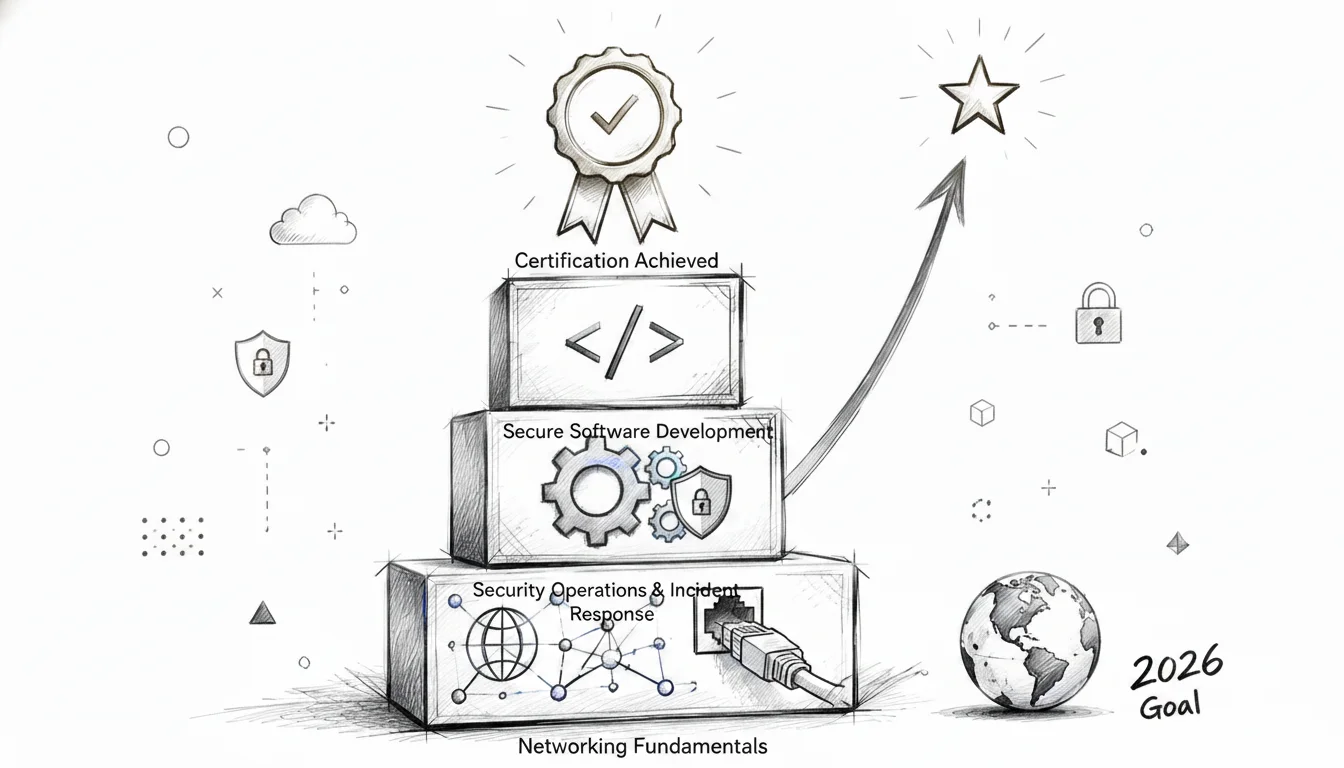
Cyber Security Prerequisite: Essential Skills for 2026
Cyber Security Prerequisites: Essential Skills for a Strong Career Foundation
You've likely seen the common advice: "Get Security+. Learn Linux. Build a home lab. Maybe get a degree, maybe not. Learn Python. Apply anyway." This can quickly become confusing. Cybersecurity attracts people from diverse backgrounds—help desk, networking, software, military, audit, compliance, and completely unrelated fields. The challenge isn't a lack of motivation, but rather that most advice treats every requirement as one big checklist.
It isn't.
A true cyber security prerequisite isn't just something listed in a course outline or job description. It's a capability that grants access to the next layer of work. If you can read packets in Wireshark, you'll understand what a firewall is blocking. If you can script in Python or PowerShell, you can automate repetitive investigation tasks. When you explain risk clearly, a manager will trust you with more responsibility.
This article views prerequisites through that lens. Instead of asking, "What boxes should I tick?", we'll ask, "What skills will change what I can actually do on the job?"
Starting Your Cybersecurity Career
Motivated career changers often start in a similar place. One browser tab shows job listings. Another has certification roadmaps. A third features someone on social media claiming degrees don't matter, while a fourth states you won't pass screening without one. It feels less like a profession and more like a maze.
A better way to approach cybersecurity is to see it as a layered trade. You're not aiming to master "cyber" all at once. Instead, you build a stack of abilities that make you employable in stages. First, understand how systems and networks function. Next, learn how attackers exploit them. Then, study how defenders detect, harden, and respond. Finally, learn how to communicate these findings in a business context.
What most beginners miss
Many beginners chase visible achievements: a badge, a course completion, or a long list of tools on a resume. Hiring teams usually care more about whether you understand the moving parts behind the tools.
A SIEM dashboard means little if you can't explain what generated the logs. A vulnerability scanner report offers limited insight if you don't understand the operating system, service, or port associated with the finding.
A strong start in cybersecurity involves building a mental model of how computers, users, and networks interact under stress, rather than simply collecting badges.
For a broad orientation before choosing a specialty, this essential guide for cybersecurity professionals provides a useful overview of common entry paths and role types.
A better starting question
Don't ask, "What's the fastest way in?"
Instead, ask, "What foundation will allow me to keep growing after I get in?"
This question directs you toward durable skills rather than temporary exam cramming.
Debunking Cybersecurity Prerequisite Myths
Believing that completion equals competence is the most expensive mistake in cybersecurity learning.
Someone finishes annual awareness training and assumes they're safer. Someone passes a quiz and assumes readiness. Someone updates a resume with "trained in phishing prevention" and expects that to translate into good judgment under pressure. It often doesn't.
Why checklist learning fails
Research from the University of Chicago found that employees who had just completed annual training performed no better in simulated phishing attacks than those who hadn't received training for over a year. This contradicts the idea that "recent certification" equals "current competency" (University of Chicago research summary).
This finding extends beyond phishing. It highlights a broader issue in how people view prerequisites. A checklist item can prove exposure, but it doesn't prove retention, skill transfer, or effective decision-making.
If you've ever seen someone pass a multiple-choice exam and then freeze during a live troubleshooting task, you've witnessed this difference firsthand.
What true readiness looks like
A practical cybersecurity learner can typically do a few things that checklist learners find challenging:
- Trace cause and effect: They can explain why a misconfiguration creates risk, not just name the control.
- Work from evidence: They examine logs, packets, headers, permissions, and process behavior instead of guessing.
- Generalize a concept: They can apply the same principle in a slightly different environment.
- Stay functional under ambiguity: They don't need a lab to look identical to the training example.
Practical rule: If your learning method only helps you recognize the right answer when it's already in front of you, it's not enough for security work.
The myth of the finished prerequisite
People often discuss a cyber security prerequisite as if it's a one-time completion. This is a misunderstanding. Most prerequisites in this field are living skills.
Networking knowledge fades if you never troubleshoot. Scripting ability weakens if you never automate anything. Incident response judgment improves only when you repeatedly examine suspicious activity and decide what matters.
So, when you evaluate a course, bootcamp, or study plan, use a simple filter:
- Does it force recall, not just recognition?
- Does it include hands-on practice?
- Does it revisit weak areas over time?
- Does it connect theory to a task you'd perform at work?
If the answer is mostly no, you're probably buying reassurance instead of genuine capability.
The Unskippable Technical Foundation
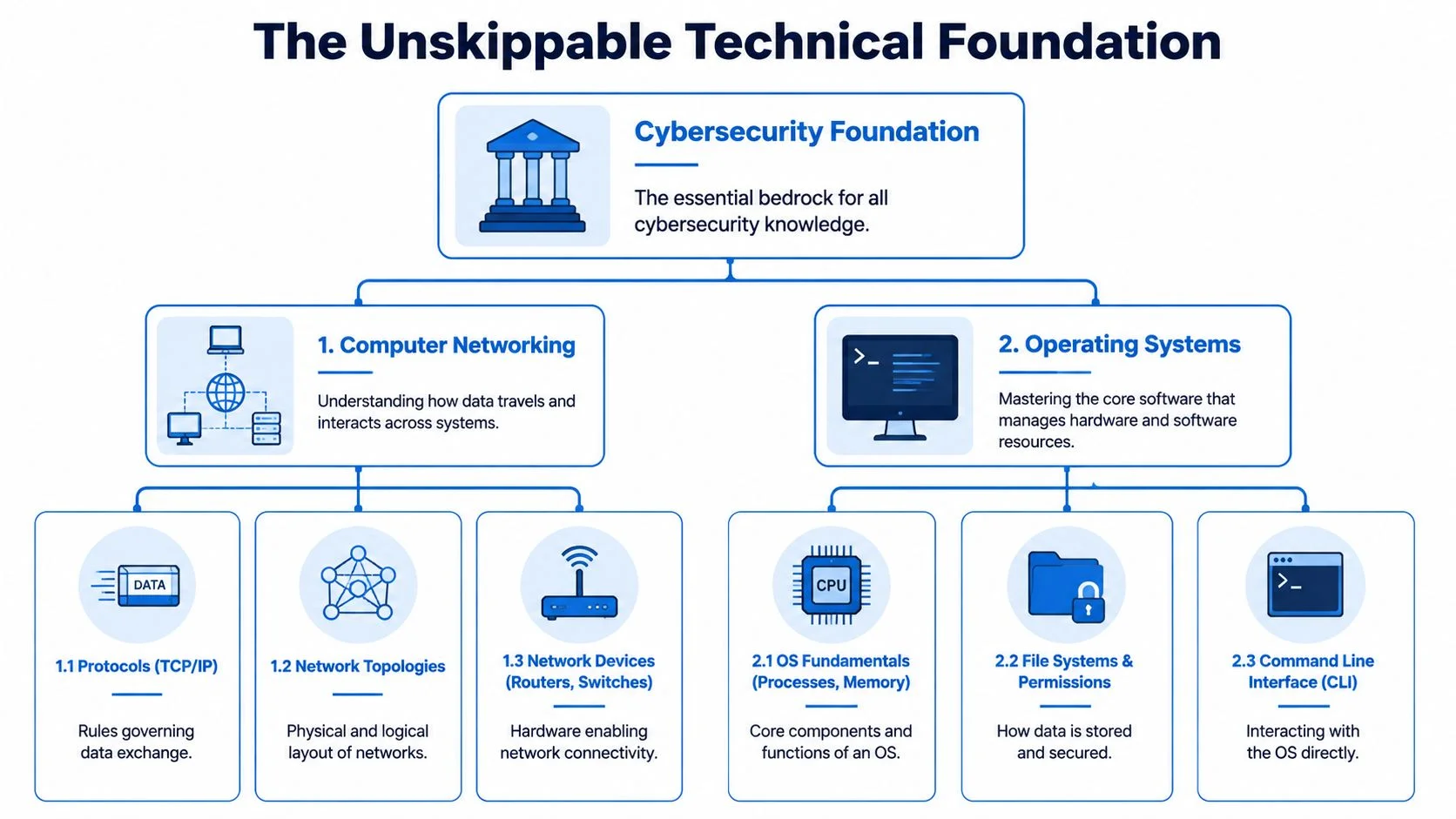
You can't secure a house if you don't understand its doors, windows, locks, wiring, and floor plan. Cybersecurity works the same way. Before you discuss threat hunting, cloud posture, malware analysis, or zero trust, you need to understand how systems communicate and how operating systems behave.
This foundation begins with networking and operating systems.
Why networking comes first
Expert analysis indicates that a failure to master networking fundamentals directly correlates to 60% of security incident vulnerabilities, as attackers exploit misconfigured firewalls, DNS, and unencrypted HTTP data streams.
This is why beginners who jump straight into "ethical hacking" often hit a wall. If you don't understand TCP/IP, DNS, ports, sessions, and routing behavior, many security alerts will seem like random noise.
A few examples make this concrete:
- Firewall troubleshooting: You can't judge whether a rule is too broad or too narrow if you don't know what traffic should flow.
- DNS abuse: You won't spot suspicious name resolution behavior if DNS remains a black box to you.
- Packet inspection: Wireshark becomes useful only when you can interpret what "normal" traffic looks like.
What to learn in networking
Start with the components that frequently appear in security work:
- Protocols: Learn what TCP, UDP, DNS, HTTP, and TLS do in plain language.
- Traffic flow: Understand how a request moves from one host to another and where it can fail.
- Segmentation: Learn why VLANs, subnets, and firewall rules limit lateral movement.
- Observation tools: Get comfortable with Wireshark and Nmap as learning tools, not just security tools.
If networking is still shaky, you can accelerate your CCNA career with this guide to build the kind of foundation that makes later security training click.
When beginners say, "I'm bad at cybersecurity," what they often mean is, "I never became fluent in the systems underneath it."
Why operating systems matter just as much
Attackers don't compromise abstractions. They abuse real machines with real users, processes, permissions, services, and logs.
This is why Linux and Windows administration belong on your prerequisite list, even if your goal is blue team, cloud security, governance, or penetration testing.
Focus on these habits:
- Read the file system and permissions model. You need to know who can access what, and why.
- Use the command line. Many investigations move faster in a terminal than in a graphical interface.
- Follow processes and services. Security alerts often tie back to something running where it shouldn't.
- Inspect logs with intent. Don't just open a log. Ask what question the log can answer.
A simple skill test
You're building a real foundation when you can do things like these without copying a walkthrough word for word:
| Task | What it proves |
|---|---|
| Explain how a browser reaches a website | You understand layered communication |
| Spot unusual open ports with Nmap | You can compare expected vs unexpected exposure |
| Use Wireshark to inspect a connection | You can observe behavior, not just read theory |
| Review file permissions on Linux or Windows | You understand access control in practice |
The strongest entry-level candidates rarely know everything. They usually know the basics well enough to investigate.
Level Up with Code: The Automation Prerequisite
Programming intimidates many aspiring defenders because they envision software engineering interviews, whiteboard algorithms, and complex application design. That's not the standard for most cybersecurity roles.
However, scripting is no longer optional if you want to work efficiently.
Technical data shows that 70% of modern cyberattacks involve automated scripts, making proficiency in languages like Python and PowerShell essential for creating custom tools for defense, penetration testing, and incident response.
What "coding for cybersecurity" actually means
In security, code often serves as a lever. It helps you do repetitive work faster, inspect more data, and respond more consistently.
You might write a Python script to hash files for integrity checks. You might use PowerShell to query Windows event logs for suspicious activity. You might modify a small script to clean up output from a scanner so you can focus on the systems that matter.
That's a different goal from building a consumer app. You're learning enough programming to automate security thinking.
Why non-coders should still learn it
Without scripting, many security tasks remain small and manual, which limits your value.
A non-coder can check ten log entries by hand. A security professional with scripting literacy can search patterns across a much larger dataset, isolate anomalies, and package the output for a teammate or manager.
Here's where automation changes your career trajectory:
- Incident response: Faster parsing of logs and artifacts.
- Security operations: Quicker triage of repetitive alerts.
- Cloud security: Policy checks and tagging tasks become repeatable.
- Penetration testing: Tool customization becomes possible.
- DevSecOps: Security starts fitting into delivery pipelines instead of slowing them down.
For learners moving toward cloud automation and modern engineering-heavy roles, these DevOps Professional certification materials show how automation and security increasingly intersect.
What to study first
Don't start with advanced computer science theory unless you already enjoy it. Begin with tasks that feel obviously useful.
A strong beginner sequence looks like this:
- Python basics: Variables, loops, functions, reading files, handling simple data.
- PowerShell basics: Querying Windows information, reading logs, filtering output.
- Security-flavored tasks: Hashing files, parsing logs, simple API calls, checking config data.
- Reading other people's scripts: You'll spend plenty of time modifying existing tools, not writing from scratch.
The goal isn't to become "a coder." The goal is to stop being blocked by code.
That shift matters in hiring. Teams trust people who can bridge tools, logs, and automation because those people reduce friction.
Decoding Your Career Path: Certs, Education, and Experience
Many newcomers ask the wrong question: degree or certification?
Hiring isn't that neat. Employers screen for a mix of formal validation, hands-on proof, and a signal of readiness. You need to understand how these pieces interact.
A 2024 analysis of 15,000 job postings shows that 43% of entry-level cybersecurity roles require a bachelor's degree, while 28% mandate specific certifications like CompTIA Security+, making formal validation a key prerequisite for 71% of new roles.
This doesn't mean every employer values degrees and certifications equally. It means many employers use them as filters before they ever evaluate your deeper potential.
How to think about the three pillars
The practical model is simple.
Education helps you get through structured screening. Certifications show focused commitment and standard vocabulary. Experience proves you can do the work.
If you're missing one pillar, the other two need to be stronger.
When a degree matters most
A degree often matters in larger organizations, regulated industries, and formal HR pipelines. It can also matter when you want long-term access to leadership tracks, management roles, or international hiring filters.
If you already have a bachelor's degree in any field, don't dismiss it. Many hiring managers care less about the title of the major than people assume, especially if you can pair that degree with technical labs, projects, and a clear learning story.
If you don't have a degree, it doesn't end the conversation. It simply means your certifications, portfolio, and practical examples need to carry more weight.
What certifications do well
Certifications are useful when they accomplish three things:
- Standardize your baseline: They show you've covered core concepts.
- Translate your skills to recruiters: HR teams may not know your home lab is impressive, but they recognize common cert names.
- Create a short-listing signal: They help you survive resume filters.
Historical data from GIAC and CompTIA indicates that candidates holding CompTIA Security+ experience a median salary premium of $15,000 annually compared to non-certified peers. The same verified data notes that hiring managers place strong emphasis on practical experience and hands-on labs for technical roles. That combination is the key point: certification opens doors best when it sits on top of real practice.
If Security+ is on your shortlist, Mindmesh Academy's Security+ exam resources can help structure the foundational material you're expected to know.
For a broader view of how employers interpret credentials, this roundup of certifications for cybersecurity roles is helpful because it frames certs in relation to job outcomes rather than as trophies.
The certification path in plain language
Not every learner needs the same sequence. A support technician moving into SOC work starts differently from a software engineer shifting into cloud security.
| Certification | Level | Key Prerequisites | Target Roles | Mindmesh Academy Path |
|---|---|---|---|---|
| CompTIA Security+ | Foundational | Basic networking, operating system familiarity, security vocabulary | SOC analyst, junior security analyst, support-to-security transition | Start with core security concepts and exam-focused review |
| CompTIA Network+ or CCNA | Foundational to intermediate | Comfort with protocols, addressing, switching, routing basics | Network security, infrastructure security, SOC, support escalation | Build networking fluency before deeper defensive work |
| AWS Security Specialty (SCS-C03) | Intermediate | Cloud basics, IAM concepts, logging, security controls, scripting helps | Cloud security analyst, cloud engineer with security scope | Pair cloud fundamentals with hands-on policy and monitoring practice |
| CISSP | Advanced | Broad security experience across domains, governance and architecture maturity | Security manager, architect, senior analyst, consultant | Use after practical experience has widened across domains |
What experience actually counts
Beginners often say, "I can't get experience because no one will hire me." That's too narrow a definition of experience.
Hiring teams usually respond well when you can show work such as:
- Home labs: Windows and Linux systems, user management, logging, firewall rules, segmentation experiments.
- Guided projects: Packet analysis, incident write-ups, vulnerability triage, basic detections.
- Current-job crossover: Helping with patching, identity controls, audit prep, or endpoint management in your existing role.
- Documentation: Clear notes on what you built, what failed, and what you learned.
Experience counts most when you can explain it calmly and specifically.
If you can describe a lab the way an analyst describes an incident, employers start seeing you as a practitioner, not just a student.
The Human Element: Essential Soft Skills
Cybersecurity attracts people who enjoy technical depth, and that's a strength. But technical depth alone doesn't carry a career very far. At some point, every security problem becomes a people problem.
An analyst has to explain why an alert matters. An engineer has to persuade another team to change a risky process. A responder has to stay calm while information is incomplete and leaders want answers immediately.
Communication is a security skill
If you find a serious issue and can't explain it clearly, the organization may still remain exposed.
Strong security communication means adjusting the message to the audience. A peer may want packet detail, process trees, or log evidence. A director may need the business risk, affected systems, likely impact, and recommended next step in plain language.
Practice these habits:
- Write short incident summaries: State what happened, what you know, what you don't know, and what should happen next.
- Translate jargon: Replace tool-heavy language with effect and consequence.
- Show evidence cleanly: Screenshots, log snippets, and timelines matter more when they're organized.
Curiosity beats passive knowledge
The best defenders are curious in a disciplined way. They notice small mismatches. A process name looks odd. A login pattern feels off. A DNS request doesn't match the normal behavior of that host.
That kind of curiosity isn't random. It's trained attention.
You can build it by asking better questions during labs and daily work:
- Why is this service running?
- What "normal" behavior should I expect here?
- If this alert is real, what evidence would support it?
- If it's benign, what would explain it?
Composure and collaboration
Security work often involves uncertainty. You won't always know the answer immediately. Good professionals don't pretend otherwise. They stay methodical.
They also collaborate well. Security rarely fixes anything alone. You'll work with system administrators, cloud teams, developers, managers, auditors, and end users. The people who earn trust are usually the ones who can be precise without being difficult.
Good security people aren't just technical. They're dependable under pressure.
That trait gets remembered. It's often what separates a solid analyst from someone who gets pulled into larger projects, lead responsibilities, and eventually leadership roles.
Your High-Impact Cybersecurity Learning Plan
Most learners don't fail because they picked the wrong certification. They stall because their study method doesn't match the kind of work cybersecurity demands.
A 2024 NIST-backed analysis highlights a significant pedagogical gap where technical teaching underemphasizes platform, cloud, and AI-enabled security contexts. This means many aspirants meet prerequisites but remain ill-equipped for high-risk, evolving threats (NIST-backed analysis discussion).
That's why your learning plan should focus on transfer. You need knowledge that survives outside the course interface and still helps when the environment changes.

Build your plan in layers
A high-impact plan is usually more effective when it follows a sequence like this:
- Layer one: Networking and operating systems until you can investigate basic behavior without guessing.
- Layer two: Security fundamentals such as access control, common attacks, logging, and defensive concepts.
- Layer three: Scripting for repetitive tasks, log handling, and lightweight automation.
- Layer four: One specialization path, such as SOC, cloud security, IAM, vulnerability management, or GRC.
- Layer five: Communication and documentation practice tied to everything above.
This structure helps because each layer supports the next one. You won't understand cloud identity controls well if IAM is your first exposure to access management. You won't understand detections well if logs remain mysterious.
Study for retention, not just exam recall
The University of Chicago finding discussed earlier points to a larger lesson. Exposure isn't enough. You need a system that helps you remember and apply.
A stronger study routine usually includes:
- Active recall: Close the notes and explain the concept from memory.
- Spaced review: Return to weak topics over time instead of cramming once.
- Hands-on repetition: Repeat the same task in slightly different environments.
- Error tracking: Keep a record of what you keep getting wrong.
- Context shifts: Practice the same concept in networking, endpoint, and cloud examples.
Career advice: If your study plan doesn't tell you what to revisit next week, it probably won't create durable skill.
Aim your learning at real gaps
Many generic prerequisite lists still overfocus on awareness-level content. Employers often need people who can handle concrete operational work: cloud permissions, web application behavior, incident handling, and platform-specific risk.
This means your cyber security prerequisite plan should include scenario-based practice, not just definitions. If you're learning IAM, apply it in a cloud console or lab. If you're learning web security, inspect requests and responses. If you're learning security operations, review alerts and write a short triage summary.
A quick demonstration can help make that mindset feel more practical:
A weekly rhythm that works
You don't need perfect conditions. You need consistency.
Try a rhythm like this:
| Day | Focus |
|---|---|
| One study block | Learn one core concept deeply |
| One lab block | Apply that concept in a guided exercise |
| One review block | Recall from memory and revisit mistakes |
| One writing block | Summarize what you learned in plain language |
That cycle turns learning into evidence. Over time, you're not just "studying cyber." You're becoming the kind of person who can learn, test, explain, and improve.
Ready to put your learning to the test? Build a strong foundation for the CompTIA Security+ exam with our CompTIA Security+ practice exam. It's designed for IT professionals who want to master certification material and keep it usable on the job.

Written by
Alvin Varughese
Founder, MindMesh Academy
Alvin Varughese is the founder of MindMesh Academy and an enterprise architecture leader. An electrical engineer by training, he moved from factory automation in South Africa to cloud architecture at GE Appliances and Humana (Fortune 50), and holds 20 professional certifications including AWS Solutions Architect Professional, Azure DevOps Engineer Expert, and Microsoft Agentic AI Business Solutions Architect. He built MindMesh Academy after interviewing too many highly certified candidates who couldn't answer basic questions: the goal is prep that makes you better at the job, not just able to pass the exam.