Computer Security Skills: Master Your Career Path
Computer Security Skills: Master Your Career Path
The number that reshapes how we think about computer security skills is 4.8 million unfilled cybersecurity jobs projected globally in 2026, according to SentinelOne's summary of ISC2 workforce data. This isn't a niche hiring problem. It's a clear signal that organizations desperately need people who can protect systems, investigate incidents, and explain risk clearly enough that action is taken.
This last point is often overlooked.
Many starting out in security focus solely on tools, commands, and technical certifications. These are important, but in real security work, technical knowledge only becomes valuable when you can frame a problem, choose the right response, and explain what's happening to people who don't speak security jargon. A junior analyst who can spot a suspicious event is helpful. A professional who can explain its business impact, coordinate a response, and document what happened is far more valuable.
That's the mindset to build from day one. Learn the technology thoroughly. But also learn to think, write, and speak like someone trusted with real risk.
Why Computer Security Skills Are in High Demand
Such a significant shortage affects hiring behavior. As we discussed, the global gap between open cybersecurity roles and available talent remains wide. This, combined with strong projected job growth for security analysts, sends a clear message: organizations need more people who can protect systems, investigate incidents, and explain risk effectively so businesses can respond.
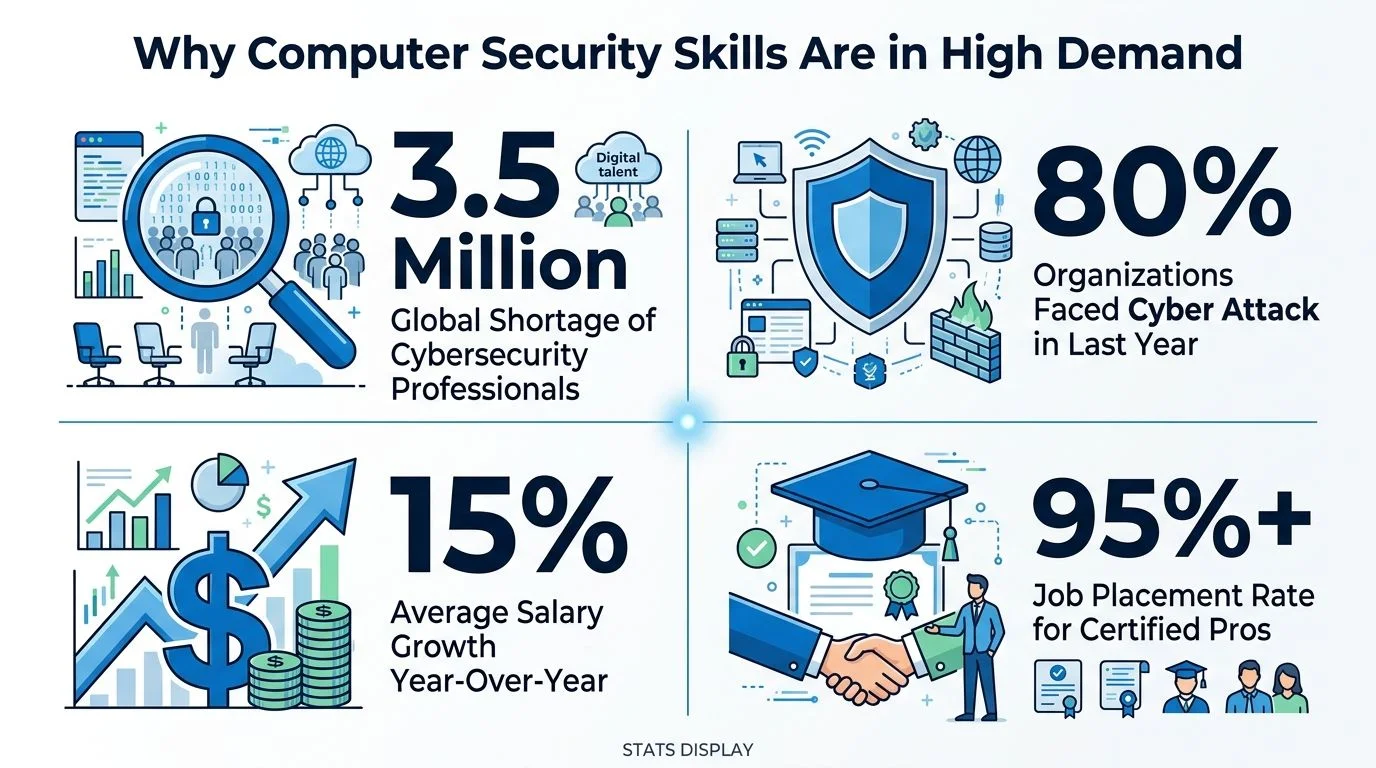
The underlying reason is straightforward. Modern companies rely on identity systems, cloud platforms, laptops, mobile devices, third-party applications, and continuous data movement. Security work exists at every potential breaking point in that chain. If one weak link fails, the problem is rarely purely technical. Someone must define what happened, assess the risk, coordinate the response, and communicate clearly with IT staff, managers, legal teams, or customers.
This communication aspect is often underestimated.
A firewall rule, suspicious login, or exposed storage bucket carries different meanings for different audiences. A security professional who can accurately frame the issue helps the organization act faster and make better decisions. In practice, problem-framing and communication become core job functions, not optional extras added after the technical work.
Why demand stays strong
Demand for security remains strong because every other area of technology generates more security work. New SaaS tools raise identity and access questions. Remote work brings endpoint and monitoring challenges. Cloud adoption introduces configuration and visibility issues. Regulatory pressure requires more documentation and governance.
Think of security as building maintenance for a busy hospital. The value isn't just in having a wrench. It's knowing which pipe matters, how a failure spreads, who needs to know first, and how to fix the issue without disrupting patient care. Security teams apply this same prioritization under pressure.
This explains why employers hire for several types of work:
- Operations roles review alerts, investigate suspicious behavior, and support incident handling.
- Engineering roles improve system hardening, logging, detection coverage, and automation.
- Governance roles turn legal, audit, and risk requirements into practical controls and policies.
- Leadership roles set priorities, allocate resources, and help teams decide what needs attention first.
If you want practical context for how these responsibilities show up at work, TekRecruiter's guide on securing your tech workplace is a useful companion read.
Practical rule: Study security as a response to real business risk. Tools make more sense once you know what problem they are helping solve.
Why this is a good career bet
Security offers a strong long-term career path because organizations require both coverage and continuity. They need new hires, but also professionals who can keep security programs running as teams evolve.
For those learning, this has a key implication. Employers aren't just looking for someone who can recite terms from a certification guide. They want professionals who can connect technical details to operational consequences. If you can explain why a misconfiguration matters, document your findings, and recommend a sensible next step, you become useful much faster.
Certifications still help. They give structure, vocabulary, and a hiring signal. If you are planning to prepare for your Security+ exam, use it as a framework for understanding systems, threats, and response decisions, not as a memorization sprint.
This approach outlasts any single tool.
The Four Pillars of Computer Security Skills
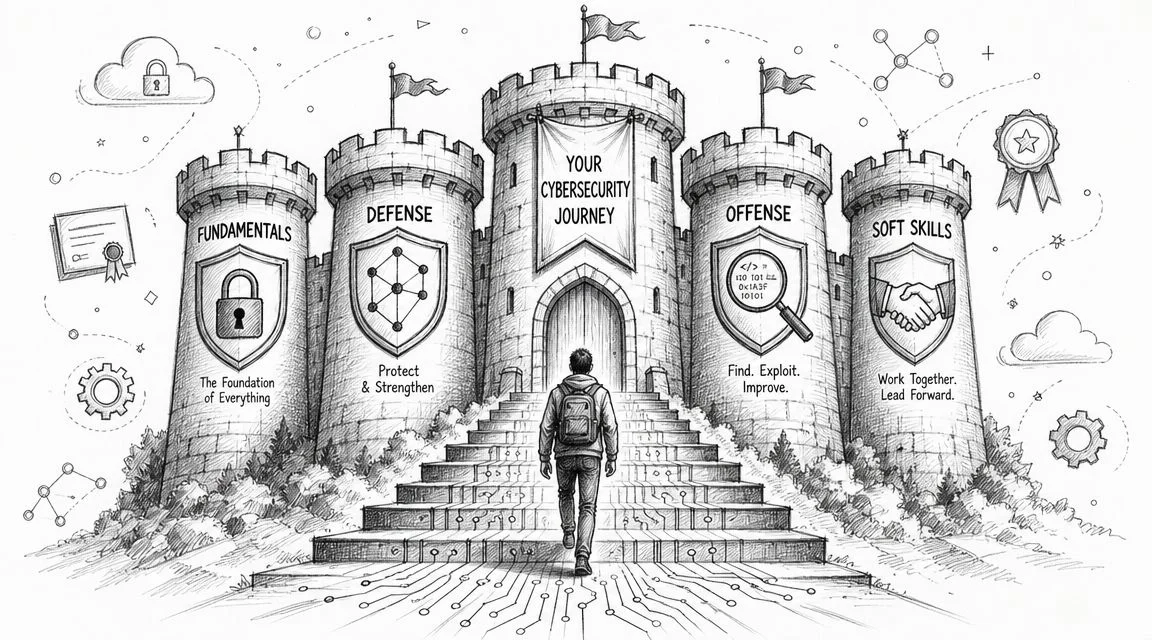
To understand computer security skills better, stop treating them as one giant checklist. A more effective model is a fortress.
A strong fortress requires a foundation, walls, scouts who understand attack paths, and people to govern the entire operation. Security work follows this same pattern. By organizing your learning into these pillars, the field becomes less chaotic.
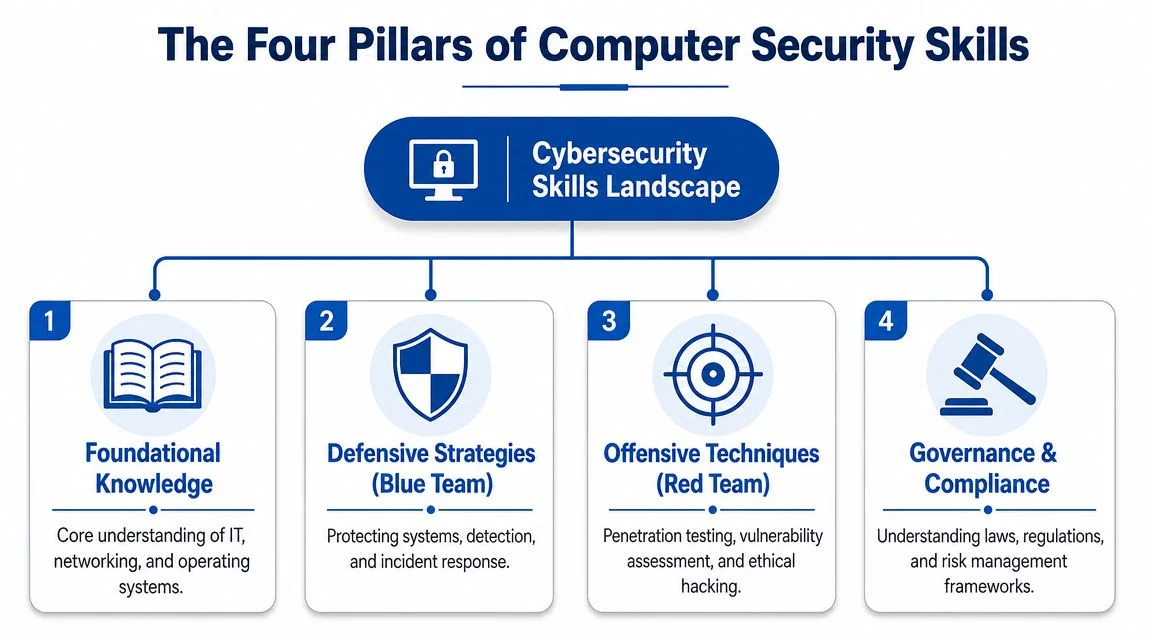
NEIT reports that businesses face an average of 1,248 cyberattacks every week. Employers seek a broad mix of competencies, including coding, incident response, cloud security, and cybersecurity laws, as highlighted in their overview of high-demand cybersecurity skills. This broad need explains why narrow learning plans quickly become insufficient.
Foundational knowledge
This is the basis for everything else. Without understanding operating systems, networking, identity, and how applications communicate, security tools will seem like magic boxes.
Focus on these core concepts:
- Operating systems: Learn how Windows and Linux handle users, permissions, processes, logs, and services.
- Networking basics: Understand packets, ports, protocols, segmentation, and what “normal” traffic looks like.
- Authentication and access: Study accounts, roles, privilege, and why identity failures cause so many downstream issues.
Beginners often ask, “When do I start learning security?” The honest answer is that you're already learning security by understanding how a system is supposed to work.
Defensive strategies
This pillar covers protection, visibility, and response. Think of it as the fortress walls and the guards patrolling them.
Defensive skills encompass monitoring, triage, incident handling, hardening, and alert investigation. It's not just about blocking threats; it's about building enough visibility to detect unusual activity.
Offensive techniques
Offensive learning refines defensive judgment. Studying vulnerability assessment or penetration testing reveals how weak points are discovered and exploited.
This doesn't mean everyone needs to become a red teamer. It does mean you should understand attacker thinking well enough to ask better questions: What can be reached? What can be misconfigured? How can access be escalated?
Knowing how a lock fails helps you choose a better lock and install it correctly.
Governance and professional execution
A fortress also needs rules, priorities, and coordination. In security, this translates to policies, frameworks, laws, risk decisions, and communication.
This pillar is where many learners underinvest. Yet it's the reason technical work gets approved, funded, and adopted. If you're building your first roadmap, a strong way to connect foundational concepts with broad exam coverage is to prepare for your Security+ exam while mapping each topic to one of these pillars.
Defensive and Offensive Security Skills in Practice
The clearest way to understand security work is to observe defense and offense interact.
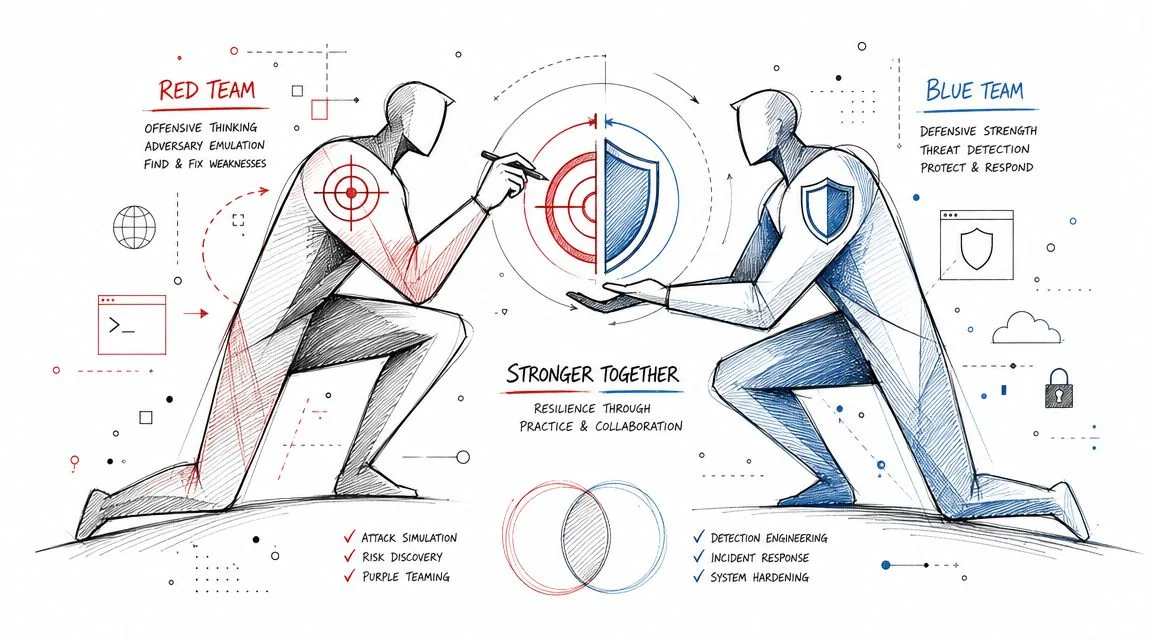
A red teamer asks, “How could someone get in, move around, or abuse trust?” A blue teamer asks, “How would we notice, stop, and investigate that?” The strongest practitioners learn from both questions.
What blue team work looks like
Imagine a security analyst observing unusual authentication activity in a SIEM. That's not the job's conclusion; it's the beginning of a decision chain.
The analyst must determine if the pattern represents normal admin behavior, a misconfigured service, or the start of account compromise. This usually involves pulling logs, comparing timestamps, checking host activity, and deciding whether to escalate.
Coursera's guide to cybersecurity analyst skills highlights that analysts use scripting to automate repetitive tasks, parse logs, test APIs, and work with SIEM, IDS, and IPS platforms. They identify suspicious activity, then connect alerts to forensics and malware analysis for incident resolution.
A practical blue team toolkit typically includes:
- Log analysis: Reviewing authentication, endpoint, and application events to separate noise from real signals.
- Detection thinking: Writing or tuning rules so the team catches meaningful behavior instead of drowning in alerts.
- Incident response: Containing affected systems, preserving evidence, and documenting what happened.
- Automation: Using Python, PowerShell, or Bash to speed up repetitive checks and reduce human error.
What red team work adds
Now consider the offensive perspective. A red teamer or penetration tester examines the same environment for weak points before a real attacker can find them. They might review exposed services, weak authentication patterns, inadequate segmentation, or vulnerable applications.
This process teaches defenders a crucial lesson. Attack paths rarely depend on a single dramatic failure. More often, they exploit small gaps connected in sequence: a reused credential here, a permissive role there, a monitoring blind spot somewhere else.
Field note: Security failures often come from combinations, not single mistakes.
If your work touches modern cloud apps and software vendors, this guide to SaaS security for SMBs is a useful example of how security testing thinking applies outside traditional on-premise environments.
Why both perspectives matter
A defender who understands offensive methods writes stronger detections. An offensive practitioner who understands operations produces actionable findings for teams. This is why effective security teams don't treat red and blue as rivals; they treat them as feedback loops.
For a quick visual explanation of that relationship, this short video is a good complement to the concepts above.
A mature skill set develops when you can perform three things in sequence: identify likely attack paths, detect meaningful signs of compromise, and explain the response clearly enough for others to assist.
The Professional Skills That Set You Apart
The most underrated computer security skills aren't optional extras. They are what make technical work actionable.
A peer-reviewed study of cybersecurity workforce skills argues that effective practitioners require technical skills, domain knowledge, and social skills, including the ability to explain vulnerabilities to non-experts and influence user behavior, as discussed in this research review on cybersecurity competencies. This means communication isn't a polish layer added later; it's an intrinsic part of the job.
Problem framing is security work
A junior practitioner often identifies a technical issue and reports the technical details. A more effective practitioner frames the problem in a way their audience can act on.
Compare these examples:
- “There is a privilege escalation risk in this workflow.”
- “A user with limited access may be able to gain broader permissions through this workflow, which changes who can reach sensitive data and who needs to fix it.”
Same issue, better framing.
Security teams constantly translate between groups with different priorities. Engineers care about implementation. Managers care about risk and timing. Executives care about operational impact. Users care about whether they can still do their jobs.
Communication changes outcomes
Effective report writing aids in correct incident triage. Clear meeting communication helps developers fix issues without becoming defensive. Strong executive summaries help leaders approve changes before a problem escalates into an outage or breach.
These are core professional competencies because:
- Writing clearly: Incident notes, remediation guidance, and handoff summaries require precision without unnecessary jargon.
- Speaking to varied audiences: You should be able to explain the same risk to an analyst, an engineering manager, and a finance leader.
- Asking effective questions: Many incidents begin with partial information. Strong practitioners narrow uncertainty rather than reacting to every alert identically.
- Collaborating under pressure: Security work often occurs when other teams are already frustrated. Tone matters significantly.
The best security advice is specific, calm, and actionable.
What this looks like on the job
Imagine discovering a risky misconfiguration. Purely technical thinking might suggest, “Document it and move on.” Professional security thinking, however, prompts a better set of questions.
- Who owns this system?
- What business process depends on it?
- What's the most realistic failure mode?
- What evidence do I need before I escalate?
- What is the clearest next step for the receiving team?
Those questions don't dilute technical rigor. They turn technical rigor into workplace effectiveness. If you want to stand out, don't just learn how to find issues. Learn how to move an organization from awareness to action.
Mapping Skills to Security Roles and Certifications
Skills are easier to develop when you can see where they lead. Most individuals don't need “all of cybersecurity.” They need a plausible first role, a shortlist of supporting certifications, and a way to determine if they enjoy the work.
The U.S. Bureau of Labor Statistics reports that information security analysts earned a median annual wage of $124,910 in May 2024 and projects 29% job growth from 2024 to 2034 in its occupational outlook for information security analysts. This doesn't mean every role is identical, but rather that the field rewards focused skill development.
How to read the map
Treat job titles as clusters, not rigid boxes. Two companies may use the same title for different work. One “security analyst” may spend most of the day in a SIEM. Another may do more vulnerability management and coordination.
Use the table below as a directional guide.
| Job Role | Primary Skill Focus | Common Certifications |
|---|---|---|
| Security Analyst | Monitoring, triage, incident response, log analysis, basic scripting | Security+, CySA+ |
| Penetration Tester | Vulnerability assessment, web testing, attacker mindset, reporting | Security+, CEH |
| Cloud Security Engineer | Identity, cloud configuration, logging, access controls, automation | Security+, CISSP, cloud security credentials |
| Security Architect | Secure design, risk tradeoffs, control selection, governance | CISSP |
| GRC Analyst | Policy, compliance, risk communication, documentation | Security+, CISSP |
| Incident Responder | Forensics coordination, containment, evidence handling, communication | Security+, CySA+, CISSP |
Choosing a role without overcommitting
If you enjoy pattern recognition, alert triage, and operational tempo, analyst work may fit. If you like thinking adversarially and writing findings, offensive paths may fit better. If you naturally translate between business and technical teams, GRC or architecture may suit you more than a pure operations track.
A useful next step is to compare your current skills against role expectations, then use structured study resources for IT professionals to close the most obvious gaps.
Career heuristic: Pick a role by preferred daily work, not by title prestige.
Certifications help validate direction, but they work best when paired with labs, portfolio notes, and examples of how you think through a problem.
Designing Your Computer Security Learning Path
Individuals often don't fail because security is inherently difficult. They fail because their learning path is too vague.
An effective learning path has four key traits: it starts from your current background, builds foundations before specialization, includes hands-on practice, and uses review methods that help knowledge stick and become usable under pressure.
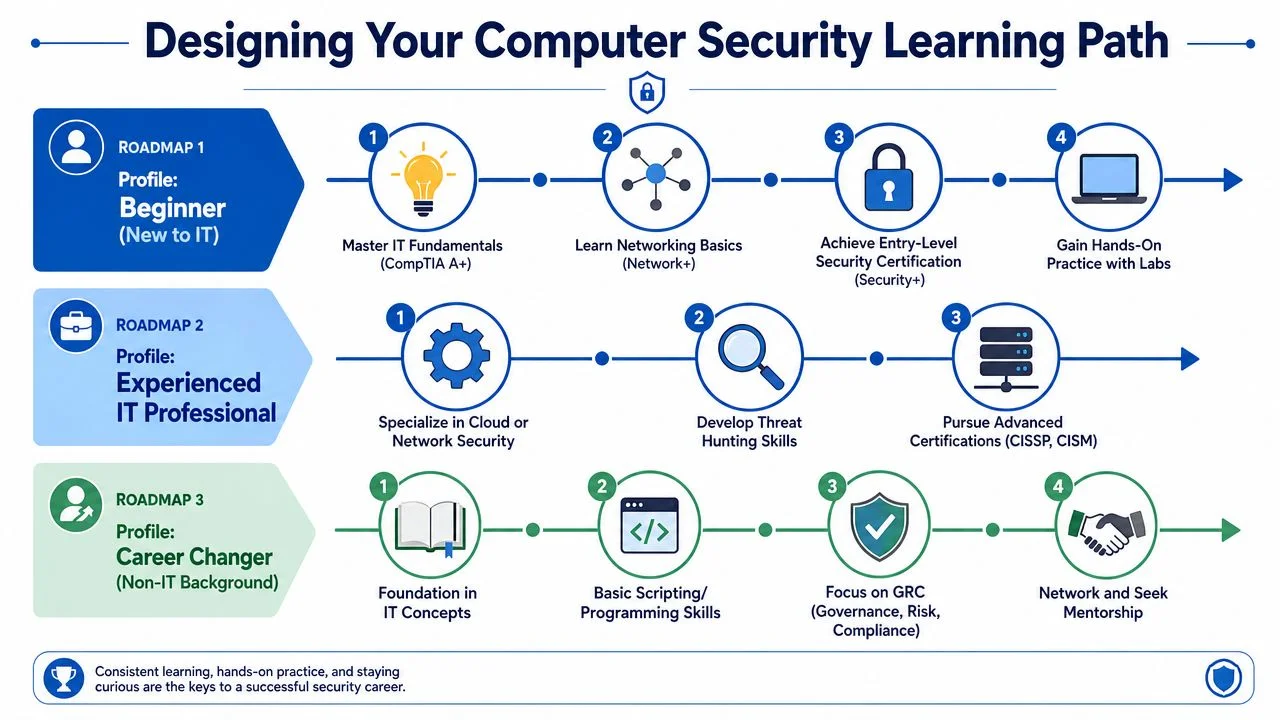
Path for beginners new to IT
If you're starting from scratch, don't rush into advanced security content. Learn how computers, operating systems, and networks behave first. Otherwise, every security topic will feel abstract.
A solid beginner sequence includes:
- Learn IT basics through hardware, operating systems, file systems, users, permissions, and troubleshooting.
- Study networking fundamentals until you can explain normal traffic, common protocols, and segmentation in plain language.
- Add entry-level security concepts such as risk, identity, access control, hardening, logging, and incident basics.
- Build a simple home lab using virtual machines so you can practice safely.
Useful projects at this stage include documenting Windows and Linux differences, analyzing sample logs, writing a short incident summary, and practicing basic PowerShell or Python automation.
Path for experienced IT professionals
If you already work in help desk, systems administration, networking, or cloud operations, use that advantage. You don't need to relearn everything. You need to reinterpret what you already know through a security lens.
Focus on these areas:
- Hardening decisions: Understanding why a default configuration may be risky.
- Detection visibility: Knowing what logs exist, what's missing, and how alerts are generated.
- Identity and privilege: Identifying where access expands beyond a role's needs.
- Automation: Turning recurring administration tasks into repeatable security checks.
This is also where structured study platforms can help. MindMesh Academy, for example, offers certification prep that uses spaced repetition and progress tracking, which fits well when you're balancing job experience with targeted exam study.
Path for advanced specialists
Once you have broad experience, your next leap comes from specialization combined with refined judgment. This may involve cloud security, architecture, DFIR, GRC, or leadership-oriented roles.
At this level, don't just accumulate topics. Build artifacts that demonstrate depth:
- Architecture reviews that explain tradeoffs and recommended controls
- Incident retrospectives that connect evidence, timeline, and lessons learned
- Detection engineering notes showing how you tuned noisy alerts
- Executive-facing summaries that translate technical exposure into business risk
For experienced professionals moving toward senior responsibilities, MindMesh Academy's CISSP resources can support a broader view of governance, architecture, and risk.
Progress speeds up when every study block answers one question: what can I now explain, do, or document better than last month?
How to make the learning stick
Regardless of your experience level, apply this cycle:
- Study a concept
- Practice it in a lab
- Explain it in writing
- Review it later
That loop matters because recognition isn't mastery. If you can only identify a term on a flashcard, you're not ready. If you can explain it, apply it, and connect it to a real task, you're getting somewhere.
Frequently Asked Questions About Building Security Skills
Do I need a degree to develop computer security skills?
Not always. What employers need is evidence that you can understand systems, solve problems, and communicate clearly. Degrees can help, but so can certifications, labs, projects, and related IT experience.
Which programming language should I learn first?
Pick one that helps you automate and inspect systems. Python, PowerShell, or Bash are all practical starting points depending on your environment. The goal isn't to become a full-time developer first. It's to make repetitive security work faster and more reliable.
Can I start in cybersecurity without prior security experience?
Yes, but it's often easier through adjacent roles. Help desk, system administration, networking, and cloud support all teach you how real environments behave. That knowledge carries directly into security work.
Should I choose blue team or red team first?
Start where your curiosity is strongest, but learn enough of the other side to sharpen your judgment. Blue team work teaches operations and response. Red team work teaches attack paths and weaknesses. The best long-term practitioners understand both perspectives.
How do I gain experience if I haven't been hired yet?
Create proof. Build a home lab. Write incident summaries from practice scenarios. Document how you configured logging, investigated an alert, or assessed a vulnerable application in a legal training environment. Employers respond well to visible, structured effort.
What's the biggest mistake new security learners make?
They chase tools before understanding systems. Tools matter, but they only make sense when you know what normal behavior looks like, what a control is supposed to do, and how to explain your findings.
Computer security skills grow like a professional craft. You build them layer by layer. The people who last in this field aren't just technical. They're reliable thinkers, careful communicators, and steady problem solvers.
Ready to test your understanding? MindMesh Academy offers guided prep resources designed to help you build lasting knowledge, track progress, and connect exam topics to practical security work. Start with our CompTIA Security+ practice exam.

Written by
Alvin Varughese
Founder, MindMesh Academy
Alvin Varughese is the founder of MindMesh Academy and an enterprise architecture leader. An electrical engineer by training, he moved from factory automation in South Africa to cloud architecture at GE Appliances and Humana (Fortune 50), and holds 20 professional certifications including AWS Solutions Architect Professional, Azure DevOps Engineer Expert, and Microsoft Agentic AI Business Solutions Architect. He built MindMesh Academy after interviewing too many highly certified candidates who couldn't answer basic questions: the goal is prep that makes you better at the job, not just able to pass the exam.