
Your Guide to the Cloud Practitioner Certification in 2026
Your Guide to the Cloud Practitioner Certification in 2026
Earning a cloud practitioner certification establishes a foundational baseline for cloud computing. This credential does not turn you into a developer or systems architect. Instead, it verifies your understanding of essential cloud principles. You can use standard terminology within infrastructures like AWS, Azure, or Google Cloud Platform (GCP).
For IT professionals, this certification demonstrates readiness to work with cloud strategies. It bridges the gap to platform proficiency. By passing the current exam, you show you can handle basic concepts. This knowledge helps you contribute to discussions and support organizational goals.
What Is a Cloud Practitioner Certification?
Cloud practitioner certifications act as a baseline credential. They validate your grasp of a cloud platform’s fundamental components. This includes understanding essential services—like compute, storage, and databases—alongside the strategic benefits for a business and basic security and billing structures. You do not need deep, hands-on technical skill to pass. The primary goal is recognizing what the cloud offers and why those features matter to modern organizations.
These certifications provide the first step for a career in technology. They do not require a background in software development, network engineering, or traditional IT operations. The focus remains on the "what" and "why" of cloud services. For example, you will learn how AWS S3 buckets offer scalable, cost-effective storage for data archives. You will understand how Azure Virtual Machines can be provisioned on demand to handle changing traffic. More complex technical setups and "how-to" implementations are reserved for professional or associate-level certifications.
Your Starting Point in the Cloud
This certification provides a clear entry point for many professionals. People in non-technical roles—such as sales, marketing, or project management—gain the vocabulary to talk to developers, clients, and technical stakeholders. Project managers can use PMP principles to define cloud project scopes and manage stakeholder expectations more effectively. If you are an IT professional with an on-premises background in system administration or network engineering, this credential builds the bridge toward cloud-native methods before you choose a specialty. It allows you to translate your existing knowledge of hardware and networking into virtualized environments.
The value of this foundation is rising. The AWS Certified Cloud Practitioner serves as the standard "Cloud 101" credential across the industry. We have seen a significant increase in job listings requiring this certification. It is priced at $100 USD (verify current pricing on the vendor site) and has no prerequisites. This makes it a practical path for career changers and business-oriented staff to enter the tech sector without a major financial investment.
A cloud practitioner certification focuses on cloud literacy rather than hands-on architecture. It proves you understand the business impact of cloud services, from optimizing costs with efficient billing models to increasing application agility with services like AWS EC2 and S3 for scalable web hosting.
Who Should Get Certified?
A foundational cloud certification is a strategic move for almost any professional. It provides a common language for discussing and implementing modern business solutions.
You should consider this certification if you identify with any of these roles:
- Non-Technical Professionals: Sales representatives, project managers who want to include cloud components in PMP-governed projects, business analysts, and product owners who must speak about the technology supporting their work.
- IT Veterans New to Cloud: System administrators migrating workloads to Azure, network engineers securing AWS VPCs, or developers shifting their focus toward cloud-first operational models.
- Students and Career Changers: People seeking a verified, entry-level credential to gain a competitive advantage when applying for roles in cloud support, tech sales, or IT operations.
- Business Leaders: Executives, managers, and strategists who make decisions about technology investments and lead digital transformation efforts within their companies.
Earning this foundational credential is your first step toward gaining advanced knowledge and reaching higher-paying positions.
Comparing the Foundational Certs from AWS, Azure, and GCP
Which cloud certification should you pursue first? The three major providers—Amazon Web Services (AWS), Microsoft Azure, and Google Cloud Platform (GCP)—offer their own entry-level exams. While every foundational exam covers basic cloud concepts, they each focus on specific areas that reflect the strengths of their respective platforms.
Choosing the right starting point is essential for your professional growth. This decision involves more than just a logo on a certificate. It determines the technology you will learn first. Each cloud practitioner certification provides a path to a specific set of tools and business philosophies.
AWS Certified Cloud Practitioner (CLF-C02): The Market Leader
The AWS Certified Cloud Practitioner (CLF-C02) is a frequent choice for beginners. AWS currently holds the largest share of the global cloud market. This exam offers a broad look at the AWS Cloud.
The curriculum covers the global infrastructure of AWS and its core services. You will study Amazon Elastic Compute Cloud (EC2) for virtualized computing power and Amazon Simple Storage Service (S3) for object storage. It also includes Amazon Virtual Private Cloud (VPC) for creating isolated network environments and Identity and Access Management (IAM) for controlling access to resources. The exam covers billing structures, pricing models, and security standards. Both technical and non-technical professionals, including those in sales, marketing, or management, can benefit from this certification. Earning this credential shows you understand the language of the most widely used cloud platform. This certification acts as a valid entry point into the cloud industry.
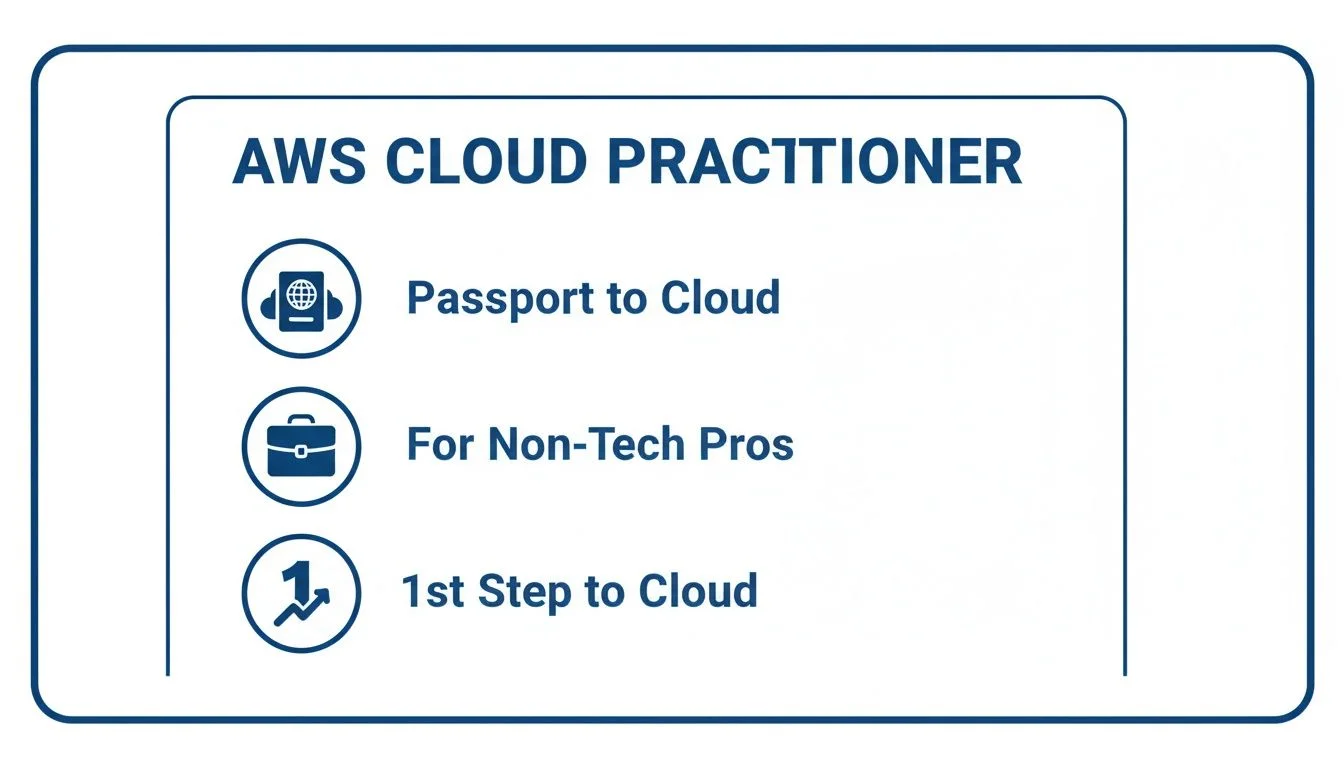 An illustration of a cloud practitioner certification, representing a foundational credential in cloud computing.
As the image shows, the certification is accessible for various roles. It is the first step for those following an AWS career path.
Microsoft Azure Fundamentals (AZ-900): The Enterprise and Hybrid Choice
Does your organization use Microsoft software like Office 365, Windows Server, or Active Directory? If so, the Microsoft Azure Fundamentals (AZ-900) is a logical step.
This exam emphasizes concepts used by large companies. It focuses on hybrid cloud setups that connect a company's own data centers to cloud resources. It also covers governance tools. For example, you will learn how Azure Arc manages resources across different environments and how Azure Policy ensures that business rules are followed. The test is less about memorizing every service and more about how Azure fits into existing business operations. If this aligns with your work, our AZ-900 study guide provides a path for your preparation.
Google Cloud Digital Leader: The Modern Application Pioneer
The Google Cloud Digital Leader is the most recent foundational offering from the major providers. It reflects the strengths of GCP in data analytics and machine learning. It also touches on modern application development using Kubernetes.
This certification is business-focused. It examines how cloud technology can improve innovation and lead to better decisions based on data. This is a good fit for roles involving data strategy or people working at startups that prioritize data analysis and AI solutions. You will study tools like BigQuery for large-scale data storage and TensorFlow for machine learning. The exam looks at how these tools solve business problems rather than just the technical details of the infrastructure.
Cloud Practitioner Certification At A Glance: AWS vs. Azure vs. GCP (2026)
This table compares the key details for each cloud practitioner certification. It provides facts to help you decide which exam fits your needs.
| Attribute | AWS Certified Cloud Practitioner | Microsoft Certified Azure Fundamentals | Google Cloud Certified Digital Leader |
|---|---|---|---|
| Exam Code | CLF-C02 | AZ-900 | N/A |
| Exam Cost (USD) | $100 | $99 | $99 |
| Exam Duration | 90 minutes | 60 minutes | 90 minutes |
| Number of Questions | 65 | 40-60 | 50-60 |
| Passing Score | 700 / 1000 | 700 / 1000 | Not publicly disclosed |
| Primary Focus | Broad AWS service knowledge, security, billing | Core Azure services, hybrid cloud, governance | Business value of cloud, data-driven transformation |
| Renewal Policy | Recertify every 3 years | Recertify annually (free) | Recertify every 3 years |
While the exam costs are almost identical, other details reveal differences. Note the variations in exam length, the number of questions, and the renewal policies. Exam prices can change, so verify current pricing of $100 for AWS, $99 for Azure, and $99 for GCP on the vendor sites. Azure's free annual renewal stands out as a unique benefit compared to the three-year cycle for the other providers. The best choice is the one that aligns with your current work environment or your future career goals. Consider what cloud services your current employer uses or what industry you want to join. Balancing your current job requirements with your long-term ambitions will help you select the right certification to start your cloud career.
How a Cloud Certification Accelerates Your Career
Earning a foundational cloud credential is about more than adding a line to a resume. This certification acts as a catalyst for your professional growth. It functions as a verifiable signal to hiring managers that you understand the language of modern technology. You show that you can communicate effectively with technical teams, stakeholders, and leadership alike.
Standing out in a crowded job market is difficult. A certification helps you separate yourself from other candidates. This is particularly useful if your current role is not in a technical department. The credential provides a link between business goals and the technological solutions used to achieve them. This makes you a more useful asset to any team because you understand how the backend infrastructure supports the bottom line.
From Non-Technical to Tech-Fluent
This shift happens often. Consider a project manager who used to struggle with technical terms during planning sessions. After getting certified, they can contribute to the conversation with confidence. They can discuss migration strategies, understand the differences between various services, and ask the right questions to keep a project on track. They ensure technical decisions align with PMP guidelines. They haven't become an engineer, but they have become cloud fluent.
A sales professional experiences a similar change. With a cloud practitioner certification, they can move past generic sales scripts. They build trust with clients by explaining exactly how specific cloud services solve business problems. They might discuss saving money with pay-as-you-go pricing or reaching a global audience with just a few clicks. This approach aligns with ITIL principles of service value. They transition from being a salesperson to a technical advisor that clients can rely on.
A cloud certification validates that you understand the reason for the technology. It proves you can connect cloud services to business outcomes like agility, cost optimization, and innovation. This skill is vital across every department in a modern company.
The demand for this basic knowledge is growing fast. The AWS Certified Cloud Practitioner was the second most-requested AWS credential in job listings during 2026. It appeared in over 32,000 job postings around the world. That is a 22% increase from the previous year. These numbers prove the value of the credential, even for people working outside of traditional IT departments.
Boosting Your Salary and Career Trajectory
Proving what you know usually leads to better career prospects and higher pay. Professionals who hold cloud certifications often earn more than those who do not. The credential gives you documented proof to use during salary negotiations. It can also help you qualify for promotions that were once out of reach because they required a technical background you didn't have before.
A Cloud Practitioner Certification validates your base knowledge of cloud concepts. This is often a requirement before you can pursue more advanced certifications. This path allows you to move into different specialized roles, including remote cloud engineer roles. This certification is the first step on a professional ladder that leads to higher titles and better earning potential.
Unlocking New Career Paths
A cloud practitioner certification is one of the best ways to start or change your career. It shows that you are dedicated to learning and that you understand the business models that employers want to see.
- For the Career Changer: It provides a way to enter the tech industry without a high barrier to entry. You get a stamp of approval that validates your skills even if you lack a long history in IT.
- For the IT Professional: It is the official start for specializing in fields like cloud architecture, security, or DevOps. These paths have their own advanced certification roadmaps.
- For the Business Leader: It gives you the strategic perspective needed to lead digital transformation. You can make better technology investments by understanding how cloud features create a competitive advantage.
Earning a cloud practitioner certification is a smart investment in your future. It gives you the vocabulary of the modern economy, proves your drive to employers, and builds a strong foundation for a stable career.
A Proven Study Plan to Pass Your Exam
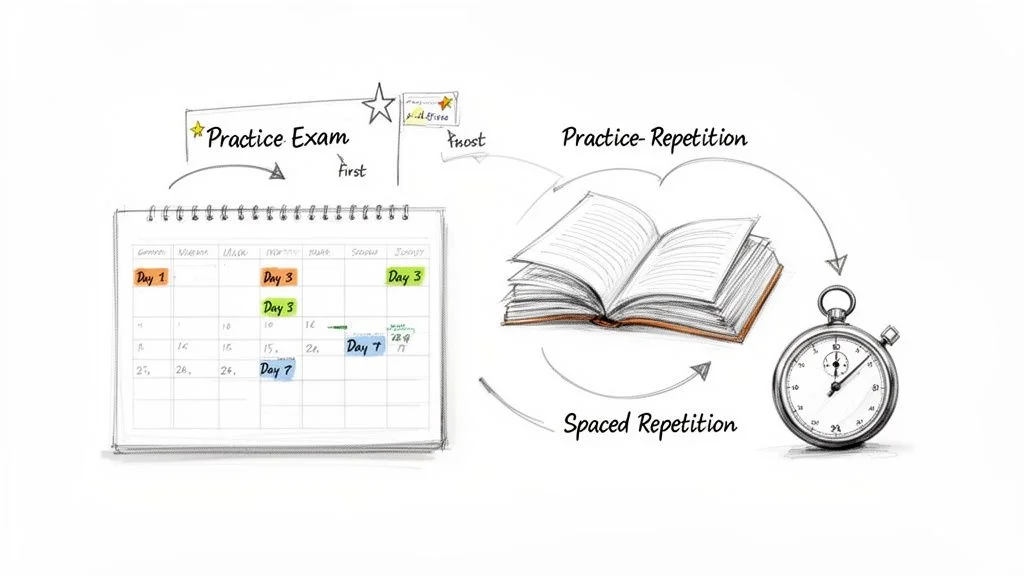 An effective study plan combines structured schedules, diagnostic practice exams, and spaced repetition techniques to ensure optimal learning and retention.
Telling someone to "just study" is useless advice. If you want to pass your cloud practitioner certification exam without wasting weeks on low-impact tasks, you need a system built on how humans actually learn and remember. Passive reading is a trap. You cannot simply sit with a textbook for hours and expect the details of cloud architecture to stick. To get results, you must be strategic.
This entire framework relies on two simple, high-impact ideas: the Practice-Exam-First approach and Spaced Repetition. When you combine these techniques, you stop studying aimlessly. You start preparing with a specific goal. You will retain more information and walk into the testing center feeling ready to perform. It is the difference between hoping you know the material and proving it to yourself before the clock starts.
Start with Practice Exams to Find Your Gaps
This might seem backwards. However, the most effective step you can take is to complete a full-length practice exam before you read a single page of a study guide. Do it anyway. Don't worry about your score. Failing this first attempt is a critical part of the strategy. The goal is to build a diagnostic baseline. This is your personal map that shows exactly where you are strong and where your knowledge is thin.
This first test shows which exam domains need your attention right now. Did you struggle with billing and pricing questions? Maybe you got confused by AWS EC2 instance types or Azure cost management tools. Did security concepts, such as the Shared Responsibility Model, feel confusing? Your diagnostic results provide data. This data ensures you do not waste time reviewing topics you already understand. You can skip the basics of "what is the cloud" if you already know it and move straight to the hard parts.
Once you have identified these gaps, you can begin focused study. Instead of trying to memorize a 500-page book from start to finish, you perform surgical strikes on the knowledge areas that will actually raise your score. You are no longer guessing what to study. You are working on the exact topics that the exam requires.
The Practice-Exam-First method changes how you prepare. Instead of learning everything and then testing, you test first to find what you need to learn. This makes every hour you spend studying much more effective.
Defeat the Forgetting Curve with Spaced Repetition
After you start learning the concepts where you were weak, the next challenge is keeping that information in your head. Human brains are wired to drop information that isn't used frequently. Scientists call this the "forgetting curve." It is a natural process, but it is the enemy of anyone trying to pass a technical exam. This is why Spaced Repetition is so effective.
Think of it this way: instead of studying a topic once and hoping it stays there, you review it at specific intervals. You check a concept after one day. Then you check it again after three days. Then you wait a week. Each review session stops the brain from clearing that data. It pushes the information deeper into your long-term memory. This is the most reliable way to ensure that the facts you learned on Monday are still there on exam day.
Modern learning platforms often have this logic built into their systems. They automatically show you topics for review based on how well you did on previous quizzes. If you need a list of the topics you should be tracking, our AWS Certified Cloud Practitioner Study Guide covers every domain in great detail. Using these tools helps you manage your time so you aren't reviewing easy topics too often while ignoring the difficult ones.
Sample Study Schedules
The time you need for preparation depends on your experience and how many hours you can study each week. Most people fit into one of two groups. Here is how to apply these study principles within a 4-week or a 2-week timeline.
The 4-Week Balanced Plan (Recommended for Beginners)
- Week 1: Take your first full practice exam. Do not worry about the result. Analyze the score report to find your two weakest domains. Spend the rest of the week on those areas. Use video lessons, read the documentation, and try hands-on labs if they are available.
- Week 2: Focus on the next two weakest domains from your first test. Read the whitepapers and create flashcards for key terms. At the end of the week, take a second full practice exam. Compare this score to your first one to see where you improved.
- Week 3: Review all domains. Give extra time to the topics that are still giving you trouble. This is the time to use flashcards and short quizzes every day. Use Spaced Repetition to make sure the definitions and service names are locked in.
- Week 4: This is for final preparation. Take a practice exam every other day. You should aim for consistent scores above 90% (verify passing requirements on the official vendor site). Use the days in between for light review of your flashcards. Get plenty of sleep.
The 2-Week Intensive Plan (For Those with Some Experience)
- Days 1-3: Start fast. Take a practice exam immediately. Spend these three days on a high-intensity study of the weakest half of the exam domains. Focus on explaining the concepts out loud or writing them down to prove you understand them.
- Days 4-7: Study the remaining domains. Connect these cloud concepts to real-world scenarios you have seen at work. Take your second practice exam at the end of day seven to see where you still have gaps.
- Days 8-11: This block is for memory retention. Use flashcards and quick quizzes every single day. Use your Spaced Repetition tool to drill the hardest topics. Take a third practice exam under real test conditions—no notes and a timer.
- Days 12-14: Final review phase. Take one last practice exam to build your confidence. Do not try to cram new information at the last minute. Spend the final 24 hours resting so your brain is sharp for the actual test.
Using a structured plan prevents the stress of wondering if you have done enough. When you follow a schedule based on testing and repetition, you can see your progress in the data. You aren't just reading; you are building a knowledge base that will serve you well beyond the exam. (Always verify exam codes and current pricing, such as the standard $100 USD fee for the AWS Cloud Practitioner, on the official vendor website before scheduling).
Common Pitfalls to Avoid on Your Certification Journey
Understanding what not to do is just as critical as having an effective study plan. We have seen many bright, motivated individuals fail their cloud certification attempt because of a few common, yet entirely avoidable, mistakes. Steering clear of these traps will save you significant frustration. It also makes you much more likely to be well-prepared to pass the exam on your first try.
The most frequent mistake is underestimating the exam. Just because AWS labels the CLF-C02 (verify current version on the AWS site) as "foundational" does not mean the material is simple. We have seen IT professionals with a decade of experience fail because they assumed they could pass without specific preparation. This approach rarely works. The exam covers a wide range of cloud-specific concepts that traditional on-premises IT work does not touch. You will face questions on complex billing models, varied service offerings, and global infrastructure architectures that require dedicated study.
This underestimation usually leads directly to the next error: treating the exam like a basic vocabulary test.
Going Beyond Simple Memorization
Many candidates try to memorize service names without understanding what they do or when to use them. You might remember that Amazon S3 provides object storage. However, you must also be able to explain why a developer would choose S3 instead of Elastic Block Store (EBS) for a virtual machine's primary drive. You need to know when Elastic File System (EFS) is the better choice for sharing files across dozens of different instances. Understanding that S3 is for web-accessible objects while EBS is a block-level volume attached to a single instance is the kind of distinction the exam looks for.
The exam tests your understanding and your ability to apply knowledge. It does not just test flashcard recall. Questions usually appear as short scenarios. These force you to apply what you know to a simulated business problem.
A classic mistake is learning service names in isolation. The exam won't ask, "What is Amazon EC2?" Instead, it will describe a company that needs scalable virtual servers for a web application with changing traffic patterns. It expects you to identify that EC2 is the right solution when used with Auto Scaling and Elastic Load Balancing. Always focus on why you use a service and when it is appropriate, rather than just what it is.
You must connect every service to its practical purpose and business value. Do not just memorize that AWS Lambda is for serverless computing. Instead, remember that Lambda is the best tool when you need to run code in response to an event. This could be a file upload to S3 or a change in a database. It allows you to run code without managing any underlying server hardware. This connection between a technical feature and a business benefit is what the examiners want to see.
Neglecting the Non-Technical Domains
It is easy to focus only on technical services and infrastructure. However, many candidates are surprised by the non-technical domains. These sections do not involve coding or setting up servers, but they make up a large part of the test.
Ignoring these areas will cost you easy points. A significant portion of your final score comes from these domains. You must set aside time to study the following:
- Billing and Pricing: You must understand the different pricing models. This includes Pay-As-You-Go, Reserved Instances, and Spot Instances. You should know how the pricing calculators work and the components of Total Cost of Ownership (TCO). Expect questions on data egress costs and how they affect a monthly bill. These questions are usually easy to answer if you have read the whitepapers and understood the basic principles.
- Security and Compliance: The Shared Responsibility Model is a central concept. It is almost certain to appear on your exam. You must know exactly where the cloud provider's security duties end and where your organization's duties begin. You will need to distinguish between these roles in Infrastructure as a Service (IaaS), Platform as a Service (PaaS), and Software as a Service (SaaS) environments. For example, in an IaaS setup, the provider manages physical data center security, but you are responsible for patching the guest operating system.
- Support Plans: You need to know the differences between the Basic, Developer, Business, and Enterprise support tiers. These are easy points that you cannot afford to lose. These questions often focus on Service Level Agreements (SLAs), costs, and how quickly the provider responds to a technical incident.
These topics might not seem as exciting as machine learning or database clusters. However, they are vital to passing. By identifying these pitfalls now, you can build a smarter, more thorough study plan. This allows you to walk into the testing center feeling well-prepared.
What to Do AFTER You Pass Your Cloud Practitioner Exam
You earned your cloud practitioner certification. This is a significant accomplishment. While you should celebrate this success, this certificate is a starting point rather than a final destination. You now hold the keys to a powerful technical toolkit. The next stage involves deciding where to apply these skills to move your career forward.
*Learn about the crucial steps to take immediately after you earn your cloud certification.*Make your first stop your professional profiles. Update them today. Add the certification to the "Licenses & Certifications" section of your LinkedIn profile and show off your new digital badge. You worked hard for it. On your resume, create a dedicated "Certifications" section. You should also mention the credential in your professional summary at the top of the page. This ensures recruiters and hiring managers see your qualifications the moment they open your file. They often scan documents quickly, so your new status must be visible.
From Certified to Career-Ready
Earning the certificate is a great first step, but you must use it to create professional momentum. This is where the real work begins. You have validated your foundational knowledge of the cloud. Now you need to link that knowledge to actual job opportunities. This certification acts as a springboard for your career. Because you have this solid foundation, you are ready to study for an associate-level certification. This level is where many people start to see much higher salaries. These certifications open doors to senior roles and more technical positions.
You have proven you understand the 'what' and the 'why' of the cloud. The next step is mastering the 'how.' This involves choosing a specialty that aligns with your interests and studying a specific, high-demand area of cloud computing.
Some professionals choose to become the people who design systems. These are the cloud architects. Others focus on defending those systems from cyber threats. Some prefer to work with data through analytics and machine learning. Your choice depends on which part of the technology interests you most.
Choosing Your Next Certification Path
Your cloud practitioner certification is the base of your professional structure. You can now build upon it. Here are several common and valuable paths to consider:
- For the Future Architect: Certifications like the AWS Certified Solutions Architect – Associate or Microsoft Certified: Azure Administrator Associate are frequent next steps. These are hands-on credentials. You will stop focusing on definitions and start learning how to design and build systems. You will learn to deploy systems that can handle thousands of users. This is where you learn to make the cloud work for a business.
- For the Security-Minded: If you enjoyed learning about security and compliance, a specialty certification is a great choice. You could look at the AWS Certified Security – Specialty (SCS-C02) or the Microsoft Certified: Azure Security Engineer Associate. These paths lead to high-impact jobs. You will be the person who protects a company's data. Organizations need experts to keep their assets safe from hackers and mistakes.
- For the Data-Driven: Are you interested in what data can do for a company? A certification in data analytics or machine learning can help you stand out. Consider the AWS Certified Data Engineer – Associate or the Google Cloud Professional Data Engineer. These roles are vital for business intelligence. They are also some of the best-paying jobs in the tech world. Companies need people who can turn raw data into useful information.
Finally, remember that you need to stay certified. Most foundational cloud certifications are valid for three years (verify the exact period on the vendor site). It is smart to put a reminder in your calendar today. If you keep working with the cloud and learning about new services, the renewal process will be simple. This ensures that your skills remain fresh and your resume stays competitive in the job market. At MindMesh Academy, we offer guided study paths to help you move from being a practitioner to being a specialized expert. We support you through every stage of your growth.
Your Top Cloud Certification Questions Answered
Earning a cloud practitioner certification involves several practical decisions. Addressing common concerns helps you plan your next steps effectively and removes the guesswork from your preparation process. Deciding to earn a credential is a significant career move.
How Much Can This Certification Boost My Salary?
Compensation is a primary driver for professional development, and the financial outlook for certified individuals remains strong. This credential is often the first step toward high-paying roles in cloud architecture or security.
For the AWS Certified Cloud Practitioner (CLF-C02), industry data shows an average annual salary between $100,000 and $105,000 in major markets (verify current market rates on employment sites). Earning a certification provides a clear edge over other candidates during the hiring process. Certified professionals often earn 20-25% more than those without formal credentials. This gain represents a fast return on your investment in training and exam fees. Read more about specific figures and compare high-yield options in this analysis of high-ROI certifications.
Can I Really Pass With No IT Experience?
Yes. Foundational certifications are built for professionals entering technology from other sectors. Many successful candidates transition from marketing, finance, or sales. You do not need a background in computer science or coding to start.
Success relies on your study method rather than your previous job title. Focus on understanding what the cloud does and how it solves specific business problems. You should prioritize the strategic benefits of cloud adoption, such as cost savings and global reach, over technical configuration details. Learning the logic behind these services allows you to pass with confidence even if you have never worked in a data center or managed a server.
How Long Should I Study for the Exam?
Preparation time varies based on your background and your weekly schedule. While there is no universal timeline, most learners follow predictable patterns based on their experience level.
Beginners with no previous cloud exposure usually need 4 to 6 weeks of regular study to feel ready. If you already understand basic IT concepts or general cloud principles, you can often prepare in roughly 2 weeks. Consistency is the most important factor in your success. A fixed daily routine where you study for one hour each morning helps you retain information better than intense cramming sessions. Evaluate your current skills honestly to set a realistic schedule for your preparation.
MindMesh Academy provides the structure needed to master these concepts. If you want to start your certification process with a proven method, view our resources at MindMesh Academy.

Written by
Alvin Varughese
Founder, MindMesh Academy
Alvin Varughese is the founder of MindMesh Academy and an enterprise architecture leader. An electrical engineer by training, he moved from factory automation in South Africa to cloud architecture at GE Appliances and Humana (Fortune 50), and holds 20 professional certifications including AWS Solutions Architect Professional, Azure DevOps Engineer Expert, and Microsoft Agentic AI Business Solutions Architect. He built MindMesh Academy after interviewing too many highly certified candidates who couldn't answer basic questions: the goal is prep that makes you better at the job, not just able to pass the exam.