
Cloud Admin Salary 2026: Increase Your Earning Potential
Boost Your Cloud Admin Salary: Skills, Scope, and Strategy
Cloud administrator salaries currently hover around $110,000 annually according to leading national benchmarks. For example, ZipRecruiter reports an average of $110,957, and ERI lists $109,994. If you still see this role as an advanced sysadmin job, you might be missing out. The highest earners have shifted into automation, security, and engineering-focused work.
This is the reality of cloud admin compensation. The average salary provides a baseline, but the range of earnings is what truly matters. Two professionals with a "cloud administrator" title can have vastly different career paths, interview advantages, and paychecks.
One version of the role handles account provisioning, routine monitoring, backups, and support tickets. This work remains important, yet cloud platforms continue to automate more of it. The other version takes ownership of system reliability, automates repetitive tasks, strengthens identity and access controls, supports production incidents, and helps teams deploy infrastructure changes safely. This version commands higher pay because companies quickly see the direct impact.
Your Cloud Admin Salary Roadmap
When looking at cloud admin salary data, understand this: the market recognizes the role as a near-six-figure to low-six-figure career path. Your specific paycheck, however, depends on whether you remain focused on routine administration or grow into higher-scope cloud operations.
This distinction is often overlooked. Many salary pages simply provide a single number, calling it useful. It isn't. A benchmark helps you negotiate, but it won't explain why one employer offers a modest package while another is willing to invest more in the right candidate.
Here's the practical framework I use as a hiring manager:
- Baseline pay is essential. You need to know the market range before interviews.
- Scope drives income potential. Employers pay more when a role includes automation, production troubleshooting, and security responsibility.
- Location still matters. Major cloud markets and tech hubs can significantly increase compensation.
- Credentials help when they signal real ability. Certifications alone won't compensate for a weak resume, but they strongly support candidates with hands-on experience.
Coach's view: Don't ask, “What does a cloud admin make?” Instead, ask, “What kind of cloud admin am I becoming?”
If your daily work is mostly reactive, your salary ceiling will feel tighter. If your work begins to overlap with platform engineering, DevOps support, cloud security, and infrastructure automation, your compensation path changes significantly.
That's the opportunity. You don't need to abandon cloud administration. You need to modernize it.
What Is the Average Cloud Admin Salary?
The most reliable benchmark for cloud admin salary comes from multiple national estimates that cluster closely. According to PayScale's cloud administrator salary roundup, ZipRecruiter reports $110,957, ERI reports $109,994, and Glassdoor shows $117,687.
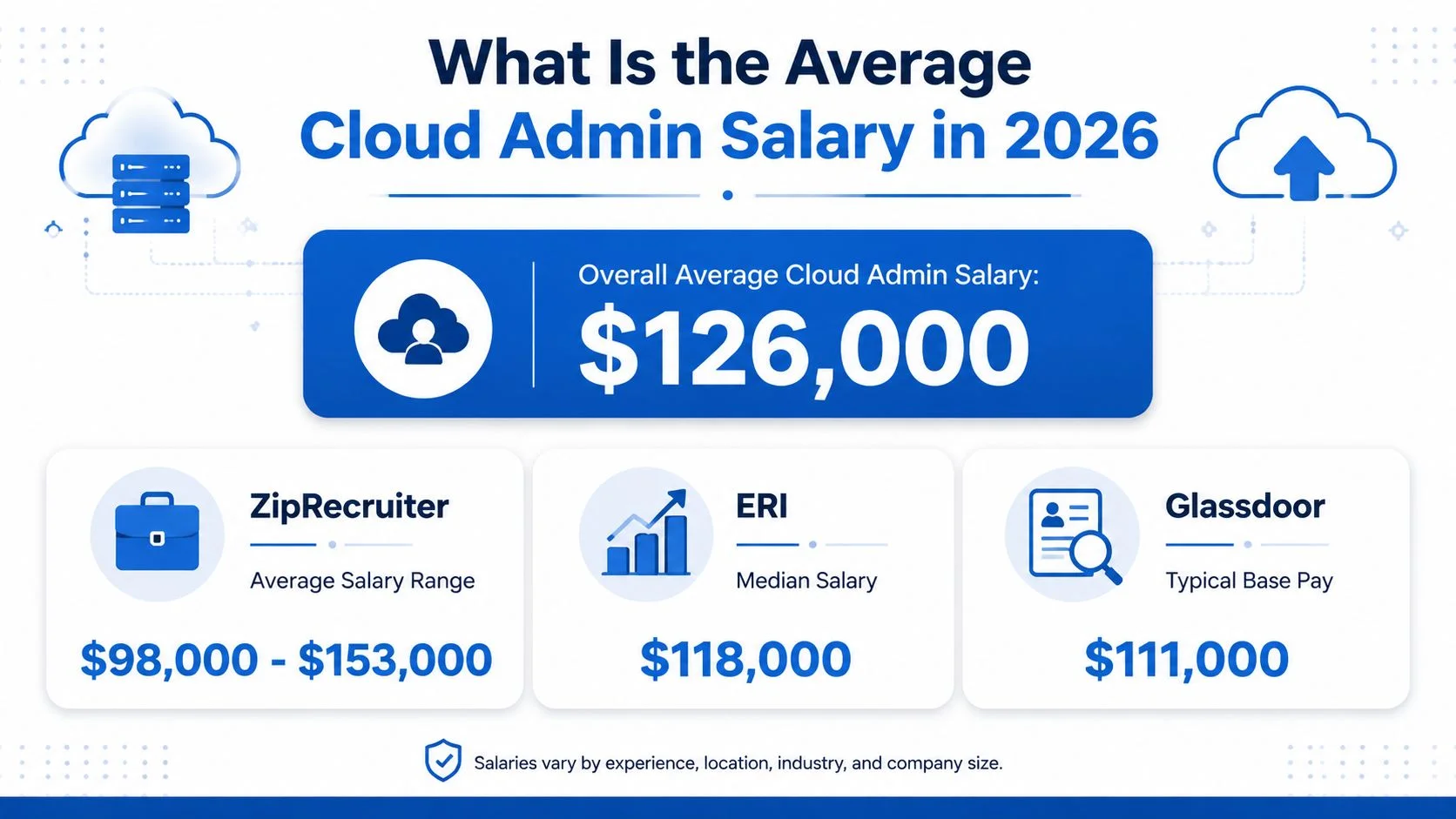
This provides a useful consensus. It's not about perfect agreement, but about multiple trackers placing the role within a similar salary band.
Key takeaway: Consider around $110,000 as the justifiable national baseline for a cloud administrator.
Why salary numbers vary
Salary sites rarely measure compensation using identical methods. Some rely more on self-reported data. Some combine base pay with estimated additional benefits. Others account for wider variations in job titles. This explains why one source might be higher and another closer to the midpoint.
The overall pattern is what matters, not the illusion of a single, flawless number.
| Source | Cloud Admin Pay |
|---|---|
| ZipRecruiter | $110,957 |
| ERI | $109,994 |
| Glassdoor | $117,687 |
When negotiating, use this cluster of data points, not just one. A hiring manager can easily dismiss a single salary site. It's much harder to ignore three sources that align.
How to use this benchmark
Apply this baseline in three ways:
- Set your salary floor realistically. If your responsibilities include genuine cloud operations ownership, don't base your expectations on outdated sysadmin pay scales.
- Check for title inflation. Some companies advertise "cloud administrator" when they're actually seeking a cloud engineer at a lower cost.
- Plan your next career move. If you're earning below market, identify whether the issue stems from location, job title, or the scope of your responsibilities.
Many candidates make the mistake of seeing a strong national average and assuming they are underpaid due to an unfair employer. While this is sometimes true, the harder truth can be that their current work falls into the lower-value half of the role.
This highlights why average salary is just the first step. You need to understand what increases that number.
Key Factors That Increase Your Salary
A cloud admin's salary isn't solely tied to their title. It depends on where you work, the kinds of problems you solve, and how difficult (and expensive) it would be for a company to replace you.
The biggest factor many candidates overlook is geography. According to Coursera's cloud computing salary guide, the U.S. median total salary for cloud computing professionals is $138,000. City-level medians show $150,000 in San Francisco, $139,000 in Seattle, and $121,000 in both New York and Boston. The same source notes that the U.S. Bureau of Labor Statistics projects about 317,700 job openings per year across computer and information technology occupations from 2024 through 2034.
This tells you two things: Cloud talent continues to be in high demand, and your work location can change your compensation faster than you might expect.
Geography changes the game
If you're in a lower-cost market, don't automatically assume national averages apply to your job offers. Employers determine salaries based on local competition, budget constraints, and replacement cost.
However, don't undersell yourself. Remote work has broadened access to employers who benchmark beyond your immediate metro area. If your skills are portable and your communication is strong, you can compete for roles outside your immediate region.
A candidate who can stabilize production, automate repetitive tasks, and manage cloud security basics competes in a different market than someone who primarily navigates console menus.
Scope matters more than time spent
Experience is valuable, but only if it translates into meaningful responsibility. Five years of low-complexity maintenance won't outweigh two years of high-accountability work in a challenging environment.
Hiring managers typically pay more when a cloud admin role includes work such as:
- Production troubleshooting: Owning incidents, conducting root-cause analysis, and managing service recovery.
- Automation: Writing scripts, using Infrastructure as Code, and reducing manual effort.
- Security ownership: Hardening access, enforcing policies, and supporting zero trust principles. Learn more about implementing Zero Trust.
- Cross-team collaboration: Supporting developers, networking teams, and security stakeholders with minimal supervision.
This explains why some candidates feel "experienced" but still receive mid-level offers. They've been busy, but they haven't expanded their impact.
Employer type affects your earnings
Large enterprises often provide structure, clear leveling, and steady benefits. Smaller companies can offer broader responsibility more quickly. Neither is inherently better.
Use this simple test before accepting an offer:
| Employer Situation | Impact on Pay |
|---|---|
| Large enterprise | More formal salary bands, steadier career progression, clearer role boundaries |
| Smaller company | Faster skill development, more title flexibility, broader ownership |
| Tech hub employer | Stronger salary pressure, especially for advanced cloud skills |
| Cost-conscious employer | Lower income potential unless you have unusually broad responsibilities |
If you want to increase your cloud admin salary, stop treating compensation as a reward for time served. It's a price tag on risk reduction, technical range, and ownership.
How Certifications and Job Titles Affect Your Pay
Certifications are helpful, but only when they support a stronger job scope. Your job title also matters, and in many cases, it matters even more.
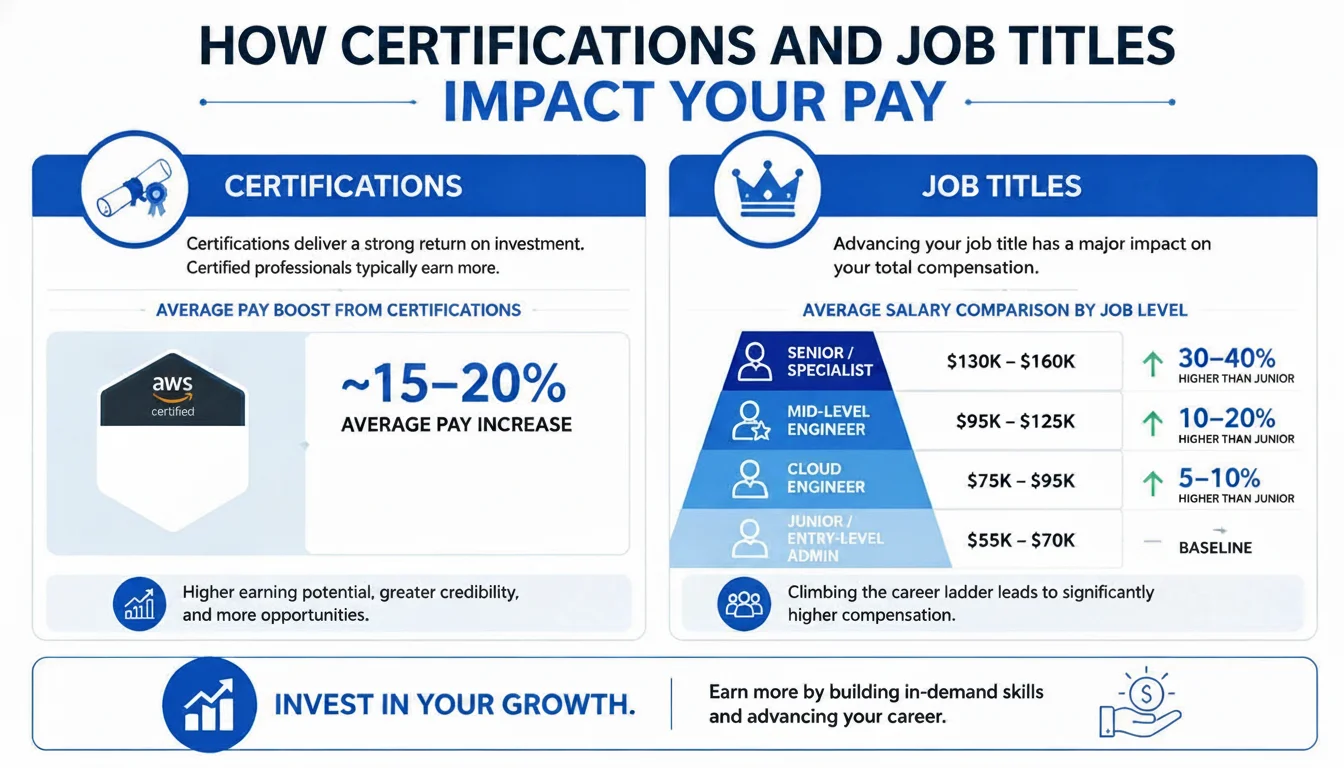
According to ERI's cloud systems administrator salary page, a cloud systems administrator averages about $109,994 per year. This sits below the typical pay for broader cloud engineer roles. That gap makes sense. Admin work often focuses on operational support and platform maintenance. Engineer roles typically involve architecture ownership, automation, and deeper platform design.
Certifications help when they change employer perception
Coursera reports that certified cloud engineers can earn about 15% more than non-certified peers. However, don't misinterpret this figure. The market doesn't pay for a badge alone. It pays for the combination of verified knowledge and reduced hiring risk.
This is why entry-level candidates and career switchers often benefit most from certifications early on. A certification gives the hiring team a reason to take you seriously before you've built an extensive cloud resume.
For practicing admins, the most effective certifications align with your actual target role. If you work in Azure-heavy environments, Azure credentials are more relevant than pursuing unrelated certifications. If you support AWS environments, choose the certification path that matches the operational work you want to own.
MindMesh Academy certifications offer a solid starting point for evaluating these paths.
Title changes can unlock new pay bands
People often leave money on the table by performing engineer-level work under an administrator title, then wonder why salary growth feels slow.
Compare the role structures:
| Title | Typical Emphasis |
|---|---|
| Cloud Administrator | Maintenance, monitoring, access management, platform operations |
| Cloud Engineer | Automation, architecture support, infrastructure design, broader ownership |
If your current work includes Terraform, incident response, cloud networking, identity controls, and scripting, your title may not reflect your actual value.
If your resume states "administrator" but your bullet points describe an engineer, correct this mismatch before your next interview cycle.
My recommendations
Don't acquire certifications randomly. Choose one that supports a title change or an expansion of your responsibilities. Good examples include the AWS operations path for those focused on AWS, and the Azure Administrator path for Microsoft-centric environments.
Then, rewrite your resume to highlight outcomes and complexity, not just tasks. "Managed Azure resources" is weak. "Owned production cloud operations, identity controls, and automation for a multi-team environment" is much stronger because it signals influence.
Certifications open doors. Better titles change your pay bracket. You want both working in your favor.
Your Action Plan to Maximize Earnings
The quickest way to increase your cloud admin salary is to stop acting as a caretaker of cloud platforms and start acting as an operator who makes systems safer, faster, and less dependent on manual work.
Begin with this roadmap.
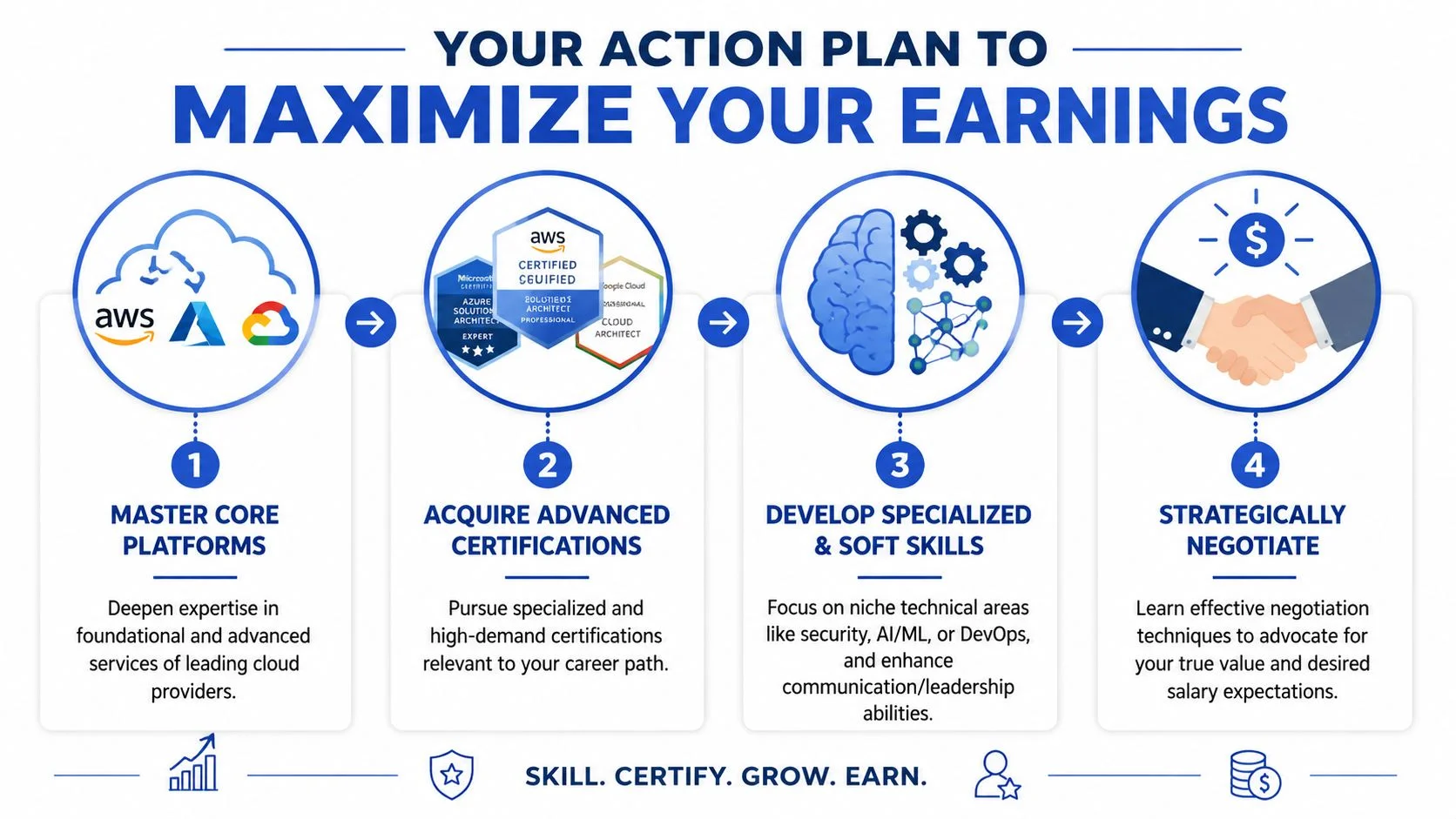
Step 1: Build skills employers pay for
Premium roles don't pay extra for routine console work. They pay for operational depth.
Focus on skills like:
- Infrastructure as Code: Terraform is a clear choice because it demonstrates your ability to standardize and repeat cloud changes reliably.
- Scripting: Python and PowerShell are both helpful. Choose the one that aligns with your environment and use it to eliminate repetitive tasks.
- Cloud security: IAM, least privilege, secrets management, logging, and policy control are critical.
- Reliability work: Monitoring, alerting, incident handling, and post-incident analysis quickly build credibility.
When a cloud admin learns to automate and secure the platform, they become more expensive to replace.
A focused certification path can help if Azure is your focus. Use this study guide to prepare for the AZ-104 certification.
Step 2: Move toward engineer-level scope
According to KORE1's cloud engineer salary guide, cloud engineer base pay commonly clusters around $135,000 to $152,000. Total compensation can exceed $175,000, and reach roughly $237,729 at the 90th percentile.
This salary map is worth studying. Not because you need to abandon administration, but because it shows where the money flows. It follows scope.
Here’s a useful benchmark for designing your own role:
- Lower-value admin work: Repetitive provisioning, routine maintenance, narrow support.
- Higher-value admin work: Production support, automation, security ownership, cross-cloud awareness.
- Engineer-adjacent work: Architecture support, platform design input, deeper infrastructure change ownership.
Step 3: Quantify your impact
Many technically strong people underperform in their job search because they write weak resumes. They did excellent work but failed to articulate it effectively.
Use business language, not vague metrics. Focus on real outcomes.
Describe your achievements with phrases like:
- Reduced manual cloud operations by automating deployment or maintenance tasks.
- Improved platform reliability by tightening monitoring and escalation practices.
- Strengthened access controls by optimizing identity and permission models.
- Supported production systems during incidents and recovery efforts.
If you can't explain your value without simply listing tasks, your resume won't help you increase your salary.
This walkthrough is worth your time before interview preparation:
Step 4: Negotiate like someone who knows the market
Don't enter negotiations apologetically. You have benchmark data and evidence of your scope. Use both.
Try language such as:
“My target reflects the current cloud admin market, but more importantly, the scope of this role. My background isn't limited to maintenance. I've worked across automation, security, and production support, and that's the level I aim to continue operating at.”
This approach works because it links your request to market reality and the value you bring to the role.
If an employer continues to frame the job as administrator-level while expecting engineer-level ownership, push back. Do so politely, directly, and with specifics. Many companies attempt to compress titles and stretch responsibilities. You don't have to accept that trade-off.
Take the Next Step in Your Cloud Career
The cloud admin salary story is clear once you filter out the noise. The baseline pay is solid, and the potential for higher earnings is even stronger. However, the increased pay doesn't go to those who remain focused on routine administration.
It goes to the administrator who evolves into an operator—someone teams trust with automation, reliability, and security-sensitive work. It goes to the candidate who can support production without panicking. It goes to the professional who can explain a cloud change in business terms, not just technical jargon.
This also explains why career growth in this field is more intentional than accidental. If you want a helpful outside perspective on long-term skill building, this article on thriving in your career reminds us that progression usually comes from deliberate development, not from hoping your title catches up.

Regional pay variations illustrate this point even more clearly. ZipRecruiter's California cloud administrator salary page shows statewide pay centered around $109,504, with San Jose at $130,040 and Santa Clara at $129,300. These markets don't pay more out of generosity. Employers there pay more because advanced infrastructure talent is costly and difficult to replace.
This presents a clear career decision. You can remain a generalist handling standard cloud admin tasks, or you can become a more valuable operator with skills that are highly transferable across employers and markets.
If certifications are part of your next move, treat them as tools to sharpen real capabilities, support a stronger resume, and justify a higher salary request. When you're ready to create a concrete study plan, you can prepare for the AZ-104 Microsoft Azure Administrator exam with our practice tests.

Written by
Alvin Varughese
Founder, MindMesh Academy
Alvin Varughese is the founder of MindMesh Academy and an enterprise architecture leader. An electrical engineer by training, he moved from factory automation in South Africa to cloud architecture at GE Appliances and Humana (Fortune 50), and holds 20 professional certifications including AWS Solutions Architect Professional, Azure DevOps Engineer Expert, and Microsoft Agentic AI Business Solutions Architect. He built MindMesh Academy after interviewing too many highly certified candidates who couldn't answer basic questions: the goal is prep that makes you better at the job, not just able to pass the exam.