
Career Path of Business Analyst: A 2026 Roadmap
The Business Analyst Career Path: Your Roadmap for Growth
You're probably seeing business analyst roles everywhere and still asking a fair question: what does this career lead to?
That uncertainty is normal. Many job descriptions make the role sound like a mix of meetings, spreadsheets, tickets, and vague “stakeholder management.” If you're coming from operations, quality assurance (QA), support, development, finance, or even project coordination, it can be hard to tell whether business analysis is a real long-term profession or just a stepping stone with a fancy title.
It's both. That's what makes it valuable.
The business analyst career path isn't a single ladder where everyone starts as a junior BA and ends as a manager. It's more like a platform. You can grow vertically into senior and lead analysis roles, or branch into product, project delivery, systems analysis, process improvement, consulting, and data-focused work. This flexibility is one of the biggest reasons smart career changers keep gravitating toward it.
Your Starting Point in Business Analysis
A common starting point looks like this: you're already solving business problems, but no one calls you a Business Analyst yet.
Maybe you're the operations specialist who keeps fixing broken handoffs between teams. Perhaps you're the support lead who notices the same customer issue appearing every week and starts tracing it back to process gaps. Or you might be the QA analyst who can already translate business intent into test scenarios better than the people writing the requirements.
This is why BA work clicks for so many people. The role usually doesn't begin with deep technical ownership. It begins with clarity. You ask better questions, separate symptoms from root causes, document what truly matters, and help people make decisions with less confusion.
Why Career Changers Choose Business Analysis
The field is no longer a niche corner of IT. The IIBA career road map cites 2.7 million U.S. job profiles for business analysts, a significant jump from 364,000 in an earlier IBM figure. It also notes a U.S. Bureau of Labor Statistics projection of 14% growth by 2028. These figures shift the conversation from "Is BA a real career?" to "Which version of BA fits me best?"
What many people overlook is how business analysis has broadened as organizations became more digital and data-driven. A BA used to be seen primarily as the person who gathered requirements for a project. In practice, many now shape process redesign, operating models, reporting logic, product decisions, and implementation quality across teams.
Practical rule: If people already rely on you to make messy work understandable, you may be closer to a BA role than your title suggests.
What Early Business Analysis Really Involves
At the beginning, the job is rarely glamorous. You'll sit in meetings where three departments use the same term to mean different things. You'll compare what a process is supposed to do with what people do in practice. You'll chase missing assumptions, edge cases, and conflicting priorities.
That's good training.
To build credibility, early business analysts consistently do a handful of things well:
- Listen for precision instead of accepting vague requests like “we need a better report.”
- Document decisions so teams avoid relitigating the same issues.
- Map processes to make bottlenecks visible.
- Clarify requirements before technical teams build the wrong thing.
- Spot risks early when workflows, data, or stakeholders don't align.
If you're evaluating the business analyst career path, don't ask only whether you'd enjoy the title. Ask whether you enjoy being the person who reduces ambiguity. People who like that work tend to stay and grow. Those who want immediate ownership without the discovery work often get frustrated quickly.
The Four Core Stages of a Business Analyst Career
Many people enter business analysis expecting a straight ladder. However, the career path offers more flexibility than that. These four stages describe how scope, judgment, and accountability typically grow, but they also act as launch points into product, operations, data, delivery, architecture, and consulting roles.
This matters because career progress in BA isn't only about getting a more senior title. It's about being trusted with harder problems, broader stakeholder groups, and decisions with higher costs if you get them wrong.
Understanding the Progression
Earlier, we noted that business analyst pay in the U.S. can be strong, with median total pay often cited around $105,000. Treat that as market context, not a guarantee. Actual compensation depends on industry, geography, domain depth, technical range, and whether you handle local process fixes or enterprise-level change.
Use the stages below as a working map, not a rigid hierarchy.
| Stage | Typical Experience | Primary Focus | Average Salary (USD) | Recommended Certification |
|---|---|---|---|---|
| Junior BA | Early career | Documentation, requirements support, process observation, data gathering | Varies by market and company | ECBA |
| Business Analyst | Growing practitioner | End-to-end requirements, stakeholder workshops, process improvement, solution support | Varies by market, domain, and scope | CCBA or PMI-PBA |
| Senior Business Analyst | Experienced practitioner | Complex problem framing, cross-functional alignment, solution shaping, mentoring | Varies by specialization and market | CBAP |
| Lead or Principal BA | Senior leadership track | Portfolio-level thinking, standards, team leadership, strategic alignment | Varies widely by organization and specialization | CBAP, AAC, or adjacent leadership credentials |
Stage 1: Junior Business Analyst
Junior BA work builds habits that can either help your career for years or slow it down early. You learn to capture requirements clearly, maintain traceability, observe real workflows, and separate stated needs from actual problems. You often support someone else's analysis, but that doesn't make the work minor. Teams remember the analyst who keeps details accurate and decisions visible.
At this stage, reliability matters more than polish.
The common trade-off is speed versus understanding. New analysts often document everything they hear because they don't yet know what's signal and what's noise. That's normal. The goal is to improve your questioning so your notes become sharper, not longer.
Stage 2: Business Analyst
This is the point where you start owning pieces of work from discovery through delivery. You run workshops, write and refine requirements, validate process changes, support testing, and keep business and technical teams aligned when assumptions begin to drift.
The move from junior to mid-level usually happens when managers stop checking your output line by line.
A strong BA at this level does more than facilitate meetings well. They hold the thread across the whole workstream. They know which decision is still open, who owns it, what the risk is if it slips, and how a vague request could turn into rework three weeks later. That follow-through is what separates a dependable practitioner from someone who is only good in the room.
This is also where branching starts. Some BAs deepen into systems, data, or regulatory work. Others become strong in customer journeys, service design, or operational change. The title may stay the same while the career path begins to split.
Stage 3: Senior Business Analyst
Senior BA work is less about producing more artifacts and more about improving the quality of decisions. The problems are usually less defined, the stakeholders are more senior, and the trade-offs are harder. You may be working through competing business goals, weak ownership, policy constraints, legacy systems, or delivery pressure from several directions at once.
Here, judgment is revealed.
Senior analysts frame the problem before the team rushes into solutions. They can tell when a requirement is a policy question, when a process issue is really a data issue, and when stakeholder conflict is being disguised as ambiguity. They also mentor other analysts, even without formal line management responsibility.
A good test of seniority is this: Can you walk into a messy initiative, create clarity, and help the group make a better decision without becoming the bottleneck yourself?
Stage 4: Lead or Principal Business Analyst
Lead and Principal BA roles differ significantly by company. In one organization, a Lead BA manages people and allocates analysts across projects. In another, a Principal BA is a senior individual contributor who sets methods, handles the hardest initiatives, and advises leaders on scope, risk, and change impact.
Either way, the center of gravity shifts from project contribution to organizational influence.
You are no longer judged only on your own analysis. You are judged on whether other analysts work better because of the standards, coaching, governance, and decision support you put in place. Strong people in these roles reduce avoidable project failure before delivery teams spend the budget. They also create lateral options. Many move from here into product leadership, transformation, enterprise change, strategy, or practice leadership.
A junior BA asks, “What are the requirements?”
A senior BA asks, “What decision are we making, who owns it, and what assumptions are still hidden?”
Outgrowing Each Stage: Common Pitfalls
Progression gets clearer if you watch for common mistake patterns at each level.
-
Junior BA
Recording everything and analyzing too little. -
Business Analyst
Running sessions well but leaving scope, ownership, or decisions unresolved. -
Senior BA
Solving every ambiguity personally instead of helping the team build shared understanding. -
Lead or Principal BA
Staying too close to project detail when the business needs standards, prioritization, and better decision structures.
If you want a practical way to assess your level, ask a harder question than “What should I study next?” Ask, “What kind of problem can I carry with minimal supervision, and in what environment?” That second part matters. Someone may be senior in process improvement, mid-level in product discovery, and new again in enterprise data work.
That is why the BA career path works well for career changers and ambitious juniors. It gives you a solid progression, but it also gives you room to move sideways once your strengths become clear.
Mapping Your Skills to Each Career Stage
The biggest shift in this profession is this: you start by capturing information, and you grow by interpreting uncertainty.
That's not just wordplay. It changes how you build your skill set. At junior levels, people reward completeness. At senior levels, they reward judgment. The documents still matter, but no one promotes you because your requirement template is neat. They promote you because teams move faster and make fewer bad decisions when you're involved.
Evolving Your Skill Set
BCS describes the BA path as a progression from investigating and modeling business functions, information flows, and data structures at the junior end to stakeholder influence and strategic alignment at more senior levels in its business analyst career pathway. That matches what good teams see on the ground. The value moves from documenting to reducing ambiguity.

Analytical Ability
At first, analytical skill means separating facts from opinions. You learn to ask, “What's happening now? Who does what? What triggers the step? Where does the data come from?” You build simple process maps, identify pain points, and keep language consistent.
Later, analysis becomes more diagnostic. You compare current state and future state, find hidden dependencies, identify rule conflicts, and assess whether a proposed fix addresses the actual cause. Senior analysts can usually tell within one conversation whether a request is a reporting issue, a workflow issue, a policy issue, or a system-design issue.
Technical Fluency
You don't need to become a developer to build a strong BA career, but you do need enough technical fluency to ask better questions. For many analysts, that means working knowledge of SQL, Excel, Power BI, Tableau, Jira, Confluence, backlog tools, and process mapping tools such as Visio, Lucidchart, or Miro.
The standard changes by level:
- Early stage means understanding fields, workflows, user stories, acceptance criteria, and how data moves between steps.
- Mid-stage means tracing impacts across systems, reports, controls, and handoffs.
- Senior stage means evaluating solution options with delivery teams and knowing when technical complexity should change business scope.
The BA who can read enough of the system to challenge assumptions is more useful than the BA who simply relays messages between business and IT.
Communication and Influence
Here, many promotions are won or lost.
A junior analyst communicates by being clear and organized. A mid-level analyst facilitates. A senior analyst influences. Those aren't the same thing. Facilitation gets people into a room. Influence gets them to commit to a decision, understand trade-offs, and own consequences.
Build this skill deliberately:
- Practice structured questioning so interviews don't drift.
- Summarize decisions in plain language that both business and technical teams understand.
- Expose unresolved risks instead of hiding them in meeting notes.
- Adapt your level of detail for executives, subject matter experts, and delivery teams.
When people talk about the business analyst career path, they often overemphasize tools and underemphasize this shift. Tools get you in the room. Influence keeps you there.
Strategic Certifications for Career Acceleration
Certifications won't turn a weak analyst into a strong one. They do something else important: they give structure to your learning, help employers recognize your baseline, and make it easier to signal where you're headed.
Used well, they shorten the gap between “I've done BA-like work” and “I can prove I understand the discipline.”

Choosing the Right Certification for Your Stage
For someone entering the field, a foundational BA certification makes sense when you need vocabulary, core concepts, and a hiring signal. It's especially useful for career changers whose experience is relevant but mislabeled on their resume.
For an established analyst, a practitioner-level credential becomes more useful when you're already doing the work and need credibility for promotion or more complex roles. At that point, the certification should support real project examples, not substitute for them.
For senior analysts, advanced BA credentials or adjacent certifications often matter more than another generalist badge. If you're moving toward Agile product work, change delivery, or enterprise-level analysis, align the credential with the role you want next.
Reasons to Certify (and When Not To)
Good reasons:
- You need structure because your experience is fragmented.
- You want role mobility across industries or employers.
- You need credibility for a promotion or lateral move.
- You're filling theory gaps after years of learning only on the job.
Bad reasons:
- You think the exam will replace project experience.
- You're collecting badges without a target role.
- You want a shortcut around weak communication or stakeholder skills.
A practical approach is to pair one BA certification with one adjacent capability. That might be Agile, project delivery, product ownership, data visualization, or a domain-specific area.
If you're planning formal certification exam preparation, use it to support a real role strategy, not just to add another line to LinkedIn.
To understand how BA learning and certification connect, watch this walkthrough:
Adjacent Certifications to Expand Your Options
Some of the best career acceleration doesn't come from doubling down on generic BA theory. It comes from proving strength in the area next to business analysis where you want to compete.
Examples include:
- Agile certifications if you want to move toward Product Owner or product delivery work.
- Project management certifications if you're already coordinating timelines, scope, and stakeholders.
- Data and reporting certifications if your work is drifting toward analytics and decision support.
- Testing or quality credentials if you're strongest in validation and implementation quality.
Career filter: Pick certifications that move you toward a target role, not certifications that merely sound impressive in isolation.
Branching Out From BA Specializations and Lateral Moves
A lot of BA career advice implicitly assumes everyone wants the same future: Junior BA, BA, Senior BA, Manager. That happens, but it's far from the only path.
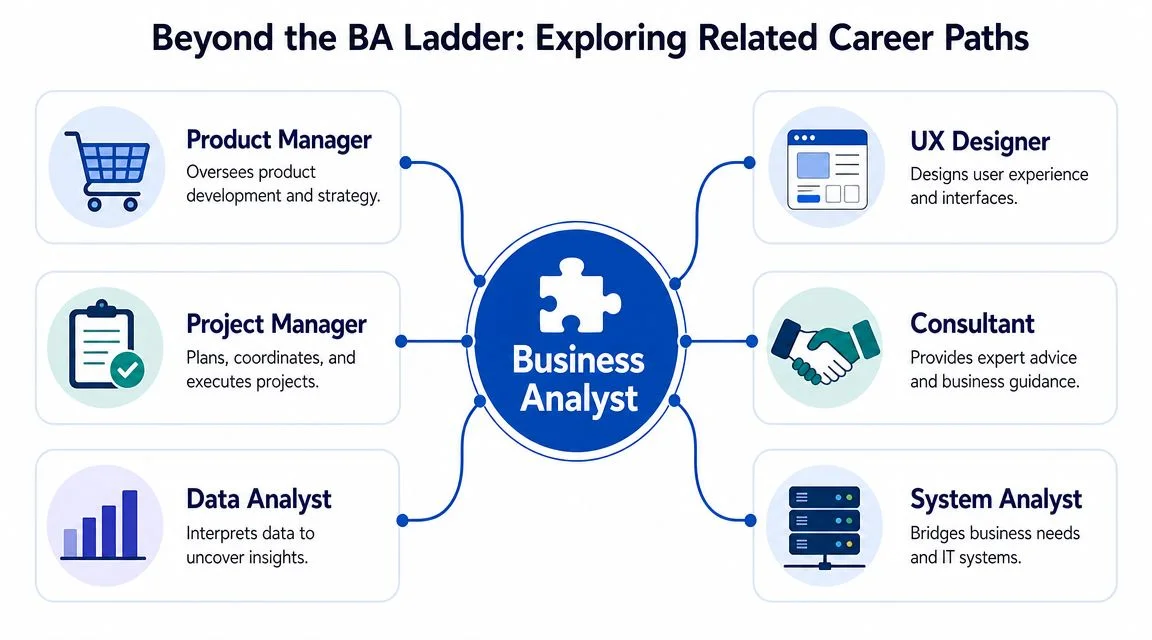
IIBA explicitly describes multiple common BA career paths beyond the traditional track, including routes such as product management and data analytics in its discussion of common business analysis career paths. That reflects reality. Many of the strongest analysts I've seen didn't “leave” business analysis because they got bored. They used it as a launchpad.
Product and Delivery Paths
A BA often transitions well into Product Owner or Product Manager work because the underlying habits overlap. You're already balancing needs, clarifying scope, working with stakeholders, and translating goals into buildable work. The missing piece is usually product strategy. You need to become stronger at prioritization, market logic, value framing, and outcome ownership.
Project Manager is another common move. Many BAs already manage dependencies informally. The difference is that project roles require stronger command of planning, governance, risk management, status reporting, and execution discipline. If this path appeals to you, structured project management professional exam prep can help you formalize what you may already be doing in practice.
Data and Systems Paths
If you enjoy tracing fields, reports, metrics, and data issues, Data Analyst is a natural branch. The BA foundation helps because you already understand business context, which many pure technical analysts struggle to build. The delta skills are usually deeper SQL, stronger dashboard design, better metric definition, and more comfort with data quality issues.
Systems Analyst is a better fit if you like integration points, application behavior, business rules, and technical constraints more than broad stakeholder facilitation. BAs with systems instincts often become very effective here because they can speak to both operational need and implementation reality.
Consulting and Process Improvement
Some analysts move into consulting, internally or externally. That path rewards people who can diagnose quickly, structure messy information, and communicate recommendations with confidence. Consulting usually demands more executive presence and comfort with ambiguity than standard project BA work.
Others move into process improvement or continuous improvement roles. If you like current-state mapping, handoff redesign, operational waste reduction, controls, and service quality, this can be a strong direction. A BA background helps because process work still depends on interviews, workflow clarity, impact analysis, and stakeholder adoption.
How to Choose Your Next Branch
Don't choose your next move based on title alone. Use your energy pattern.
Ask yourself:
- Which work do you volunteer for naturally? Workshops, dashboards, delivery planning, testing, redesign, product decisions?
- Which problems drain you least? Conflicting stakeholders, messy data, changing scope, unclear rules, implementation defects?
- What do people already trust you for? Clarifying logic, organizing work, presenting findings, spotting risks, shaping solutions?
Here's a simple way to read those signals:
| If you enjoy this | Consider this path | Skill gap to close |
|---|---|---|
| Prioritization and customer value | Product roles | Strategy and outcome ownership |
| Timelines, dependencies, governance | Project management | Delivery control and formal PM methods |
| Reporting, metrics, data logic | Data analytics | SQL, visualization, metric design |
| Workflows and operational redesign | Process improvement | Improvement methods and change adoption |
| Cross-functional diagnosis | Consulting | Executive communication and structured recommendations |
| Rules, systems, integrations | Systems analysis | Technical depth and solution architecture awareness |
The business analyst career path makes sense when you stop treating BA as a destination and start treating it as a transferable problem-solving profession.
Building a Standout Portfolio and Acing the Interview
If you don't have “Business Analyst” in your title, your portfolio and interview stories have to do more work.
The mistake most career changers make is showing responsibilities instead of evidence. Hiring managers don't just want to hear that you “worked with stakeholders” or “improved processes.” They want to see what problem existed, how you analyzed it, what artifact you created, and what decision or change followed.
What to Put in a BA Portfolio
A strong portfolio doesn't need confidential employer material. It needs proof of thinking.
Include a small set of anonymized artifacts such as:
- A process map that shows a current-state workflow and a cleaner future-state version.
- A requirement pack with business objective, scope, user stories, acceptance criteria, and assumptions.
- A business case summary that explains a problem, options considered, risks, and recommendation.
- A reporting mockup in Excel, Power BI, or Tableau tied to a decision need.
- A test scenario set that shows how you validate whether requirements were met.
Don't build a portfolio around templates alone. Build it around decisions. A hiring manager wants to see how you think, not just whether you can format a document.
Translating Old Experience into BA Language
You may already have solid examples from another role.
A customer support lead can describe recurring complaint analysis, root-cause identification, and service process improvement. An operations coordinator can show workflow redesign and exception handling. A QA analyst can show requirement interpretation, defect triage, and validation planning. A finance analyst can show reporting logic, stakeholder requests, and business rule clarification.
The key is to rewrite your experience around these questions:
- What business problem existed?
- Who was affected?
- How you investigated it?
- What artifact or recommendation you produced?
- What changed after your involvement?
Interview Answers That Sound Like an Analyst
Good BA interview answers are structured, specific, and calm. Use STAR if it helps, but don't make it robotic. The best answers explain your reasoning, not just your activity.
Prepare for questions like:
- How do you handle unclear requirements?
- How do you manage difficult stakeholders?
- Describe a time you found a gap others missed.
- How do you prioritize competing requests?
- What happens when business and technical teams disagree?
You should also prepare your own questions to ask in an interview. That's especially important for BA roles because poor role design is common. Ask who owns requirements, how decisions get made, what artifacts the team uses, and whether the BA is expected to influence scope or merely document requests. Those answers tell you whether the company wants an analyst or a note-taker.
Your Actionable 9-Month Learning Plan
A good 9-month plan should leave you with evidence, not just notes. By the end of it, you should be able to show how you analyze a problem, structure requirements, and communicate clearly enough that a hiring manager can picture you doing the job. If you discover halfway through that you prefer data work, systems work, or delivery support, adjust the plan. That is a strength of the BA path, not a detour.
Months 1-3: Build Your Foundation
Build your base and get honest about where you already have analyst experience.
- Study core BA concepts such as requirements types, stakeholder analysis, process mapping, user stories, acceptance criteria, and scope.
- Audit your transferable experience and rewrite past work in BA language.
- Learn the basic tool stack with Excel, SQL fundamentals, one visualization tool, and one collaboration tool such as Jira or Confluence.
- Start networking with analysts, project managers, product people, and recruiters.
At this stage, avoid collecting random courses. Pick one source for BA fundamentals, one source for SQL, and one tool to practice every week. Breadth feels productive, but repetition is what makes you sound credible in interviews.

Months 4-6: Produce Visible Work
Start producing visible work.
- Build two portfolio pieces using realistic business scenarios.
- Pick one certification target and begin structured prep.
- Add one adjacent skill such as Agile delivery, dashboarding, or testing.
- Explore data-heavy pathways if that branch interests you, including resources like MindMesh Academy's AWS Data Engineer study guide.
This is usually where career changers either gain momentum or stall. The difference is simple: strong candidates stop studying in the abstract and start creating artifacts like a process map, a requirements document, a backlog, a dashboard, or a gap analysis. If you are considering a lateral move later into data, product, systems analysis, or project delivery, this is the right time to test that direction with one serious project instead of guessing.
Months 7-9: Shift to Job Readiness
Shift into job-readiness mode.
- Tailor your resume for BA, systems, data, or project-adjacent roles.
- Practice interviews weekly with scenario-based examples.
- Apply selectively to roles that match your current evidence, not your ideal future title.
- Keep improving one live artifact so your portfolio gets sharper as interviews begin.
Treat applications as feedback, not as a verdict on your potential. If interviews reveal weak spots, fix those specific gaps and keep going. I usually recommend that candidates keep one structured study resource in the mix during this phase so progress stays disciplined. MindMesh Academy is one reasonable option if certification prep supports your target branch and helps you stay consistent while you interview.
If you're ready to formalize your project management skills, explore our PMP practice exam to test your readiness.

Written by
Alvin Varughese
Founder, MindMesh Academy
Alvin Varughese is the founder of MindMesh Academy and an enterprise architecture leader. An electrical engineer by training, he moved from factory automation in South Africa to cloud architecture at GE Appliances and Humana (Fortune 50), and holds 20 professional certifications including AWS Solutions Architect Professional, Azure DevOps Engineer Expert, and Microsoft Agentic AI Business Solutions Architect. He built MindMesh Academy after interviewing too many highly certified candidates who couldn't answer basic questions: the goal is prep that makes you better at the job, not just able to pass the exam.