Boot Camp Project Management: Your Complete 2026 Guide
Boot Camp Project Management: Your Complete 2026 Guide
Many IT professionals eventually reach a plateau in their advancement. You might be an experienced systems administrator, a skilled developer, or a support specialist who handles team leadership tasks without the official title. You are good at solving problems and keeping technical work on track. Despite these skills, you likely see project roles go to people who talk about methodology with more confidence and hold specific credentials. This imbalance often happens because technical skills are not always equated with organizational leadership.
Other professionals want to transition into the IT project management field from different industries. This shift is often difficult because the field can feel closed off to outsiders. The industry uses many acronyms and offers various training options that rarely explain what a manager actually does every day. Without a clear map, you might waste time on courses that do not lead to a job.
This situation leaves talented people feeling stuck. You have the natural ability to lead and deliver results, but you lack a formal structure to prove your expertise. You need a path to earn the PMP certification, create a reliable workflow, and build a professional story that attracts recruiters.
This is where project management boot camps fit in. These programs turn a long learning period into an intense, short-term sprint. But be careful. If you choose a poor program, it becomes an expensive study session that provides no lasting benefits. The goal is to gain functional knowledge, not just pass a test.
Smart professionals view a boot camp as one part of a total career plan. Before you spend money, look at how this training fits into your future. This guide on building an effective career development plan provides a framework to help you align your education with your specific salary and role targets.
Your needs depend on your current level. Some people require a fast, exam-heavy path to finish the 35 contact hours for PMP certification eligibility. Others need to learn basic project logic before they worry about an exam. Look at available certifications and ask yourself if you are trying to break into the industry or improve your current standing.
Your Next Career Move Starts Here
One junior cloud engineer managed complex migrations to AWS and Azure for several years but never landed a formal Project Manager role. She handled the heavy lifting of project work. She tracked dependencies between development and operations teams, spoke with various infrastructure vendors about provisioning, and explained technical risks to senior executives. She kept deployment deadlines on track through careful monitoring. Yet, she remained "technical support" in the eyes of hiring managers rather than a strategic project leader.
This gap is frustrating for technical professionals. You know you can organize work because you do it every day. However, your knowledge often exists in isolated fragments. One team might use Agile terms without following the framework, while another sticks to traditional Waterfall methods with endless spreadsheets and status meetings. If someone suggests getting PMP-ready, you might wonder if you need a basic introduction or a high-pressure exam preparation course.
A project management boot camp offers a solution by providing momentum. Instead of trying to learn everything on your own over several months, you join an intensive program designed for one specific result: becoming job-ready. These programs aim to build your professional credibility and help you speak clearly about the planning, execution, and leadership of complex technical projects.
The appeal is strong, but many students hit a wall. Some expect the intensity of a boot camp to do the hard work for them. Others think these programs lack intellectual depth. Both views miss the point. A good boot camp can speed up your learning, but it cannot replace professional judgment. You still need hands-on practice and the ability to apply these concepts to actual IT scenarios.
"View intensive training as the launchpad for a professional identity shift, not the final destination."
If you are looking at a project management boot camp for 2026, the question is not just about whether these programs work. You should ask which program fits your current skills and what specific areas you need to study after the class ends.
Reflection Prompt: Have you ever found yourself doing significant project coordination or leadership tasks without a formal PM title? How did that experience impact your career progression or job search?
What Exactly Is a Project Management Boot Camp?
A project management boot camp is a fast, high-pressure training schedule. It aims to give you vital skills and industry knowledge in a short window. This format replaces the slow, fragmented learning process often found in traditional academic settings where subjects are taught in isolation over several months.
The speed of the program is its most important feature. You are not just memorizing lists of definitions. You are learning how different project parts react to one another under stress. For example, you will see how a change in project scope directly forces a change in the schedule. You will learn how that schedule change then impacts your budget for personnel. You will see how identified risks require immediate trade-offs and how a single stakeholder decision can rewrite an entire plan. An effective boot camp helps you build a practical, intuitive understanding of these complex links.
Why the format feels intense
The speed of these programs matches the pressure found in technical project environments. Think about the stress of fixing a critical system bug before a major release. Consider the pressure of a software update that affects several different departments at once. In a boot camp, you must manage many factors at the same time. Technical leads rarely focus on a single task in isolation. They constantly balance technical specs, team moods, and shifting expectations from management.
In an effective program, three specific shifts usually happen:
- Systems thinking development: You start to view projects as connected parts rather than isolated events. Tasks stop looking like random items on a list. You begin to see clear project stages and the handoffs between developers, QA testers, and operations teams. You spot the points where work usually gets stuck or where approvals might cause a delay.
- Methodology and language mastery: Terms like Agile, Waterfall, and hybrid delivery models stop being buzzwords. You learn to use scheduling tools, risk assessments, and change requests as actual tools for your daily work. This is very helpful when you need to talk to different teams that use different work styles.
- Targeted outcome focus: Every program has a specific goal. You might be aiming for an entry-level IT Project Coordinator role. You might want to lead your current technical team with more authority. Or, you might be studying for a major exam like the PMP or ITIL 4.
The name "boot camp" might make you think of a military drill. You might also think project management is just a pile of paperwork. In reality, the format works more like a fast, hands-on workshop. You study a core idea, use it in an exercise immediately, and build enough skill to contribute to a project with much more confidence.
What a boot camp is designed to do
These programs are built for speed. They give structure to people who know project management is more than just making charts, but don't know where to start. They provide a map for a field that can feel too big to learn on your own.
Speed has its costs. A fast program gets you ready for an exam, like the PMP. However, it does not give you years of experience overnight. Good judgment comes from doing the work, failing, and trying again. It comes from handling messy technical problems where there is no easy fix. You need to reflect on your work to build that level of skill.
This matters because the industry is changing quickly. Old programs only taught old frameworks. Modern teams now use AI tools for planning and automated data boards to track progress. They have to make hard choices about new tech that changes the project's risk level. If a class ignores these changes, it teaches you a language that people are starting to stop using. It leaves you ready for the past but not for the future.
Mindmesh Academy uses a different model. Instead of a short burst of information that you might forget, it focuses on building skills that stay with you. It combines classic project rules with modern software and new tech. This approach supports career growth in a changing tech industry without relying on outdated teaching methods.
What a boot camp is not
This is not a casual class. You cannot just check in when you have a few minutes of spare time. It takes a high level of focus and a real time commitment.
It is also not a passive activity. You cannot just watch videos and expect to learn the material. Even the versions you take at your own pace require deep study and regular practice. You must work through case studies and exercises to understand how the concepts work in the real world.
I tell junior IT workers this: if you can clear your schedule and focus for a few weeks, do the boot camp. It gives you the structure you need. But if your work is chaotic and you have no free time, a slower path is better. A slower pace helps you remember what you learn and builds better judgment on the job. Do not try to force an intensive program into a schedule that is already at its limit.
Why people choose this route
Many professionals pick this path to get into the field faster or to get a specific certificate. For instance, PMP programs are built to hit the 35 contact hours of formal education required for the exam (verify current candidate requirements on the Project Management Institute (PMI) website). This is a strict rule set by PMI for anyone who wants to become a certified Project Management Professional.
This is a practical choice for most people. Managers want to see that you know how to run a project before they give you a budget or a team. Many tech workers have to learn these management skills while they are still working their full-time technical jobs. They do not have years to spend in a classroom.
A boot camp organizes the many different pieces of project management into one system. The real question is if the program just helps you pass a test or if it teaches you how to keep learning. You need a mindset that lasts long after the class ends. Success in project management depends on your ability to apply these fast-learned skills to slow, difficult problems over many years.
Decoding the Boot Camp Curriculum and Outcomes
Many people think of a project management boot camp as a simple collection of slides. They imagine a teacher talking for hours about calendar deadlines and how to run a team meeting. This view is far too narrow. In the world of high-stakes technology projects, a basic understanding is not enough. Effective project management requires a grasp of the entire lifecycle of a project, from the first spark of an idea to the final handover of a product.
A strong curriculum goes much deeper than surface-level definitions. It teaches the full process of how projects are framed and started. You learn how to plan with high precision, monitor work as it happens, and close out projects so that the results are actually used. The most important lesson is how these different parts connect. For example, if you change the scope of a software feature late in the process, your timeline will change. If the timeline changes, your budget will likely increase. If you overlook a single technical risk, your costs can spiral out of control. If you do not communicate with the people who have a stake in the project, your engineering team might spend months solving the wrong problem.
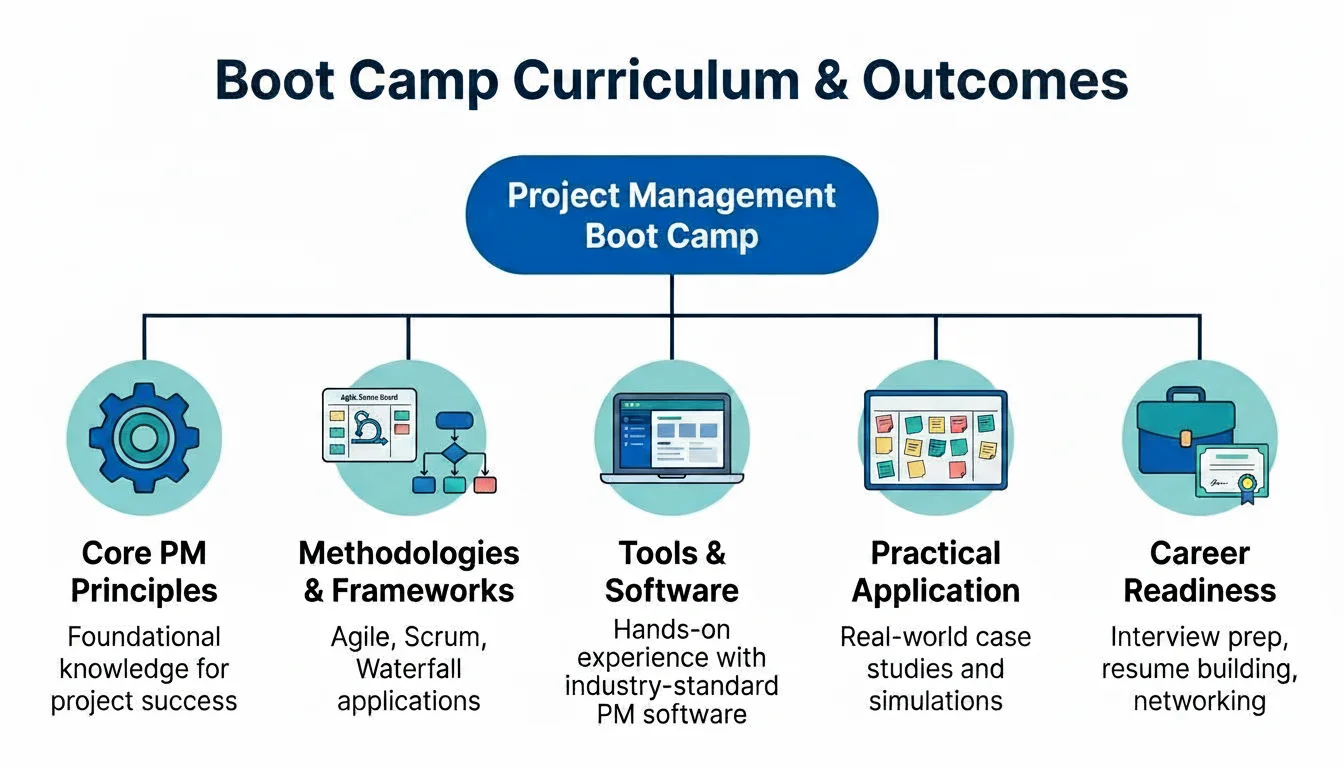 Caption: A visual representation of a comprehensive Project Management Boot Camp curriculum, highlighting the interconnectedness of foundational principles, diverse methodologies, essential tools, real-world applications, and practical career readiness strategies.
The core topics you’ll usually meet
Most project management boot camps use a standard structure. This structure creates a framework for managing any type of work, but it is especially useful for the unpredictable nature of IT.
| Curriculum Area | What You Learn & IT Application |
|---|---|
| Project Foundations | You learn to distinguish a specific project, such as building a mobile app, from routine daily work, such as resetting user passwords. You study how to define success using data, like meeting specific service level agreements or hitting user adoption targets. |
| Scope and Planning | You learn how to take a giant goal, like a cloud migration, and break it into small, manageable tasks. This process prevents scope creep, which happens when a project grows larger without any increase in time or money. |
| Scheduling and Sequencing | You learn to identify which tasks depend on others. For instance, you cannot deploy an application before the database is configured. You learn how to find the critical path and how to adjust when a developer gets sick or a server fails. |
| Cost and Resources | You learn to link the work to the people and the money. This includes budgeting for software licenses, cloud computing credits, and the salaries of developers and testers. You learn how to track if you are spending too fast. |
| Risk and Change | You study how to find potential problems, like a security vulnerability or a change in government regulations. You learn how to manage these changes so they do not stop the project or cause a panic within the team. |
| Delivery Methods | You learn when to use different styles of work. You might use Agile for a fast-moving software update, but you might use Waterfall for a physical hardware installation. You also learn how to mix them into a hybrid model. |
| Stakeholder Communication | You learn how to speak to different groups. Your report to the CEO will look very different from your update to the coding team. You learn how to set expectations so that no one is surprised by a delay or a change. |
While these topics look neat and tidy in a table, the actual classroom experience is often different. It feels messy because real projects are messy. You might be learning about risk at the same time you are trying to figure out a budget. This is intentional. It mimics the reality of a project manager who has to handle five different problems at the exact same time. Learning to find order in that chaos is one of the most important skills you can develop in a boot camp.
The advanced concept that often separates beginners from professionals
One specific topic often makes new students nervous: Earned Value Management (EVM). Many people who do not have a background in finance or heavy math worry that they will not understand it. They think it is only for massive government contracts or giant bridge-building projects. This is a misunderstanding. The logic behind EVM is actually very simple and is extremely useful for IT projects of any size.
The main idea is that you should not wait until a project is over to find out that you failed. You need to know that you are failing while there is still time to fix it. Advanced boot camps teach EVM as a way to use math to see the future of your project. It uses three main numbers to tell you exactly where you stand.
First, you have Planned Value (PV). This is the value of the work you expected to finish by a certain date. Second, you have Earned Value (EV). This is the actual value of the work you have completed so far. Third, you have Actual Cost (AC). This is the amount of money you have actually spent to get that work done.
From these three numbers, you can find two key indicators. The Cost Performance Index (CPI) tells you if you are over or under budget. If your CPI is less than 1.0, you are spending more than you planned for the work you have finished. The Schedule Performance Index (SPI) tells you if you are on time. If your SPI is less than 1.0, you are moving slower than you planned.
In the IT world, projects go over budget all the time. Research shows that overruns of 20% to 40% are common (verify these figures at Turing Cyber Tech). Using EVM helps you spot these overruns early. If your CPI starts to drop in the second month of a six-month project, you can change your strategy immediately.
Here is an example of how this works in a real IT setting. Imagine you are leading a project to build a new data analytics platform. Your plan says that by week 8, half of the work should be done. That is your Planned Value. When week 8 arrives, you look at the progress and see that only 30% of the platform is actually working. That 30% is your Earned Value. When you check the bills, you see that you have already spent 60% of your total budget. That 60% is your Actual Cost.
EVM turns these numbers into a clear warning. You are 20% behind on your schedule, and you have spent double what that 30% of work should have cost. This is not a guess. It is a mathematical fact. You can now go to your leadership and explain exactly why the project is in trouble and what resources you need to fix it before the budget runs out.
What this feels like in practice
Consider a team rolling out a new enterprise resource planning (ERP) system across several different business departments. This is a complex task with many moving parts.
A beginner project manager might give a status update like this: "The team is working hard. We are making progress on the integration, and everyone is very busy." This update tells the boss nothing. It provides no data to help make decisions.
A project manager who has finished a boot camp and earned a PMP certification would say it differently: "The system configuration is on track, and our Earned Value matches our Planned Value for that specific phase. However, our user testing is falling behind. The Earned Value for testing is much lower than what we planned. This has pushed our SPI below 1.0. We are not getting the value we expected for the time we have spent. I recommend we move two developers to the testing team for two weeks to get back on track."
The second statement is much more useful. It takes vague feelings and turns them into clear, actionable information. IT organizations value this kind of precision. It allows them to manage risks proactively rather than just reacting to disasters as they happen.
EVM is not about complex math or corporate jargon. It is about having the vision to see project problems before they show up on a final budget report. It is about early detection.
Reflection Prompt: Look at a project you are working on right now. If you calculated the Earned Value today, would it match what you planned to have finished by this date?
The outcomes that matter after class
A boot camp should give you more than just a certificate to hang on a wall. It should change the way you think and act on the job every day. When you finish a high-quality program, you should see several specific changes in your professional behavior.
- A Shared Vocabulary: You will be able to talk about things like scope baselines, risk registers, and critical paths. You will not have to guess what these terms mean. This makes it easier to talk to other departments and ensure everyone is on the same page.
- A Planning Mindset: You will stop seeing a big project as one giant mountain. Instead, you will see it as a series of small, manageable steps. You will naturally start breaking down a project, like a data center move, into tiny pieces that you can control.
- A Data-Driven Reporting Habit: You will stop saying "I think we are okay." Instead, you will use charts, defect rates, and performance indexes to prove where the project stands. You will rely on evidence rather than your gut feeling.
- Methodology Awareness: You will understand why a specific way of working is better for a specific project. You can explain why a software team should use Scrum, but an infrastructure team might need a more traditional Waterfall approach. You will be able to justify these choices to your boss.
- Exam Alignment: If your goal is a certification like the PMP, you will understand how the exam writers think. You will know how to read a tricky question and figure out exactly which project management principle they are testing.
Good boot camps also give you time to use modern tools. You might spend time working in Jira, Asana, or Microsoft Project. You might participate in simulations where things go wrong on purpose. This hands-on work is vital. It is one thing to read about a risk register in a book, but it is much different to keep one updated while three different stakeholders are arguing about what the top priority should be. By the time the class ends, you should feel ready to handle those real-world conflicts with confidence.
Choosing Your Path: Introductory vs. PMP Boot Camps
Many professionals find themselves in a familiar situation: they sign up for a fast-paced weekend project management boot camp because the marketing promises immediate career growth. By Monday morning, they have memorized a list of terms, but they still feel confused. They are often unsure if they needed a foundational understanding of how to run a project or if they actually required the specific, rigorous test preparation needed for a PMP certification. This common error results in lost time and a lack of confidence when actually performing the work.
The best way to avoid this is to ask a direct question about your goals. Are you trying to learn how project work actually happens in an IT environment? Or is your immediate goal to meet the eligibility requirements and pass the PMP exam? Your answer will determine which training path fits your current needs.
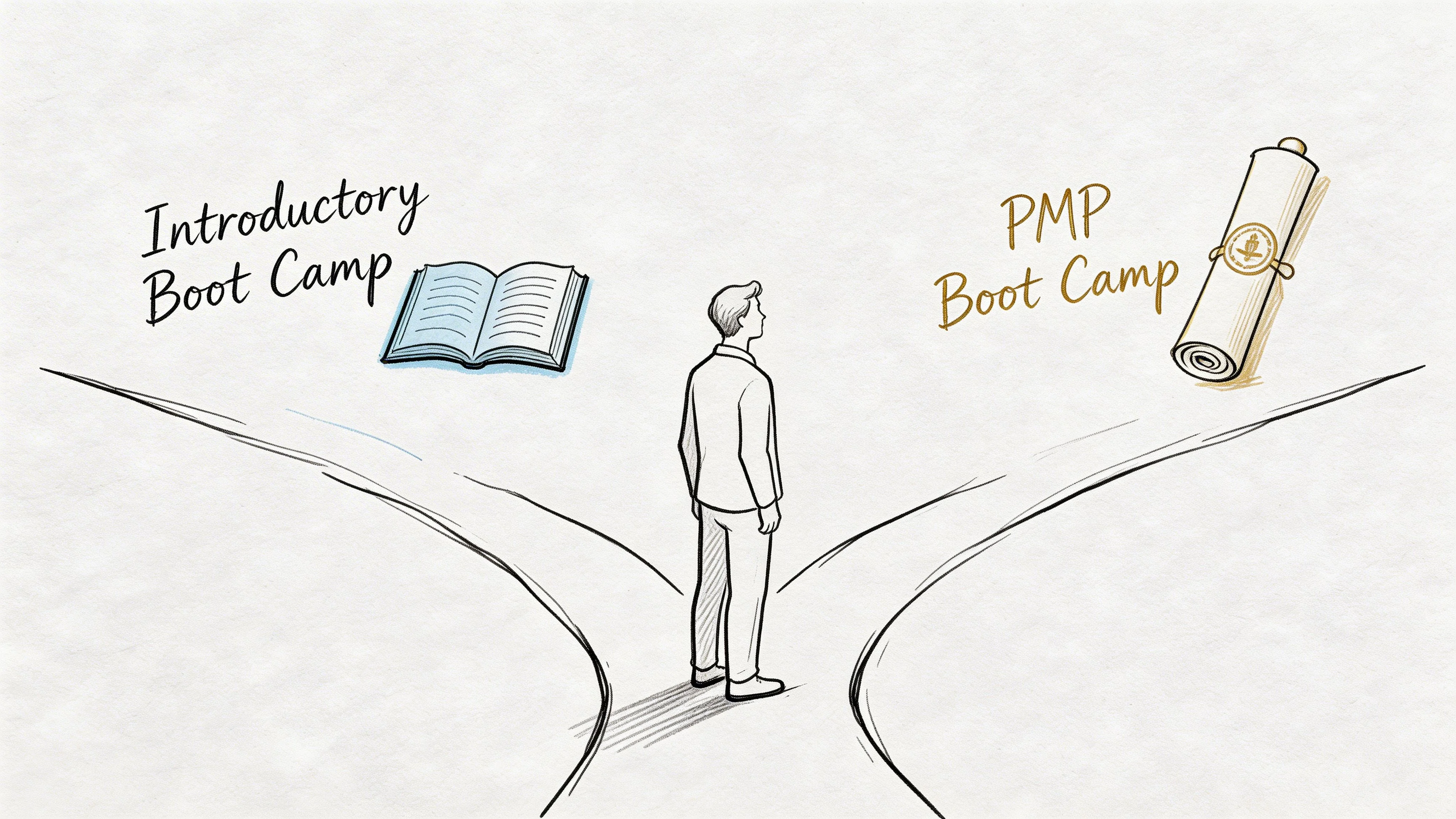 Caption: Navigating your project management career path: A visual metaphor for choosing between foundational introductory training and a specialized PMP certification boot camp.
The introductory route
An introductory project management boot camp works best for those shifting into IT project roles or early-career staff who need a formal structure. This includes technical specialists, such as DevOps engineers or cybersecurity analysts, who frequently lead specific tasks but have never been taught how to manage a full project lifecycle.
The main goal of this training is to build a clear framework before you try to tackle advanced topics. You will learn how to distinguish between a project and standard operations. For example, implementing a new enterprise security system is a project with a start and end date. Routine server patching or handling daily service desk tickets is an operational task. Understanding this difference is vital for resource planning.
You will also learn how project scope affects your timeline and how to spot risks early in a technical environment. The training covers how to report progress to management and the differences between delivery methods like Agile, Waterfall, and Hybrid. A strong beginner program gives you the skills to contribute to meetings. You will not feel like people are speaking a different language. Instead, you will follow the logic of the project plan and contribute to its success.
This path is the right choice if you find yourself asking these questions:
- “What truly differentiates an IT project (such as a new software release) from routine IT operations or standard service desk tickets?”
- “How do I determine whether an IT team needs an Agile framework, a traditional Waterfall approach, or a hybrid model for their specific work, like application development versus a data center migration?”
- “What are the essential components of a useful status update for stakeholders when I am trying to explain technical progress or complex roadblocks?”
The goal here is practical fluency in the workplace. You will be prepared for roles like IT Project Coordinator or Junior IT Project Manager. Even if you stay in a technical role, you will become a more effective lead who can work with senior project managers to hit deadlines.
The PMP route
A PMP boot camp serves a different type of student. It assumes you already have years of experience managing projects. These students do not need to learn what a project is; they need to learn how the Project Management Institute (PMI) defines project management. They require focused preparation that matches PMI eligibility requirements.
These programs follow the structure of the PMP exam. They focus on the specific logic used in exam questions, situational scenarios, and a thorough review of the exam domains. A major reason professionals take these courses is to earn the 35 hours of formal project management education. The PMI website states that all candidates must have these 35 hours before they can apply for the exam. For an experienced manager, these intensive sessions are the fastest way to check that box.
If you have other professional certifications, such as being a certified public accountant or a security specialist, you already understand how professional education hours work. You can look at this guide on CPE credit to see how structured training hours support various certification systems.
I must offer a caution based on years of observing these programs. Many PMP boot camps function only as "cram sessions." They help you pass the test, but they do not always help you develop the judgment needed for real-world IT problems. This is a growing problem because many standard courses ignore modern tools. They might mention AI-assisted planning or automated reporting as an afterthought, even though these tools are changing how we work. If a program only teaches you the terminology from a few years ago, you might pass the exam but still feel unprepared for a modern IT office. You need to be ready for an environment where predictive analytics and real-time data drive decisions.
A side-by-side view
To help you choose the right path, use this table to compare the two types of boot camps.
| Question | Introductory Boot Camp | PMP Boot Camp |
|---|---|---|
| Who it fits | People moving into IT project roles, Project Coordinators, and technical staff like software engineers or network admins. | Experienced IT professionals who need PMP certification, including senior Project Managers and Program Managers. |
| Main purpose | To build a foundation of project knowledge and learn how to speak the language of IT project delivery. | To meet the 35 contact hours requirement and prepare to pass the PMP exam on the first attempt. |
| Typical focus | Basic concepts, Agile and Waterfall methods, software tools, and how to communicate with technical teams. | The three PMP exam domains: People, Process, and Business Environment. It focuses on PMI terms and test strategies. |
| Best outcome | Getting your first job in project management or becoming a better technical lead who understands the big picture. | Earning your PMP certification to validate your years of experience and qualify for senior leadership roles. |
It is easy to think the PMP route is always better because the title carries more weight. However, that is like signing up for a marathon when you are still learning how to walk for exercise. if you do not understand the basic principles of how a project moves from start to finish, advanced exam prep will feel overwhelming. You might memorize the answers, but you won't be able to apply the lessons when a project goes off track.
Mentor’s shortcut for IT professionals: You should choose introductory project management training if you still find project terminology or methodologies confusing in your current IT role. You should choose PMP certification preparation if you have already managed many IT projects and simply need a structured way to prove that experience and pass the exam with confidence.
If you are ready for the PMP path, look for programs that offer more than just test tips. Some PMP boot camps show the difference between a quick cram session and a study plan designed to help you remember the material for years. This is the main focus of the Mindmesh Academy model. Learning should not be a rushed sprint over a single weekend. Instead, it should involve evidence-based practice and the use of modern tools. A good program will include the context of AI and other new technologies that standard boot camps often miss.
If you prefer to learn by watching and listening, the following video provides a helpful overview. It covers the basics before you start comparing different training providers in detail:
## How to Evaluate and Select the Right Boot CampOnce you have determined whether an introductory path or one focused on PMP certification matches your career goals, the hard work of selection begins. Your objective is to separate genuine instructional value from high-pressure marketing tactics. Approach the evaluation of a project management boot camp with the same technical rigor you would use for a high-priority IT project plan. You are looking for a program that aligns with your specific needs, reflects current technical realities, and provides evidence that it can produce the specific results you want.
Start with curriculum relevance
Curriculum gaps are the most significant flaw in many project management programs available right now. While many providers can teach the core concepts found in the Project Management Body of Knowledge (PMBOK® Guide), they often stop there. They cover project lifecycles, risk registers, scope statements, and scheduling techniques, but they treat new technologies as an afterthought. For an IT professional, failing to address the role of artificial intelligence and advanced data analytics is a major mistake. You need to be ready for how projects are managed now, not how they were managed five years ago.
Statistics from a 2025 PMI report show that 68% of organizations now use AI for project prediction and forecasting. Despite this, only about 12% of boot camps have fully updated their course materials since 2024 to include topics like AI ethics or the practical use of tools such as Microsoft Copilot for Project Management. Gartner estimates that 80% of project management tasks will be AI-augmented by 2026. If a training company ignores these shifts, their curriculum is becoming obsolete. You might pass your exam, but you will find yourself unprepared for the actual technical challenges you will face on the job.
This does not mean you must find a course that teaches machine learning. Instead, look for a program that explains how AI supports standard functions. You should learn how to use these tools to forecast timelines, automate status reports, identify risks in complex systems, and handle administrative overhead. Gaining experience with Jira, Asana, Monday.com, or Azure DevOps Boards when they are enhanced by automation is much more useful than studying abstract management theories in a vacuum.
The checklist I’d use
When you compare different project management boot camp programs, use these specific questions to verify the quality of the investment:
- Who teaches the course? Seek out instructors who have led actual IT projects in professional environments. Ask about their background in software development lifecycles, cloud migrations, or cybersecurity rollouts. Verify that they hold a current PMP certification and have experience with Agile frameworks. An instructor who has never managed a technical team will struggle to provide context for the theoretical concepts they teach.
- How current is the study material? Review the syllabus for mentions of modern planning tools and predictive analytics. The course should discuss how to use collaboration platforms like Microsoft Teams or Slack with project management integrations. If you are pursuing a certification, confirm the syllabus follows the most recent version of the PMBOK Guide.
- What kind of exercises are included? High-quality programs use simulations and case studies based on real-world IT scenarios. You should be asked to manage a simulated project crisis or solve a problem related to scope creep. These practical applications are far more effective than watching a long series of presentation slides.
- How is exam preparation handled? If you are in a certification-track program, ask if the provider includes a large bank of practice questions. They should offer feedback on your practice scores and teach specific strategies for managing your time during the actual test.
- What support is available after the course? Check if you will have continued access to study materials, recorded sessions, or updated practice exams. Learning doesn't end when the class stops, and post-course resources help you retain the information until your exam date or until you start your next project.
- How does the schedule fit your availability? An intensive boot camp requires your full attention. If you have heavy work commitments, a five-day immersion might be difficult to manage. Be realistic about whether you can dedicate the necessary hours to the program without distractions.
I also suggest using a dedicated PMP practice exam to test your knowledge. Taking a test under simulated conditions will show you if you have actually mastered the material or if you are just recognizing terms you saw in a lecture.
What the daily pace usually feels like
The mental effort required for a project management boot camp is significant. Most students find the volume of information challenging. To help you prepare, here is a breakdown of what a typical five-day intensive schedule looks like, organized like a fast-moving IT project sprint:
| Day | Morning Session (9 AM - 12 PM) | Afternoon Session (1 PM - 5 PM) |
|---|---|---|
| Day 1 | Foundations of project management. Defining roles in IT teams and the project lifecycle. Differentiating between ongoing operations and unique projects. | Defining scope for technical projects. Building a Work Breakdown Structure (WBS) for a software module. Identifying and mapping stakeholders for a new application rollout. |
| Day 2 | Scheduling logic and dependency mapping. Understanding why infrastructure must be ready before database installation. Critical path analysis and milestone planning for Agile releases. | Identifying risks in IT security projects. Creating strategies for production outages. Managing change control processes when a system requires an emergency upgrade. |
| Day 3 | Reviewing different delivery models, including Waterfall, Agile, and hybrid approaches. Examining case studies of successful and failed IT projects. | Team exercises focused on handling scope creep. Collaborative Scrum simulations, including Sprint Planning. Communicating project status to technical and non-technical audiences. |
| Day 4 | Cost control and budgeting for IT departments. Establishing reporting mechanisms and tracking performance using Earned Value Management (EVM) methods. | Solving complex exam scenarios or participating in a workshop on vendor migration. Applying management principles to a high-pressure technical challenge. |
| Day 4 | Cost control and budgeting for IT departments. Establishing reporting mechanisms and tracking performance using Earned Value Management (EVM) methods. | Solving complex exam scenarios or participating in a workshop on vendor migration. Applying management principles to a high-pressure technical challenge. |
| Day 5 | Focusing on areas where students struggle. Learning techniques to analyze difficult exam questions. Final review of the core curriculum. | Final project simulation or a full-length practice exam. Creating a study plan for the weeks following the course. Discussing how to apply these skills in current IT roles. |
This schedule is demanding. If a training provider claims the course is easy or low-stress, they are likely not providing the depth of instruction you need to be successful.
Red flags that deserve skepticism
You should be wary of certain signs during your research. If a provider claims to teach "modern project management" but never mentions how AI is changing the field, that is a problem. You should also be cautious if a school refuses to show you a detailed syllabus before you pay. Watch for generic testimonials that do not explain what the students actually learned or how they applied it.
Keep an eye out for these specific warning signs:
- Outdated project examples: If the case studies focus on old technology or pre-cloud environments, the teaching methods are probably outdated as well. You need to learn how to manage projects in a world of remote teams and rapid software deployments.
- Lack of practical assessments: If you are not required to complete exercises, simulations, or tasks, you are just a passive observer. You will likely finish the course with a general familiarity with the terms but no ability to use them on a job.
- Vague career promises: Reliable programs tell you exactly which skills you will learn and what kind of support they offer, such as resume reviews or interview prep. Avoid programs that make broad, unverified claims about salary increases or job placements.
- A single design for all students: A person new to project management has different needs than a veteran manager studying for a certification. If a program uses the exact same content for both groups, it is likely too simple for the professional and too fast for the beginner.
Choose a boot camp that prepares you for the actual project work you will perform next year, rather than one that only helps you pass a test next month. Your goal is to gain functional skills that survive long after the exam is over. UM Relief and similar organizations offer resources that emphasize this type of long-term readiness.
ROI of a Project Management Boot Camp
Professionals rarely doubt that education requires a financial commitment. Instead, their primary concern is whether that commitment leads to a real, visible shift in their professional life. This is the correct focus. A project management boot camp justifies its price tag when it speeds up your transition into more significant work, increases your salary, or opens doors to senior IT roles that once felt out of reach.
The measurable career case
The strongest argument for these programs centers on employability and career advancement for IT staff. Data shows that these programs produce results. Specifically, 72% of graduates secure a position in the field within six months of completion. Around 73% of participants report feeling ready for the specific challenges of a new workplace, and 80% of employers express satisfaction with the practical skills these students demonstrate on the job.
Financial gains follow this preparation. Graduates often see a 17% median growth in pay and a $11,000 salary increase within just twelve months of finishing their program (verify current figures on the DigitalDefynd site). These numbers matter because they show that the training translates to market value. PMP exam success is one part of the equation, but the broader data suggests that employers in the competitive IT sector respect the applied training provided by an effective boot camp.
Financial return is only half the story
While salary jumps are easy to measure, the real impact of this training often shows up in ways that are harder to put on a spreadsheet. In many mentoring sessions with IT staff, I have seen that the return on investment appears in three specific areas:
- You become easier to trust with ambiguity. IT managers eventually stop viewing you as someone who only handles specific technical tickets. Instead, they see a leader who can take a messy situation and create order. You might be asked to organize a software release where requirements change weekly or coordinate a cloud migration that involves multiple secure environments. Your ability to handle these shifting parts makes you a safer bet for high-stakes projects.
- You communicate with authority and clarity. You develop the skill to explain technical risks without getting lost in jargon. When a project hits a snag, you can explain the trade-offs between different IT solutions to stakeholders. You can tell a technical team why a deadline is firm and explain to an executive why a specific feature will take longer than expected. This clarity helps everyone move faster and reduces friction between departments.
- You gain career mobility. Project management gives you a framework that works across many domains. The way you plan and execute work in software development is remarkably similar to how you manage DevOps or cybersecurity initiatives. This shared methodology allows you to move between different technical departments or industries without losing your professional standing. A boot camp provides the standard structure for how work is planned and delivered, making your background relevant to many different teams.
Where ROI gets overstated
Be careful with exaggerated claims. A boot camp will not replace the need for sound judgment or actual experience. IT projects fail for many reasons, and a certificate alone won't stop that. If you finish the course but cannot describe how you would manage a risk register for a new product, the market will not reward you. You must be able to handle real problems, like a delayed dependency in a deployment pipeline or a conflict between engineering and product owners. If you cannot apply the tools, the job market will ignore the credentials.
Measure your progress in these distinct layers to track your actual return:
| ROI Layer | What to Look For (IT Context) |
|---|---|
| Immediate | Clearer understanding of IT project lifecycles, stronger resume language (e.g., using Agile terminology), immediate PMP exam readiness (if applicable). |
| Near-term | Delivering more compelling interview answers focused on IT project scenarios, increased confidence in project discussions, improved fit for IT Project Coordinator or Scrum Master roles. |
| Long-term | Access to promotions (e.g., from IT Project Manager to Program Manager), broader responsibility for strategic IT initiatives, more durable professional credibility within the tech industry. |
A PMP certification may help open the door to new opportunities. Your demonstrated ability to effectively manage uncertainty, risks, and changes in complex IT projects is what truly keeps you in the leadership room.
Beyond the Boot Camp: A Smarter Way to Learn with Mindmesh
One of the most obvious flaws in the traditional project management boot camp model is not the quality of the teaching. The real issue is the human brain's struggle with long-term memory.
You might take in huge volumes of data during an intensive week of study. You learn frameworks and memorize specific formulas. However, this knowledge often starts to fade once you return to a standard work routine. Your inbox fills up. Meetings resume. Consistent review usually becomes a low priority. Within two weeks, terms and concepts that felt clear in the classroom can become difficult to recall during a project crisis. This does not mean training programs are useless. Instead, it shows that intensity and retention are different challenges that need different solutions.
Why cramming often disappoints good students
Students often confuse recognizing a term with actually knowing how to use it. During an intensive course, you stay immersed in the content. You hear terms like Scrum, the critical path, or EVM formulas every hour. You solve practice problems back-to-back while maintaining total focus on the subject. This creates a strong feeling of competence, but it is often temporary.
Without systematic reinforcement, the ability to recall and apply that information under pressure disappears quickly. Project management is hard to retain because it combines vocabulary, logic, math, and judgment. You cannot master these skills through passive reading alone. Real retention requires retrieving information at specific intervals. You must prove you can apply the knowledge when the answer is not right in front of you. This is the difference between passing a practice test in a quiet room and managing a high-stakes IT project.
What sustainable learning looks like
Mastering project management for the PMP certification requires a mix of focused study and intelligent review. Do not try to hold every detail in your head after one long sprint. Instead, rotate concepts back into your study sessions over several weeks.
You should prioritize reviewing weak topics more often than the ones you already know. Test your recall of Agile principles or mathematical formulas instead of just looking at the answers. Track your performance in domains like risk management or stakeholder engagement using timed simulations. This method prevents the "memory leak" that occurs after an intensive course ends.
Mindmesh Academy fits naturally into this cycle. It provides a platform built for long-term retention using spaced repetition, adaptive learning paths, and thorough progress tracking. You can use it to build a foundation before a class starts or to keep your skills sharp after a boot camp ends. It serves as a flexible alternative if a one-week schedule does not fit your professional life. By using a system that adapts to what you have forgotten, you spend more time on difficult concepts and less time on material you have already mastered.
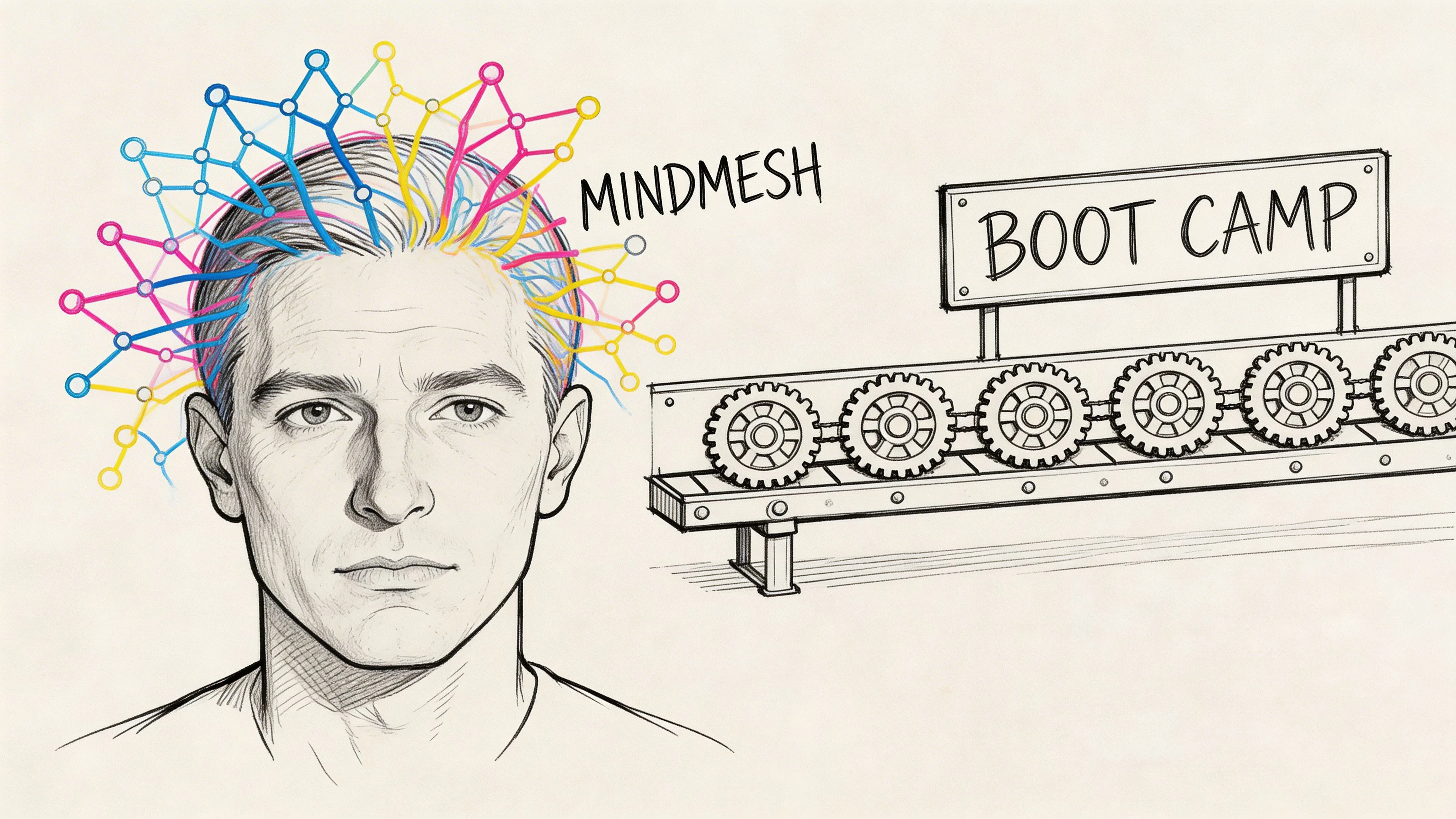 Caption: Visualizing the Mindmesh Academy approach to sustainable learning, blending neural connections for retention with adaptive pathways for continuous skill development in project management.
How I’d use each path
Career changers in the IT sector find that an introductory boot camp provides quick orientation. It helps you see how projects are structured. However, you will need daily repetition to make that new language feel natural. You do not want to be looking up definitions while you are leading a team or talking to stakeholders. The goal is to make the methodology second nature so you can focus on the people and the technology.
In contrast, experienced project managers often use these sessions to organize their existing knowledge. A boot camp helps you focus on what the exam specifically asks for. You still need ongoing practice for the complex logic and scenario analysis required for the current test. The exam asks you to apply knowledge to difficult situations, rather than just repeating definitions. If your schedule is unpredictable, a slower, evidence-based system often works better. It matches how adults actually learn and prevents the "reset" that happens when you stop studying for three days because of a work emergency.
The long-term career lens
Five years into your career, your colleagues will not care how hard you studied for one week back in 2026. They will care if you can save a failing IT initiative. They will look to see if you can explain technical trade-offs to executives or use modern tools to find efficiencies.
This is why the lack of AI coverage in many current boot camps is a significant problem. If a program only teaches traditional processes without mentioning AI-supported prediction or reporting, it is incomplete. It might help you pass a test, but it will leave you underprepared for the current reality of technical project work. Modern projects move too fast for manual tracking alone. You must know how to use automation to stay ahead of risks.
Boot camps have their place. They build momentum and provide structure. But the best IT leaders combine that intensity with constant reinforcement. They do more than just finish a course; they build a memory that lasts. They focus on clear judgment and staying adaptable as technology changes. This balanced approach ensures that when a project faces a sudden crisis, your training is ready to be used, not forgotten in a notebook from three months ago.
If you want a learning path that builds thorough project management knowledge for the long term, Mindmesh Academy offers certification preparation designed for retention. It is a tool for those on a PMP-focused route, people rebuilding their foundational understanding, or anyone looking to reinforce the skills started in an intensive boot camp.

Written by
Alvin Varughese
Founder, MindMesh Academy
Alvin Varughese is the founder of MindMesh Academy and an enterprise architecture leader. An electrical engineer by training, he moved from factory automation in South Africa to cloud architecture at GE Appliances and Humana (Fortune 50), and holds 20 professional certifications including AWS Solutions Architect Professional, Azure DevOps Engineer Expert, and Microsoft Agentic AI Business Solutions Architect. He built MindMesh Academy after interviewing too many highly certified candidates who couldn't answer basic questions: the goal is prep that makes you better at the job, not just able to pass the exam.