
Choosing Books on AWS: A Strategic Study Guide
Choosing Books on AWS: A Strategic Study Guide
You're probably starting your AWS learning journey the same way many others do. You open a bookstore page, search for AWS books, and face an overwhelming number of options: certification guides, architecture manuals, serverless titles, data analytics books, or DynamoDB resources that look brilliant if you already know what a partition key is, and intimidating if you don't.
This overload leads to a common mistake. People start hunting for the single best book, as if one title will solve everything. In practice, AWS study works better when you treat books as one component of a larger learning system. A book provides depth, structure, and context. What it typically doesn't offer is feedback on what you've forgotten, a clear way to track weak areas, or a mechanism to convert reading into lasting retention.
I coach learners who are intelligent, motivated, yet still stuck because their study method is passive. They read chapters, highlight paragraphs, and feel productive. Then a practice question asks them to choose between Amazon S3, Amazon EFS, Amazon DynamoDB, and Amazon Redshift for a real workload, and the details blur together. The issue wasn't a lack of effort. It was a flaw in the study design.
Beyond the Bestseller List
The most effective AWS learners stop asking, “What’s the best AWS book?” Instead, they ask a sharper question: What book fits my goal, my current level, and my study process?
This shift matters because AWS books serve different purposes. Some function as exam maps. Others act as technical references. Some are like a workshop, guiding you to build things as you go. If you acquire the wrong type of book, even a highly regarded title can feel unproductive.
Training for a long hike involves distinct tools. You need a trail map. You also need a field guide to weather and terrain. And you need the actual backpack you test on shorter walks. You wouldn’t confuse one for the other. AWS books operate similarly.
Practical rule: Don’t pick a book by popularity alone. Pick it by what it helps you accomplish.
A learner aiming for AWS Certified Cloud Practitioner needs a different reading experience than someone preparing for a specialty exam. A career changer often needs clearer explanations and more examples. An experienced engineer, on the other hand, might prefer fewer analogies and more discussions on architecture tradeoffs.
A strong study setup usually includes three elements:
- Core explanation: A book that clearly teaches service concepts.
- Hands-on reinforcement: Labs, examples, and architecture scenarios you can work through.
- Feedback loop: A method to test recall, identify weak areas, and review on a schedule.
That last part is where many readers falter. Reading feels solid in the moment, but memory fades quickly without revisiting the material. The best results typically come from combining the depth a book offers with an adaptive review process that continuously brings up what you're close to forgetting.
Understanding AWS Book Categories
Most learners see one giant category called “AWS books.” This is the primary source of confusion. It helps to sort AWS books the way you’d sort sections in a library. Once you do that, the shelf starts making sense.
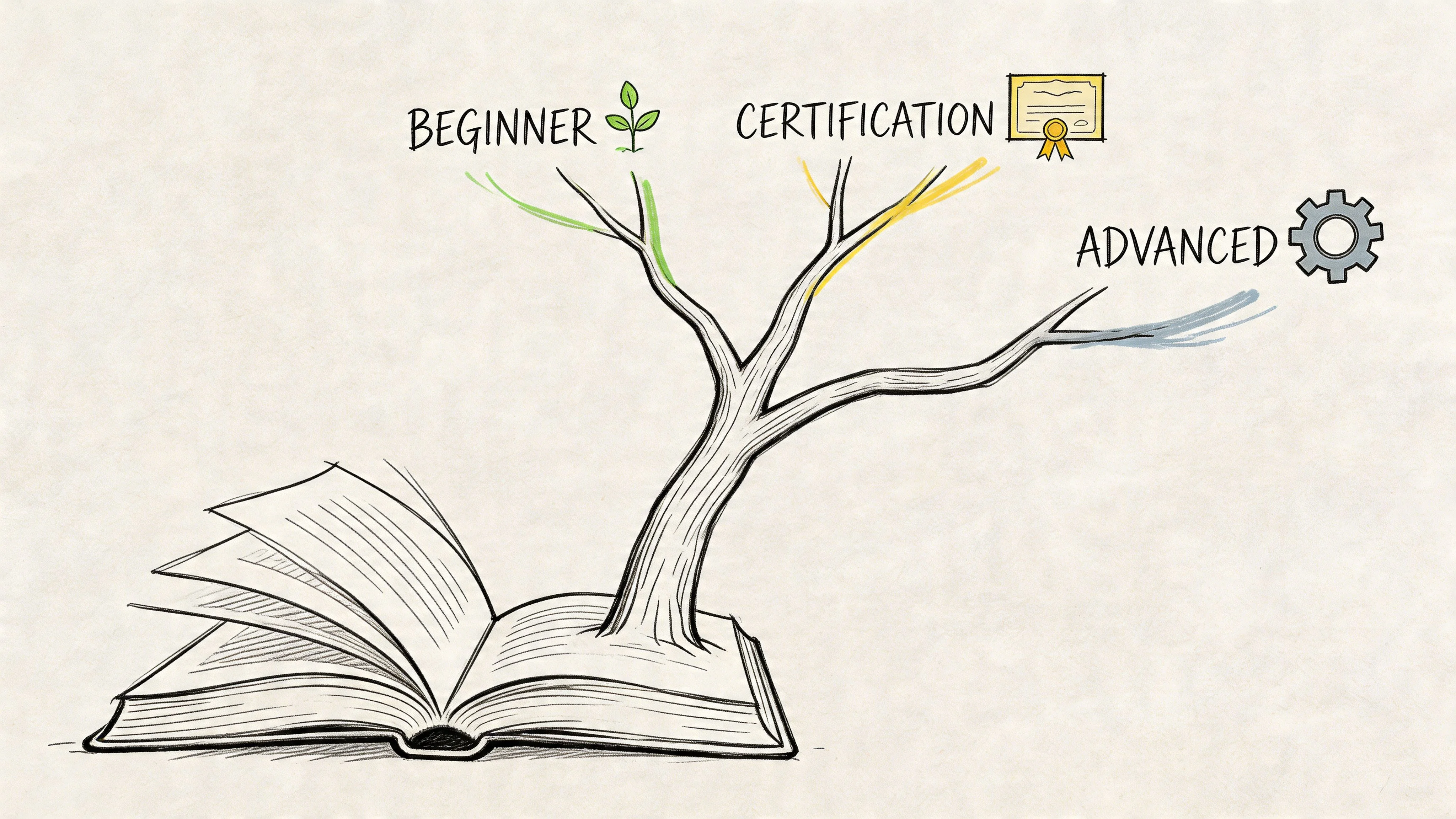
Official Certification Guides
These books act as your exam maps. Their main job is to ensure comprehensive coverage of exam topics.
They tend to follow the exam blueprint closely, which offers a clear checklist. For beginners, this structure can be reassuring, as you see the scope of the exam. You know where compute ends and storage begins. You recognize that identity, networking, monitoring, and pricing are all within the exam's scope.
The tradeoff is that official-style guides often prioritize breadth over depth. You might learn that Amazon Route 53 routes traffic, or that AWS Lambda runs code without managing servers, but still not feel comfortable choosing one service over another under pressure.
Third-Party Comprehensive Manuals
These books function like field manuals. They typically explain services in greater detail, add diagrams, and spend more time on why one design works better than another.
Many associate-level candidates find these books most beneficial. A strong manual can bridge the gap between "I’ve heard of this service" and "I can defend this architecture choice in an exam answer." These books often include lessons authors have learned from real implementation patterns, not just service definitions.
Still, these books have a limitation: AWS changes rapidly. Printed explanations can lag behind current service behavior or best practice wording.
Focused Specialty Books
These books are for specialized mastery. They aim to make you highly proficient in one area of the cloud, rather than covering the entire cloud.
A good example is in the analytics track. The AWS Certified Data Analytics - Specialty was introduced in October 2018, and advanced books aligned to it focus on services such as Amazon EMR, Kinesis, Redshift, and Athena. Demand for AWS credentials has grown sharply, with more than 1 million active AWS certifications by mid-2023. Prepared candidates for this specialty exam often see pass rates around 75-80% according to verified data tied to Data Analytics in the AWS Cloud. This matters because specialty study often falters without a strong reference text.
Project-Based Cookbooks
These are "build-first" books. They demonstrate how to create something concrete, often by walking through patterns or small solutions.
For some learners, these books are a turning point. Reading about IAM, API Gateway, or DynamoDB in abstract terms doesn't always stick. Building a small event-driven flow or deploying a simple application does. The downside is coverage. A cookbook might teach one path very well but leave major exam domains thinly covered.
What Books Don't Cover Well
Books excel at explanation. They are less effective at orchestration.
AWS literature still leaves a notable gap in connecting technical learning to broader training systems. Verified summaries indicate that books often neglect enterprise concerns such as cost governance, alignment with business KPIs, and visualizing team progress. Research also notes that 55% of IT leaders cite skill gaps as top cloud adoption barriers in 2025 Gartner reports, and that organizations are underserved when they need dashboards or adaptive paths for teams, as discussed in the AWS Well-Architected material linked here on serverless application guidance from AWS.
This same gap affects solo learners. You might understand a chapter but still lack a reliable way to measure whether that knowledge will last until next week.
Matching Books to Your AWS Certification Path
The right reading stack changes with the exam level. A beginner usually needs clarity and confidence. An associate candidate needs service comparison skills. A professional or specialty candidate needs depth, understanding of tradeoffs, and pattern recognition.
Foundational Path
If you’re aiming for Cloud Practitioner, don’t overwhelm yourself with heavy architecture books.
Use a clear certification guide as your main text. Only add a lighter third-party manual if the official material feels too sparse. Your study should focus on service purpose, billing basics, the shared responsibility model, core security concepts, and broad architecture vocabulary.
At this stage, your biggest risk isn't a lack of depth. It's getting lost in detail before you've built a foundational mental map.
Associate Path
At this level, book selection becomes much more critical.
For Solutions Architect Associate, a certification guide combined with an extensive manual is usually the strongest approach. You need to compare storage classes, networking options, database choices, and resilience patterns. You're no longer just memorizing names; you're making decisions.
For Developer Associate, keep one guide that tracks the exam domains, then add a focused book covering event-driven design, serverless patterns, and application integration. If billing and architecture tradeoffs confuse you, reading a practical cost primer such as CLOUD TOGGLE's AWS cost guide can help you think more clearly about service choices rather than treating them as isolated trivia.
For SysOps Administrator Associate, choose books that explain monitoring, operations, incident response, backups, and scaling behavior in clear language. This exam penalizes shallow familiarity.
If you’re planning your long-term career path, it helps to accelerate your career with certifications by choosing books that support both your current exam and your next one, rather than buying a completely new set of materials each time.
Professional Path
Professional-level candidates need books that explain systems, not just individual services.
At this level, expect longer scenario questions and more subtle distractors. A good book for Solutions Architect Professional or DevOps Engineer Professional needs to illustrate competing designs, migration concerns, automation patterns, governance choices, and failure handling.
Dense manuals are helpful here, as are books with architecture diagrams and explanations of implementation reasoning. Light exam "cram guides" usually aren’t sufficient on their own.
A professional-level AWS book should help you answer, “Why this design instead of the obvious one?”
Specialty Path
For specialty preparation, focused books are often essential.
The best verified example is the analytics track. For advanced credentials like the AWS Certified Data Analytics - Specialty, a specialized book is crucial because the exam blueprint expects comfort with analytics services and large-scale data workflows. Verified data also notes that AWS held 32% global cloud infrastructure share in Q4 2023, which contributes to the global relevance of these skills.
AWS Certification Book Recommendations
| Certification Level | Primary Book Type | Secondary Book Type | Study Focus |
|---|---|---|---|
| Foundational | Official certification guide | Light third-party overview | Core AWS concepts, billing, security basics |
| Associate | Comprehensive manual | Certification guide | Service comparisons, architecture choices, scenario reasoning |
| Professional | Deep technical manual | Architecture case-based resource | Tradeoffs, governance, automation, resilience |
| Specialty | Focused specialty book | Blueprint-aligned exam guide | Domain expertise in services tied to the specialty |
A short rule of thumb helps here:
- If you’re new: Choose clarity over completeness.
- If you’re at associate level: Choose comparison-heavy explanations.
- If you’re advanced: Choose books that explore architecture decisions under constraints.
- If you’re on a specialty path: Choose depth first, then layer exam practice around it.
A Framework for Evaluating Any AWS Book
A smart buyer doesn’t ask whether a book is famous. They ask whether it’s useful for how AWS works now. When learners tell me a book was “good,” I usually ask four follow-up questions: Was it current? Was it deep enough? Did it make you build anything? Did it match how you learn?
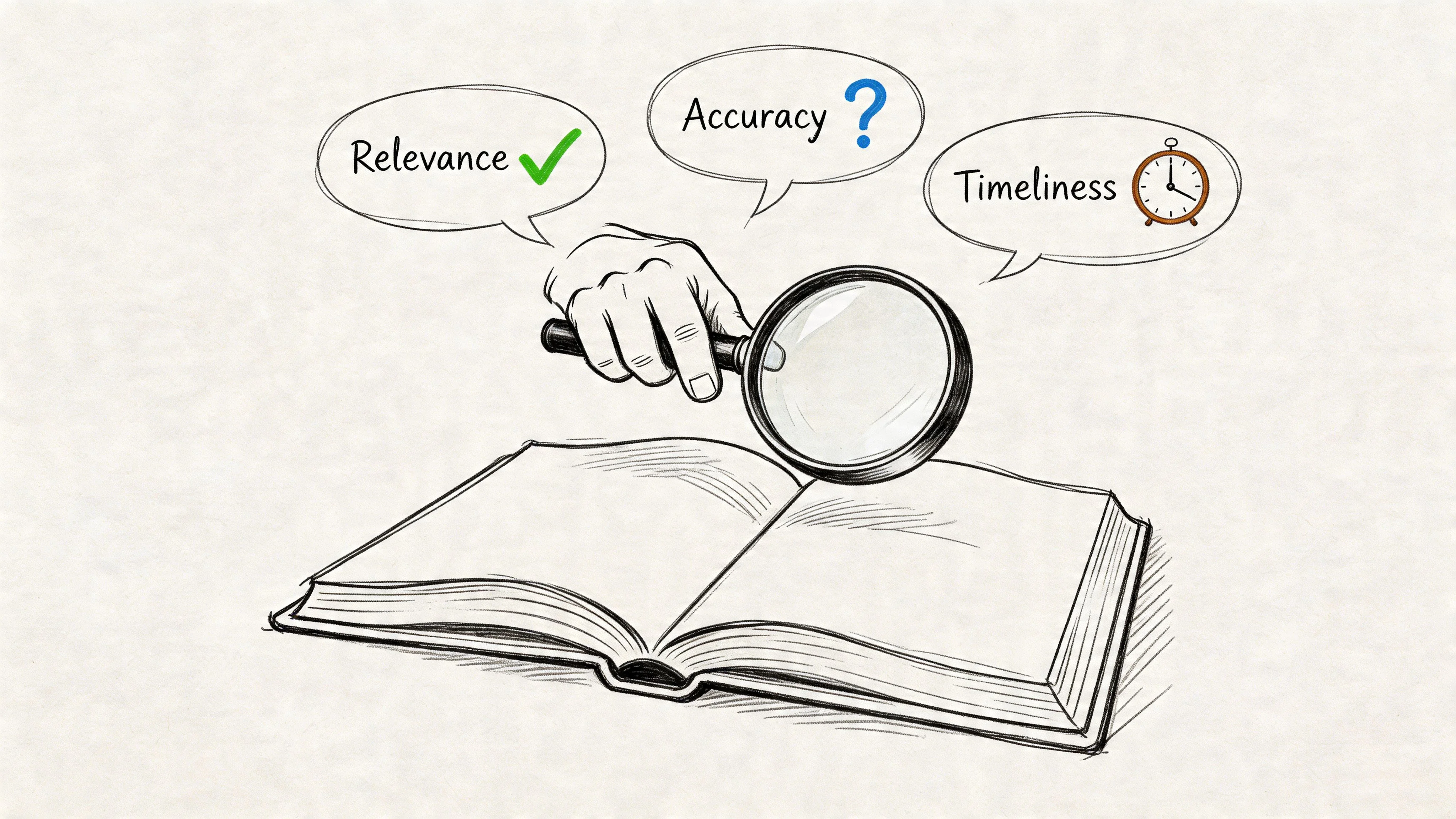
Check Freshness First
AWS evolves quickly enough that an outdated book can teach incorrect habits.
Look at the publication date, edition number, and the services emphasized in the table of contents. Then ask a simple question: Does this align with the exam version or skill target I care about? A strong older book can still teach architecture thinking, but a current edition is safer when your goal includes exam preparation.
Freshness isn’t only about dates. It’s also about whether the author writes in a way that still fits current AWS patterns. If examples continuously refer to outdated defaults or ignore newer service options, proceed with caution.
Look for Depth, Not Just Service Names
A weak AWS book lists services. A strong one explains decision logic.
The difference is easy to spot. If a chapter on serverless states that Lambda runs code on events and then moves on, that’s superficial coverage. If it explains event sources, scaling behavior, pricing logic, integration with API Gateway, and where the pattern fits or doesn’t fit, that’s useful depth.
A verified example appears in discussions of Amazon Web Services in Action by Andreas Wittig and Michael Wittig. The book’s treatment of AWS Lambda goes beyond slogans and into implementation patterns such as event-driven triggers, API Gateway integration, and combining Lambda with Elastic File System. Verified data also notes Lambda pricing at $0.20 per 1M requests plus $0.00001667 per GB-second as of 2024 updates, contrasted with baseline EC2 costs in the same example set, as summarized in this overview of AWS books and serverless automation. Whether you’re certification-focused or architecture-focused, that kind of detail signals a book that teaches you how to make informed decisions.
Coach’s note: If a book helps you compare services under a real workload, keep reading. If it only defines them, treat it as a supplement.
Judge Labs by Realism
Many books promise hands-on learning. Some deliver only superficial exercises.
Effective labs do at least one of three things: they connect multiple services, they force you to interpret an architecture choice, or they leave you with something you could explain to another engineer.
This is why some specialized books stand out. In The DynamoDB Book, Alex DeBrie emphasizes single-table design and access-pattern-first thinking. A verified summary highlights patterns involving composite keys, GSIs, DynamoDB Streams, and Lambda-based change data capture, with concrete discussion of throughput, latency, and cost behavior in the context of DynamoDB design. You can see that style reflected in this resource roundup that highlights DynamoDB modeling depth. Even if DynamoDB isn’t your primary exam domain, this demonstrates meaningful technical instruction.
Match the Writing Style to Your Brain
This aspect is often overlooked, but it's crucial.
Some learners thrive on dense manuals. They appreciate conciseness, precise language, and fewer anecdotal stories. Others need a more narrative flow with examples, diagrams, and repeated comparisons. Neither style is inherently superior; one is simply better for you.
Use this quick test before purchasing a book:
- Read a sample chapter: If you lose focus after two pages, the style might be wrong, even if the content is strong.
- Check the diagram density: Visual learners typically need architecture sketches, flow diagrams, and service maps.
- Scan the exercises: If the tasks are too simplistic, you won’t build confidence. If they’re too advanced, you’ll stop halfway.
- Notice the assumptions: Some books implicitly assume you already understand IAM, networking, or JSON policies.
A Practical Scorecard
You can rate any AWS book on four questions:
| Question | What good looks like |
|---|---|
| Is it current enough? | Recent edition, current service framing, exam-relevant scope |
| Is it deep enough? | Explains tradeoffs, not just definitions |
| Does it make you do anything? | Labs, architecture exercises, review questions, build steps |
| Does it fit your learning style? | Readable pace, diagrams or density based on your preference |
If a book scores well on three out of four, it’s likely a solid choice. If it misses on freshness and depth, it's probably best to leave it on the shelf.
How to Build an Integrated Study Plan with MindMesh Academy
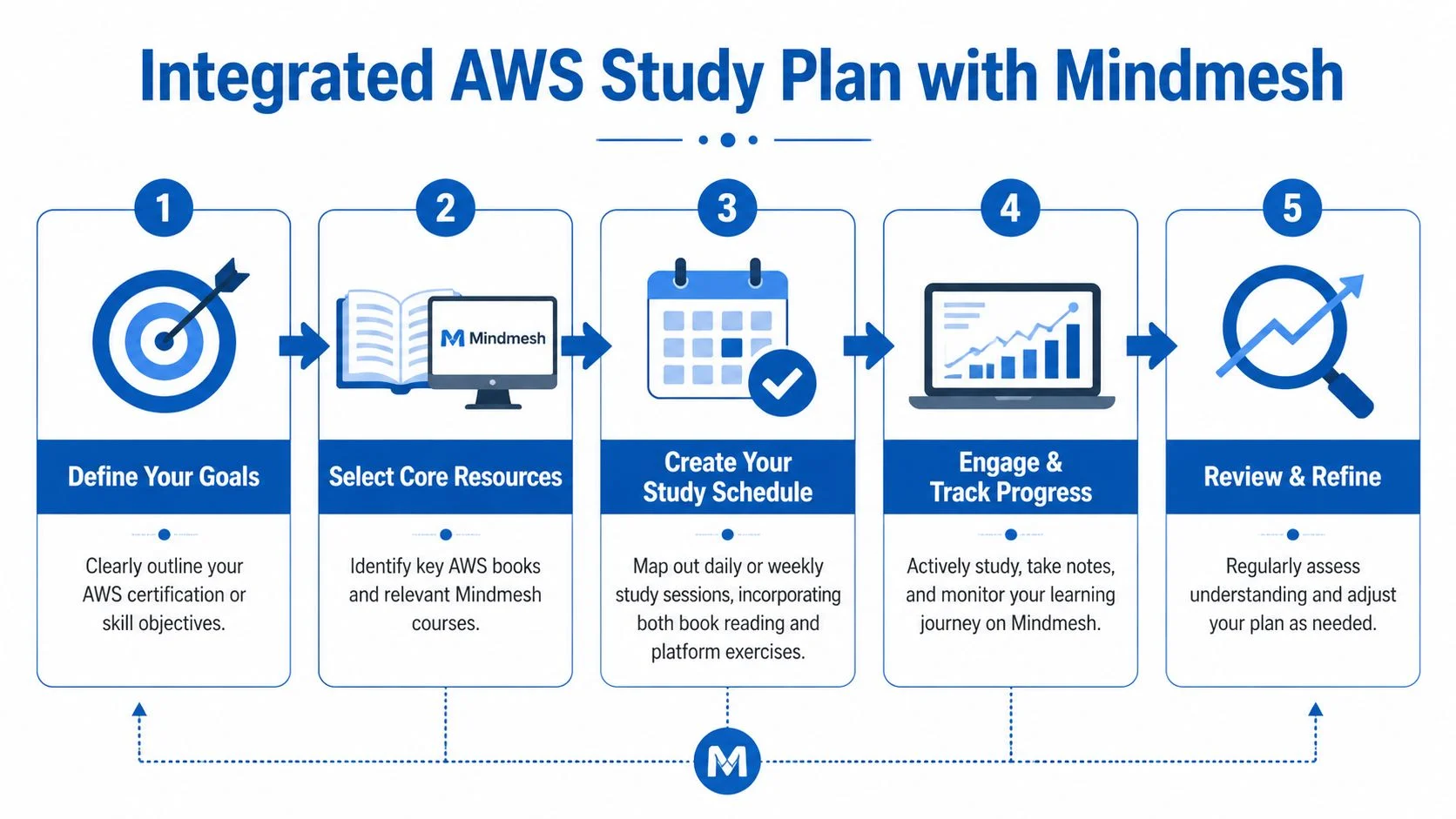
A book becomes powerful when you stop treating reading as the finish line. Reading is input. Learning occurs when you retrieve that input from memory, apply it in context, and revisit it before it fades.
The easiest way to visualize this is as a loop rather than a straight line.
Start with One Core Book and One Clear Goal
First, choose a certification target or a skills target. Then, select one primary book, not three.
If you’re studying for Solutions Architect Associate, your core text should explain service choices and architecture patterns. If you’re studying analytics, your core text should focus on the services and workflows in that specialty. A single anchor book provides structure for your study week.
Once that book is chosen, divide it into reading blocks. Don’t write “study AWS” on your calendar. Write “read storage chapter,” “review IAM notes,” or “build event-driven lab.”
Convert Chapters into Recall Material
Reading a chapter and highlighting it feels productive because the information is right in front of you. The real test is whether you can retrieve it later without the page open.
This is where a structured review system is crucial. After each chapter, convert the key ideas into short prompts. Compare Amazon SQS and Amazon SNS. Explain when to use Amazon EFS instead of Amazon S3. List the design reason for Multi-AZ in a database scenario. Keep the prompts brief enough for quick review.
For broader planning, I often direct learners to career-boosting AWS certification advice that emphasizes turning passive study into active review.
Pair Every Reading Block with an Action Block
After each substantial reading session, do something with the material.
That action could be a lab from the book, a small architecture sketch, or a set of exam-style questions. The key is sequence: read first for understanding, act second to expose weak spots, and review third to cement the lesson.
The rhythm looks like this:
- Read the chapter and extract the main ideas.
- Write short recall prompts from memory, not by copying.
- Complete the lab or scenario exercise tied to the chapter.
- Identify weak areas and tag them for extra review.
- Revisit those weak areas later instead of rereading everything.
Here’s a practical visual walkthrough before we go further:
Track Progress in a Way Books Can’t
Books are poor dashboards. You can finish a chapter and still not know whether you truly understand the material.
An integrated platform helps by making study measurable. You can track which domains you’ve covered, where your confidence is low, and what needs another pass. This matters for individuals, and even more for teams. As noted earlier, the literature gap around dashboards, adaptive pathways, and structured skill development is a real challenge.
“A finished chapter is not the same thing as a mastered chapter.”
Use Adaptive Review to Narrow Your Focus
Most learners waste time reviewing what already feels comfortable.
A better system continuously brings back the concepts you miss or hesitate on. If your weak spots are networking and storage edge cases, your next review block should automatically shift focus there. This is how you protect your time.
This approach gives books a new job. Instead of being the entire study method, they become the deep explanation layer within a wider loop of recall, practice, tracking, and revision.
Sample Schedules and Study Checklists
Theory helps. Calendars help more. If you’re using AWS books for Solutions Architect Associate, a four-week sprint can be effective when each week has a clear theme and each day has one primary task.
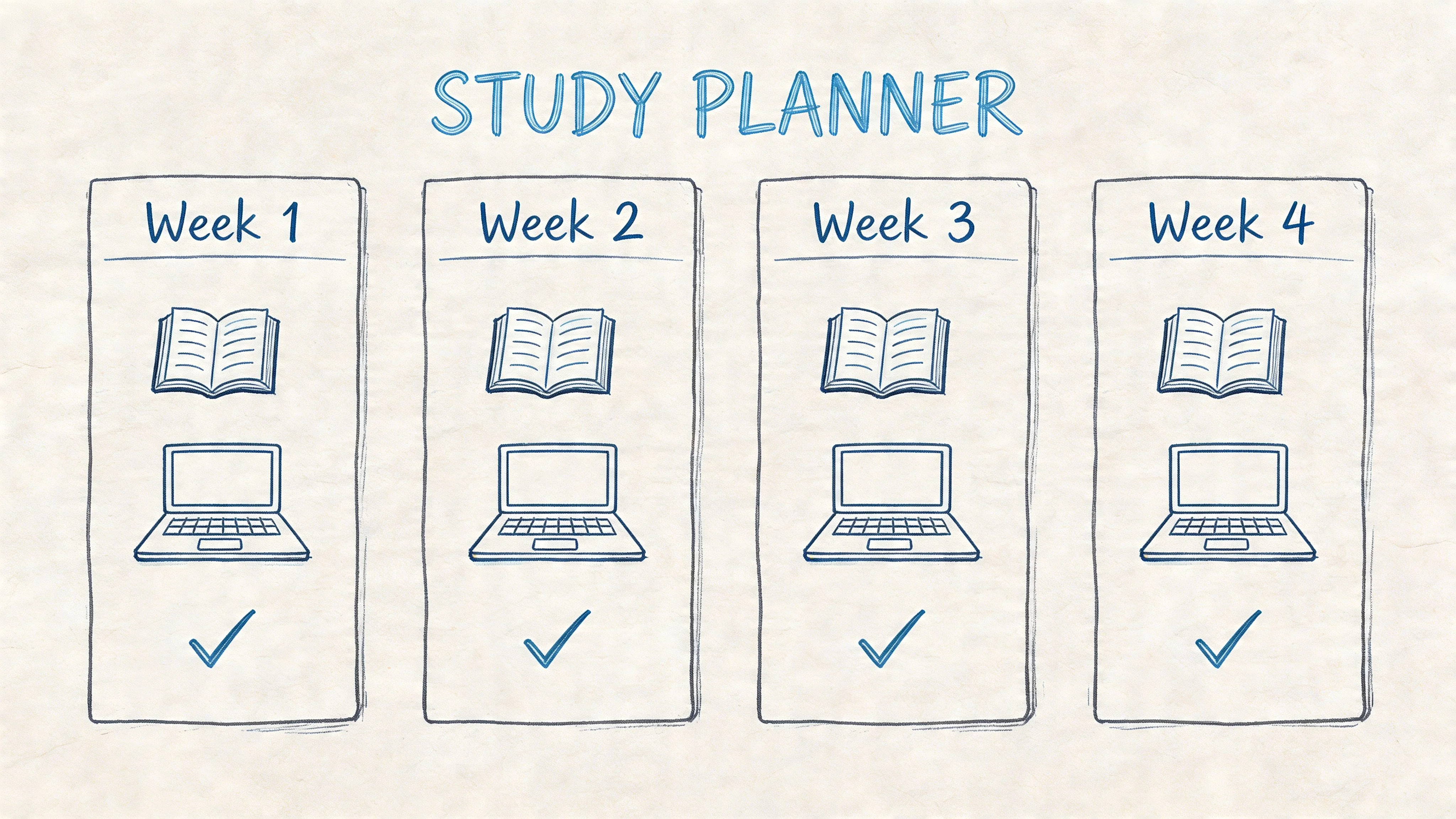
A Sample Four-Week Rhythm
This schedule assumes you already chose one core book and one question source. Adjust the chapter names to match the book you’re using.
| Week | Focus | Reading | Practice | Review |
|---|---|---|---|---|
| 1 | Core services | Compute, storage, database chapters | Short quiz blocks and one small lab | Review notes from memory |
| 2 | Networking and security | VPC, IAM, load balancing, Route 53 | Architecture scenarios | Revisit weak terms and diagrams |
| 3 | Reliability and operations | Monitoring, scaling, backups, HA patterns | Mixed questions and one end-to-end lab | Rewrite confusing topics in plain language |
| 4 | Exam integration | Chapter summaries and edge cases | Full practice sets | Final error log review |
A Practical Weekly Schedule
Here’s what one week can look like if you’re balancing study with work:
- Monday
- Read one focused chapter: Keep it to a single domain such as Amazon EC2 or Amazon S3.
- Write recall prompts: Five to ten short questions from memory.
- Tuesday
- Read the next chapter: Stay in the same theme if possible.
- Do one short lab: Build or configure something small that uses the services from Monday and Tuesday.
- Wednesday
- Review without the book open: Explain the chapter concepts aloud or on paper.
- Take a short quiz: Identify which wrong answers felt tempting.
- Thursday
- Read an architecture-heavy section: Focus on service tradeoffs.
- Draw one diagram: Simple boxes and arrows are enough.
- Friday
- Return to mistakes: Reread only the pages tied to missed questions.
- Condense notes: Turn the week into one page.
- Saturday
- Do a longer mixed practice block: Pull concepts from multiple chapters.
- Tag weak areas: Networking, databases, IAM, analytics, or cost reasoning.
- Sunday
- Light review only: Flashcards, summary notes, and one quick recap session.
- Plan next week: Don’t leave Monday vague.
Pre-Exam Readiness Checklist
A good checklist removes emotion from the final week. Don’t ask whether you “feel ready.” Ask whether you can do the following:
- Explain service tradeoffs clearly: You can articulate why one AWS service fits better than another in a common scenario.
- Recall key architecture patterns: You can sketch basic high-availability and scaling designs from memory.
- Summarize each major domain: Compute, storage, networking, databases, security, and monitoring all have one-page notes.
- Review chapter summaries actively: You’re testing recall, not just rereading highlighted text.
- Handle mixed question sets calmly: You can switch between topics without losing your footing.
- Maintain an error log: You know your recurring mistakes and have reviewed them more than once.
Readiness test: If you miss a question, can you explain why the correct answer wins and why the distractors lose?
That one habit separates superficial preparation from durable preparation.
Stop Reading and Start Learning
The vast array of AWS books becomes manageable once you stop searching for a single magic solution. What works is a system. Choose the right kind of book for your certification path. Check whether it’s current, deep, practical, and readable for you. Then pair it with a study process that forces recall, practice, and targeted review.
That’s the difference between collecting resources and building skill.
Books still matter. They provide context that short videos and cram sheets often miss. They help you understand why AWS services exist, how they fit together, and where design choices go wrong. But books alone can leave blind spots. You might finish a chapter and still forget it a week later. That’s why many learners benefit from active review methods. If you want a clear explanation of that principle, you can learn faster with this study method and see why retrieval and timing are so important.
When you’re ready to move from reading to performance, use your book as the foundation, not the whole structure. Build a repeatable loop around it. Review from memory. Practice by domain. Track mistakes. Revise selectively. If you’re planning your next step, this guide on how to prepare for AWS certification exams is a strong companion to the framework you’ve just built.
MindMesh Academy helps learners turn scattered AWS study into a clear, trackable system. If you want a smarter way to combine deep book learning with structured review, adaptive practice, and progress tracking, explore MindMesh Academy.

Written by
Alvin Varughese
Founder, MindMesh Academy
Alvin Varughese is the founder of MindMesh Academy and an enterprise architecture leader. An electrical engineer by training, he moved from factory automation in South Africa to cloud architecture at GE Appliances and Humana (Fortune 50), and holds 20 professional certifications including AWS Solutions Architect Professional, Azure DevOps Engineer Expert, and Microsoft Agentic AI Business Solutions Architect. He built MindMesh Academy after interviewing too many highly certified candidates who couldn't answer basic questions: the goal is prep that makes you better at the job, not just able to pass the exam.