Azure vs GCP vs AWS A Head-to-Head Cloud Platform Comparison
AWS vs. Azure vs. GCP: A Strategic Cloud Platform Showdown for IT Professionals
Selecting a cloud provider is a strategic decision that affects an organization's agility, cost structure, and innovation capacity. For IT professionals, these distinctions are crucial for architectural design and career growth. This guide from MindMesh Academy filters out promotional claims to provide a practical comparison of the "Big Three": Amazon Web Services (AWS), Microsoft Azure, and Google Cloud Platform (GCP).
Standard feature lists rarely explain the full picture. The right platform depends on specific project needs, current technology stacks, and long-term goals. As you study for certifications like AWS Solutions Architect, Azure Administrator, or Google Cloud Professional Cloud Architect, understanding these differences is useful for passing with confidence.
To help you make an informed choice, we analyze each provider across four specific areas:
- Core Services: An evaluation of how foundational compute instances, object storage, and virtual networking interact. We focus on how these services perform in production environments.
- Advanced Capabilities: An assessment of performance in specialized areas such as managed databases, container orchestration, and artificial intelligence.
- Pricing Philosophy: An analysis of billing models, per-second charging, and tools used to monitor cloud spending. This helps you manage budgets and prevent unexpected charges.
- Market Position: An examination of each provider's industry standing. This affects the size of the user community, documentation quality, and the availability of skilled engineers.
The following visual shows how each provider occupies a specific space in the cloud market.

The data shows that AWS remains the established leader by volume. Azure serves as the primary choice for large-scale enterprise environments that require integration with existing tools. GCP maintains a focus on data-heavy applications and high-performance machine learning workloads.
Industry data confirms these positions. As of Q3 2025, AWS holds a 29% share of the global cloud infrastructure market (verify current figures on the vendor site). The cloud market continues to expand, showing 28% year-over-year growth. This trend highlights the necessity of cloud services for modern business operations.
The following table summarizes the primary strengths of each provider to help you compare them at a glance.
Quick Look: AWS vs Azure vs GCP Strengths at a Glance
| Provider | Primary Strength | Ideal For | Key Differentiator |
|---|---|---|---|
| AWS | Extensive, mature service catalog | Startups and enterprises that need a wide, proven environment. | Broadest selection of services and features. |
| Azure | Integration with Microsoft software | Organizations using Microsoft tools or needing hybrid cloud setups. | Integrated hybrid cloud functionality via Azure Arc. |
| GCP | Proficiency in data, ML, and Kubernetes | Applications focused on data analysis or containerized software. | Strong history of open-source contributions like Kubernetes. |
While this summary provides a useful overview, the most practical insights come from looking at technical details. For an even more detailed comparison, you can read a technical guide comparing AWS, Azure, and GCP. We will now look at how these platforms handle the specific services used in daily IT operations.
Evaluating Market Leadership And Global Infrastructure
When IT professionals choose a cloud provider, long lists of features can become confusing. To simplify the decision, focus on two factors: market position and physical infrastructure. Market leadership is about more than company size. It indicates financial health, the capacity for research and development, and the availability of third-party software and certified experts. The physical network of data centers—the global infrastructure—dictates how fast an application runs, where data is legally stored, and how quickly a system recovers after a failure.
AWS has maintained its top position for many years. It gained this advantage by being an early mover and building a wide catalog of services. This history has produced a mature platform with a massive support community. Its physical reach is the benchmark that other companies try to match. For any business that needs a proven track record and the broadest possible geographic coverage, AWS is usually the standard and safest option.
Comparing Global Footprints: Regions, AZs, and Edge Locations
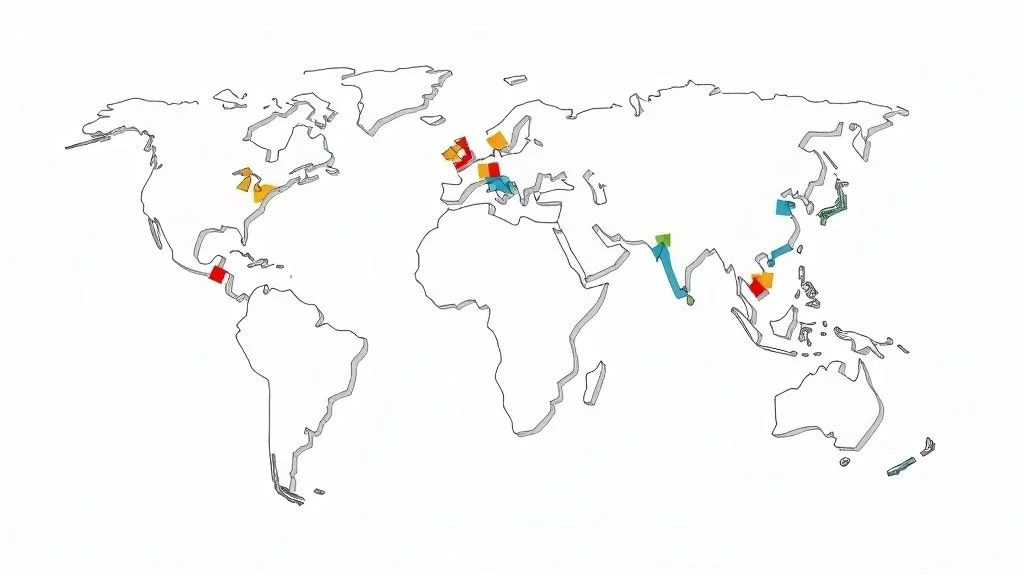
Mapping out the physical layout of a provider's network is a vital part of the AWS vs Azure vs GCP comparison. This infrastructure relies on three concepts that every cloud certification student must know: Regions, Availability Zones (AZs), and Edge Locations. Each component has a specific job in keeping cloud services fast and reachable.
- Regions: These are distinct geographic areas, such as "US East" or "EU West," where a provider groups its data centers. Running an application across several regions is a standard way to handle disaster recovery. It also helps serve a global user base with low latency. For example, the AWS Solutions Architect exam often presents scenarios where you must design a system that survives a total region failure by failing over to another geographic area.
- Availability Zones (AZs): Every region contains multiple AZs. An AZ is made of one or more physical data centers that use their own power, cooling, and networking equipment. They sit close enough to each other to allow fast communication but far enough apart that a local disaster—like a fire or a flood—in one AZ will not take down the others in that region. This redundancy is the foundation of high-availability design.
- Edge Locations: These smaller sites are part of a Content Delivery Network (CDN). They store copies of files closer to the people using them. This setup ensures that images, videos, and other files load very quickly for users, regardless of where the main data center is located.
Understanding these terms is required to pass foundational exams like the AWS Certified Cloud Practitioner (CLF-C02), Azure Fundamentals (AZ-900), or Google Cloud Digital Leader. For a more detailed look at these components, our AWS Global Infrastructure overview explains how these parts work together to provide reliable services.
Azure and GCP’s Strategic Market Positioning
While AWS stays at the top, Microsoft Azure has secured the second spot, particularly among large corporations. Microsoft’s strategy focuses on connecting its cloud services with the tools businesses already use, such as Windows Server, Active Directory, and Microsoft 365. For a company that already runs on Microsoft software, moving to Azure is often a direct and simple transition.
Azure continues to grow and gain more users. By Q3 2025, Azure represented 20% of the global cloud infrastructure market (verify current market share figures on the vendor or analyst sites). Microsoft's cloud operations now produce revenue at a $120 billion annual rate (verify latest financial filings for exact numbers), showing that the platform has strong staying power. Its influence is strongest with large organizations; industry reports suggest that 85% of Fortune 500 companies now use Azure (verify specific percentage in current annual reports).
Google Cloud Platform (GCP) follows a different plan. It carves out its space by focusing on its own strengths: big data, machine learning, and managing software containers with Kubernetes. While it has a smaller total market share, its technical leadership in these specific areas makes it the first choice for companies that process vast amounts of data or want to build modern, cloud-native applications from the start.
GCP uses the same physical network and hardware that runs Google Search and YouTube. This gives the platform a reputation for high performance and reliability. Google owns a private global fiber network, which often provides faster speeds when sending data between different regions compared to other providers. This makes GCP an excellent choice for tasks that involve moving and analyzing massive datasets, even if it has fewer total regions than its competitors. Choosing the right provider means matching your specific technical needs with what each company does best.
Comparing Core Services: Compute, Storage, And Networking
The fundamental building blocks of any cloud environment are its core infrastructure services: compute, storage, and networking. While AWS, Azure, and GCP all provide highly capable offerings, their underlying philosophies and specific service architectures significantly impact your application's performance, cost efficiency, and scalability. Mastering these core services is critical for actual deployments and remains a primary requirement for most cloud certification exams.
This initial decision is often the most significant choice you will make in the Azure vs GCP vs AWS comparison. Architects must evaluate how each provider handles the basic units of power and data to ensure the platform matches the technical requirements of the workload.
A Look At Compute Engines: EC2 vs. VMs vs. Compute Engine
Virtual machines serve as the essential processing units of the cloud, providing the base for most modern applications. AWS offers EC2 (Elastic Compute Cloud), Azure provides its Virtual Machines, and GCP features Compute Engine. All three platforms execute your code on virtualized hardware, but their configuration options and pricing models reveal distinct operational strengths.
AWS, as the original pioneer of public cloud, has the most extensive and mature catalog. It presents a massive list of instance types with specialized hardware designed for specific tasks. For example, the General Purpose M-series handles balanced workloads, while the C-series offers high-performance processors for compute-heavy tasks. If your project requires high-end GPU performance or FPGA-powered processing for specialized calculations, AWS likely has a predefined instance ready for use. Understanding these EC2 instance families and their specific use cases is a standard requirement in the AWS Certified Cloud Practitioner (CLF-C02) and Solutions Architect exams.
GCP takes a different approach by prioritizing flexibility and customization. Compute Engine allows you to define custom machine types, letting you specify the exact vCPU count and memory capacity your application needs. This flexibility is a significant advantage for cost optimization. Rather than paying for a fixed "T-shirt size" that might leave 30% of the memory unused, you provision only what you consume. Google also offers Preemptible VMs (and Spot VMs) which provide deep discounts for fault-tolerant tasks, a strategy frequently discussed in the Associate Cloud Engineer certification.
Azure strikes a pragmatic balance focused on enterprise compatibility. Its Virtual Machines come in various predefined sizes, but the platform's true value is evident for organizations using Microsoft software. The integration with Windows Server, SQL Server, and Active Directory is tight and efficient. Using the Azure Hybrid Benefit, companies can repurpose existing on-premises licenses to reduce cloud costs, which is a major financial differentiator for large corporations. This synergy is a key topic for those studying for Azure administration and architecture certifications.
MindMesh Academy Insight: For certification exams like AWS Solutions Architect, understanding EC2 instance families (such as General Purpose, Compute Optimized, and Memory Optimized) is mandatory. For Azure certifications like AZ-104, you should focus on Windows Server integration and the financial impact of the Azure Hybrid Benefit. For Google Cloud certifications, focus on how custom machine types and per-second billing drive cost efficiency.
Object and Block Storage Nuances
Storage is another area where technical details dictate the success of a deployment. The two most common types used in cloud architecture are object storage and block storage. Object storage is designed for unstructured data like images, video files, and system logs, while block storage acts as the persistent virtual hard drive attached to your VMs.
For object storage, the primary competitors are AWS S3, Azure Blob Storage, and GCP Cloud Storage.
AWS S3 (Simple Storage Service) is the veteran of the industry and acts as a functional benchmark for the market. It provides high durability and scalability with a massive ecosystem of supporting tools. AWS categorizes data into storage classes like S3 Standard, S3 Intelligent-Tiering, and S3 Glacier. Learning how to move data between these classes using lifecycle policies is a major component of AWS certification exams.
Azure Blob Storage provides a structured approach to data management through its access tiers. Users choose between Hot, Cool, and Archive tiers based on how often they need to access the data. This clear distinction simplifies cost management for administrators, making it a foundational concept for the Azure Fundamentals (AZ-900) exam.
GCP Cloud Storage offers a unique technical advantage: a unified API across all its storage classes. Whether you are using Standard, Nearline, Coldline, or Archive storage, the commands to access the data remain the same. This allows developers to change storage tiers as data ages without rewriting the application code, reducing the complexity of the development cycle.
You can examine these comparisons in more detail in our Azure vs AWS services comparison guide.
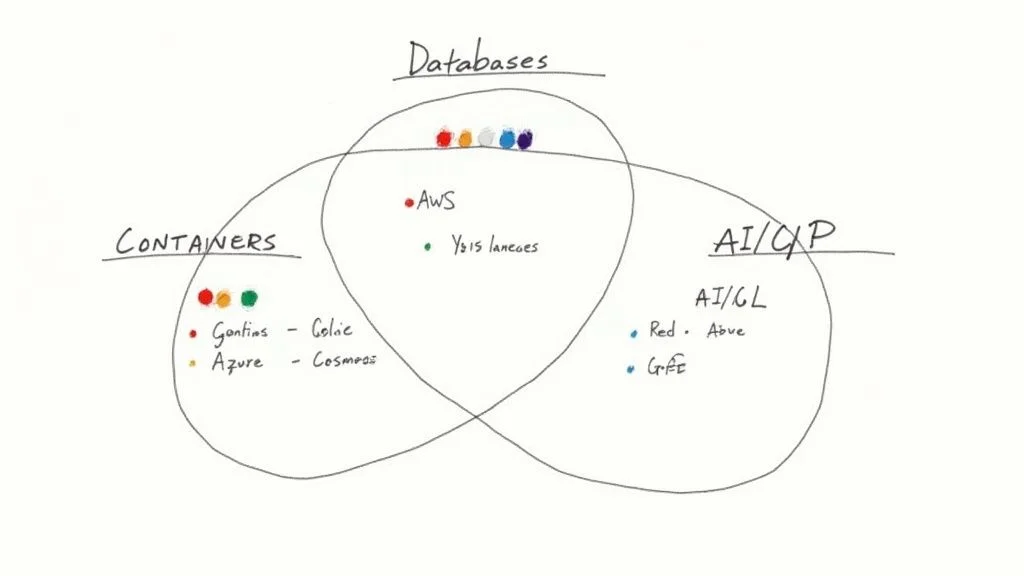
For a quick reference on how these services align, see the mapping below.
Core Services Feature Mapping AWS vs Azure vs GCP
| Service Category | AWS Service | Azure Service | GCP Service | Key Educational Highlight |
|---|---|---|---|---|
| Compute | EC2 (Elastic Compute Cloud) | Virtual Machines | Compute Engine | GCP: Custom machine types allow for precise resource allocation and significant cost savings. |
| Block Storage | EBS (Elastic Block Store) | Managed Disks | Persistent Disk | AWS: Provides a wide variety of performance tiers (gp3, io2) to meet specific I/O requirements. |
| Object Storage | S3 (Simple Storage Service) | Blob Storage | Cloud Storage | GCP: A single API across all storage classes simplifies the data lifecycle for developers. |
| Networking | VPC (Virtual Private Cloud) | VNet (Virtual Network) | VPC Network | GCP: Global VPC architecture simplifies multi-region deployments and cross-region communication. |
| CDN | CloudFront | Azure CDN | Cloud CDN | Azure: Offers a multi-CDN option (Microsoft, Akamai, Verizon) to optimize content delivery based on provider. |
This table provides a high-level summary, but passing a certification exam requires understanding the architectural logic behind these choices and how the services connect.
Networking and Content Delivery
The communication paths between your applications and your users are defined by the cloud's networking layer. All three providers offer Virtual Private Cloud (VPC) solutions, but their architectural designs for global traffic differ significantly.
GCP’s global VPC is a major technical differentiator. In the Google Cloud environment, a VPC is a global resource rather than a regional one. This means you can deploy resources in different parts of the world—like North America and Europe—and they can communicate over a private network without the need for complex peering or VPN setups. This design simplifies the management of globally distributed applications and is a key topic for high-availability architecture.
In contrast, AWS and Azure use a regional VPC (or VNet) model. In this setup, the network is confined to a specific geographic region. To connect services across different regions, you must explicitly configure VPC Peering or use a Transit Gateway. While this provides a very traditional and isolated network boundary, it requires more manual configuration for multi-region setups. Understanding the trade-offs between these regional and global models is essential for any network-focused certification path, such as the AWS Certified Advanced Networking specialty or the Azure Network Engineer Associate.
To deliver content quickly to a global audience, providers use Content Delivery Networks (CDNs) to cache data closer to the user:
- AWS: CloudFront is a mature CDN with a massive network of edge locations. Its deep integration with S3 and AWS Shield for security makes it a standard choice for high-traffic websites.
- Azure: Azure CDN provides a hybrid approach. It allows you to select from multiple delivery networks, including Microsoft’s own infrastructure or third-party providers like Akamai and Verizon. This lets you choose the provider that offers the best performance for a specific geographic area.
- GCP: Cloud CDN uses Google’s private fiber network. By keeping traffic on Google’s internal backbone for as long as possible and avoiding the public internet, it can significantly reduce latency for global users.
Reflection Prompt: How might the choice between a global VPC and a regional VPC impact your network design for an application that needs to serve users across multiple continents, and what are the cost implications for each approach? Consider how this affects data transfer fees and the complexity of routing tables in an Azure VNet versus a Google Cloud VPC. This comparison is vital for those pursuing advanced networking certifications.
Diving Deeper: Databases, Containers, and AI
Foundational services like compute and storage are standard across all providers, but the real technical differences between AWS, Azure, and GCP appear when you look at their advanced features. These services show the strategic direction and engineering focus of each platform. We are talking about managed databases, advanced container platforms, and AI toolkits that allow you to build intelligent applications without the burden of managing underlying hardware. For professionals working in Data Engineering, DevOps, or Machine Learning, learning these services is the best way to grow a career and earn specialized certifications.
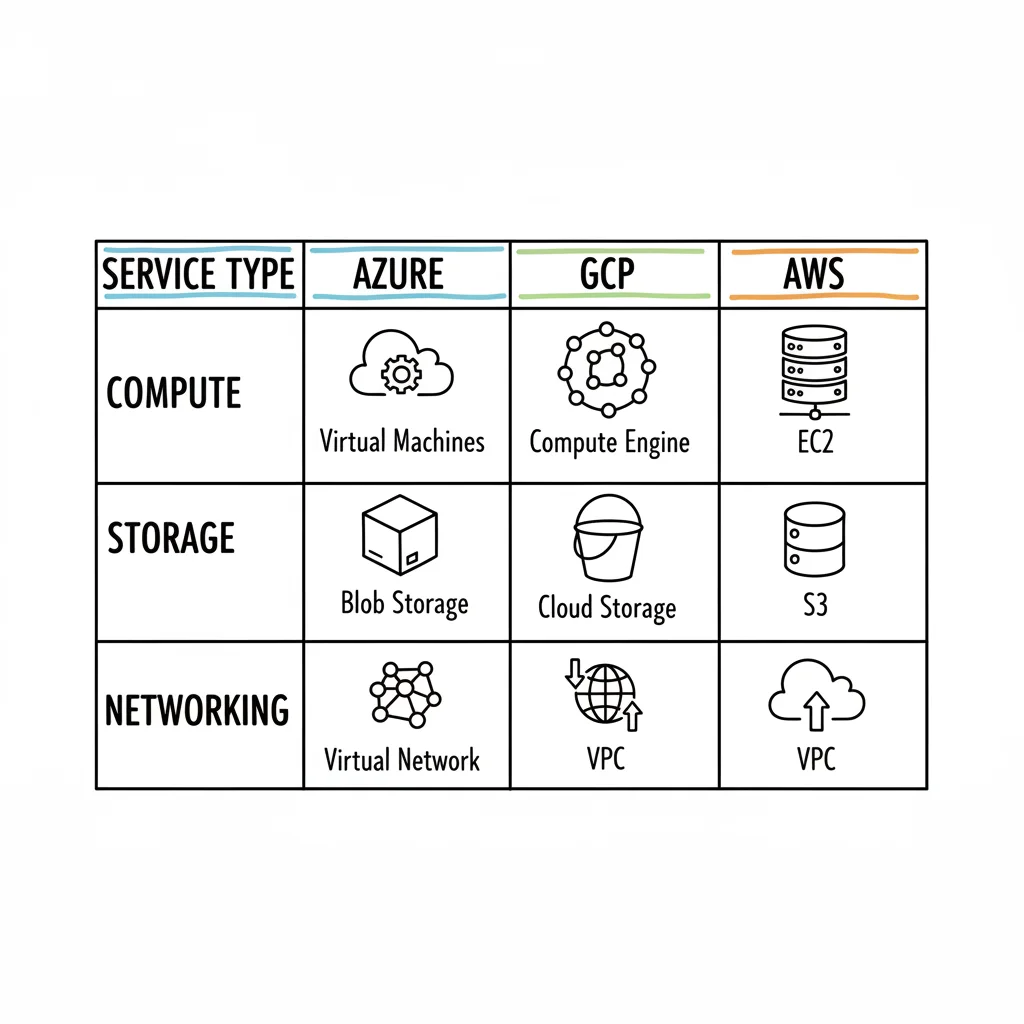
Let’s examine how the three cloud leaders compare in these areas. We will look past the marketing claims to find the details that actually affect your projects and your professional path.
The Database Deep Dive: Relational and NoSQL
Managed database services change the way developers work by handling the repetitive tasks of patching, backups, and scaling. All three providers offer strong relational and NoSQL options, though they each follow a different design philosophy.
For traditional relational databases:
- AWS Relational Database Service (RDS): This is the most established service in the group. It offers the widest variety of database engines, including PostgreSQL, MySQL, MariaDB, Oracle, and SQL Server. It also features Aurora, a proprietary engine built for the cloud. Its main strength is this high level of choice and its connection to a wide range of AWS monitoring and security tools.
- Azure SQL Database: This is the best option for organizations already using the Microsoft software stack. It is built on the SQL Server engine and feels like a natural extension of that environment. It includes features like serverless compute tiers and automated performance tuning that uses machine learning to optimize queries.
- GCP Cloud SQL: Google focuses on making PostgreSQL and MySQL as easy to run as possible. This service is known for high performance and a very simple setup process. It is a great choice for teams that want a low-maintenance database that still handles high traffic efficiently.
The differences become even more obvious when looking at NoSQL databases:
- AWS DynamoDB: This is a serverless key-value and document database built for extreme scale. It can handle massive amounts of traffic with response times under ten milliseconds. It is the primary choice for high-volume web applications and gaming platforms. You will find it used extensively in the AWS Certified Solutions Architect – Professional exam.
- Azure Cosmos DB: Microsoft designed this as a globally distributed database that supports many different data models. It can act as a document, graph, or key-value store using APIs for SQL, MongoDB, Cassandra, and Gremlin. It allows you to write data to multiple geographic regions at the same time with guaranteed low latency.
- GCP Bigtable: This is the wide-column store that Google uses for its own search and maps services. It is built to handle massive analytical workloads and can ingest data at a petabyte scale. It is often used for time-series data from IoT devices or financial applications where high-speed data ingestion is mandatory.
MindMesh Academy Certification Focus:
- AWS: You must understand how DynamoDB handles consistency models and global tables to pass the current advanced architect exams.
- Azure: The Azure Data Engineer (DP-203) exam requires you to know how to manage global data distribution and consistency levels in Cosmos DB.
- GCP: For the Google Cloud Professional Data Engineer certification, you need to know how BigQuery handles analysis while Bigtable manages operational data at scale.
Container Orchestration: EKS vs. AKS vs. GKE
Containers are now the standard method for deploying software, and Kubernetes is the leading tool for managing those containers. Each cloud provider has a managed Kubernetes service, but they differ in how they handle automation and user experience.
Google Kubernetes Engine (GKE) is the industry leader for container management. Since Google originally created Kubernetes, they have the most experience running it at scale. GKE features the most advanced autoscaling and multi-cluster management tools available. The system automates many tasks that require manual work on other platforms, making it the preferred choice for teams that want a highly polished container environment.
Azure Kubernetes Service (AKS) focuses on the developer experience. It is designed to work closely with Azure DevOps and GitHub Actions, which makes it easy to set up automated deployment pipelines. For companies that already use Microsoft development tools, AKS provides a familiar environment that simplifies the move to container-based architecture.
Amazon Elastic Kubernetes Service (EKS) provides a flexible and highly secure platform for Kubernetes. AWS has put a lot of work into making EKS easier to use in recent years, though it still offers the most granular control for those who want it. Its biggest benefit is how it works with the rest of the AWS environment, including its advanced networking features and the Identity and Access Management (IAM) system for fine-grained security.
The AI and Machine Learning Showdown
The competition in artificial intelligence is currently the most intense part of the cloud market. Demand for these tools is growing very quickly. In Q2 2025, Google Cloud reported sales of $13.6 billion (verify current pricing on the vendor site). This was a 32% increase over the previous year, driven largely by AI. Their Generative AI services alone saw growth between 140-180%.
Amazon SageMaker is a complete platform that handles the entire machine learning life cycle. It gives data scientists a set of tools to prepare data, build models, and then train and deploy them in production. SageMaker is ideal for teams that want total control over their machine learning models and need a wide range of specialized tools for every step of the process.
Google Vertex AI reflects Google’s history as a data-first company. This platform focuses on Machine Learning Operations (MLOps) and connects directly with BigQuery. This allows you to build models using your existing analytical data without having to move it between different services. It is designed to get a model from the experimental stage into a production environment as quickly as possible.
Microsoft Azure AI has taken a different path by forming a close partnership with OpenAI. This allows Azure users to use models like GPT-4 through the Azure OpenAI Service. For businesses that want to use advanced generative AI right away, Azure is often the standard choice. Large companies are already using these tools to change their operations, such as Three UK using Azure AI to improve their network performance. This partnership gives Microsoft a strong advantage for companies focused on the latest AI trends.
Reflection Prompt: If you want to become an AI/ML Engineer, which platform fits your goals? Do you want the full control of SageMaker, the data-integrated approach of Vertex AI, or the generative AI features of Azure?
Navigating Pricing Models And Cost Optimization
For any IT professional managing cloud resources, mastering the pricing philosophies of AWS, Azure, and GCP is where theoretical knowledge meets practical application. This isn't merely about comparing hourly VM rates; it's about understanding how each platform handles discounts, billing intricacies, and the native tools provided to prevent costs from escalating. A careful choice here can yield substantial savings, while a misstep can lead to surprises on your monthly bill. Effective cost management is a core skill tested in many cloud certification exams.
When evaluating Azure vs GCP vs AWS, you'll discover that each provider has a distinct mindset regarding cost. This directly influences your approach to budget management and resource provisioning.
Core Pricing Philosophies
AWS pioneered the granular, pay-as-you-go model, and it remains central to their strategy. This offers high flexibility but places the weight of cost management on your shoulders. You're billed by the second for consumed resources, requiring active monitoring to identify idle resources and right-size instances. Understanding this model is fundamental for any AWS certification, including the AWS Certified Cloud Practitioner (CLF-C02) (verify current exam codes on the AWS site).
Azure also operates on a pay-as-you-go basis, but its primary advantage lies in the cost benefits it extends to existing Microsoft customers. The Azure Hybrid Benefit allows you to bring your on-premises Windows Server and SQL Server licenses to the cloud, reducing expenses by a significant margin. This makes Azure a standard financial choice for organizations with deep investments in Microsoft software. If you already own these licenses, the savings can make Azure much cheaper than competitors for specific workloads.
GCP adopts a different approach, prioritizing automatic discounts that do not require complex configurations. Their Sustained Use Discounts are a standout feature—the longer a virtual machine operates within a month, the cheaper its effective hourly rate becomes. This happens without any manual intervention from your team. This is a clear advantage for teams seeking cost optimization without a dedicated financial operations specialist or the time to manage Reserved Instances.
MindMesh Academy Certification Tip: For cloud practitioner exams like AWS CLF-C02, AZ-900, or the Google Cloud Digital Leader, be prepared to differentiate between these core pricing models. You must understand how automatic and manual discounts impact overall cloud expenditure.
Commitment-Based Savings Models
For predictable, long-running workloads, committing to a longer term is the fastest route to lower bills. All three providers offer substantial discounts for one- or three-year commitments.
- AWS: Offers two primary options: Reserved Instances (RIs) and Savings Plans. RIs provide discounts up to 72% (verify current pricing and discount percentages on the vendor site) when you commit to a specific instance type for a one- or three-year term. Savings Plans, while offering similar discounts, are more flexible. They apply to your total compute spend across different instance families and even regions, which simplifies management for growing fleets.
- Azure: Its Reserved Virtual Machine Instances (RIs) function very similarly to the AWS version. Committing to a one- or three-year term yields steep discounts. They are ideal for applications known to run 24/7 without changing their resource requirements. Azure also allows for some flexibility in exchanging or canceling reservations, though specific terms apply.
- GCP: Their equivalent is called Committed Use Discounts (CUDs). Many professionals find these to be the most flexible options. Instead of locking you into a specific machine type, you commit to a certain amount of vCPU and memory usage within a region. This provides greater adaptability if you need to change your machine configurations as your software evolves.
Real-World Application: Cloud architects and finance professionals use these commitment-based savings to forecast budgets and guarantee optimal resource utilization. Understanding the differences between an AWS Savings Plan and a Google CUD is crucial for building cost-effective cloud solutions that stay within budget.
Native Cost Management Tools
You cannot manage what you do not measure. Fortunately, each provider equips you with a specific suite of tools to track, analyze, and optimize your cloud spending.
AWS Cost Explorer is a tool for analyzing historical and current spend, allowing you to filter by service, tags, and accounts. Azure Cost Management and Billing provides comparable features and is particularly strong at setting budgets and forecasting future costs based on your usage patterns. If you want to see more, our guide covers the primary factors affecting Azure costs in more detail. This is a common area for Azure certification questions.
Finally, Google Cloud Billing reports are known for their clarity. They make it straightforward to pinpoint where your money is going and observe how automatic discounts are being applied to the final bill. Mastering these native tools is not merely a good practice; it's a necessary skill for running an efficient and compliant cloud environment. This level of oversight ensures that projects remain viable and that resources are never wasted on unused capacity.
Making the Right Choice for Your Business and Career
IT professionals recognize that choosing a cloud provider is a strategic commitment. This decision involves more than just renting virtual machines; it requires aligning your company’s goals and your own career growth with a platform’s strengths. The debate between AWS, Azure, and GCP usually comes down to your current technology stack, technical needs, and future objectives. Rather than comparing every feature, we will focus on recommendations for common business scenarios. No single cloud provider is best for every situation. The right choice is the one that fits your organization.
Recommendations for Common Business Scenarios
Choosing a provider is like picking a long-term professional partner. You need a vendor whose philosophy and strengths complement your own goals and technical requirements.
For the Startup and Agile Innovator: AWS
Startups and tech companies that move fast often choose AWS because of its variety. AWS offers a service for almost every challenge an engineer might face. This prevents teams from running into roadblocks when they build new features or change their business model. Having access to these capabilities is vital for companies that need to innovate quickly.
The community support for AWS is a major factor. Because it has been available the longest, you can find answers easily through documentation or forums. The market for AWS talent is large, making it easier to hire engineers who can work immediately. This makes the platform a logical starting point for building a career in cloud architecture or DevOps.
Go with AWS if your organization needs:
- Maximum Flexibility and Breadth: You need a wide set of services to experiment, build, and change your strategy quickly.
- A Mature Community: You want access to a large marketplace of third-party tools and a pool of certified experts and community knowledge.
- Proven Scalability: You expect your application to grow fast and you need a platform that has shown it can handle massive global traffic.
- Your Career Path: If you want to work as an AWS Solutions Architect or a DevOps Engineer, AWS provides the most job openings and the most learning materials.
For the Established Enterprise and Hybrid Cloud Adopter: Azure
For companies that have used Microsoft software for years, Azure is often the most natural choice. It connects with Microsoft 365, Windows Server, and Active Directory. Moving to Azure feels like expanding your own data center rather than starting over. This integration makes the transition easier for teams used to enterprise tools.
Financial benefits also matter. The Azure Hybrid Benefit lets companies use existing software licenses in the cloud to lower costs. This helps IT managers justify the cloud budget to their stakeholders.
Go with Azure if your organization needs:
- Enterprise Integration: Your company uses Microsoft software and you want a cloud that works with those tools without a total rebuild of your systems.
- A Hybrid Strategy: You need Azure Arc to manage servers on your own site, in other clouds, and at the edge from a single interface.
- Use Existing Skills: Your IT staff already knows how to manage Microsoft environments. They can start using the cloud quickly without a long training period.
- Your Career Path: Earning the Azure Administrator (AZ-104) or Azure Solutions Architect Expert (AZ-305) certification is useful for roles in large corporations that use hybrid cloud setups.
For the Data-Driven Modernizer: GCP
Google Cloud Platform (GCP) is a strong choice for companies that focus on data, machine learning, and modern container applications. Google’s history of managing global data is built into its cloud products. If your company builds intelligent systems or needs to analyze huge amounts of data quickly, GCP provides some of the most advanced tools in the market.
Developers often prefer GCP because the interface is simple and the services are easy to use. The platform focuses on letting engineers write and ship code instead of spending all their time managing hardware settings. This focus on the developer experience helps teams move from ideas to production more efficiently.
Go with GCP if your organization needs:
- Best-in-Class Kubernetes: You use containers and want an automated experience. GKE is widely considered to be the most refined version of Kubernetes available.
- Advanced Data Analytics and AI: Your business needs to process huge datasets using BigQuery or create complex machine learning models with Vertex AI.
- Developer Productivity: You want an intuitive console and a set of services that allow your team to focus on building features rather than managing infrastructure.
- Your Career Path: If you want to work as a Google Cloud Professional Data Engineer or a Machine Learning Engineer, GCP’s specialized tools will give you a significant advantage.
Frequently Asked Questions
Choosing between AWS, Azure, and GCP usually comes down to several specific questions. These answers come from direct field experience and help you pick the right platform for your goals. If you are building a new product or looking to grow your skills, understanding these differences is vital to your success.
Which Cloud Is Best For A Startup?
Many startups choose AWS. The platform offers the AWS Activate program, which provides free credits that help new companies build without high initial costs. Because AWS has existed longer than its competitors, the talent pool is larger than those of its competitors. You will find it easier to hire engineers who already know how to manage these cloud environments. This availability of talent speeds up development and reduces training time for new hires.
Google Cloud serves as a strong alternative for technical startups. If you are building a data-heavy application from the ground up, GCP offers specific advantages in Kubernetes and data analytics. Their pricing model includes automatic discounts that can provide your business a financial edge by lowering monthly operational bills. Developers often find GCP tools more intuitive for building modern, containerized applications.
How Difficult Is It To Switch Cloud Providers?
The difficulty of switching providers depends on your application architecture. To avoid vendor lock-in, use cloud-agnostic tools from the beginning. Using Terraform for infrastructure-as-code and Docker for containers makes moving much easier. These tools allow you to define your environment in a way that is not tied to a single vendor's dashboard.
The hardest part of migration is untangling proprietary vendor services. If your application relies heavily on AWS Lambda for serverless functions, moving to Azure Functions requires significant code rewrites, mapping, and testing. Such moves often lead to high re-engineering costs. By using open-standard services where possible, you maintain the flexibility to move your workloads if pricing changes or new features appear elsewhere.
MindMesh Academy Advice: Aspiring cloud architects should plan for a multi-cloud or cloud-agnostic architecture from the start. This prevents technical debt and keeps your options open as the business grows. This approach aligns with PMP and ITIL frameworks, which prioritize strategic planning and long-term infrastructure flexibility. Designing for portability ensures that your infrastructure can adapt as business requirements change.
How Do The AI And Machine Learning Offerings Compare?
All three providers compete in the AI space, but they serve different needs:
- AWS SageMaker: This platform supports the whole machine learning lifecycle, from data preparation to deployment. It works best for teams that want total control over how they build and deploy models. It offers tools for labeling, training, and fine-tuning models in one environment.
- Azure: Microsoft has a major advantage through its partnership with OpenAI. Direct API access to models like GPT-4 via the Azure OpenAI Service makes it the standard for generative AI projects. Companies that already use Microsoft tools find it easy to integrate these powerful AI capabilities into their existing workflows.
- GCP Vertex AI: Google focuses on data. It integrates with BigQuery, allowing you to turn raw data into deployed models quickly. This data-centric approach is perfect for organizations that want to use their existing data pools to train and run predictive models without the need for complex data movement.
Which Cloud Provider Offers The Best Hybrid Cloud Solution?
Microsoft Azure leads in hybrid setups. Its Azure Arc service provides a centralized way to manage resources on-premises, in other clouds, or at the edge. Large companies with existing data centers find this very useful because they can manage all their remote servers from one interface. It allows for consistent policy application across environments.
AWS offers AWS Outposts to bring their services to your hardware. This allows you to run AWS APIs on your own physical servers. Google Cloud uses Anthos for cross-environment management, focusing on containerized applications. Still, for complex enterprise needs involving legacy servers and diverse environments, Azure is often seen as the most unified option.
Ready to master these cloud platforms? MindMesh Academy offers expert-led prep to help you pass exams and understand the technology. Check out our AZ-104 Azure Administrator Practice Exams to start your certification preparation.

Written by
Alvin Varughese
Founder, MindMesh Academy
Alvin Varughese is the founder of MindMesh Academy and holds 20 professional certifications including Microsoft Agentic AI Business Solutions Architect, AWS Solutions Architect Professional, and Azure DevOps Engineer Expert. He's held senior engineering and architecture roles at Humana (Fortune 50) and GE Appliances. He built MindMesh Academy to share the study methods and first-principles approach that helped him pass each exam.