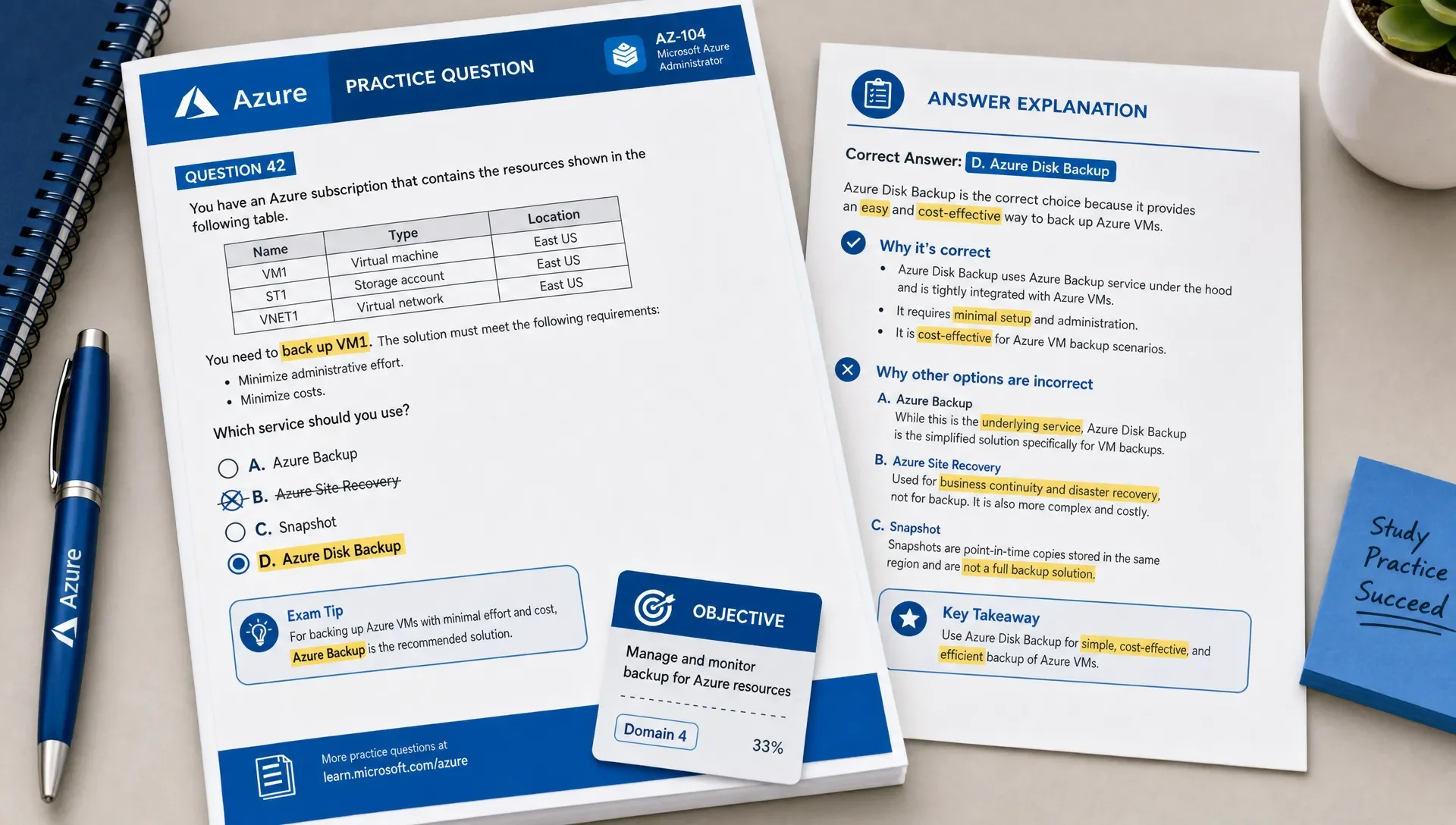
Azure Certification Sample Questions Explained
Azure Certification Sample Questions Explained
Azure certification sample questions prove useful only when you review the reasoning behind each answer. The goal isn't to memorize a bank of prompts. It's to learn how Microsoft asks about services, scopes, responsibilities, constraints, and tradeoffs.
Below are practice-style questions with explanations for common Azure certification paths, covering topics found in AZ-900, AZ-104, AZ-204, and AZ-305 exams. If you're still deciding which exam fits your role, MindMesh Academy's Azure certification list offers a broader view of the main Azure paths before you focus on practice questions.
How to Use Azure Certification Sample Questions the Right Way
Start by mapping each sample question to an exam objective. Microsoft publishes the skills measured for each exam on Microsoft Learn, like the official AZ-900 exam page. That skills outline should guide your practice. If a question doesn't connect to an objective, it's likely not the best use of your study time.
A good Azure certification sample question should test one of three things: choosing the right Azure service, applying a design constraint, or distinguishing between two similar concepts. Weak questions merely test recall. Strong questions push you to notice details such as scope, pricing intent, availability requirements, identity boundaries, or who manages a specific component.
| Exam level | Common question style | What you need to prove |
|---|---|---|
| Fundamentals | Concepts, service categories, and basic cloud models | You understand what Azure services do and when to apply them |
| Administrator | Identity, compute, storage, networking, and monitoring tasks | You can operate Azure resources securely and efficiently |
| Developer | App hosting, Azure Functions, storage SDKs, messaging, and identity | You can build cloud solutions using Azure services |
| Architect | Resilience, governance, integration, migration, and cost tradeoffs | You can choose designs that fit business and technical constraints |
Don't treat sample questions like flashcards where only the letter matters. After reviewing each answer, write down why every wrong option is incorrect. That detailed review is where most of the learning happens.
How to Read an Azure Certification Question Before Choosing an Answer
Before you even look at the options, find the final ask. Azure questions often include extra context, but the last sentence typically tells you the specific decision you need to make. Are you choosing a service, a role assignment, a deployment model, a monitoring feature, or a design pattern?
Next, identify the boundary. Many Azure exam questions hinge on whether something operates at the tenant, subscription, resource group, resource, network, or application layer. Mixing up these scopes means you can know the service and still select the wrong answer.
Use clue words carefully. They don't always give away the answer, but they help you eliminate choices that are too broad, too manual, or intended for the wrong layer.
| Clue in the question | Usually points toward | Common trap |
|---|---|---|
| Least privilege | Narrow Azure RBAC role and narrow scope | Choosing Owner or Contributor too quickly |
| Protect from datacenter failure in one region | Availability Zones | Confusing zones with region pairs |
| No public internet exposure | Private Endpoint or private connectivity | Choosing a firewall rule alone |
| Run code when an event occurs | Azure Functions or event-driven design | Choosing a full VM for a small task |
| Route global web traffic with failover | Azure Front Door or Traffic Manager | Ignoring protocol and routing needs |
Now, let's apply that reading process to specific sample questions.
Sample Question 1: Azure Shared Responsibility for Virtual Machines
Question: Your company deploys a custom application on an Azure virtual machine running Windows Server. Which responsibility remains with your company?
| Option | Answer choice |
|---|---|
| A | Maintaining the physical server host |
| B | Applying operating system updates inside the virtual machine |
| C | Replacing failed datacenter storage hardware |
| D | Supplying power and cooling for the datacenter |
Correct answer: B. Applying operating system updates inside the virtual machine
This is a classic shared responsibility question. With Infrastructure as a Service (IaaS), Azure manages the physical datacenter, host hardware, and underlying infrastructure. You manage what you place inside the virtual machine, including the guest operating system, installed software, application configuration, and data.
Microsoft's shared responsibility model is a core AZ-900 topic because it changes across IaaS, Platform as a Service (PaaS), and Software as a Service (SaaS). In a PaaS service, the cloud provider handles more of the platform. In an Azure VM, you're much closer to managing a traditional server, even though you never interact with the physical hardware.
The trap is answer A. The word "host" sounds related to a virtual machine, but the physical host is still Azure's responsibility. If the question mentions guest OS, installed application, or data, think customer responsibility.
Sample Question 2: Azure Availability Zones for Datacenter Failure
Question: A company runs an application in Azure. The application must remain available if a single Azure datacenter within the same region becomes unavailable. Which Azure feature should the company use?
| Option | Answer choice |
|---|---|
| A | Availability Zones |
| B | Resource groups |
| C | Management groups |
| D | Azure Policy |
Correct answer: A. Availability Zones
Availability Zones are physically separate locations within an Azure region. They help protect supported workloads from failure in a single datacenter location inside that region. This question tests whether you understand the difference between organizing resources and increasing workload resilience.
Resource groups organize resources for lifecycle management. Management groups organize subscriptions for governance. Azure Policy helps enforce rules. None of those features, by themselves, ensure an application remains available through a datacenter failure.
The wording matters. If the question had asked for protection from a full regional outage, you would consider a multi-region design. Since it specifies a single datacenter within the same region, Availability Zones are the best match.
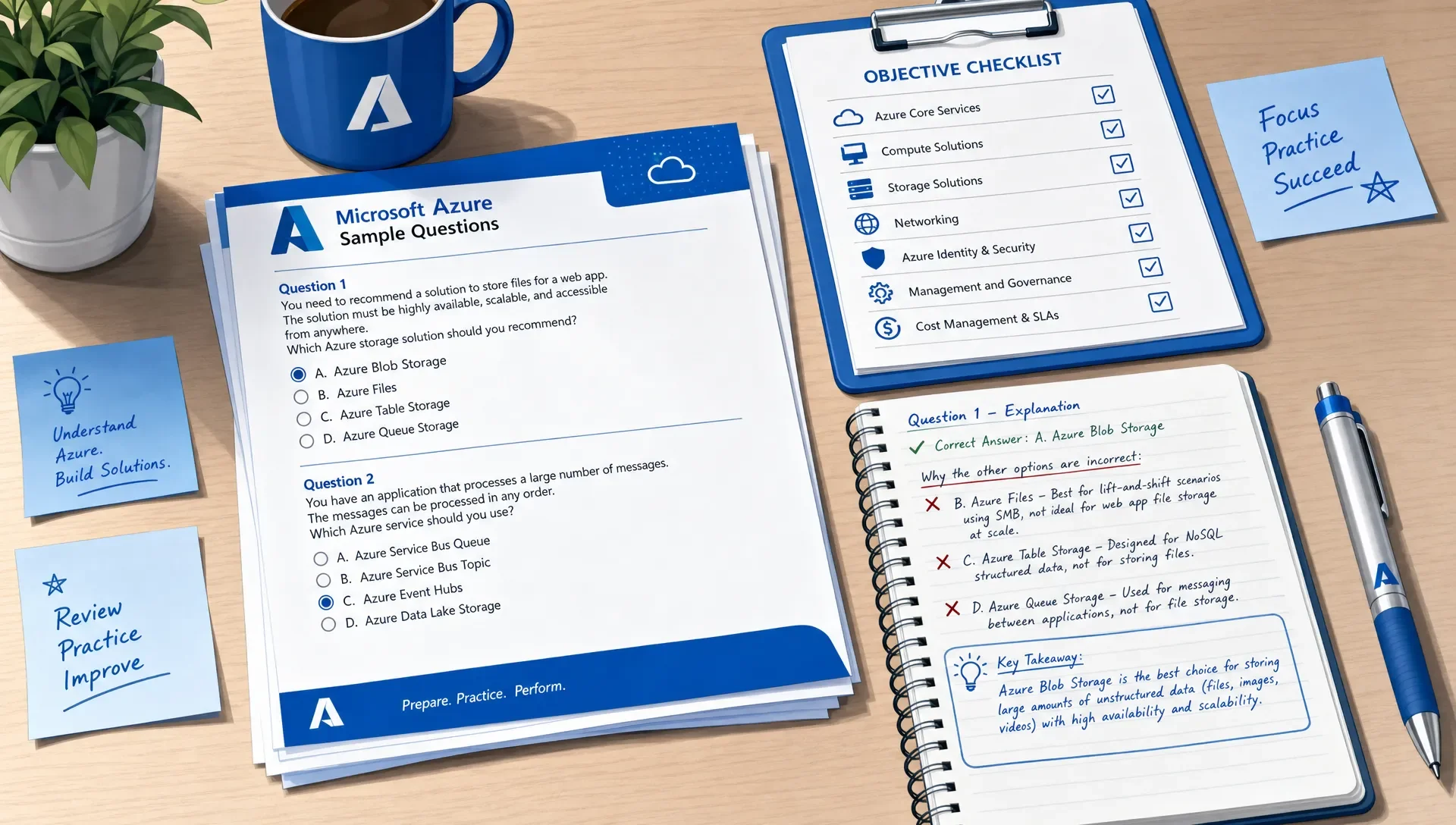
Sample Question 3: Azure RBAC and Microsoft Entra ID Roles
Question: A help desk technician can sign in to the Azure portal. They need to start, restart, and stop virtual machines in a resource group named RG-App. They shouldn't manage access for other users. What should you assign?
| Option | Answer choice |
|---|---|
| A | Global Administrator in Microsoft Entra ID |
| B | Owner at the subscription scope |
| C | Virtual Machine Contributor at the RG-App resource group scope |
| D | Reader at the RG-App resource group scope |
Correct answer: C. Virtual Machine Contributor at the RG-App resource group scope
This question tests identity versus authorization. Signing in is authentication. Permission to manage Azure resources is authorization, which is commonly handled with Azure role-based access control (RBAC). Microsoft explains the model in its Azure RBAC overview.
Global Administrator is a Microsoft Entra ID role. It's powerful, but it isn't the right answer for routine VM operations within a single resource group. Owner at the subscription scope is also too broad, as it allows access management and covers more than just RG-App. Reader is too limited because it doesn't allow the technician to start or stop VMs.
The phrase "shouldn't manage access" is a major clue, ruling out Owner. The phrase "in a resource group named RG-App" is another clue, directing you to keep the assignment scope narrow.
Sample Question 4: Azure Storage Lifecycle Management
Question: A company stores monthly report files in Azure Blob Storage. Files are accessed frequently for the first 30 days, rarely after 90 days, and must be retained for several years. The company wants to reduce storage cost with minimal manual effort. What should you configure?
| Option | Answer choice |
|---|---|
| A | A lifecycle management policy |
| B | A new resource group for old reports |
| C | A network security group |
| D | A virtual machine backup policy |
Correct answer: A. A lifecycle management policy
Blob lifecycle management can move data between access tiers or delete data based on rules. The question provides a time pattern and asks for minimal manual effort, which clearly points to automation.
A new resource group doesn't change the storage tier or cost behavior of blobs. A network security group controls traffic to network interfaces or subnets, not blob tiering. A VM backup policy applies to virtual machines, not lifecycle rules for blob objects.
This is the kind of question where the service is already identified as Blob Storage. The real decision is which specific storage feature solves the operational requirement.
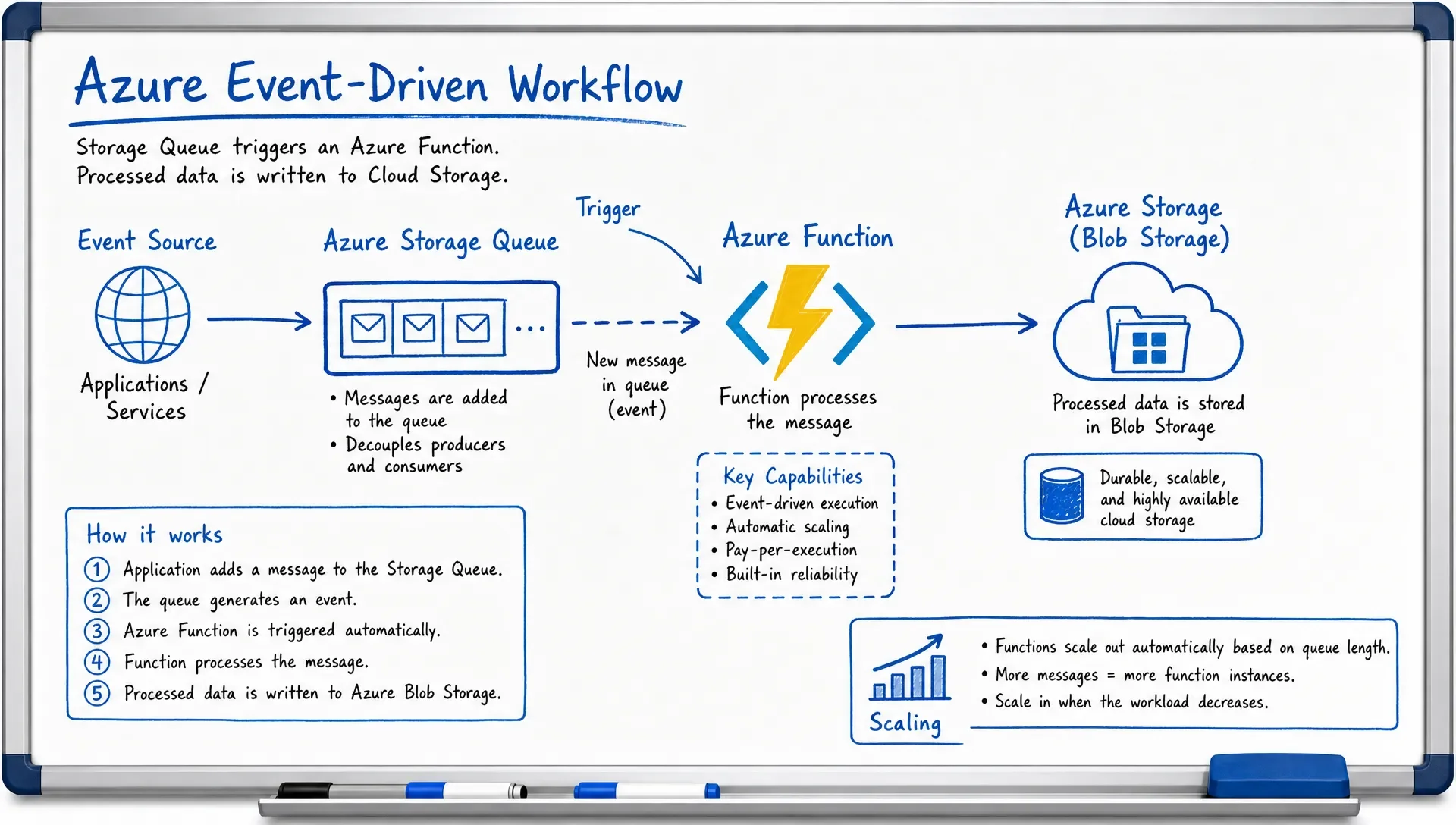
Sample Question 5: Azure Functions for Event-Driven Processing
Question: A developer needs to run a small piece of code every time a message is added to an Azure Storage queue. The solution should require minimal server management and should scale based on demand. Which service should the developer use?
| Option | Answer choice |
|---|---|
| A | Azure Functions with a queue trigger |
| B | An Azure virtual machine running a scheduled task |
| C | Azure Bastion |
| D | Azure DNS |
Correct answer: A. Azure Functions with a queue trigger
Azure Functions is designed for event-driven code. A queue trigger lets a function run automatically when a message appears in a supported queue. The question asks for minimal server management and scaling based on demand, which rules out a VM as the primary choice.
Azure Bastion provides secure browser-based access to VMs. Azure DNS hosts DNS zones. Both are valuable services, but neither runs code in response to queue messages.
For AZ-204, practice questions often combine several clues: event source, hosting model, identity, configuration, and scaling behavior. If you're preparing for developer-level scenarios, the AZ-204 practice exams are a better fit than broad fundamentals drills, as they focus on building solutions, not just naming services.
Sample Question 6: Private Access to Azure SQL Database
Question: An application hosted in Azure must connect to Azure SQL Database without exposing the database to the public internet. Which feature should you use for the database connection?
| Option | Answer choice |
|---|---|
| A | Private Endpoint |
| B | Public IP address |
| C | Azure Load Balancer inbound rule |
| D | Management group |
Correct answer: A. Private Endpoint
A Private Endpoint provides private connectivity to supported Azure platform services through Azure Private Link. For Azure SQL Database, it allows clients to connect over a private IP address from the virtual network path instead of relying on public exposure.
The official Azure Private Link overview is useful here because it clarifies the difference between a Private Endpoint and normal public service access. The exam trap is picking a networking feature that sounds connected but operates at the wrong layer.
A public IP address does the opposite of what the question asks. An inbound load balancer rule distributes incoming traffic to backend resources. A management group organizes subscriptions, not secures database connectivity.
Sample Question 7: Azure Front Door for Global Web Traffic
Question: A company hosts a public web application in two Azure regions. Users should be routed to the closest healthy endpoint. The solution must support HTTP routing and automatic failover if one region becomes unavailable. Which service should you choose?
| Option | Answer choice |
|---|---|
| A | Azure Front Door |
| B | Azure Files |
| C | Azure Key Vault |
| D | Azure Virtual Network peering |
Correct answer: A. Azure Front Door
Azure Front Door is built for global HTTP and HTTPS traffic routing. In this scenario, the key clues are "public web application," "closest healthy endpoint," "HTTP routing," and "regional failover."
Azure Files provides managed file shares. Azure Key Vault stores secrets, keys, and certificates. Virtual network peering connects virtual networks but doesn't provide global public web routing for users.
For architect-level questions, pay close attention to the workload type. If the workload is web traffic and the design calls for global routing, HTTP features, and failover, Azure Front Door is often a strong candidate. If the question involves DNS-based routing without HTTP-specific requirements, you might need to compare it with Azure Traffic Manager.
Answer Key and What Each Sample Question Was Testing
Use this table to review the deeper skill behind each answer. If you only remember the correct letters, you miss the point of the exercise.
| Sample question topic | Correct answer | Skill being tested |
|---|---|---|
| Shared responsibility | OS updates inside the VM | Distinguishing Azure responsibility from customer responsibility |
| Datacenter failure | Availability Zones | Matching resilience requirements to region-level architecture |
| VM operations access | Virtual Machine Contributor at resource group scope | Applying least privilege with Azure RBAC |
| Blob cost optimization | Lifecycle management policy | Automating storage tier changes based on access patterns |
| Queue-based code execution | Azure Functions with a queue trigger | Choosing event-driven compute for developer scenarios |
| Private database connectivity | Private Endpoint | Avoiding public exposure for platform services |
| Global web routing | Azure Front Door | Selecting an edge routing service for HTTP applications |
A useful pattern should be clear by now: Azure certification questions rarely test a service in isolation. They test whether you can connect a service to a specific constraint.
How to Review Missed Azure Certification Sample Questions
When you miss a question, avoid vague notes like "review networking." That doesn't tell you what went wrong. Instead, use a short review log that captures the actual decision error.
| Review note | Example entry | Why it helps |
|---|---|---|
| Objective | Azure RBAC scope and built-in roles | Ties the miss back to the exam outline |
| Wrong assumption | I confused Entra admin roles with Azure resource roles | Identifies the exact misconception |
| Clue I missed | The question said resource group named RG-App | Trains you to read scope details |
| Follow-up drill | Do 10 more RBAC questions and review role definitions | Turns the miss into a focused practice block |
This approach is where structured prep beats random question grinding. MindMesh Academy organizes study guides by exam objectives, pairs practice questions with explanations, and supports flashcards with spaced repetition. Our adaptive weakness-based practice and readiness tracking help you see whether your misses are isolated or part of a larger pattern.
If you're working toward your first Microsoft cloud exam, start with the AZ-900 practice exam and review every explanation until you can explain the wrong answers without looking.
When to Move From Sample Questions to Full Practice Exams
Sample questions excel at helping you learn how to think. Full practice exams, on the other hand, are best for testing whether you can sustain that thinking under exam-like pressure.
Move into full practice exams when you can answer topic-based questions with a clear reason, not a guess. If you're still choosing between two answers because both sound familiar, stay in review mode. If you can identify the final ask, the scope, and the key constraint before reading the options, you're ready for longer, timed sets.
A balanced routine looks like this: study one objective, answer a small set of targeted questions, review every miss, convert weak facts into flashcards, and then return to mixed practice. Mixed practice matters because the real exam won't announce that the next question is about storage, identity, or governance.
Frequently Asked Questions
Are Azure certification sample questions the same as the real exam? No. Good sample questions should reflect the exam objectives and reasoning style, but they shouldn't copy real exam content. Use them to practice decision-making, not memorization.
Which Azure exam should I practice first? If you're new to Azure, AZ-900 is usually the best starting point because it covers cloud concepts, core Azure services, pricing, governance, and support basics. If you already work with Azure, choose a role-based exam that matches your job duties.
How many Azure certification sample questions should I answer before scheduling the exam? There isn't a universal number. Focus on consistency by objective. If you can explain correct and incorrect answers across all major domains, you're in a stronger position than someone who has rushed through hundreds of questions without a thorough review.
Why do I understand Azure but still miss practice questions? Most misses come from reading issues, scope confusion, or choosing a service that's technically related but doesn't satisfy the exact constraint. Slow down and underline the final ask, required scope, and words like least privilege, private, automated, or highly available.
Should I use sample questions before or after studying Microsoft Learn material? Use both together. Study the objective first, answer a small group of questions, and then return to the documentation for anything you missed. That loop builds understanding faster than reading everything once and waiting to practice later.
Are explanations more important than the answer key? Yes. The explanation teaches you how to eliminate tempting wrong answers. If a practice resource gives you only letters without reasoning, it won't help much when the exam changes the wording.
Build a Practice Routine That Explains Every Miss
Azure certification sample questions work best when they're part of a connected study workflow. Don't just count how many you got right. Track which objectives are weak, review the explanation for every miss, turn repeat mistakes into flashcards, and retest until your readiness is based on evidence.
To truly understand these concepts and prepare for your certification, MindMesh Academy provides focused study guides by exam objective, alongside practice questions with detailed explanations. This helps you pinpoint weak areas and build confidence. When you're ready to step up your administrative skills, check out our AZ-104 Microsoft Azure Administrator practice exam.

Written by
Alvin Varughese
Founder, MindMesh Academy
Alvin Varughese is the founder of MindMesh Academy and an enterprise architecture leader. An electrical engineer by training, he moved from factory automation in South Africa to cloud architecture at GE Appliances and Humana (Fortune 50), and holds 20 professional certifications including AWS Solutions Architect Professional, Azure DevOps Engineer Expert, and Microsoft Agentic AI Business Solutions Architect. He built MindMesh Academy after interviewing too many highly certified candidates who couldn't answer basic questions: the goal is prep that makes you better at the job, not just able to pass the exam.