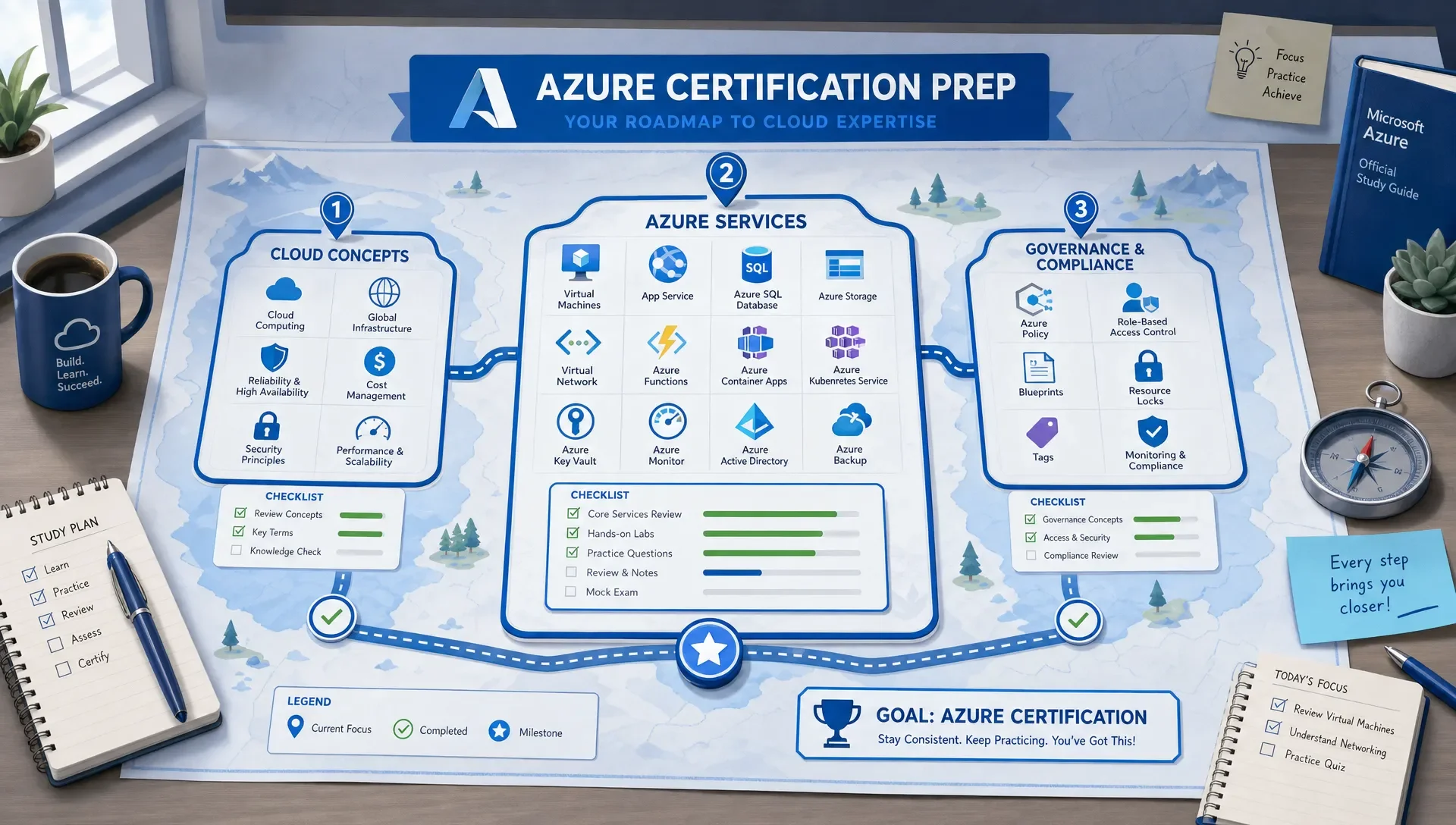
AZ-900 Exam Prep: What to Study and When to Practice
AZ-900 Exam Prep: What to Study and When to Practice
Start AZ-900 exam prep by using the official exam objectives as your checklist. Then, practice in layers: a short diagnostic on day one, topic quizzes after each study block, and full timed exams only after you've covered the main domains. Don't treat practice tests as the first step or the final step. Use them to steer your study while there's still time to fix weak areas.
The exam tests whether you understand cloud concepts, core Azure services, and Azure management and governance at a fundamentals level. According to Microsoft's official AZ-900 study guide, the exam currently weights cloud concepts at 25-30%, Azure architecture and services at 35-40%, and Azure management and governance at 30-35%. This means your preparation should spend the most time on services and governance, not just basic cloud vocabulary.
Start With the Official AZ-900 Exam Objectives
Before you open a course, flashcard deck, or practice test, read the skills measured page from Microsoft. AZ-900 is broad, but it isn't random. Every good study session should map back to one of the official domains.
A common beginner mistake is studying Azure like a product catalog. You memorize that Azure Functions is serverless, Azure Blob Storage stores objects, and Azure Monitor collects telemetry, but you can't explain when each one truly matters. The exam usually rewards recognition, comparison, and scenario judgment more than raw recall.
Use this simple rule: if you can't explain a concept in one sentence and choose it correctly in a scenario, keep studying before you take another full practice exam.
| AZ-900 domain | Microsoft weighting | What to study first | Best practice format |
|---|---|---|---|
| Cloud concepts | 25-30% | Shared responsibility, cloud models, consumption-based pricing, high availability, scalability, elasticity | Short concept quizzes and flashcards |
| Azure architecture and services | 35-40% | Regions, availability zones, subscriptions, resource groups, compute, storage, networking, identity | Scenario questions and service comparison drills |
| Azure management and governance | 30-35% | Cost management, Azure Policy, RBAC, resource locks, tags, monitoring, compliance, service health | Mixed questions with explanations |
If you want a structured path that follows the exam objectives instead of jumping between unrelated topics, use the AZ-900 Microsoft Azure Fundamentals study guide as your main roadmap.
What to Study for AZ-900 by Domain
Cloud concepts to learn first
Start with cloud basics because they make every later Azure service easier to understand. You should be comfortable with public, private, and hybrid cloud. You should also know the difference between Infrastructure as a Service (IaaS), Platform as a Service (PaaS), and Software as a Service (SaaS).
The highest-value concepts are the ones that appear across many Azure services. Shared responsibility is a good example. In a SaaS model, the provider manages more of the stack. In IaaS, the customer keeps more responsibility. That idea connects directly to virtual machines, managed databases, identity, backups, and security.
You should also understand availability, scalability, elasticity, reliability, predictability, security, governance, and manageability. Don't just define the terms. Ask yourself what a business gains from each one. For example, elasticity matters when demand changes quickly, while high availability matters when downtime has a direct business impact.
Azure architecture and services to study next
This is the largest AZ-900 domain, so don't save it for the last few days. Start with the Azure hierarchy: management groups, subscriptions, resource groups, and resources. Then study physical infrastructure concepts such as regions, region pairs, and availability zones.
Once the foundation is clear, move into service categories:
- Compute: virtual machines, containers, Azure App Service, Azure Functions
- Networking: virtual networks, VPN Gateway, ExpressRoute, Azure DNS, network security groups
- Storage: Blob Storage, Azure Files, Azure Disk Storage, storage tiers, redundancy options
- Identity: Microsoft Entra ID, authentication, authorization, multifactor authentication, conditional access
This is where comparison practice matters. AZ-900 often asks you to choose between similar options. For example, you should know why an organization might use Azure App Service instead of managing virtual machines, or when object storage is a better fit than file shares.
Azure management and governance to study after services
Governance becomes easier after you know what resources Azure is managing. Study Azure Policy, role-based access control (RBAC), resource locks, tags, Azure Cost Management, Azure Advisor, Azure Monitor, Azure Service Health, and Microsoft Defender for Cloud at a fundamentals level.
The goal here is to understand control and visibility. RBAC answers who can do what. Azure Policy helps enforce rules. Tags help organize costs and resources. Azure Monitor helps collect and analyze signals. Service Health helps track Azure issues that may affect your environment.
This domain is also where many candidates lose points because they treat governance tools as interchangeable. They're not. A policy, a lock, a role assignment, and a tag solve different problems. Practice questions are useful here because the wrong answers often sound plausible.
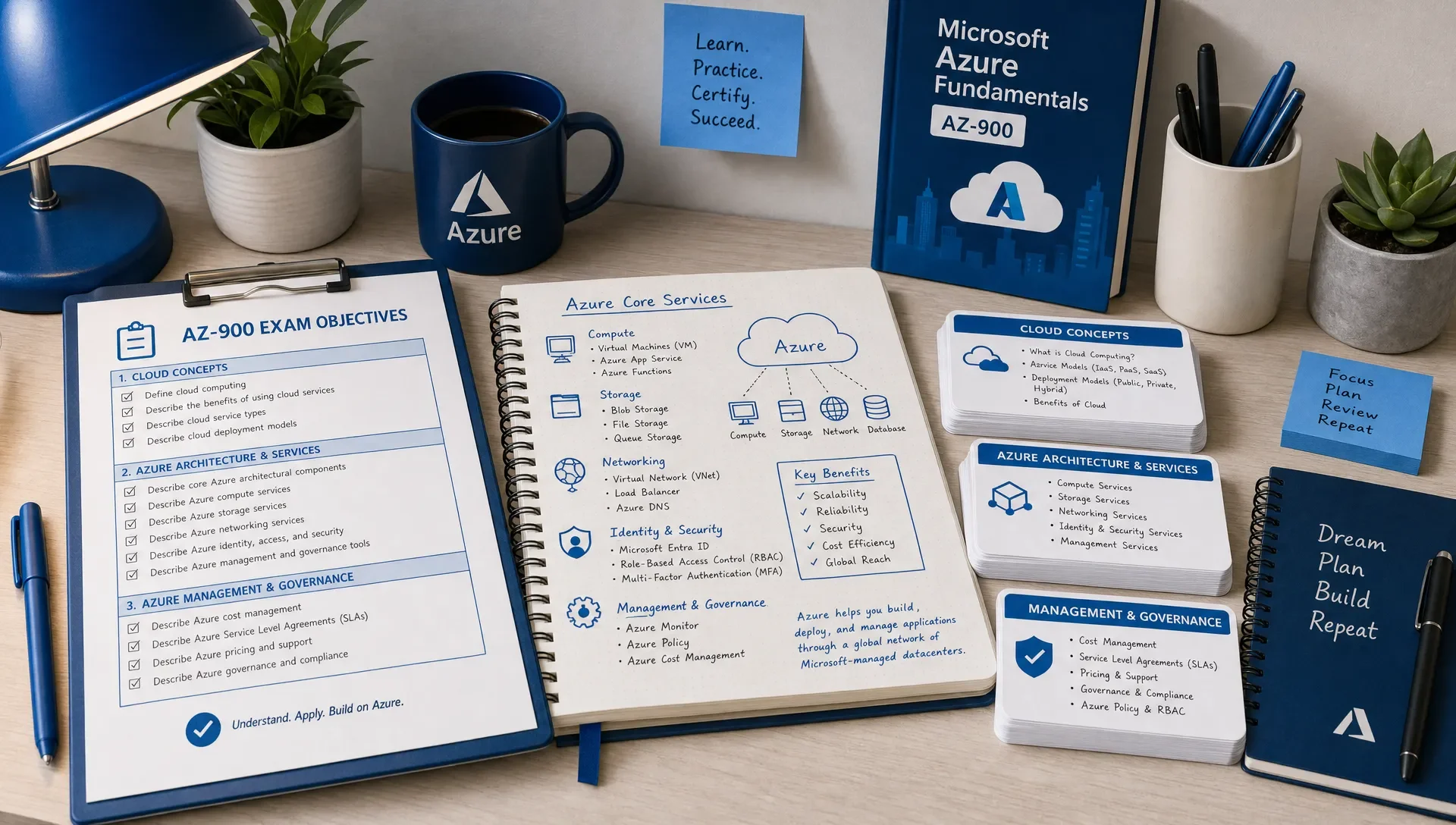
When to Use Practice Questions During AZ-900 Prep
Practice questions should start early, but full-length exams should come later. There's a difference between using questions to learn and using a timed exam to measure readiness.
Research on retrieval practice supports this approach. In a controlled study published in Science, Karpicke and Roediger found that practicing retrieval improved long-term retention more than repeated study alone (Science). In plain terms, answering questions helps you find out what you really know, not just what looks familiar.
For AZ-900, the best practice sequence looks like this:
| Prep stage | When to practice | What to use | What the result should tell you |
|---|---|---|---|
| Day one | Before deep study | 20-30 mixed diagnostic questions | Which domains need the most attention |
| After each topic | Same day or next day | 10-20 objective-based questions | Whether you understood the concept well enough to move on |
| Midway through prep | After cloud concepts and most services | 40-60 mixed questions | Whether you can switch between domains without hints |
| Final stretch | After all domains are covered | Full timed practice exam | Whether your accuracy and pacing are exam-ready |
| Last 48 hours | Light review only | Missed questions and flashcards | Whether weak facts are sticking without overloading yourself |
A diagnostic quiz at the beginning shouldn't discourage you. Its job is to expose gaps. If you score poorly before studying, that's normal. What matters is whether your explanations improve after review.
Save your best full-length practice exam attempts for the end. If you take full exams too early, you may memorize the question wording instead of learning the objective behind it. If you wait too long, you won't have enough time to repair weak areas. The middle path works best: practice early in small sets, then validate with timed exams later.
When you're ready for exam-style review, the AZ-900 practice exam gives you practice questions, explanations, flashcards, adaptive weakness-based practice, and readiness tracking in one workflow.
A Practical AZ-900 Study Timeline
Your timeline depends on your background. If you've worked with cloud or IT basics, you may only need 1-2 focused weeks. If you're new to cloud, plan closer to 3-4 weeks. The exam is entry level, but entry level doesn't mean no preparation.
Here are three realistic paths:
| Learner profile | Suggested timeline | Weekly study time | Best approach |
|---|---|---|---|
| IT professional new to Azure | 1-2 weeks | 6-8 hours | Fast objective review, heavy practice questions, targeted flashcards |
| Beginner with basic tech confidence | 3 weeks | 5-7 hours | Study one domain at a time, then mixed practice |
| Non-technical learner | 4 weeks | 4-6 hours | Build cloud vocabulary first, use more repetition, practice in small sets |
A 3-week plan works well for many candidates because it gives enough space for learning and review.
In week 1, study cloud concepts and the Azure hierarchy. Focus on definitions, responsibility models, subscriptions, resource groups, regions, and availability zones. Use short quizzes after each topic.
In week 2, study compute, storage, networking, and identity. This is your heaviest week. Build comparison tables in your notes, then answer scenario questions to test whether you can choose between services.
In week 3, study governance, cost, monitoring, compliance, and security basics. Take one full timed practice exam early in the week, review every missed question, then take another timed attempt after targeted remediation.
If you want a deeper walkthrough of how to interpret scores and avoid wasting question banks, MindMesh Academy's AZ-900 practice exam guide covers practice strategy in more detail.
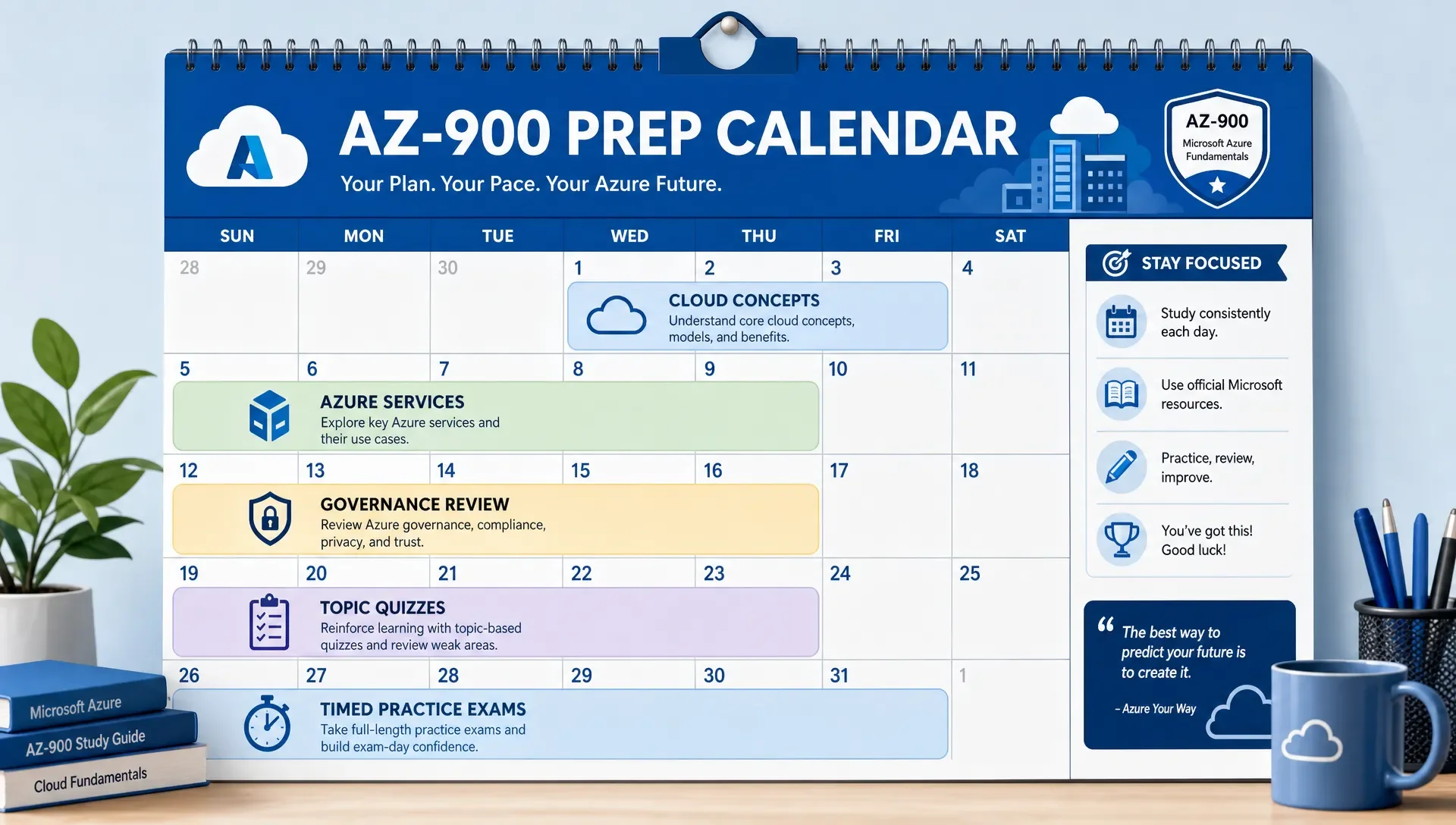
How to Review Wrong Answers So They Improve Your Score
The value of a practice question is in the review, not the score. If you miss a question and only read the correct answer, you'll probably miss a similar question later with different wording.
Use a three-part review method. First, identify the objective being tested. Was the question about identity, cost, storage redundancy, or governance? Second, explain why the correct answer fits. Third, explain why each incorrect option is wrong. That final step is where real learning happens.
For example, if you confuse Azure Policy with RBAC, write the difference in plain language. RBAC controls user permissions. Azure Policy evaluates resources against rules. Both support governance, but they don't do the same job.
Keep a running error log with four columns: question topic, why you missed it, correct concept, and next review date. This turns mistakes into a study plan instead of a source of anxiety.
| Wrong answer pattern | What it usually means | How to fix it |
|---|---|---|
| You chose a service from the wrong category | You memorized names without use cases | Rebuild notes by problem solved, not by product name |
| You narrowed it to two options and guessed | You know definitions but not comparisons | Create side-by-side comparisons and answer scenario questions |
| You missed governance questions repeatedly | You haven't separated RBAC, Policy, locks, and tags | Write one sentence for what each tool controls |
| You ran out of time | You spent too long rereading questions | Practice timed sets and flag uncertain answers faster |
| You changed correct answers to wrong ones | You lacked confidence in first-principles reasoning | Require a reason before changing any answer |
MindMesh Academy's adaptive weakness-based practice and progress tracking by topic can help you focus your next session on the areas that actually need attention instead of rereading everything from the beginning.
How to Know You're Ready to Schedule the Exam
Don't schedule AZ-900 just because you finished a course. Schedule it when your practice results show repeatable understanding across domains.
Readiness looks like this: you can explain the major cloud models without notes, compare common Azure services in scenarios, identify the right governance tool for a business need, and review missed questions without seeing the same mistakes again.
Your full practice scores should be stable, not lucky. One strong score can happen because the questions aligned with your strengths. Two or three strong mixed attempts, combined with clear explanations for missed items, are a better sign.
You should also check the current exam details directly on Microsoft's AZ-900 exam page before booking. Microsoft can update exam details, languages, and policies, so always confirm the latest information at the source.
Final Week AZ-900 Prep Checklist
The last week should feel more like refinement than first-time learning. If you're still discovering entire domains, push the exam back if possible. AZ-900 rewards broad familiarity, and cramming tends to create shallow recognition.
Use the final week to tighten the topics that are easy to confuse:
- IaaS vs PaaS vs SaaS responsibility boundaries
- Availability zones vs region pairs
- Azure Blob Storage vs Azure Files vs disk storage
- RBAC vs Azure Policy vs resource locks
- Azure Monitor vs Azure Service Health vs Azure Advisor
- CapEx vs OpEx and consumption-based pricing
Spend more time explaining than rereading. If a flashcard asks what Azure Policy does, don't stop at the definition. Add a quick example: enforce allowed regions, require tags, or audit noncompliant resources. That level of understanding is more useful than memorizing a sentence.
On the day before the exam, avoid a marathon practice session. Review your error log, complete a light set of mixed questions, and stop when your accuracy and confidence are stable. Your goal is to walk in clear, not exhausted.
Frequently Asked Questions
Is AZ-900 hard for beginners? AZ-900 is beginner-friendly, but it still covers a wide range of cloud, Azure service, and governance concepts. Beginners usually struggle less with deep technical detail and more with telling similar services apart.
When should I take my first AZ-900 practice test? Take a short diagnostic quiz at the start of your prep, but don't take a full timed exam immediately unless you already know the objectives. Use topic quizzes while learning, then move to full practice exams after you've covered all major domains.
What should I study most for AZ-900? Spend the most time on Azure architecture and services because it has the largest weighting. Don't ignore management and governance, though. Tools like RBAC, Azure Policy, tags, monitoring, and cost management are heavily connected to real exam scenarios.
Should I memorize every Azure service for AZ-900? No. You should know the major services covered by the exam and understand what problems they solve. Focus on categories, use cases, and comparisons instead of trying to memorize every Azure product name.
How many weeks do I need for AZ-900 exam prep? If you already understand basic IT and cloud ideas, 1-2 focused weeks may be enough. If you're new to cloud, 3-4 weeks is more realistic. The right timeline depends on how quickly you can explain concepts without notes and apply them in practice questions.
Are flashcards useful for AZ-900? Yes, especially for terms, service categories, and governance differences. Flashcards work best when you combine them with practice questions, because the exam tests recognition and application, not just definitions.
Build a Study Workflow That Matches the AZ-900 Exam
Good AZ-900 exam prep isn't about collecting more resources. It's about using the right activity at the right time: study the objective, test the objective, review the mistake, and repeat until your weak areas shrink.
MindMesh Academy's platform supports this workflow with objective-based study guides, practice questions with detailed explanations, and adaptive practice to focus on your weak areas. If you're preparing for Microsoft Azure Fundamentals, test your readiness and build confidence with our AZ-900 practice exam.

Written by
Alvin Varughese
Founder, MindMesh Academy
Alvin Varughese is the founder of MindMesh Academy and an enterprise architecture leader. An electrical engineer by training, he moved from factory automation in South Africa to cloud architecture at GE Appliances and Humana (Fortune 50), and holds 20 professional certifications including AWS Solutions Architect Professional, Azure DevOps Engineer Expert, and Microsoft Agentic AI Business Solutions Architect. He built MindMesh Academy after interviewing too many highly certified candidates who couldn't answer basic questions: the goal is prep that makes you better at the job, not just able to pass the exam.