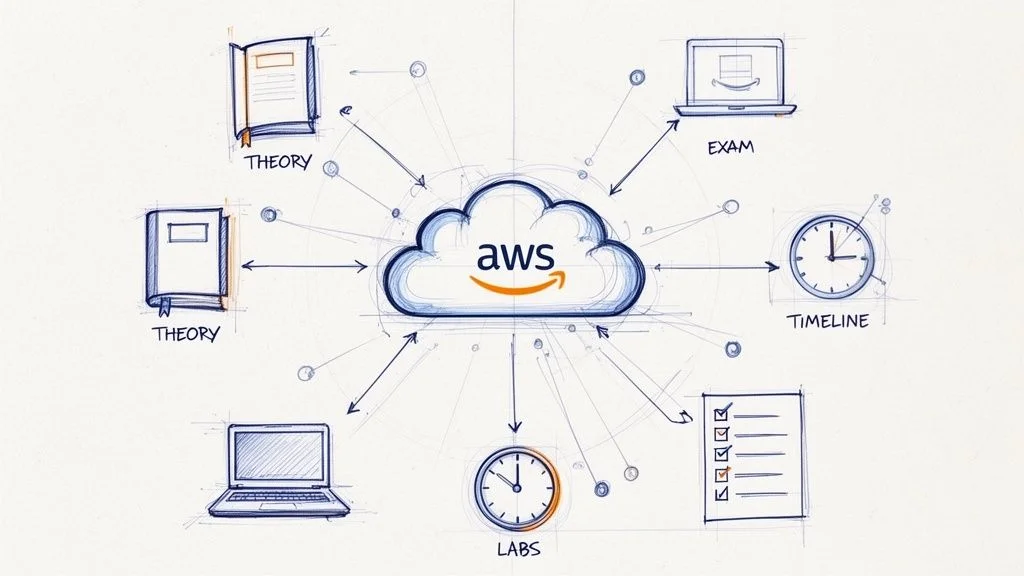
Your AWS Solution Architect Training Plan for 2026
Your AWS Solution Architect Training Plan for 2026: Mastering Cloud Design
Earning the AWS Certified Solutions Architect credential signals a commitment to advancing your career by designing, deploying, and managing cloud solutions. This process involves more than memorizing service lists or individual features. You must learn to solve real-world business challenges by building architectures that scale and perform under pressure. Successful architects focus on strategy. They understand how different services interact to create stable environments. Develop the practical skills required for cloud design in 2026.
Your Blueprint for Certification Success
The AWS Solutions Architect certification path includes the Associate (SAA-C03) and Professional (SAP-C02) levels. These exams exist to validate your ability to think like an architect. Employers do not just look for a digital badge on a profile. They want to hire people who can design and build systems that are secure, stay running during failures, and do not waste money. To reach this level of skill, you need a training plan that focuses on active learning.
A strong training plan requires more than watching videos or reading slides. You must interact with the AWS platform to gain actual experience. You should not just memorize what Amazon S3 does. Instead, you should practice designing a plan to recover data across multiple geographic regions if a disaster occurs. You might look at how to replicate data between buckets in different parts of the world to keep a business running. This hands-on approach is what turns basic knowledge into the expertise you need for a career in cloud computing.
The Value Beyond the Badge
The certificate is a way to get an interview, but your ability to explain your technical choices is what gets you the job. A hiring manager cares more about your reasoning than your ability to remember facts. If you can explain how to build a web store that handles millions of users without crashing, you will impress them more than if you simply state the maximum size of a file in S3.
The real test of your knowledge happens during the interview. You will likely be asked: "Given this specific business problem, how would you architect the optimal AWS solution?" To answer this well, you must show you understand the balance between cost, how fast the system runs, how safe it is, and how hard it is to manage.
This guide acts as a roadmap for your study. We have put together a strategy that has helped many IT professionals pass these exams. The focus is on the specific skills that companies actually look for when they hire cloud architects.
AWS Solution Architect Certification Path at a Glance
There are two main certifications in this path. Each one is meant for a different level of experience and tests different skills.
| Certification Level | Target Audience | Primary Exam Focus |
|---|---|---|
| Solutions Architect – Associate | Individuals with 1+ year of hands-on AWS experience. | Designing secure, available, and cost-efficient systems using individual AWS services. Focus on well-architected principles for single applications. |
| Solutions Architect – Professional | Individuals with 2+ years of comprehensive AWS experience. | Complex, multi-account solutions, migrations, and optimizing for cost and performance at scale. Focus on connecting services to solve complex business requirements. |
Table 1: Overview of AWS Solutions Architect Certification Levels
This table shows the basic differences, but you should also see how these fit into the larger AWS system. You can find more information in our guide on all available AWS certifications and their career impact.
In this guide, we will look at:
- A Structured Study Path: How to move from the basics of the cloud to advanced strategies involving many different AWS accounts.
- Mapping Exam Objectives: Connecting the official goals of the exam to specific lessons and lab exercises.
- Building Real-World Skills: Focusing on the practical tasks that you will actually do on the job.
Use this as your playbook. It was built from years of experience to help you handle the challenges of the certification process.
Your goal is to move up the ladder from the Associate level to the Professional level. Many people fail because they think the two exams are the same. They are not. Moving to the Professional level requires a change in how you think about architecture. You have to stop looking at small pieces and start looking at the entire organization.
Let’s look at the steps for this journey. We will start with the mindset you need for the Associate exam and then show how to build on that for the Professional exam.
Nail the Associate Mindset First
The AWS Certified Solutions Architect – Associate (SAA-C03) is your starting point. Many people try to pass this exam by memorizing a list of AWS services and their features. This usually leads to failure. The exam does not just ask what a service is. It asks how you would use that service to solve a specific problem in a real-world scenario.
Do not use the official exam guide as a simple checklist. You should look at each domain in the guide as a business problem that a client is paying you to fix. If you can solve the problem, you understand the material.
Thinking Like an Associate Architect
You need to turn the exam domains into architectural thoughts. Imagine a client has given you a list of requirements. You must decide which AWS tools will meet those requirements in the best way possible.
-
Design Resilient Architectures: This domain is about keeping a business running. You need to ensure that if something breaks, the system stays up. Think about an online store. If the store goes offline, the company loses money every minute. You have to ask yourself how to build the store so it survives if an entire AWS data center fails. You should immediately think of tools like the Application Load Balancer. You would use it to send traffic to multiple servers. You would also use Auto Scaling groups to add or remove servers as needed. For the data, you would use a Multi-AZ setup for Amazon RDS. This ensures that a backup of the database is always ready in a different location.
- Reflection Prompt: In a disaster recovery scenario, why would a Multi-AZ RDS deployment be preferable to simply running your database on a single EC2 instance, even if that instance is backed up?
-
Design High-Performing Architectures: Performance is about more than just being fast. It is about being efficient. Imagine you are building a system that collects data from thousands of sensors in real time. You have to choose the right tool for the job. Should you use Amazon Kinesis to handle the data stream, or is Amazon SQS a better choice for sending messages between parts of the system? You also need to think about storage. You should know when to keep data in a fast S3 storage tier and when to move it to a cheaper, slower tier to save money without hurting performance.
-
Design Secure Applications and Architectures: Security is the most important part of any AWS project. You must know more than just the definition of an IAM role. You have to know how to use it to protect data. For example, if a company has an application running on an EC2 instance, that application might need to read files from an S3 bucket. You should never put secret passwords or API keys inside the application code. Instead, you use an IAM role. This gives the application permission to access the files without needing a permanent password. This is a basic pattern that you will use in almost every project you work on.
- Reflection Prompt: Beyond IAM roles, what other AWS security services would you immediately consider to protect an internet-facing web application, and why? (Hint: Think network perimeter and DDoS protection.)
-
Design Cost-Optimized Architectures: A good architect is always looking for ways to save the client money. This domain tests your ability to pick the most affordable solution that still works well. You will need to choose the right way to pay for EC2 servers. You might choose On-Demand instances if the work is unpredictable. You might choose Reserved Instances if you know you will need the server for a year or more. You might use Spot Instances for tasks that can be interrupted. The right choice depends on what the business needs and how much risk they can take.
- Key Takeaway: You must understand the "why" behind every service you choose. Knowing how it fits into the AWS Well-Architected Framework is the best way to prepare for the Associate exam.
When you study with this mindset, you are doing more than preparing for a test. You are learning the problem-solving skills you will use every day as a cloud architect.
This process is a cycle. You plan, you build, and you create value for the business. It never really ends.
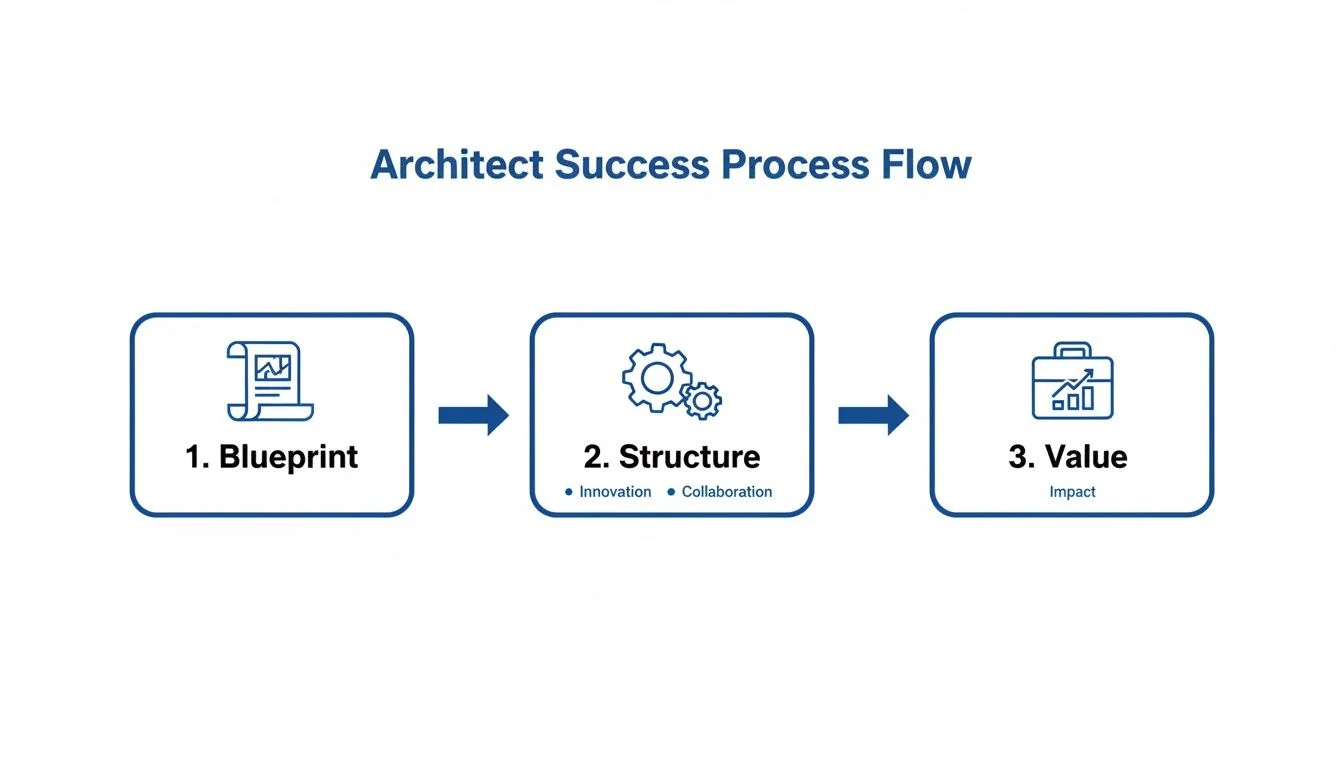 Figure 1: The Architect's Success Process — A continuous cycle of planning, building, and value creation.
As the image shows, you have to keep moving through these steps. This is the mindset you must take with you when you move to the Professional exam. At that level, the problems get much bigger and more difficult.
Making the Leap to the Professional Level
The AWS Certified Solutions Architect – Professional (SAP-C02) is much harder than the Associate exam. It covers more topics, and it requires you to understand them more deeply. The Associate exam asks if you can build a single application. The Professional exam asks if you can solve massive problems for an entire company by using many different AWS services together.
The questions on the Professional exam are very long. They describe complex situations with many different requirements. Often, there is no perfect answer. You have to find the answer that is the "best" fit based on the specific constraints given in the story. You might have to choose between a solution that is cheaper and one that is more secure.
The big change here is moving from "how do I build this piece?" to "how do I solve this organizational problem?" You have to think about many different business units, security rules, and budgets all at once. The exam tests how you handle complicated situations and how you design for the long-term goals of a large company.
Your perspective must shift. You are no longer just looking at one Virtual Private Cloud (VPC). You might be looking at a global company that has dozens of VPCs in different countries. They might also have their own data centers that need to connect to the cloud. You have to decide if they should use AWS Transit Gateway to connect everything or if AWS Direct Connect is a better choice. You have to weigh the costs and the technical limits of each option.
Mastering Professional-Level Complexity
To get ready for the SAP-C02, you must spend a lot of time on advanced topics. You will build on what you learned for the Associate exam, but you will go much deeper into the details.
Key Focus Areas for the Professional Exam:
-
Advanced Networking: You need to know more than just how to connect two VPCs. You must master AWS Transit Gateway for managing complex connections. You need to understand how to use AWS Direct Connect for a dedicated physical link to the cloud. You also need to know how to manage DNS across a hybrid environment where some servers are on-premises and some are in the cloud.
- Reflection Prompt: Consider a large enterprise with offices in multiple continents and several on-premises data centers. What is the most robust and scalable networking solution to connect all these endpoints securely to their AWS environment, and what are the key considerations for latency and cost?
-
Multi-Account Strategy and Governance: Large companies use many different AWS accounts to keep their teams separate. You must understand AWS Organizations. You need to know how to use Service Control Policies (SCPs) to set limits on what people can do in those accounts. You also need to know how to manage billing for all these accounts in one place. Your job is to design a system that keeps the company secure and follows the law, even when there are hundreds of accounts to manage.
-
Large-Scale Migrations: Many companies are moving their old servers to the cloud. You will see many questions about this on the exam. You have to know the difference between just moving a server as it is (rehosting) and changing the application so it works better in the cloud (refactoring). You will need to know which tools to use, such as the AWS Database Migration Service (DMS) or the AWS Application Migration Service. You also have to plan for how to move the data without causing the business to stop working.
-
Cost Management at Scale: At the Professional level, you have to think about money for the whole company, not just one project. You need to know how to use tags to track who is spending money. You should be able to create reports that show each department how much they are using. You must design systems that automatically grow and shrink so the company only pays for what it actually uses. This requires a deep understanding of tools like AWS Cost Explorer and how to set up budgets and alerts.
This is where you start to develop an instinct for cloud architecture. You stop looking for a single right answer in a book. Instead, you start evaluating different options to see which one fits the messy reality of a real business. You have to consider the people, the existing technology, and the financial goals of the organization.
If you are ready for this level of difficulty, you need a plan. A good place to start is our study guide for the AWS Certified Solutions Architect – Professional exam. This guide shows you how to turn these hard topics into a clear path for learning.
Passing these exams is about more than just study time. It is about changing how you look at technology. You are training yourself to be a problem solver who uses the cloud as a tool. Whether you are working on the Associate or the Professional level, keep your focus on the business value of your technical choices. This is the difference between someone who has a certificate and someone who is a true architect.
By following this training plan, you will be prepared for the specific technical challenges of the current exams. You will understand how to use the latest AWS features to build systems that stand up to real-world pressure. Stay consistent with your study, spend plenty of time in the AWS console, and always ask yourself why a specific architecture is the right choice for the situation. This approach will help you pass with confidence and build a successful career in the AWS cloud.
Mastering Concepts with Smart Study Tools
Let's be candid: theoretical knowledge and practice exams are necessary, but internalizing the high volume of information required for AWS Solutions Architect exams demands more than rote memorization. Passively watching video courses or reading whitepapers multiple times is not enough to pass. You need specific strategies and tools to ensure technical details remain accessible in your memory when you are under pressure.
You must transition from studying for longer periods to studying with better methods. Instead of adding more hours to your schedule, use modern learning tools to lock in technical knowledge for the long term. These tools act as a strategic advantage for any AWS solution architect training schedule, helping you manage the 200-plus services AWS currently offers.
Use Spaced Repetition to Beat the Forgetting Curve
Your brain is naturally wired to discard information it does not encounter frequently. This is a biological function known as the forgetting curve. Spaced Repetition is a learning technique that works with this natural tendency rather than trying to override it. It forces you to review information right as you are likely to forget it, which strengthens the neural pathways associated with that data.
Consider the difficulty of remembering the specific differences between an IAM Policy, an IAM Role, and an IAM User. These concepts seem simple at first but become complex when applied to cross-account access or federated identities. A Spaced Repetition System (SRS), like the one found in MindMesh Academy, quizzes you on these concepts at mathematically optimized intervals.
- If you answer a question incorrectly: The system recognizes the weakness and schedules the concept for review again within a few hours or the next day.
- If you answer correctly: The system increases the time gap before the next review, moving from days to weeks and eventually months.
This process moves technical facts from fragile short-term memory into reliable long-term recall. It is especially effective for memorizing service limits, API parameters, and configuration options that often appear as the deciding factors on exam questions. To get the most out of these tools, you must maintain your mental energy. Reviewing methods for how to concentrate while studying can help you get the highest return on every study session.
Close Knowledge Gaps with Adaptive Learning Paths
Study time is a finite resource. If you have years of experience with relational databases but have never configured a virtual network, you should not spend an equal amount of time studying Amazon RDS and Amazon VPC. An adaptive learning path solves this by changing your study plan based on your actual performance in real-time.
Suppose you take a quiz and struggle with the differences between a Network Access Control List (NACL) and a Security Group. A smart learning tool does not just tell you that you were wrong. It identifies a gap in your understanding of VPC security layers.
The tool might adjust your path to include a video on CIDR blocks or a specific drill on stateful versus stateless firewall rules. It focuses on the fact that NACLs are stateless and operate at the subnet level, while Security Groups are stateful and operate at the instance level. Once you demonstrate mastery of these foundational rules, the system reintroduces more complex scenarios involving route tables and internet gateways. This method prevents you from wasting hours on topics you already understand, ensuring every minute of study improves your weakest areas.
Diagnose Weaknesses with a Performance Dashboard
You cannot fix a technical weakness if you cannot identify it with data. A Performance Dashboard acts as a diagnostic center, providing a map of your skills across the official exam domains. It replaces vague feelings about your progress with hard facts.
A high-quality dashboard, like the version used in MindMesh Academy, tracks your scores across practice exams and individual quizzes. It visualizes your proficiency in specific areas like high availability, storage optimization, and identity management.
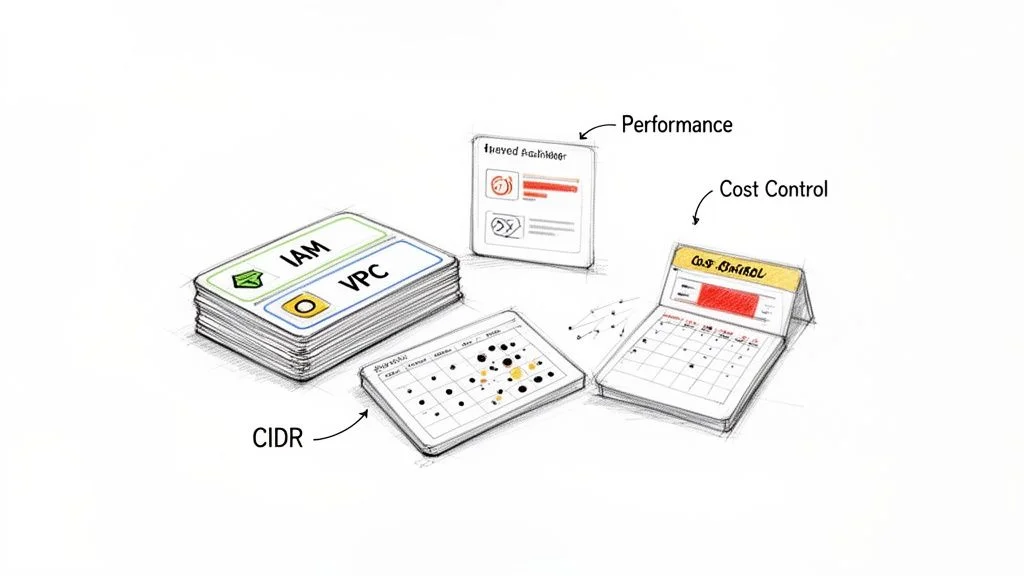 Figure 2: A performance dashboard visually breaking down proficiency across key AWS domains, helping identify areas for focused study.
Seeing a visual breakdown helps you choose where to put your effort. If your score in the "Cost Control" domain is significantly lower than your score in "Design Resilient Architectures," you have a clear target for your next study block. This data-driven approach removes the guesswork from your preparation.
Consider this practical scenario to see how you can apply this data to your daily routine.
Scenario: Your dashboard consistently shows low scores in the 'Cost Control' domain.
- Identify the Problem: You see a 55% score in the cost domain. Meanwhile, your scores in networking and compute are strong, ranging between 85% and 90%. The data shows a clear deficiency that could lead to a failing grade if ignored.
- Drill Down: You review your incorrect answers and find a specific pattern. You are confusing the use cases for AWS Budgets, AWS Cost Explorer, and the AWS Cost and Usage Report (CUR). You also realize you are missing questions regarding S3 storage classes and their respective price points.
- Build a Targeted Plan: Instead of starting a 20-hour video course from the beginning, you spend two hours on specific tasks:
- Compare the proactive alerting of AWS Budgets against the historical trend analysis of AWS Cost Explorer.
- Use a hands-on lab to set up a budget alert that triggers an SNS notification when spending exceeds a certain threshold.
- Study the official documentation for S3 Intelligent-Tiering and S3 Glacier Instant Retrieval to understand how they automate cost savings for data with unpredictable access patterns.
- Validate Your Learning: After this focused study, you take a quiz dedicated only to cost management. Your score rises to 80%. You have now proven that you closed the gap and can move on to the next topic.
This iterative cycle is a vital part of effective preparation. It transforms your weak points into strengths and gives you the confidence to face the exam. By focusing on data rather than intuition, you ensure that you are ready for the current exam requirements and the technical challenges you will face in a professional role. Using these tools correctly allows you to master the material efficiently, leaving you better prepared for the exam and for your career as an architect.
Building Real-World Skills with Hands-On Labs
Theoretical study and practice exams build a solid knowledge base, but they will not secure a job on their own. The real differentiator in any AWS solution architect training program is working directly within the AWS console. This environment is where abstract cloud concepts solidify into technical skills that employers value.
Hiring managers want concrete evidence that you can build, manage, and troubleshoot cloud solutions. You cannot prove this by just passing a multiple-choice exam. You provide proof by moving beyond simple tutorials and tackling projects that solve common business problems. These projects demonstrate that you understand how services interact under pressure.
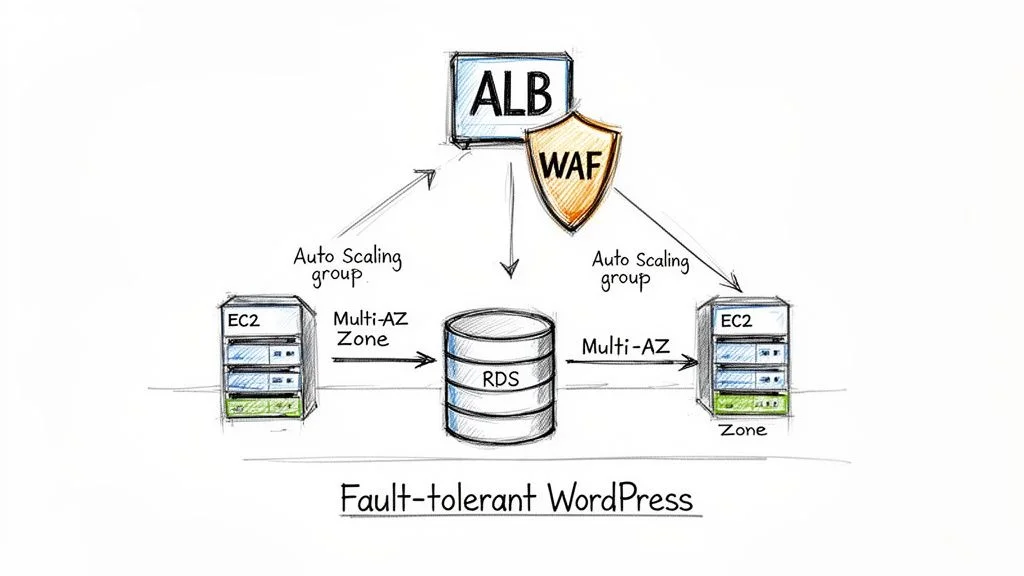 Figure 3: A fault-tolerant WordPress architecture illustrating key AWS services for high availability, scalability, and security.
Go Beyond Basic Lab Exercises
Do not just launch a single EC2 instance and stop there. That level of practice is insufficient for a professional architect. Instead, challenge yourself to build a system with a clear business purpose. A standard project for aspiring architects is deploying a fault-tolerant WordPress website. This project is common in the industry and forces you to integrate multiple AWS services to handle networking, compute, and data storage.
The goal is not just to get a website to load in a browser. Your objective is to build the architecture correctly by making it secure, resilient, and ready for high traffic. This requires configuring different layers of the AWS infrastructure to work together. You will learn how to handle persistent storage, manage database connections, and route traffic across different geographic locations within an AWS region.
A High-Impact Lab Blueprint
A resilient WordPress architecture involves several components that work together to satisfy business requirements. Think of this as your first major portfolio piece. Each component you configure serves a specific function that addresses a common technical challenge.
- Application Load Balancer (ALB): The ALB functions as the entry point for your application at the request level. It distributes incoming web traffic across multiple backend web servers. By using an ALB, you achieve high availability. If one server fails, the load balancer stops sending traffic to it and directs users to the remaining healthy servers. This removes the risk of a single point of failure at the web tier.
- EC2 Auto Scaling Group: You will configure an Auto Scaling group to manage your web servers automatically. These servers should be distributed across at least two Availability Zones to ensure the site stays online if one data center loses power. You must also set up scaling policies based on metrics like CPU utilization or request counts. This ensures the system adds servers during traffic spikes and removes them when traffic drops, which controls costs and maintains performance.
- Multi-AZ Amazon RDS Database: A database failure can stop a business entirely. By deploying Amazon RDS for MySQL in a Multi-AZ configuration, you create a primary database and a synchronous standby replica in a different Availability Zone. If the primary instance fails, AWS performs an automatic failover to the standby. This transition happens by updating the DNS record of your database endpoint, meaning your application can reconnect quickly without manual changes.
- Web Application Firewall (WAF): You must treat security as a primary requirement. Attach an AWS WAF to your Application Load Balancer to protect the site from web exploits. You should apply managed rulesets that block SQL injection and cross-site scripting. These rules help defend against the OWASP Top 10 threats and provide a layer of defense that standard firewalls cannot offer at the application layer.
When you finish this project, you will be able to explain how you designed a system to meet a 99.99% uptime Service Level Agreement. You will have moved from understanding a service name to implementing a professional configuration.
Real learning happens when you connect a technical choice to a business problem. You implement a Multi-AZ database to prevent revenue loss during a hardware failure. You use an Auto Scaling group to handle a Black Friday sales event without a site crash. These connections show that you understand the value of the technology you use.
To help you move from certification knowledge to career readiness, use these lab scenarios. They range from associate-level tasks to complex professional challenges. Each scenario focuses on a specific business outcome that companies look for when hiring.
Essential Hands-On Lab Scenarios
| Lab Scenario | Key AWS Services | Business Goal Achieved |
|---|---|---|
| Deploy a Static Website | S3, CloudFront, Route 53 | Build a low-cost, secure website that scales globally and stays available for marketing or technical documentation. |
| Build a Three-Tier Web Application | ALB, EC2, Auto Scaling, RDS, VPC | Create a high-availability environment that handles dynamic content and scales automatically based on user demand. |
| Decouple Services with SQS & Lambda | SQS, Lambda, S3, IAM | Design an asynchronous architecture that processes data or orders without losing requests when traffic spikes suddenly. |
| Automate Infrastructure with CloudFormation | CloudFormation, VPC, EC2, RDS | Use Infrastructure as Code to ensure your deployments are repeatable, consistent, and easy to manage across different accounts. |
| Establish a Hybrid Cloud Network | VPC, VPN Gateway, Direct Connect, Route 53 Resolver | Connect a physical data center to AWS to allow for data migration, resource expansion, or a disaster recovery setup. |
| Implement a Disaster Recovery Plan | RDS Multi-AZ/Cross-Region Replication, S3 Cross-Region Replication, Route 53 Failover | Maintain business continuity during a regional outage by failing over your data and traffic to a secondary AWS region. |
Table 2: Essential Hands-On Lab Scenarios for AWS Solutions Architects
These labs are realistic simulations of the work you will do as a professional Solutions Architect. Completing them gives you the confidence to talk about architecture during technical interviews.
Intentionally Break Your Architecture
One of the best ways to learn is to break what you have built. Once your WordPress site is running, start testing its limits. This practice is part of chaos engineering. Professional architects use these tests to find weaknesses in a system before they cause a real outage. You should conduct these experiments and document every result to show that you understand how AWS handles failures.
Use these three experiments to test your architecture:
- Terminate an EC2 Instance: Go to the EC2 console and stop one of your running web servers. Watch the Auto Scaling group to see how long it takes to detect the health check failure. Note the time it takes to launch a new instance. Check if your website stayed online during this process and if the load balancer correctly rerouted traffic.
- Simulate a Database Failure: Use the RDS console to perform a "Reboot with Failover" on your database. Monitor your website during this transition. Does the site show an error page? How many seconds pass before the standby database becomes the primary? Understanding this window of downtime is vital for communicating recovery times to stakeholders.
- Create a Traffic Storm: Use a tool like Apache JMeter or a simple load testing script to send thousands of requests to your site. Watch your CloudWatch metrics to see when your Auto Scaling policy triggers. You need to know if your site slows down before the new servers are ready. This test helps you fine-tune your scaling thresholds so the system responds before users experience lag.
Document these tests with care. Take screenshots of your architecture before and after the failures. Write down the steps you took and what you learned from each experiment. This documentation is a powerful addition to your portfolio. It proves to a hiring manager that you do not just know the names of the services, but you understand how they recover when things go wrong. This deep understanding is what separates a certified candidate from an experienced architect.
Your Final Exam Prep and Test-Day Strategy
Video 1: AWS Certification Exam Prep: Top 5 Tips to Pass Your Exam (MindMesh Academy)
As you enter the final weeks of your AWS solution architect training, you must change your approach. Stop trying to memorize new services or scrolling through endless documentation. Your priority now is shifting from basic learning to sharpening the specific skills required to pass the test. This phase involves identifying your remaining weak spots, mastering your timing, and entering the testing center with a clear plan of action.
High-quality practice exams are your best resource during this period. Many students make the mistake of focusing only on their percentage score. While a passing score on a practice test is encouraging, the actual value lies in the data behind that score. You need to treat every practice attempt as a diagnostic session. A score of 85% is great, but the 15% you missed contains the specific information you need to study to ensure you pass with confidence on your first attempt.
Practice Exams Are Your Diagnostic Tool
Do not simply finish a practice test and move on to the next one. Treat each attempt like an investigation. Every wrong answer is a signal that identifies a specific gap in your knowledge or a flaw in how you read the questions. If you ignore these signals, you are likely to repeat the same mistakes during the actual exam when the stakes are much higher.
After you finish a set of practice questions, spend time looking at every answer you got wrong. I find it helps to sort these mistakes into categories. This method turns a general feeling of confusion into a specific list of tasks. Instead of saying "I don't understand networking," you can identify that you specifically struggle with the differences between VPC Peering and Transit Gateway.
- Knowledge Gaps: Use this category when you did not know the specific service or feature required for a solution. For example, you might have chosen SQS for a task that required ordered message processing for multiple independent consumers. That specific requirement makes Amazon Kinesis the correct choice. These gaps are easy to fix with a quick review of the service FAQs or the AWS documentation.
- Misreading the Question: This happens when you have the right technical knowledge but miss a keyword in the prompt. AWS often hides the real requirement in words like "most cost-effective," "lowest latency," or "maximum durability." You might know how to build a resilient system, but if the question asks for the cheapest option, your expensive multi-region solution will be marked wrong. You can fix this by slowing down and reading the prompt twice.
- Process of Elimination Fails: This is for situations where you narrow the choices down to the final two but pick the wrong one. This usually happens when you do not fully understand the subtle trade-offs between two similar services. You might understand that both S3 and EFS provide storage, but you need to know exactly when the sub-millisecond latency of EFS justifies the higher cost compared to S3.
By breaking down your errors this way, you can build a focused study plan. You do not need to re-watch a 10-hour course. If your data shows you are consistently missing questions about high-performing architectures, spend an hour reviewing specific services like Amazon ElastiCache or AWS Global Accelerator. This targeted approach is the most efficient way to use your remaining study time.
Developing Your Test-Day Game Plan
Entering the exam room without a strategy is a mistake that leads to unnecessary stress. The AWS Solutions Architect exams are difficult because they test your mental stamina as much as your technical skill. This is especially true at the Professional level, where scenarios are long and complex. These questions are designed to use up your time and exhaust your focus.
You need a plan to manage the clock and your energy. If you spend too much time on a single difficult question, you might not have enough time to finish the easier questions at the end of the test.
You must control the clock. Do not let the time limit dictate your pace. Set a strict time limit for every question. For the Associate level, try to spend no more than two minutes per question. For the Professional level, you can allow a bit more time. If you cannot decide on an answer within your time limit, pick your best guess, flag the question for review, and move to the next one. It is better to answer every question than to leave easy points on the table because you got stuck on one difficult scenario.
Try a consistent routine for every question you face. Start by reading the last sentence of the question first. This sentence usually tells you exactly what the question is asking for, such as a "cost-effective solution" or a "highly available architecture." Once you know the goal, look at the four answer choices. Then, read the full scenario. This helps your brain filter out the "noise" in the text and focus only on the details that matter for the final choice.
As you take more practice tests, you will find the rhythm that works best for you. When you are ready for a final dry run, use a realistic simulator like the MindMesh Academy AWS practice exam environment. This prepares you for the actual interface you will see on exam day.
Battle-Tested Techniques for the Exam
When a question seems impossible, stay calm and use logic to narrow your choices. You can almost always remove one or two options immediately. Look for answers that suggest using a service for something it cannot do or solutions that ignore the specific constraints mentioned in the prompt. If a question asks for a serverless solution and an answer choice mentions managing EC2 instances, you can discard that option immediately.
After you eliminate the obvious wrong answers, you will likely have two choices left that both seem correct. This is where your knowledge of AWS trade-offs becomes the deciding factor. Go back to the prompt and look for the specific business drivers that AWS uses to differentiate between two working solutions:
- "Cost-effective" or "minimize cost" means you should look for serverless options like AWS Lambda or S3. You should also consider Spot Instances or S3 Glacier for long-term storage where immediate access is not required.
- "Highly available" or "resilient" means the solution must survive a failure. Look for answers that include Multi-AZ deployments, Load Balancers, or Auto Scaling groups that span multiple availability zones.
- "Improved performance" or "low latency" directs you toward caching and edge services. Look for Amazon ElastiCache for database acceleration or Amazon CloudFront to move content closer to your users.
When you combine technical knowledge with a methodical approach, the exam stops being a confusing wall of text. It becomes a puzzle that you have the tools to solve. This preparation allows you to walk into the testing center with the confidence needed to earn your certification.
Frequently Asked Questions About AWS Training
You likely have several questions before committing to an AWS solution architect training program. You are investing significant time and energy, so you deserve clear answers to help you decide on your next steps. Below are the most common inquiries from professionals starting their cloud path.
How Long Does AWS Solution Architect Training Take?
The time you need for training depends on your technical background and how much time you can dedicate to study each week. There is no single timeline that applies to every student.
If you are new to cloud computing and AWS, expect to spend 3-6 months (verify current exam preparation timelines on the AWS website) of consistent study to prepare for the AWS Certified Solutions Architect – Associate exam. This timeframe allows you to grasp core concepts, complete hands-on labs, and review the material without feeling rushed. It ensures you have enough time to understand how services like compute, storage, and networking function together in a cloud environment.
If you have a background as a systems administrator, developer, or network engineer, you may progress faster. Your experience with infrastructure and programming principles often reduces the timeline to 1-2 months of focused preparation. You will likely find many AWS concepts familiar, allowing you to focus on how AWS specifically manages those resources.
The Professional level exam is a much larger challenge and requires a higher level of technical depth. Most architects plan for an additional 3-6 months of study after earning their Associate certification. This phase must include extensive hands-on lab work. You need to become comfortable with complex, multi-service designs and scenarios where you must migrate large amounts of data or manage multi-account environments.
Are There Prerequisites Before Starting?
AWS does not set official prerequisites for its certification exams. You can register for the Solutions Architect – Associate exam today without holding any other certificates.
However, attempting the exam without preparation is not recommended. To improve your chances of passing with confidence, AWS suggests having about one year of hands-on experience with its core services. This includes working with EC2, S3, IAM, and VPC. This practical background helps you move beyond just memorizing facts. It allows you to understand how to solve real-world architectural problems on the platform.
The path to the Professional level certification is more rigorous. While not a strict requirement, most candidates earn the AWS Certified Solutions Architect – Associate certification first. The most important prerequisite is actual experience. You should aim for at least two years of experience designing and deploying cloud architectures on AWS. This background ensures you understand the trade-offs involved in large-scale deployments and cost optimization.
What Is the Real-World Value of an AWS Certification?
An AWS certification is a recognized credential that shows employers you have the skills to build secure and scalable cloud systems. It proves you can design solutions that address business challenges while keeping costs under control.
These certifications can help you qualify for several key roles in the industry:
- Cloud Architect
- Senior Cloud Engineer
- Solutions Architect
- DevOps Engineer
- Cloud Security Engineer
A certification is more than a line on a resume. It is a professional credential that shows you can discuss cloud architecture with precision. This often translates into better job opportunities and can lead to a higher salary. It demonstrates that you are ready to provide value to a cloud team immediately.
Ready to turn these answers into career progress? MindMesh Academy provides the structured learning paths and hands-on labs you need to meet your AWS certification goals. Start your journey with a proven plan.

Written by
Alvin Varughese
Founder, MindMesh Academy
Alvin Varughese is the founder of MindMesh Academy and an enterprise architecture leader. An electrical engineer by training, he moved from factory automation in South Africa to cloud architecture at GE Appliances and Humana (Fortune 50), and holds 20 professional certifications including AWS Solutions Architect Professional, Azure DevOps Engineer Expert, and Microsoft Agentic AI Business Solutions Architect. He built MindMesh Academy after interviewing too many highly certified candidates who couldn't answer basic questions: the goal is prep that makes you better at the job, not just able to pass the exam.