Asymmetric and symmetric encryption: Learn the Essentials of IT Security
IT professionals who secure cloud resources, develop software, or manage networks must understand asymmetric and symmetric encryption. These two cryptographic methods are foundational for digital security. Knowing the difference is a vital skill for anyone pursuing certifications like CompTIA Security+, AWS Certified Security Specialty, or Azure Security Engineer.
The primary difference involves the keys used during the encryption and decryption process. Symmetric encryption uses one shared secret key for both encrypting and decrypting information. Asymmetric encryption uses two mathematically linked keys: a public key for encryption and a private key for decryption. While the concept is simple, it dictates how these methods function, their relative performance speeds, and the specific security problems they are designed to solve.
First, Essential Encryption Basics
Encryption transforms readable information, known as plaintext, into an unreadable format called ciphertext to maintain data confidentiality. This conversion depends on a specific mathematical algorithm and a secret key. Without the corresponding key, reversing the process to access the original plaintext is effectively impossible for unauthorized parties even with significant computing resources.
This process is essential for protecting data across two primary states:
- Data at Rest: Information residing on a physical hard drive, stored within a relational database, or held in cloud storage services like AWS S3 and Azure Blob Storage.
- Data in Transit: Information moving across a network, including standard web traffic (HTTPS), sensitive email messages, or active VPN connections between remote sites.
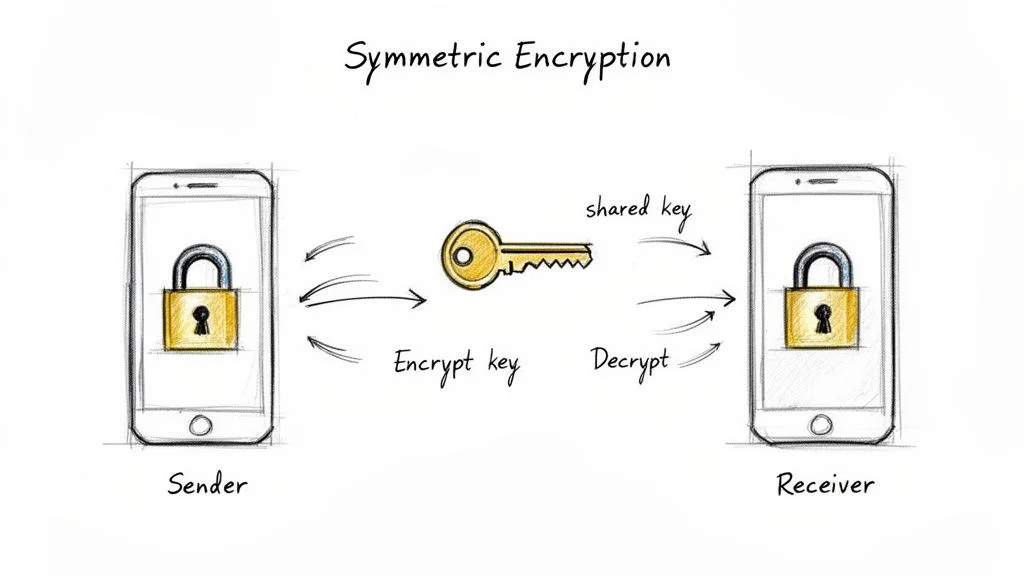 Figure 1: The fundamental encryption process, illustrating how plaintext and a key combine via an algorithm to produce ciphertext.
Every encryption system involves four distinct elements:
- Plaintext: The original, human-readable data or message that requires protection from unauthorized viewing.
- Ciphertext: The scrambled, unreadable version of the plaintext that results from the encryption process.
- Algorithm: The mathematical formula or set of rules—such as AES or RSA—used to perform the actual encryption and decryption tasks.
- Key: A secret string of bits that directs the algorithm's specific operation. The key ensures the ciphertext is unique, so only those holding the correct secret key can decrypt the data.
The Two Fundamental Approaches to Secure Data
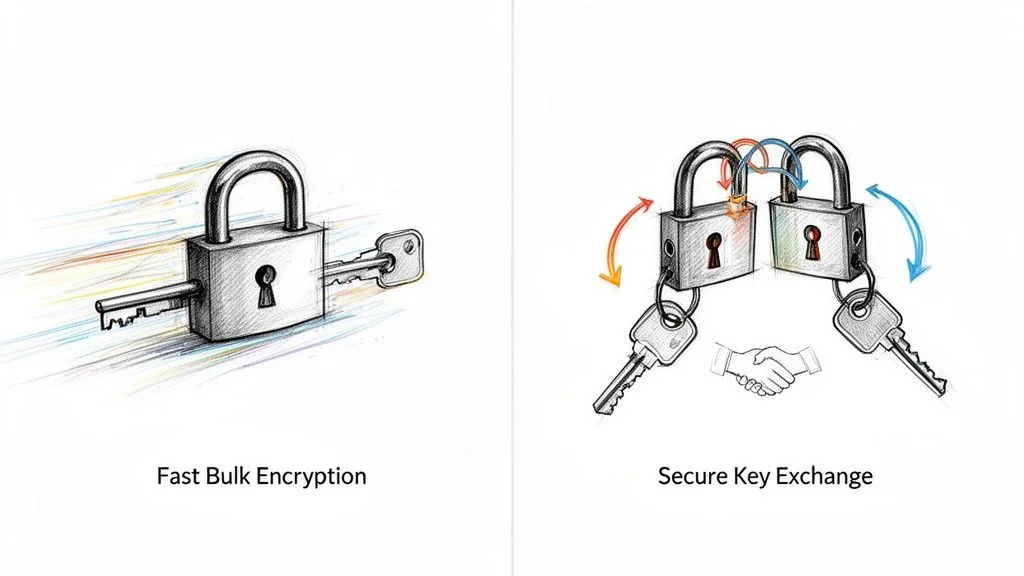
How systems manage and use these keys determines the two primary categories of encryption. One approach is designed for maximum speed and efficiency when protecting large amounts of data. The other is built for establishing trust and exchanging secrets between parties who do not have a pre-existing secure communication channel.
The Expert's Take: Symmetric encryption works like a high-speed freight train. It moves massive volumes of data efficiently once a secure track—the shared key—is in place. Asymmetric encryption functions like an armored vehicle. It is slower but specifically built to safely deliver that initial track setup and verify the identities of the participants.
This is a strategic choice that dictates the security architecture of modern IT systems. To understand more about these principles, you can read our guide on encryption fundamentals.
The following comparison highlights the distinctions between these two methods:
At-a-Glance Encryption Comparison
| Criteria | Symmetric Encryption | Asymmetric Encryption |
|---|---|---|
| Key Type | Uses a single, shared secret key for both the encryption and decryption processes. | Uses a key pair: one public key for encrypting data and one private key for decrypting it. |
| Primary Strength | Speed and efficiency. This method is the standard for high-volume data encryption. | Secure key exchange and identity verification, including digital signatures and TLS handshakes. |
| Main Challenge | Securely distributing the shared key. Sharing the key with others without it being intercepted is difficult. | Slow performance. The complex mathematics behind this method require significant computing power. |
| Best For | Encrypting large databases, local file systems, and bulk network traffic. | Digital signatures, initial TLS/SSL handshakes, and secure email formats like PGP or S/MIME. |
Symmetric Encryption Explained
Symmetric encryption is the standard choice when security requirements prioritize high throughput and raw speed. The underlying principle is straightforward: a single, shared secret key performs every operation. You can compare this to a physical safe with only one key. You use that key to lock the safe, and you use the exact same key to unlock it later. Anyone who holds a copy of that key can access the contents inside. This single-key architecture is the defining factor in discussions comparing asymmetric and symmetric encryption.
The process functions like this: a sender uses the shared secret key to transform readable plaintext into scrambled ciphertext. The receiver must already possess an identical copy of that key to reverse the process and recover the original message. This direct design leads to high efficiency and performance.
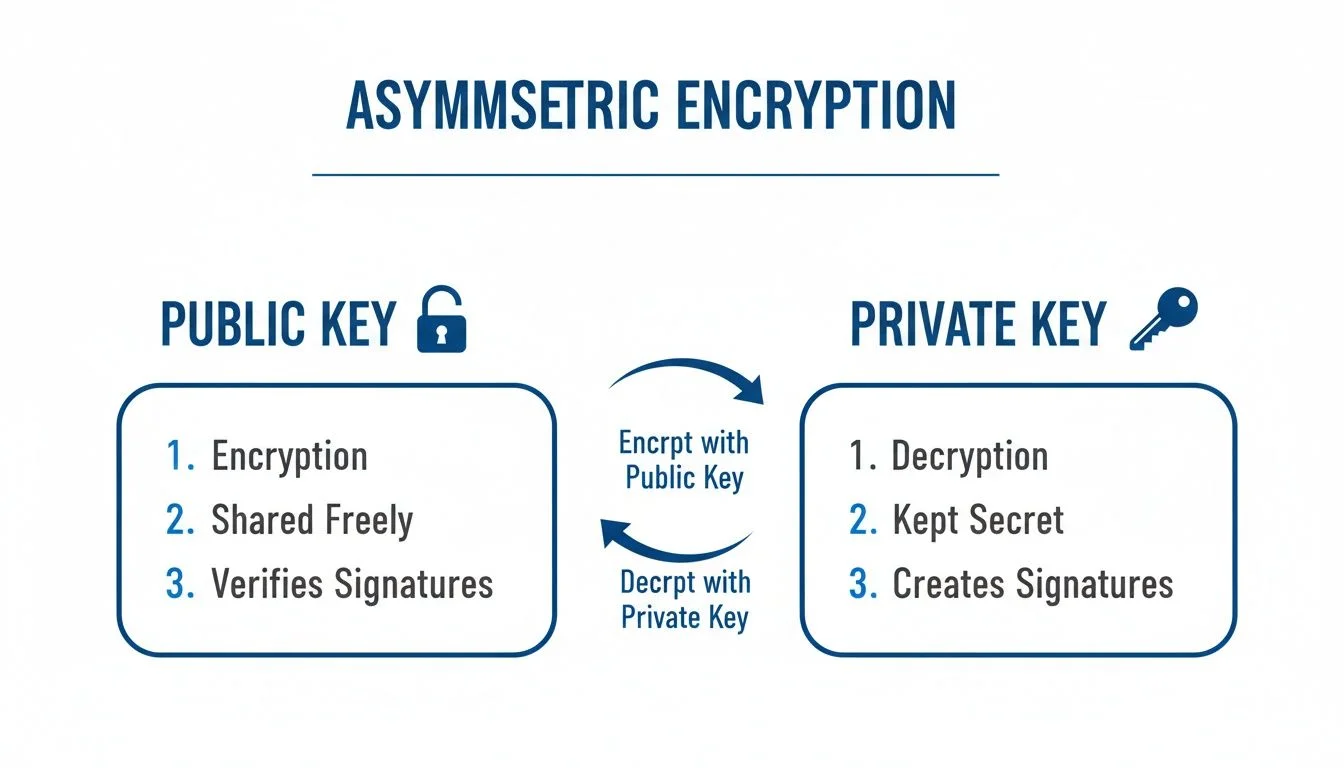 Figure 2: Symmetric encryption in action, where both parties use the same key for secure communication.
Why Speed Is Its Superpower
The mathematical logic behind symmetric algorithms is built on substitution and permutation operations. These tasks require significantly less computing power and fewer CPU cycles than the complex modular exponentiation used in asymmetric algorithms. This performance gap is not just a minor detail; it makes symmetric encryption the only viable option for protecting massive datasets in real-time.
This efficiency is why symmetric methods continue to lead the global data encryption market. They currently account for a 61.3% revenue share. Low computational overhead makes these algorithms necessary for applications that demand high performance without latency. If you are encrypting multi-terabyte databases or supporting real-time 4K video streaming, symmetric methods provide the necessary scale. You can find more details on these trends in the global data encryption market research.
Because of this performance advantage, symmetric encryption handles the heavy lifting in these common security scenarios:
- Full-Disk Encryption (FDE): Tools like Windows BitLocker and macOS FileVault apply symmetric ciphers to every byte stored on a drive. This protection happens behind the scenes as the processor reads and writes data, ensuring the user experiences no noticeable slowdown.
- Database Encryption: High-volume databases often use Transparent Data Encryption (TDE) to protect sensitive columns or entire tables. These systems must process thousands of transactions every second. Symmetric algorithms are built to maintain this level of scale without creating bottlenecks.
- Bulk Network Traffic: Modern web security typically uses a hybrid approach. While asymmetric methods might start a connection, symmetric encryption takes over for the actual data transfer. It protects the large volume of packets moving between a client and a server, providing a balance of high-level security and fast transmission speeds.
Common Symmetric Algorithms for Certification Exams
Not every symmetric algorithm provides the same level of security or speed. When preparing for technical certifications, you must be able to identify which algorithms are current standards and which are obsolete.
Key Takeaway for Exams: Organizations like CompTIA (Security+, CySA+) and (ISC)² (CCSP) regularly test your ability to categorize symmetric algorithms. You will need to know which ones are considered secure and which have been deprecated due to vulnerabilities.
- AES (Advanced Encryption Standard): This is the global benchmark for encryption. Selected by NIST in 2001 and adopted by the U.S. government for classified data, AES supports key lengths of 128, 192, and 256 bits. It remains secure against all known practical attacks. Most cloud environments rely on it; for example, AWS KMS uses AES-256 to protect customer data at rest.
- DES (Data Encryption Standard): This was once the primary standard, but it uses a small 56-bit key. Modern computers can break DES via brute force in less than a day. It is now considered entirely insecure for modern use and usually appears on exams only as a historical reference point.
- 3DES (Triple DES): This algorithm was created to extend the life of DES by applying the DES cipher three times using different keys. While it is more secure than the original DES, it is much slower and inefficient compared to modern alternatives. You might find it in older legacy banking systems, but it is not a recommended choice for new hardware or software.
When you configure encryption options for at-rest and in-transit logs, choosing a modern, hardened algorithm like AES is a requirement for maintaining data integrity.
The Achilles' Heel: The Key Distribution Problem
Symmetric encryption is fast and strong, but it faces one significant hurdle: secure key distribution. Two parties must share a single secret key to communicate. If those parties have never met and have no secure way to talk, how do they exchange that key? If an attacker intercepts the key while it moves across a public network, they can decrypt every message sent afterward.
This creates a paradox. You need a secure channel to send the key, but you need the key to create the secure channel. This "chicken and egg" problem was the primary reason researchers developed asymmetric encryption, which uses a different approach to solve the challenge of sharing secrets over untrusted networks.
Reflection Prompt: Consider a scenario where you must share a symmetric encryption key with a remote colleague for the first time. What specific risks would you face if you sent that key through a standard email or chat message? How would you solve this problem if you didn't already have a secure way to communicate?
Asymmetric Encryption Explained
Symmetric encryption works well for protecting data at high speeds, but it has a significant flaw known as the key distribution problem. If two people want to communicate privately, they must first share a secret key. If they are in different locations, sending that key over the internet is dangerous because anyone monitoring the connection can steal it. Asymmetric encryption, also called public-key cryptography, addresses this issue by using two different keys that are mathematically linked. This dual-key system is the primary factor that sets asymmetric and symmetric encryption apart.
This key pair includes two distinct components:
- Your public key: This key is designed for open distribution. You can post it on a public server, send it via email, or embed it in a digital certificate. Sharing this key does not create a security risk for the owner.
- Your private key: This key must remain confidential and stored in a secure location. It should never be shared or transmitted. If someone else gains access to this key, your entire security system is compromised.
The functionality of asymmetric encryption depends on a specific mathematical relationship. Data that is encrypted using a public key can only be decrypted by the matching private key. Conversely, the private key can be used to create digital signatures that any person with the public key can verify.
This arrangement fixes the difficulty of exchanging keys. You can send your public key to anyone in the world without worrying about interceptors. When someone wants to send you a private message, they use your public key to lock the data. Even if an attacker captures the message while it is moving across an insecure network, they cannot read it. Only you, the holder of the private key, have the ability to unlock and view the information.
Understanding the Key Pair in Action
The system relies on one-way mathematical functions. These are operations that are easy to calculate in one direction but nearly impossible to reverse without a specific piece of information. It is computationally impossible to figure out a private key just by looking at a public key. A helpful way to visualize this is a public mailbox equipped with a small delivery slot. Any person walking by can drop a letter into the slot to encrypt the message with the public key. However, once the letter is inside the box, no one on the street can reach in and take it back out. Only the authorized person with the unique physical key to the door at the back of the box can retrieve and read the mail.
This mechanism supports two essential security operations:
- Confidentiality (Encryption): When Alice needs to send a private file to Bob, she first gets a copy of Bob's public key. She uses this key to transform her plain text into ciphertext. Alice then sends this ciphertext to Bob. Even if a third party intercepts the file, the data remains unreadable. Only Bob can use his private key to turn the ciphertext back into the original file. This logic is used in Secure Shell (SSH) connections when managing remote servers. The server holds your public key and uses it to encrypt a challenge. Your computer proves its identity by using the private key to decrypt that challenge and respond correctly.
- Digital Signatures (Authenticity and Integrity): In this scenario, the keys perform different roles. To sign a digital file, Bob uses his private key to encrypt a cryptographic hash of the data. This hash acts as a unique digital fingerprint. Anyone who receives the file can use Bob’s public key to decrypt the signature and reveal the original hash. The receiver then generates their own hash of the file. If the two hashes match exactly, two facts are confirmed:
- Authenticity: The message definitely came from Bob. Only his private key could have created a signature that works with his public key.
- Integrity: The message was not changed during transit. Even a tiny modification to the file, like changing a single character, would result in a completely different hash value, making the signature invalid. This is a vital process for verifying the safety of software downloads and code commits.
The primary advantage of asymmetric encryption is its ability to build trust between two parties who have never met and do not share a secret password. It serves as the foundation for identity verification and secure handshakes on the internet. These concepts are core requirements for passing professional certifications such as CompTIA Security+ and CySA+.
Common Asymmetric Algorithms
Different asymmetric algorithms are used today, each based on various mathematical challenges that computers find difficult to solve.
- RSA (Rivest-Shamir-Adleman): RSA has served as the standard asymmetric algorithm for several decades. Its security is based on the extreme difficulty of factoring the product of two very large prime numbers. While a computer can easily multiply two primes together, reversing the process to find those primes is nearly impossible for modern hardware when the numbers are sufficiently large. RSA is a standard component in digital certificates and secure email systems. You will likely encounter questions about RSA in cloud security exams, such as the AWS Certified Security - Specialty (SCS-C03) or the Azure Security Engineer Associate, specifically regarding how certificates are managed.
- ECC (Elliptic Curve Cryptography): ECC is a more efficient alternative to RSA. It uses the algebraic properties of elliptic curves to provide high levels of security. The main benefit of ECC is that it offers the same protection as RSA but uses much smaller keys. This makes it a better choice for mobile phones, tablets, and Internet of Things (IoT) sensors. Because the keys are smaller, ECC requires less battery power, less memory, and less network bandwidth to function. It is often used in high-performance cloud environments to reduce latency.
- Diffie-Hellman Key Exchange: While it is often grouped with encryption algorithms, Diffie-Hellman is actually a method for two people to agree on a shared secret key. They exchange public information over an insecure channel, and through modular arithmetic, they both arrive at the same secret value. This secret value is then used as a symmetric key for the rest of the session. This protocol is a fundamental part of TLS/SSL and is a major topic in the CompTIA Network+ (N10-009) exam.
The demand for secure web communication has made asymmetric encryption a fast-growing part of the technology market. It provides the logic for Public Key Infrastructures (PKI) and ensures that digital signatures remain reliable. You can find more details on these industry trends by reviewing the latest research on the data encryption market.
The Performance Trade-Off
Despite its advantages, asymmetric encryption has a major drawback: it is slow. The complex math involved in these algorithms requires a lot of processing power. Asymmetric encryption is significantly slower than symmetric methods, sometimes by a factor of hundreds or thousands.
Because of this performance cost, asymmetric encryption is not used for large-scale data tasks. You would not use RSA to encrypt a database containing several terabytes of information or to protect a high-definition video stream. Doing so would make the system too slow to use. Instead, engineers use asymmetric encryption for small, high-priority tasks. Its most common use is to authenticate a user and then safely exchange a symmetric key. Once the symmetric key is shared, that faster algorithm takes over to handle the heavy lifting of data encryption. This hybrid approach is explained in detail in study materials for certificates and Public Key Infrastructure (PKI).
Comparing Encryption Methods Head-to-Head
When you evaluate which encryption method is superior—symmetric or asymmetric encryption—the comparison is similar to asking if a hammer is better than a screwdriver. Both are mandatory tools in the kit of any security professional, but they serve different roles. Each method has specific performance traits, security models, and operational requirements that make it suitable for different tasks.
The real strength of modern cryptography comes from using these two methods together. High-quality security systems rarely rely on just one type of encryption. Instead, they combine the advantages of both to create a resilient defense. The primary difference between the two systems always comes down to how they handle and distribute keys.
Symmetric encryption uses a single, shared secret key. This approach provides high speed but creates a difficult logistical problem: how to distribute that key to all parties without it being stolen. Asymmetric encryption solves this distribution issue by using a public and private key pair. However, this solution comes at the cost of much slower encryption speeds. This specific trade-off between speed and key management determines how each method is used in a real-world environment.
Performance and Efficiency
In a test of pure speed, symmetric encryption is the clear winner. Algorithms like AES are built to work with modern computer processors. They use rounds of substitutions and permutations to scramble data. Because these operations are mathematically simple, the CPU can process them with high efficiency. This performance gap is a common topic for questions on the current CompTIA Security+ and CCSP exams.
Asymmetric algorithms, including RSA, rely on much more difficult mathematical problems. For example, RSA is based on the difficulty of factoring very large prime numbers. Solving these equations requires significant computing power and time. This makes asymmetric encryption much slower than symmetric methods. For a security engineer, this performance difference is a major factor when designing an application.
Key Differentiator: Symmetric encryption is the high-speed workhorse designed to protect large volumes of data. Asymmetric encryption acts as a secure negotiator. It is slower and more processor-heavy, but it is used to establish trust, confirm identities, and safely start a connection where precision is more important than raw speed.
Consider a situation where you need to encrypt a full hard drive, stream a high-definition video, or process thousands of financial transactions per second. Using asymmetric encryption for these tasks would slow the system to a crawl. In these high-throughput scenarios, symmetric encryption is the only practical option available to keep the system running smoothly.
Security and Key Length
A common misunderstanding is that one encryption method is naturally more secure than the other. In reality, the security of a system depends on the specific algorithm used and the key length. However, you cannot compare key lengths directly between symmetric and asymmetric systems. They do not operate on a one-to-one scale.
For example, a 128-bit symmetric AES key provides a level of security roughly equal to a 2048-bit asymmetric RSA key. If you move up to a 256-bit AES key, you get security similar to a 3072-bit RSA key. This huge difference in key length exists because the two methods defend against different types of mathematical attacks:
- Symmetric Security: This method depends on resisting brute-force attacks. Every extra bit added to the key doubles the number of possible combinations. A longer key makes it mathematically impossible for an attacker to guess the key through trial and error within a reasonable timeframe.
- Asymmetric Security: This method depends on the difficulty of solving a specific math problem, such as integer factorization. A longer key makes the underlying math problem much harder to crack. Because computers are getting better at factoring large numbers, asymmetric keys must be much longer to stay ahead of the processing power available to attackers.
This diagram shows how the asymmetric key pair works in practice. The public key is like an open padlock. You can give it to anyone so they can lock (encrypt) data. However, only the specific private key that matches that public key has the power to unlock (decrypt) the data.
 Figure 3: The distinct roles of public and private keys in asymmetric encryption.
This separation of keys is the specific technology that allows people to communicate securely over the internet. Because the internet is an untrusted network, you cannot simply send a secret key to someone else. Asymmetric encryption provides the mechanism to build a secure bridge across that untrusted space, which is something symmetric encryption cannot do on its own.
Key Management and Distribution
Key management is the area where asymmetric encryption provides its greatest value. It fixes the biggest flaw found in symmetric encryption. In a symmetric system, the secret key is a single point of failure. Both the sender and the receiver must have the exact same key before they can start talking. If an attacker intercepts that key during the handoff, the entire conversation is exposed.
Asymmetric encryption was created specifically to fix this problem. You can share your public key with the entire world without any risk to your security. You can put it on a public website, include it in a digital certificate, or send it in a plain text email. Anyone who has that public key can use it to send you an encrypted message. Because only your private key can open that message, the data remains safe even if the public key is known by everyone.
This logical approach makes asymmetric encryption the standard tool for building trust. It is the technology used to exchange keys safely within the Transport Layer Security (TLS/SSL) protocols that protect the web.
Reflection Prompt: Imagine you are a security architect designing a system for a new online banking application. How would the challenge of key management influence your choice between symmetric and asymmetric encryption for different phases of communication, and what are the direct security implications of a failure in key distribution for each?
Symmetric vs Asymmetric Encryption Key Differences
The table below summarizes the technical differences and standard uses for both encryption methods. This is an effective study tool for understanding how these technologies function in professional environments.
| Attribute | Symmetric Encryption (e.g., AES) | Asymmetric Encryption (e.g., RSA) |
|---|---|---|
| Key System | A single, shared secret key is used for both encryption and decryption. | A pair of keys is used: one public (for sharing) and one private (for keeping secret). |
| Performance | Extremely fast and computationally lightweight. Ideal for large amounts of data. | Significantly slower due to the complex mathematical operations involved. |
| Primary Use Case | Encrypting data at rest (files, databases, storage) and bulk data in transit (network traffic after handshake). | Securely exchanging keys, creating digital signatures, and authenticating identity. |
| Key Length | Shorter keys offer strong security (e.g., 128, 256 bits). | Requires much longer keys for equivalent security (e.g., 2048, 3072 bits). |
| Main Challenge | Distributing the shared key securely without interception. | Slower performance and higher computational overhead. |
| Real-World Example | Encrypting your laptop’s hard drive (BitLocker) or cloud storage buckets (AWS S3 server-side encryption). | The initial handshake that establishes a secure HTTPS connection in your web browser (TLS/SSL). |
Choosing between these methods is not a binary decision. Symmetric and asymmetric encryption work as partners. They are built to function together, with each using its specific strengths to support the other. This partnership is what allows for the creation of the complex, layered security systems that protect data across the globe every day. Understanding how to balance the speed of AES with the secure distribution of RSA is a vital skill for anyone working in IT security.
How Hybrid Encryption Powers the Web
*Video: A concise explanation of the differences between symmetric and asymmetric encryption.*Discussions about asymmetric versus symmetric encryption often fail to address a fundamental reality: modern security does not require picking a winner. In actual deployment, standard security protocols do not rely on a single method. They combine the specific advantages of both into a hybrid encryption system.
This integrated model provides the identity verification and trust-building features of asymmetric cryptography alongside the high speed and data-handling efficiency of symmetric ciphers. This combination serves as the engine for almost every secure connection made over the internet. It is the primary technology behind Transport Layer Security (TLS). This is the protocol that provides the "S" in HTTPS and displays the padlock icon in your web browser interface.
The Best of Both Worlds: A Step-by-Step Guide to TLS
A hybrid system follows a precise sequence to build and maintain a protected communication channel. It delegates tasks by using each encryption type for its most effective purpose. This results in a process that is highly secure while remaining fast enough for real-time use.
Here is a breakdown of how a standard TLS handshake operates:
- Server Authentication (Asymmetric): When your browser attempts to connect to a website such as
mindmeshacademy.com, the server provides its digital certificate. Your browser then checks the public key of the Certificate Authority (CA) that signed the certificate to confirm its validity. This step verifies that the server is legitimate and has not been replaced by an imposter. It relies on the identity-verification strengths of asymmetric cryptography, using algorithms like RSA or Elliptic Curve Cryptography (ECC) contained within the certificate files. - Secure Key Exchange (Asymmetric): After the browser verifies the server's identity, it generates a unique, temporary symmetric key known as a session key. The browser then encrypts this session key using the server's public key, which it retrieved from the digital certificate. The browser sends this encrypted package to the server. Because the session key is encrypted with the public key, only the specific server with the matching private key can access it.
- Decryption and Agreement: The server receives the encrypted package and uses its private key to decrypt the message and extract the session key. At this point, both your browser and the server hold the exact same secret session key. This action concludes the asymmetric portion of the handshake. No third party has access to this key because it was never sent over the network in an unencrypted format.
- Switching to Symmetric Encryption: With a shared session key established, the communication method changes. All data sent for the rest of that specific browsing session is encrypted and decrypted using this session key. This allows for high-speed data transfer because symmetric algorithms require significantly less processing power than asymmetric ones. The server and browser can move large files or stream media without the performance delays caused by complex mathematical calculations.
This hybrid model solves the inherent limitations found in each individual method. Asymmetric encryption handles the slower tasks of verifying identity and distributing keys. Symmetric encryption then manages the heavy lifting of high-volume data movement, ensuring both security and speed.
Why This Matters: The TLS handshake functions as a system of cryptographic teamwork. Asymmetric encryption works like a secure courier service, delivering a locked box that contains a secret key only the recipient can open. Once the recipient has that key, both parties can use it to communicate privately and rapidly without needing the slower courier for every message. This is a central concept for professional certifications that focus on network security and cloud operations.
Hybrid Encryption in the Cloud and Beyond
Hybrid models are not limited to web browsers. They are the foundation for protecting modern cloud infrastructure, where massive scale requires a balance of speed and safety. Security professionals, such as a Senior Cloud Security Engineer Devsecops, apply these strategies to protect data across distributed networks.
The growth of the Encryption-as-a-Service (EaaS) market shows how important these systems have become. Market research projects the EaaS sector will grow from USD 2.2 billion to USD 20.3 billion (verify current market data on industry analyst sites). This represents a 822.3% increase. In this service model, providers use asymmetric encryption to manage cloud encryption keys and protect API handshakes. Meanwhile, symmetric ciphers encrypt the actual data stored in services like AWS S3 or Azure Blob Storage. You can find more details on this sector by reviewing data on the Encryption-as-a-Service market.
Why Not Just Use One Type?
A common question is why systems include this level of complexity instead of using asymmetric encryption for everything. The reason is tied directly to hardware performance and latency.
Asymmetric algorithms like RSA are built on complex mathematics involving very large prime numbers. If a server tried to stream high-definition video where every packet had to be encrypted using a private key, the CPU usage would be massive. The resulting user experience would involve constant buffering and lag, making it unusable for modern applications.
By limiting asymmetric encryption to the initial tasks of establishing trust and sharing keys, and then switching to a fast symmetric cipher like AES for the data itself, we get high-level security without high-level latency. This balance makes the modern internet possible.
Choosing the Right Encryption for the Job
Selecting the right tool for a specific security task is the key to managing encryption effectively. It is not a matter of deciding which method is better overall, but rather which one fits the current requirement. You must evaluate the speed of the operation, the specific security goals, and the environment where the data resides. This decision-making process is a frequent topic on professional certification exams and remains a fundamental skill for security architects.
Where Symmetric Encryption Shines
Symmetric encryption is the standard choice when you need to protect large amounts of data without creating significant delays. Because it uses the same key for both encryption and decryption, it requires less computational power than other methods. This makes it a reliable option for bulk data protection, provided you can safely manage the shared key within a controlled space.
- Database Encryption: Systems like SQL Server and Oracle use Transparent Data Encryption (TDE) to protect sensitive information. These systems use symmetric algorithms, most often AES, to encrypt entire database files or specific columns of data. This happens while the database is running, allowing the system to process thousands of transactions per second without a drop in performance.
- Cloud Storage Encryption: Major providers like AWS, Google Cloud, and Azure use symmetric encryption to secure data at rest. When you store a file in an S3 bucket or a Blob storage container, the service typically applies AES-256 encryption. This ensures the data is protected immediately upon upload.
- Self-Encrypting Drives (SEDs): Many modern hard drives and SSDs now include dedicated hardware for encryption. These chips handle the process of encrypting every bit of data as it is written to the physical disk. Because the encryption happens at the hardware level, it provides strong protection with almost no impact on the speed of the computer.
The demand for this technology is reflected in current market trends. The hardware encryption market is expected to grow from USD 359.5 million to USD 815.6 million (verify current market data on the analyst or vendor site). This growth is largely driven by the adoption of self-encrypting drives in enterprise data centers and consumer electronics. Integrating symmetric encryption directly into storage hardware has become a standard method for protecting data on laptops, servers, and IoT devices. You can view more details on the growth trends of the hardware encryption market.
Where Asymmetric Encryption Is Essential
Asymmetric encryption functions differently. It is not designed for high-speed bulk data processing. Instead, it provides the identity verification and trust required for secure communication over public networks. Its ability to verify who sent a message makes it a central topic for certifications like the PMP, CompTIA CySA+, and various cloud security roles.
- Digital Signatures: When you need to prove a document is authentic and has not been changed, you use a digital signature. The sender creates a cryptographic hash of the file and encrypts that hash with their private key. A recipient uses the sender’s public key to check the signature. This confirms the identity of the sender and ensures the document remained intact during transit.
- Secure Email Protocols (PGP/S/MIME): These protocols use asymmetric encryption to start a secure session. During the initial connection, the two parties use public and private keys to exchange a single-use symmetric key. Once that exchange is finished, the symmetric key is used to encrypt the actual text of the emails for better performance.
- Certificate Authority (CA) Infrastructure: The security of the modern web depends on asymmetric encryption. Certificate Authorities use their private keys to sign the public key certificates of websites. Your web browser is configured to trust these CAs. When you visit a site, the browser checks the signature on the certificate to confirm the site is legitimate. This process is what allows HTTPS to function securely.
Situational Guidance for Certifications: Use this simple rule to help with exam questions:
- Symmetric encryption: Select this for protecting large datasets that are not moving, or for high-speed transmission after you have already established a secure link.
- Asymmetric encryption: Select this when you need to verify an identity, establish trust between two strangers, or securely exchange a secret key to start a conversation.
Managing sensitive data, particularly in fields with strict regulations, requires applying these principles correctly. For instance, choosing the right encryption method to protect patient records is a core part of HIPAA compliance. These regulations often specify how data must be protected, making these cryptographic concepts a daily reality for people working in IT management or cybersecurity.
Reflection Prompt: Imagine your company is distributing a critical software update to users around the world. How would you use both symmetric and asymmetric encryption to ensure the update remains private while also proving to the users that the file has not been maliciously altered?
Answering Common Encryption Questions
Certification exams frequently feature specific questions about symmetric and asymmetric encryption. Simply memorizing answers is rarely enough. To prepare for actual security roles, you must grasp the logic behind these concepts and how they apply to real-world systems.
Which Is More Secure: Symmetric or Asymmetric Encryption?
This question is a common trap. Security strength depends less on the general category and more on the chosen algorithm and its key length. For example, a 256-bit AES key used in symmetric encryption provides a security level roughly equivalent to a 3,072-bit RSA key in an asymmetric system.
Each type serves a distinct purpose. Asymmetric encryption handles secure key exchanges and identity verification. Symmetric encryption acts as the primary engine for high-speed, bulk data protection. The superior option depends entirely on the specific security requirement and the operational environment.
Why Is Asymmetric Encryption So Much Slower Than Symmetric?
The speed difference comes down to math. Asymmetric algorithms use heavy mathematical operations, such as factoring enormous prime numbers in the case of RSA. These processes require significant CPU cycles and memory, which slows down the encryption and decryption of large files.
Symmetric algorithms like AES use simpler techniques. They rely on substitution and permutation cycles that hardware can execute very quickly. This efficiency allows systems to encrypt gigabytes of data with minimal impact on overall system performance.
This performance gap is a deliberate trade-off rather than a flaw. Asymmetric encryption is slower because its purpose is to establish trust through an initial handshake. Symmetric encryption remains fast to handle the high-volume data transfer that follows that handshake.
In modern security, these two methods work together in hybrid systems to provide both speed and secure key distribution. Mastering the way they interact is essential for anyone pursuing a career in information security.
Accelerate your career with MindMesh Academy and master the concepts you need to pass your next certification exam with confidence. Explore our expert-curated study guides and learning tools at CompTIA Security+ Practice Exams.

Written by
Alvin Varughese
Founder, MindMesh Academy
Alvin Varughese is the founder of MindMesh Academy and an enterprise architecture leader. An electrical engineer by training, he moved from factory automation in South Africa to cloud architecture at GE Appliances and Humana (Fortune 50), and holds 20 professional certifications including AWS Solutions Architect Professional, Azure DevOps Engineer Expert, and Microsoft Agentic AI Business Solutions Architect. He built MindMesh Academy after interviewing too many highly certified candidates who couldn't answer basic questions: the goal is prep that makes you better at the job, not just able to pass the exam.