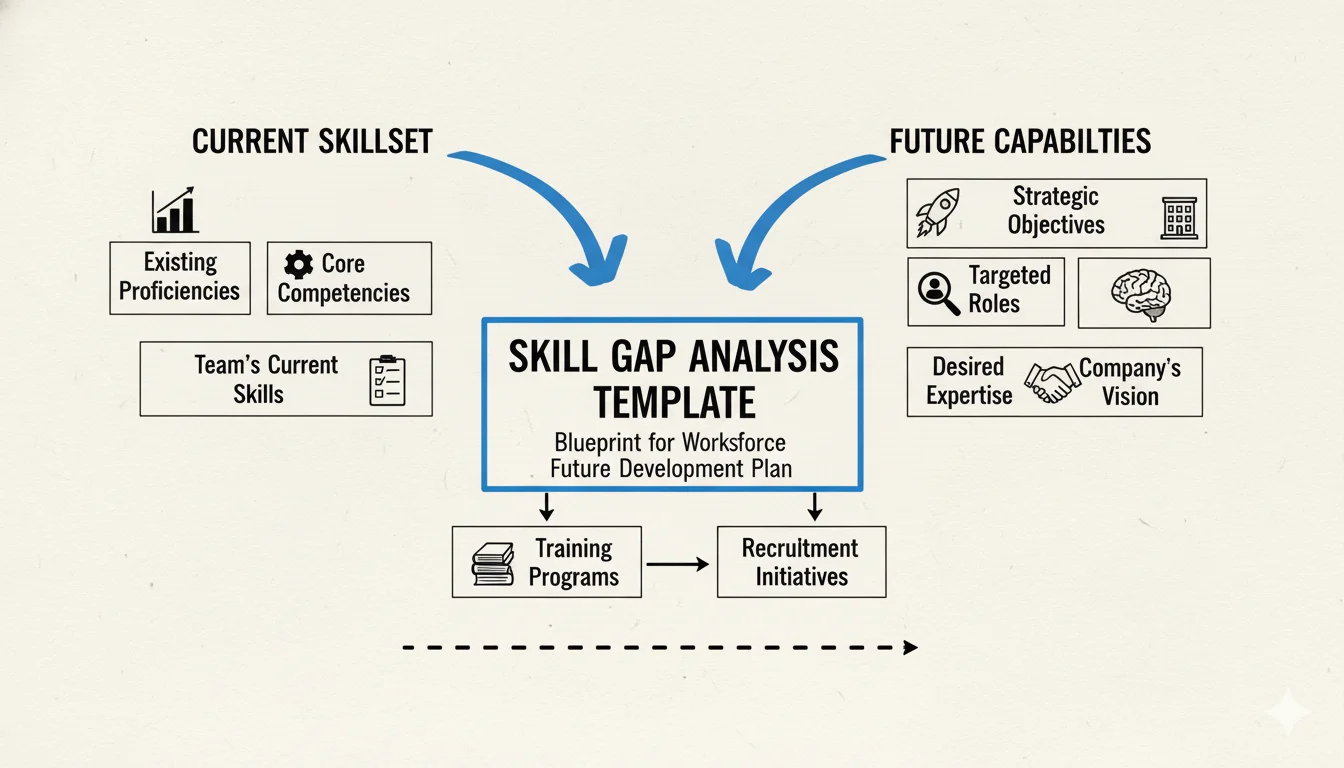
Master Your Skill Gap Analysis Template
Mastering Your Skill Gap Analysis Template for IT Success
An effective skill gap analysis template is more than a simple spreadsheet. It serves as a blueprint for the future performance of your IT staff. For managers and tech professionals, this tool provides a clear structure to measure current technical and soft skills against organizational goals and the changing demands of the tech industry. Using this process helps identify specific talent shortages. From there, you can create effective training programs, improve hiring strategies, and build a resilient, adaptable IT team prepared for upcoming technical challenges. This proactive process ensures your department maintains necessary skills to support business objectives without falling behind.
Why Skill Gap Analysis Is Now a Business Imperative in IT
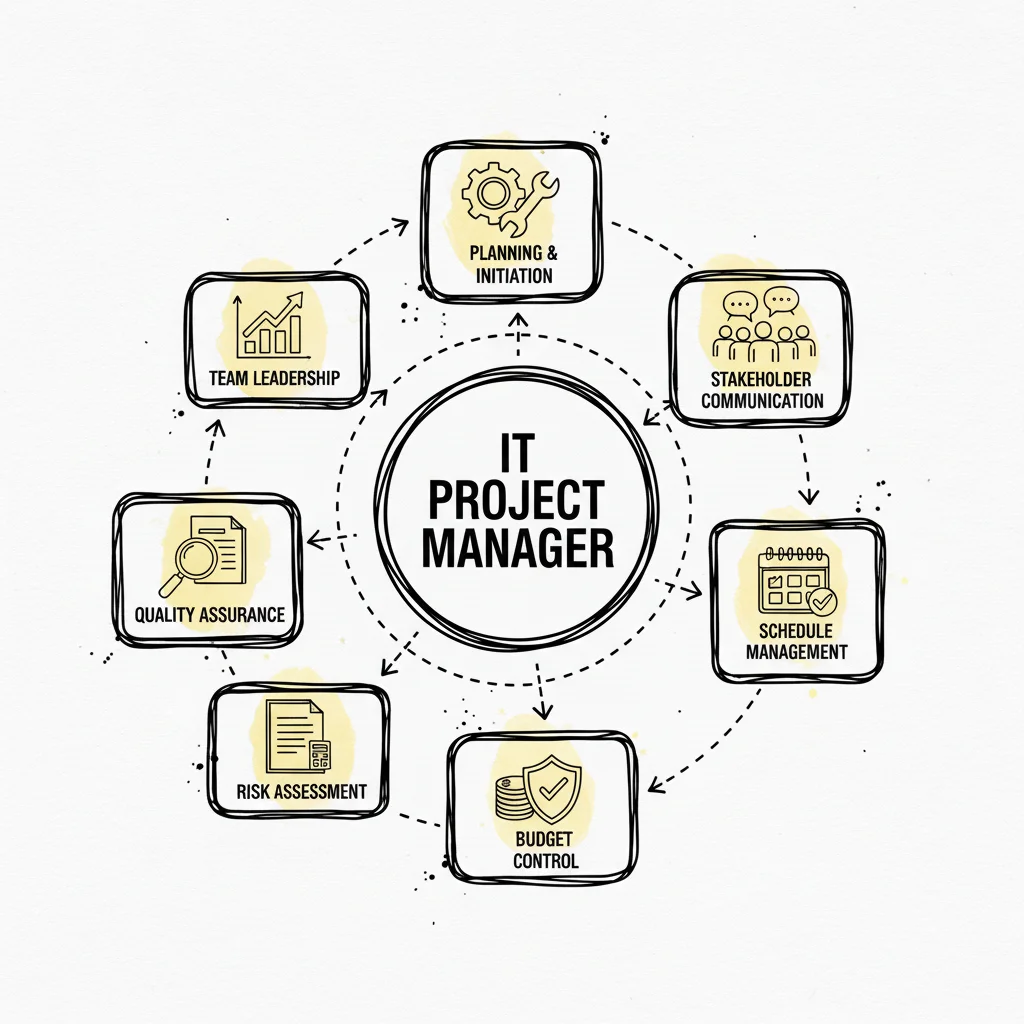
In the fast-moving IT sector, treating a skill gap analysis as a mere administrative checkbox is a mistake. This process has shifted from a simple audit into a central business strategy. Trends in cloud computing, artificial intelligence, cybersecurity, and DevOps are forcing organizations to rethink their approach to talent. Without an honest assessment of your IT team's capabilities, your organization risks falling behind. You cannot adapt to market demands, implement new technologies, or secure your infrastructure if you do not understand the collective skills of your staff.
Consider a software development firm that built its reputation on traditional on-premises application architecture. For years, they delivered strong solutions. However, as the industry turned toward cloud-native development and serverless architectures like AWS Lambda or Azure Functions, their team hit a wall. While the developers were experts in legacy systems, they lacked deep knowledge of tools like Kubernetes, Docker, or specific cloud provider APIs. Projects stalled. Deployment cycles took longer. They eventually lost contracts to smaller, faster competitors who were fluent in modern cloud stacks. This isn't a hypothetical situation. It is a direct result of failing to assess and address the changing skill needs of an IT team.
The Real Cost of Unaddressed Gaps
Ignoring IT skill gaps affects the entire organization and the bottom line. It isn't just a missed opportunity; it creates measurable financial losses. Many companies are currently feeling this pressure. A recent study found that 87% of companies worldwide (verify current statistics on the vendor site) are either struggling with skill gaps now or expect to within a few years. Discover more insights on the global skills gap from the full report, which shows how universal this problem has become.
Ignoring these gaps in a technical setting leads to specific problems:
- Innovation Stagnation: Your team lacks the expertise to explore or implement modern solutions, from integrating AI into products to using advanced data analytics. This hinders product development and makes it harder to distinguish your company from competitors.
- Productivity Dips: Adopting new tools like advanced CI/CD pipelines or security suites becomes difficult. This leads to slow workflows, missed deadlines, and higher costs for daily operations as teams struggle to use the tools effectively.
- Loss of Competitive Edge: While your rivals invest in AWS Certified Solutions Architects, Microsoft Certified Azure Administrators, or CompTIA Security+ specialists, your organization struggles to build secure, scalable, and efficient IT systems.
- Employee Morale Decline: IT professionals get frustrated when they feel unequipped to handle new technologies. This leads to burnout and higher turnover. This is common when teams are expected to figure out a complex new platform without any formal training or resources.
A skill gap analysis is not about highlighting what your IT team cannot do. Instead, it is about building a bridge from your current operations to the future state required for business success. It turns uncertainty into a clear, actionable roadmap for growth and improvement within your technology departments.
Using a well-structured skill gap analysis template is the best way to start. It converts a vague idea into a data-driven exercise. To help you understand what is involved, we have listed the core components found in an effective template below.
Core Components of a Skill Gap Analysis
This table summarizes the essential stages of the process, showing the move from strategic planning to concrete action.
| Component | Objective | Key Outcome |
|---|---|---|
| Goal Alignment | Define the strategic business objectives that make the analysis necessary, which are often tied to digital transformation, new product launches, or regulatory compliance. | A clear "why" that ensures the analysis supports critical IT and business goals. |
| Skill Identification | Pinpoint the specific technical and professional skills required for future success across various IT roles. | A detailed inventory of technical expertise such as Python, Kubernetes, and cloud security, alongside essential soft skills. |
| Current Skill Assessment | Measure the existing proficiency levels across your IT workforce for identified skills using testing or manager reviews. | An accurate baseline of your team's current technical capabilities and areas for development. |
| Gap Analysis & Action | Identify the difference between current and required skills to formulate a specific development plan. | A strategic roadmap for targeted training, certification pursuits, new hiring, or upskilling initiatives. |
Each of these components builds upon the previous one. Together, they provide a complete view of your IT organization's strengths and the areas that need immediate attention.
Aligning Your Analysis with Strategic Business Goals
Before you enter data into a template, you must establish alignment. An IT skill gap analysis performed in a vacuum is rarely effective. When you link this process to the organization’s high-level strategic goals, it becomes a plan for measurable growth and technical innovation. Without this initial step, you risk spending time and money on training programs that do not help the business reach its objectives. For example, paying for training on legacy database maintenance is a mistake if the company is moving toward a serverless cloud architecture.
Start by asking a fundamental question: "Why are we performing this analysis for our IT department?" The answer must be specific and tied to a business outcome. You might want to increase DevOps productivity by 20% after deploying a new CI/CD pipeline. Or perhaps the company is expanding into new international markets, requiring compliance with data protection laws like GDPR. A major product launch next year might depend on advanced machine learning capabilities. Each goal requires a different set of technical skills from your staff. This strategic link turns the project into a priority for both the C-suite and technical leadership.
Pinpointing Your Strategic Drivers
To move from a concept to a plan, speak with the leadership team and department heads. Focus on those leading technical initiatives to understand what is coming in the next 3 to 5 years. Avoid vague goals like "improving IT efficiency." Instead, look for specific technical shifts that change what your team needs to know.
Consider how these strategic drivers change the requirements for IT professionals in practice:
- Product Innovation (AI/ML): If the goal is to add AI features to a flagship product within 18 months, you have a clear priority. You will need skills in machine learning engineering, data science, Python programming, and AI ethics. Your team may need to pursue certifications such as the AWS Certified Machine Learning – Specialty or the Microsoft Certified: Azure AI Engineer Associate (check vendor sites for current exam requirements and pricing).
- Market Expansion (Compliance & Localization): A plan to launch operations in Germany by the end of the year creates an immediate need for expertise in EU data privacy. IT professionals must understand GDPR and localized data residency rules. You may also need cybersecurity specialists who are familiar with specific regional standards and localized network configurations.
- Operational Excellence (Cloud Migration): Many companies aim to move all on-premises infrastructure to the cloud within two years to lower costs. This requires certifications like the AWS Certified Solutions Architect or the Microsoft Certified: Azure Administrator Associate. It also requires updated security knowledge found in the current CompTIA Security+ or the Certified Information Systems Security Professional (CISSP). These roles require skills in cloud governance, cost management, and change management that differ significantly from traditional data center work.
- Service Management Improvement: If the objective is to improve how IT services are delivered to the business, you may need skills in ITIL 4 Foundation. For those managing large technical transitions, the PMP certification for project management becomes a useful asset.
Defining these drivers creates a filter for your analysis. Every skill you evaluate is weighed against its importance to these core goals. This disciplined approach prevents you from collecting too much data and keeps your attention on the areas that have the most impact on the organization.
Reflection Prompt: Consider the IT strategy for your organization over the next 1 to 3 years. What are the three most important initiatives? This might include a cloud migration, a new security framework, or the adoption of microservices. How would a skill gap in your current team stop these projects from succeeding?
Gaining Leadership and Team Buy-In
Once you have defined the purpose of the analysis, you must communicate it to others. You need support from C-level executives, department heads, and IT team leads. The best way to get this support is to show how the analysis solves their problems. Frame the project as a way to prepare IT professionals for success and career growth rather than an audit that looks for weaknesses.
When you speak to the Head of Infrastructure, do not say you want to find out which engineers are behind on their cloud skills. Instead, explain that the cloud-first strategy requires the team to master AWS EC2, Azure Virtual Machines, and network security groups. Explain that the analysis will help build a training plan that gets everyone up to speed with the latest certifications and practical experience quickly.
This approach turns the skill gap analysis into a partnership. It makes the technical teams feel supported rather than scrutinized. When the team understands that the training is tied to the company's future, they are more likely to participate in the assessment and the subsequent learning programs. This creates a culture where skills are viewed as a tool for reaching the company's goals rather than just a personal requirement for employment. By focusing on the shared success of the business and the individual, you ensure the data you collect in your template leads to real progress.
Figuring Out the Skills That Actually Matter for IT
You have established your high-level goals. Now you must identify the technical and professional skills required to meet those objectives. This phase involves populating your skill gap analysis template by converting broad ambitions into the specific capabilities your IT department needs daily. Avoid vague terms like "strong problem-solving skills." Instead, aim for precision: "troubleshooting Kubernetes clusters," "automating CI/CD pipelines," or "configuring multi-factor authentication."
Look at the actual labor required for your upcoming projects. If your organization aims for ISO 27001 compliance, the cybersecurity team needs more than a general sense of security. They must understand information security management systems (ISMS), risk assessment frameworks, and audit processes. They likely need expertise validated by certifications such as CompTIA Security+, CISSP, or CISM. Being this specific ensures the analysis produces useful, actionable results.
Look at Your IT All-Stars
Observe your top performers to find critical IT skills quickly. Look at the people who consistently manage complex projects, fix critical incidents, or find new ways to use technology. Look beyond their job descriptions. Examine their daily workflows and how they make decisions when systems fail.
Talk to them for 15 minutes. These quick discussions often provide more clarity than reading internal HR manuals or outdated job postings.
- Essential Tools: Which platforms (such as Terraform, Ansible, or Git) or cloud services (like AWS S3 or Azure DevOps) are essential to your daily tasks?
- Incident Response: During a system outage, which diagnostic tools do you use first, and what specific knowledge guides your troubleshooting?
- Professional Development: Which technical certifications—perhaps PMP, ITIL, or AWS Solutions Architect—provided the most help when solving your hardest technical problems?
These answers reveal the high-impact tools that separate average performers from experts. You are defining what "exceptional" looks like in your specific environment rather than relying on generic job requirements. This creates a realistic standard for the rest of the team to reach.
Talk to the People on the Front Lines
Next, meet with department heads and technical leads. These staff members understand daily operational struggles. They see where bottlenecks occur and can often name the exact missing skill causing the delay.
An IT Operations Manager might say, "Our response times for critical apps are stuck because nobody knows how to use our observability tools, like Splunk or Datadog, to correlate logs across distributed systems." This identifies a clear, actionable gap in distributed systems observability and log analysis rather than a vague need for "better monitoring."
When you interview these stakeholders, the process changes from a top-down administrative task into a team-wide project. It builds support because you are targeting skills that solve their actual problems. This participation is vital for the success of your training plans.
Don't Reinvent the Wheel
You do not have to define every role from scratch. Use existing industry competency frameworks to save time. Organizations like the Project Management Institute (PMI), CompTIA, AWS, and Microsoft have already mapped out the skills and knowledge domains for roles like Project Manager, Cloud Engineer, and Cybersecurity Analyst. These are often linked to their certification tracks.
These frameworks offer an objective way to measure your team’s current ability. They also help you anticipate new skill requirements before they become urgent. Using a skill map helps you see these competencies clearly. It ensures you do not miss the foundational or new skills that are becoming standard in the IT sector.
By combining insights from your top talent, team leaders, and industry standards, you will build a list of critical skills. This list is the core of your analysis. It shows where your IT team stands today and creates a path for their future growth. Avoid the temptation to list every possible skill. Focus on the ones that move the needle for your current business objectives. Having a targeted list prevents your training budget from being spread too thin on skills that do not provide a clear return on investment. This focused approach ensures that every training hour spent directly contributes to the resilience and efficiency of your IT operations.
Putting Your Skill Gap Analysis Template to Work
Once the strategic goals are aligned and the necessary skills are identified, the focus shifts to the data itself. This is the stage where the skill gap analysis template stops being a plan and becomes a functional record of your team’s capabilities. Your goal is to develop a transparent and precise profile of the current skill sets within your IT department.
Accuracy depends on using varied data sources. Relying on a single metric, such as self-reporting, often results in a distorted view. Some engineers might overstate their proficiency in a specific language, while others might underestimate their ability due to a lack of confidence. To get an honest picture, you must mix subjective opinions with objective, verifiable evidence of what each team member can do on a daily basis.
Choosing the Right Assessment Methods for IT Skills
Gaining a clear view of your team's current standing requires multiple evaluation techniques. This multi-angled approach moves past what employees think they can do and highlights what they actually achieve when faced with production issues or deployment deadlines.
Several methods are effective for collecting this data within a technical environment:
- Self-Assessments: These serve as an initial baseline. They highlight where an employee feels confident and where they feel they are lagging behind. Often, self-assessments reveal personal interests in specific career paths, such as moving toward AWS or Azure certifications. While subjective, they tell you which technologies your team members are actually motivated to learn.
- Manager Evaluations: IT managers see the reality of daily operations. They observe how a technician applies their knowledge during a network failure or how a developer writes code under a tight deadline. This perspective is vital for understanding how theoretical knowledge translates into work performance and identifying exactly where a person needs to improve to help the team meet its goals.
- 360-Degree Feedback: This is useful for evaluating soft skills that are critical in modern IT environments. Consider factors like communication during a sprint, how well a person works within an agile framework, or how they lead project teams for PMP related tasks. Feedback from peers, subordinates, and managers provides a broad view of a person’s professional impact that a technical test might miss. This method reveals how technical staff interact with non-technical departments.
- Practical Demonstrations & Technical Assessments: Technical roles require proof of ability. Hands-on coding tests, network troubleshooting in a lab environment, or deploying cloud infrastructure are the most reliable ways to measure proficiency. These exercises are the best way to confirm that a candidate is ready for the CompTIA A+ (220-1201/220-1202) or the AWS Solutions Architect – Associate exam. Watching a team member handle a mock incident response scenario provides more information than a hundred-question multiple-choice test.
Organizing this information is easier if you use a structured skill gap analysis template. Many free versions exist online, but the focus should remain on creating a clear, easy-to-read comparison of all collected data.
The choice of assessment depends on the specific skill in question. A coding skill requires a different verification method than a leadership skill. Use the following guide to help choose the right tool for each area you are measuring:
Skill Assessment Method Comparison
| Method | Best For | Potential Drawback |
|---|---|---|
| Self-Assessments | Measuring confidence levels and identifying which specific technologies (like new cloud platforms) employees want to study. | Prone to bias; employees may overrate or underrate themselves based on their personality. |
| Manager Evaluations | Observing how skills are used in live projects and ensuring individual work aligns with business objectives. | Can be influenced by recency bias, where a manager only remembers the last few weeks of work. |
| 360-Degree Feedback | Measuring interpersonal skills, project leadership, and how effectively a person collaborates with other departments. | Requires a high level of trust within the company and takes significant time to coordinate. |
| Practical Demonstrations | Verifying technical ability in areas like scripting, cloud configuration, security patching, or database management. | Does not account for theoretical depth or the person’s ability to communicate their process to others. |
Using a combination of these methods results in a dataset that is more reliable than any single evaluation.
Understanding the Skill vs. Experience Gap in IT
As you look through your collected data, you will likely see two different types of issues: skill gaps and experience gaps. Differentiating between the two is a requirement for choosing the right training solution.
A skill gap occurs when an IT professional has no foundational knowledge of a concept. They simply have not been taught the material. For example, a developer who has never worked with containerization will have a skill gap regarding Kubernetes. They need direct teaching, formal courses, or textbooks to understand the basics. Without the fundamental theory, they cannot begin to apply the technology.
An experience gap is different. This happens when a professional knows the theory but has not used it in a high-stakes, real-world setting. An engineer might pass the AWS Certified Developer exam, meaning they have the knowledge, but if they have never actually deployed a production-grade serverless application, they have an experience gap. They do not need another class; they need a chance to work on a live project under the guidance of a senior staff member. They have the "what" but lack the "how" that only comes from repetition.
Distinguishing these two is vital for resource allocation. A skill gap is fixed with a certification course or an online module, such as those found at MindMesh Academy. An experience gap is fixed with mentorship, shadowing, or "stretch assignments" that challenge the person to use what they know in a new way. If you send someone with an experience gap to another basic training course, you waste time and money without solving the actual performance issue.
The data supports this focus on practical application. A Deloitte survey found that 66% of managers believe new hires are not ready for their roles, specifically citing a lack of practical experience as the primary issue. In the IT field, knowing how a system works on paper is only half the battle. You must build paths that allow your team to move from knowing a concept to mastering it through practice.
Filling Out Your Template
The graphic below shows how to define the specific skills that your template will track. You should not try to list every technical skill in existence. Instead, focus only on the skills that are required to meet your current and future business goals. Overcrowding the template with irrelevant data makes it harder to see the most critical training needs.
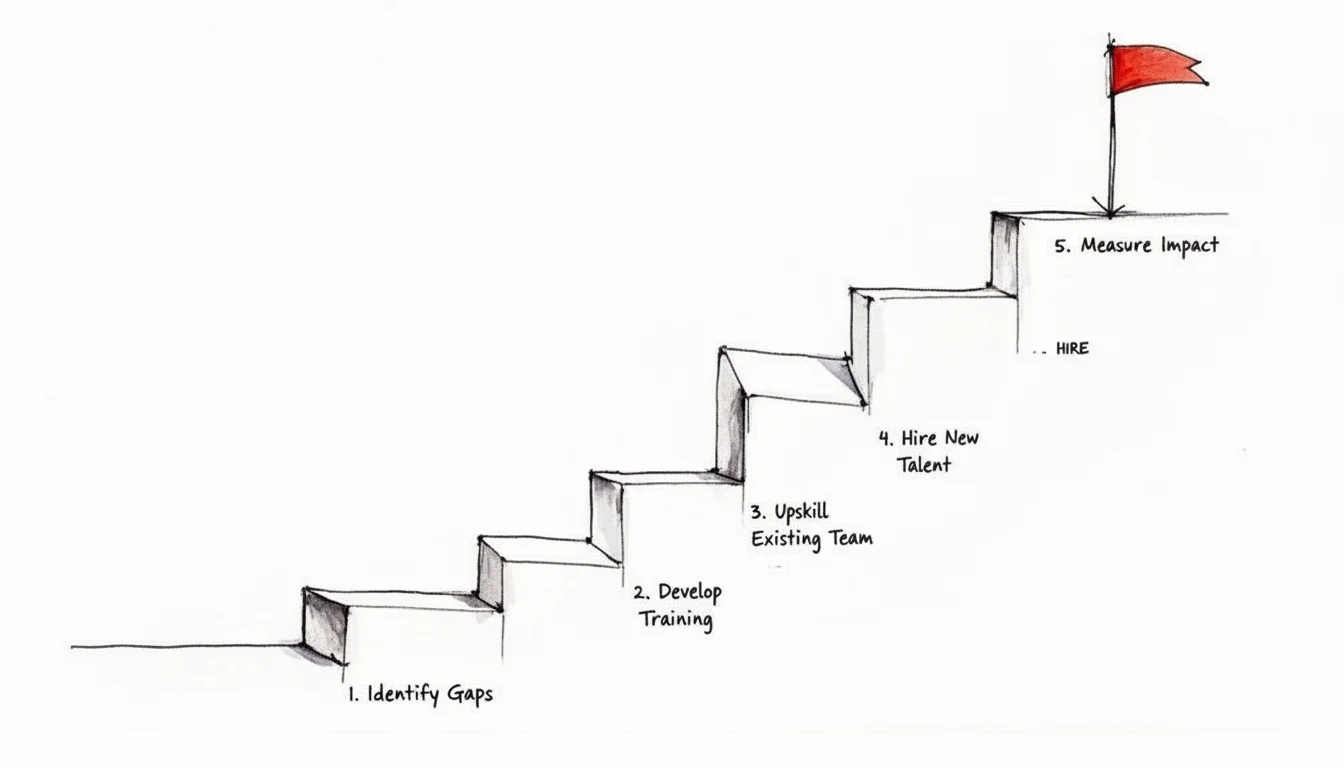
After identifying these skills by observing your most successful team members and talking to department heads, you can fill in the template with your assessment results. This data collection is the first step toward building a long-term learning plan. For more information on how to structure these plans, you can read our comprehensive guide on creating a training needs assessment template is an excellent next step.
Pro Tip for IT Teams: Implement a standardized scoring system to keep your template data clean. A 1-5 scale is standard and effective, provided the definitions are clear. For example: 1 = Novice (requires constant supervision; might need entry-level training like CompTIA IT Fundamentals), 3 = Proficient (can complete standard tasks alone; ready for intermediate certifications like AWS Certified SysOps Administrator), and 5 = Expert (capable of mentoring others and leading high-level architecture projects; likely holds multiple advanced certifications such as CCIE or Azure Solutions Architect Expert). Using these definitions ensures that when two different managers rate their teams, a "3" means the same thing across the entire organization. Consistency in scoring allows you to compare the cloud team against the security team without ambiguity.
Turning Insights into an Actionable Growth Plan for IT Professionals
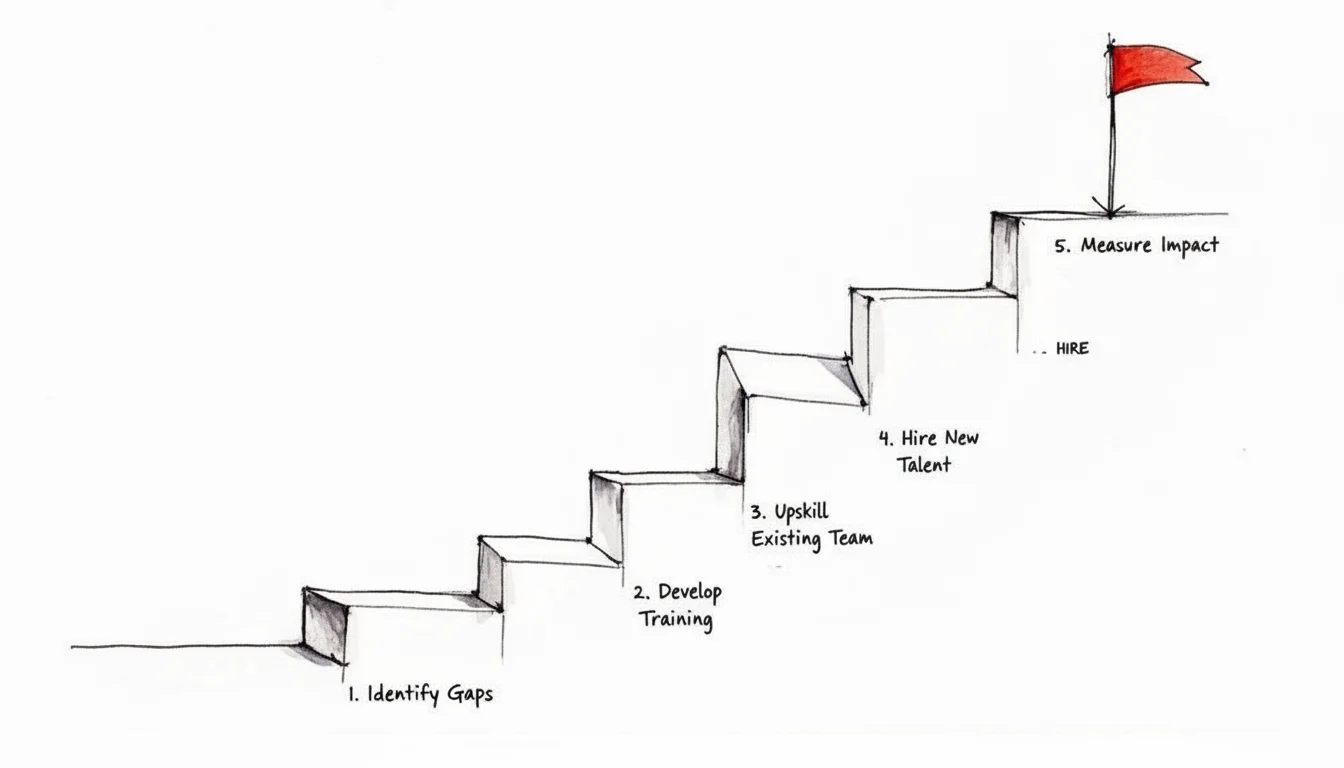
The information you gathered and sorted in your skill gap analysis template is a solid starting point, but data is only a tool. A collection of metrics and spreadsheets will not improve performance on its own. Actual progress starts when you translate those findings into a specific growth plan for your IT staff. You are building a bridge from the current technical levels of your team to the advanced capabilities they need for future business goals. This is not about finding one generic training video for everyone. An effective plan uses different methods to fix the specific holes found in your team's knowledge.
Crafting Your IT Development Strategy
Your analysis shows where the team is currently struggling. Now, you must choose the right fix for each problem. Not every missing skill requires a week of expensive off-site classes. Sometimes, a short workshop or a mentor produces better results. You have several clear options to close these gaps.
-
Targeted Upskilling & Certification Programs: Use this for major technical shifts across the whole department. If your company is moving to AWS or Azure, or adopting a new DevOps workflow, look for structured training that leads to industry-recognized credentials. This might include programs for the AWS Certified Developer or the Microsoft Certified: Azure DevOps Engineer Expert exams. This also applies when you need to strengthen management skills through ITIL 4 or PMP certifications. These programs provide a clear syllabus and a way to verify that the employee actually learned the material.
-
Mentorship and Coaching: This is the best way to handle gaps in hands-on experience. High-level technical work, like complex troubleshooting or managing IT teams during a system outage, is hard to learn from a book. By matching a junior cloud engineer with a senior architect, or a new project coordinator with a PMP certified veteran, you help them gain practical knowledge that only comes from years in the field. This ensures that the specific "know-how" of your organization stays within the team rather than being lost when senior staff members move on.
-
Strategic Hiring: Sometimes a gap is too wide to bridge with training alone. If you need a specialist in a field like advanced blockchain development or forensics for cybersecurity immediately, hiring new talent is the most efficient choice. While training current staff is good for morale, some roles require years of focused study that your project timeline might not allow. In these cases, bringing in a new person with the right background can help the rest of the team learn by working alongside an expert. This approach helps you move quickly while still supporting your existing staff.
-
Internal Mobility & Stretch Assignments: Do not ignore the talent you already have. Your employees might have hidden skills or the desire to move into different technical areas. Creating ways for people to change roles, such as a network engineer moving into a cloud networking position, helps fill gaps while keeping employees from leaving. Stretch assignments allow people to learn on the job while they contribute to company goals. This builds a more versatile workforce that can adapt to new technology faster than hiring from the outside.
An effective IT growth plan is more than a list of classes. It is a strategy that uses internal training, like the certification prep offered by MindMesh Academy, and external hiring to create a capable team.
To learn more about building development programs that work, see our guide on how to upskill employees. It provides a framework for creating learning programs that result in real, measurable improvements.
A Real-World IT Example in Action
Look at a mid-sized fintech company that used its skill gap analysis to fix a major risk. Their developers were great at writing code but knew little about API security protocols or secure coding for microservices. Since the company was about to launch a product relying on public APIs, this was a dangerous situation. They needed a solution that would work quickly.
They did not just send everyone to a generic security class. Instead, they picked the top 20% of their developers who showed the most interest in security. These people went through a specialized certification program focused on secure coding and OWASP best practices. These developers then became internal security leads. They worked with the rest of the team through code reviews and workshops to share what they learned. This spread the knowledge without taking every developer away from coding for weeks.
The results were significant. Within one year, the company fixed its API security problems and saw a 15% decrease in security bugs. The culture shifted to focus on security. Employees felt the company was helping them grow, which improved retention. This case shows how a data-driven plan turns a list of problems into a clear advantage for an IT organization.
Answering Your Top Questions About Skill Gap Analysis for IT
As you start or refine your IT skill gap analysis, it is natural to have questions. I have assisted many technical teams through this specific work. The following answers provide the clarity you need to move forward with your plan.
How Often Should We Conduct This for Our IT Teams?
Managers usually ask this first because the IT field moves so quickly. For a total analysis of your entire IT department, doing it once a year provides a solid baseline for your staffing and budget. This allows you to see high-level trends in your workforce.
However, technology changes faster than an annual schedule can track. New cloud services, security threats, and software development methods arrive monthly. For roles that deal with these changes—such as cloud engineers, AI developers, or security analysts—I suggest a lighter check every quarter. Do not view this as a heavy audit. Instead, use it as a way to monitor how your team’s current abilities match the needs of your current projects. If you wait twelve months to check your cybersecurity skills, you might find that your team is behind on the latest threat mitigation techniques. Frequent checks keep your training budget aligned with the reality of your operations.
What's the Biggest Mistake People Make in IT Skill Gap Analysis?
The biggest error I see in technical teams is focusing only on the present. Teams often get stuck trying to fix today's immediate skill shortages. In doing so, they forget to look at what is coming in two or three years. Your analysis must connect to your organization’s three-to-five-year strategic IT goals. If your company plans to move to a microservices architecture or adopt generative AI tools for coding, you need to identify those requirements today. If you wait until the project starts, you will spend the entire first year playing catch-up.
Another error is ignoring the people involved in the process. If your staff does not trust the analysis, they will provide inaccurate data about what they actually know. You must explain clearly that this process is for their professional development. It is a way to find new career paths and growth opportunities, not a way to find mistakes or blame people for what they have not learned yet. Transparency is the only way to get the honest data you need for a successful plan.
Can I Use This for Individual IT Career Planning?
Yes, this template is effective for one-on-one professional development. While it works for large teams, it is just as useful for personal growth.
An IT manager can use this same template with a direct report to build a clear career path. It helps identify the specific technical skills or certifications required for a promotion. Examples include AWS Solutions Architect, PMP, ITIL, or Azure Data Engineer. Using the template turns a general talk about "getting better" into a list of specific, measurable tasks. This gives the employee a clear set of goals to follow over the next six to twelve months.
We've Found the Gaps... Now What for Our IT Team?
Finding the gaps is a big win, but it is only the first half of the work. Now you must create training to fix them. You cannot simply buy a library of videos and hope it fixes the problem. You need a way to see if the time and money spent on training are helping the team perform better.
Our detailed guide on how to measure training effectiveness explains how to do this. It shows you how to track the impact of your training programs. You can see the return on investment by watching for improvements in system uptime, ticket resolution speed, or project delivery times. This ensures that your training efforts lead to better IT performance.
At MindMesh Academy, we believe that specific training and industry certifications are the keys to closing skill gaps. Our platform provides exam preparation for top IT certifications across cloud providers and technical domains. This helps you and your team learn the skills needed for future challenges. Build your future-ready IT team and advance your career with MindMesh Academy today.

Written by
Alvin Varughese
Founder, MindMesh Academy
Alvin Varughese is the founder of MindMesh Academy and holds 20 professional certifications including Microsoft Agentic AI Business Solutions Architect, AWS Solutions Architect Professional, and Azure DevOps Engineer Expert. He's held senior engineering and architecture roles at Humana (Fortune 50) and GE Appliances. He built MindMesh Academy to share the study methods and first-principles approach that helped him pass each exam.