12 Best Online Learning Platforms for Business
For IT professionals, continuous learning isn't just an advantage; it's a career imperative. Whether you're aiming for a new certification like AWS Solutions Architect, PMP, or ITIL 4, or striving to master the latest cloud technologies, choosing the right online learning platform for business can be a game-changer. The sheer volume of options, however, can make this crucial decision feel overwhelming. Is your team better served by a broad content library, a hyper-focused certification preparation tool, or a platform that integrates deeply with your existing corporate infrastructure?
This comprehensive guide is tailored for IT leaders, training managers, and individual professionals seeking to optimize their learning strategy. We'll cut through the marketing hype, offering a detailed, practical analysis of 12 leading online learning platforms for business. For each, we'll delve into ideal scenarios, weigh their distinct strengths against potential limitations, and highlight key implementation factors. Our objective is to empower you with the insights needed to select a platform that not only meets your organization's budget and technical requirements but, most importantly, propels your IT team towards verifiable skill mastery and certification success. While this article focuses on corporate training and content delivery, for a broader perspective, you might also consider this overview of the 8 best online course platforms.
Below, you'll find a comprehensive breakdown of each service, complete with screenshots and direct links, to simplify your evaluation process. We'll cover solutions ranging from MindMesh Academy, with its unique certification mastery focus, to broad platforms like Udemy Business, and specialized options like Pluralsight and O'Reilly Learning. This ensures you have the information needed to make a confident and strategic decision for your team's IT development.
1. MindMesh Academy
Best For: Durable Knowledge Retention and Certification Mastery
MindMesh Academy stands out as a premier choice among online learning platforms for business by addressing a critical challenge for IT professionals: achieving not just exam pass rates, but durable knowledge retention for complex technical skills. Its entire ecosystem is engineered around a "memory-first" Mastery Path, a proprietary methodology that leverages evidence-based learning science (like spaced repetition) with rigorously exam-aligned content. This makes it an exceptional tool for organizations dedicated to upskilling their IT teams for lasting impact and true certification mastery, ensuring knowledge sticks long after the exam.
The platform's core strength lies in its intelligent application of cognitive science. It proactively leverages spaced repetition and adaptive learning algorithms to create personalized study plans that dynamically adapt to each learner's progress. For an IT professional, this means valuable study time is optimized to reinforce weak areas – perhaps specific AWS security services or obscure PMP formulas – rather than redundantly covering concepts they have already mastered.
Standout Features & Use Cases
MindMesh Academy is more than just a content library; it’s a strategic training partner purpose-built for IT certification success.
- Adaptive Learning Paths: The platform's algorithm dynamically adjusts the curriculum based on quiz and practice exam performance. Use Case: Consider an IT team preparing for an AWS Solutions Architect certification. Junior engineers might focus on foundational EC2 and S3 concepts, while senior cloud architects might see their path prioritize advanced networking or serverless architecture topics where their knowledge gaps are identified. This intelligent tailoring optimizes study time across the board, ensuring everyone gains mastery where it's needed most. Alternatively, for a team pursuing ITIL 4 Foundation, the system ensures each member masters the service value chain components they struggle with, rather than re-reviewing already understood principles.
- Progress Analytics Dashboard: A clear, intuitive dashboard provides both learners and managers with a visual representation of individual and team strengths and weaknesses. Use Case: A training manager preparing a team for the PMP exam can quickly pinpoint common areas of struggle – perhaps specific knowledge areas like Risk Management or Integration Management. This insight allows them to schedule targeted workshops or provide supplementary resources to address those specific gaps, maximizing pre-exam preparation efficiency.
- Exam-Proven Content: The platform offers a comprehensive suite of rigorously exam-aligned study guides, intelligent spaced-repetition flashcards, and realistic practice exams. This content covers a wide range of critical industry credentials essential for IT professionals, including AWS, Azure, CompTIA (A+, Network+, Security+), ITIL, PMP, and ServiceNow.
Reflection Prompt: How confident are you that your current learning approach for IT certifications translates into long-term, applicable knowledge rather than just short-term recall?
Considerations
The primary drawback is the lack of public pricing information; organizations must contact MindMesh Academy directly for a quote, which can slow down the evaluation process. Additionally, while the platform excels at knowledge reinforcement and exam practice, businesses seeking extensive hands-on labs or live instructor-led sessions may need to supplement it with other resources.
Website: Explore IT Certification Practice Exams
2. Udemy Business
Udemy Business distinguishes itself with an enormous, constantly updated course catalog, making it one of the most versatile online learning platforms for business for IT teams. It excels in providing rapid access to training on emerging tech and business topics – from new programming languages like Rust or Go to specialized DevOps tools – often faster than traditional corporate training providers. This platform is ideal for organizations seeking to offer IT employees a wide range of learning options, whether it's diving into cloud computing fundamentals, exploring data science techniques, or honing essential soft skills crucial for IT leadership, like communication and agile project management.
Its primary strength lies in the sheer breadth and depth of its content library. The self-serve "Team" plan is particularly effective for small to mid-sized IT departments (2-50 employees) that need to quickly onboard new tech, close specific skill gaps, or offer diverse learning without a lengthy sales process. Administrators can easily assign relevant courses – perhaps "Python for Data Analysis" or "Introduction to Kubernetes" – and track learner progress through a clean, intuitive dashboard.
Key Features & Use Cases
Udemy Business provides robust features tailored for corporate learning environments, making it highly adaptable for IT teams. Its AI-powered recommendation engine personalizes the learning experience, suggesting relevant courses based on an employee's role and learning history – a valuable asset for IT professionals navigating complex career paths.
- Best For: IT departments and companies needing a diverse, multi-language content library and a quick-to-deploy solution for smaller teams. It's also exceptionally effective for closing specific, immediate IT skill gaps with its on-demand courses, such as mastering a new scripting language, learning a particular CI/CD tool, or getting an initial overview of a cloud platform like Google Cloud.
- Unique Offerings: The Enterprise plan significantly enhances its value for IT professionals by including advanced features like hands-on labs, workspaces, and specific certification prep paths, which are critical for technical upskilling and validating skills for popular IT certifications.
- Implementation Tip: For larger IT department rollouts, utilize Udemy's "learning paths" feature. Curate a sequence of courses aligned with specific IT job roles (e.g., "DevOps Engineer Learning Path" including Git, Docker, Kubernetes, and Jenkins) or career development tracks to provide structured guidance for employees preparing for their next role or certification.
Key Takeaway: While Udemy Business offers breadth for exploration and foundational knowledge, IT professionals aiming for specific certifications should verify the depth and alignment of available "certification prep paths" to ensure they meet rigorous exam requirements.
| Feature Analysis | Assessment |
|---|---|
| Content Library | Excellent. Over 13,000 courses on the Team plan and 30,000+ on Enterprise, covering a vast range of topics. |
| Admin & Reporting | Good. Provides essential analytics on learner engagement and adoption, though deeper integrations require Enterprise. |
| User Experience | Excellent. The platform is user-friendly for both learners and administrators, with a familiar, intuitive interface. |
| Pricing Model | Mixed. The Team plan offers transparent, per-user pricing, but Enterprise plan pricing requires a sales consultation. |
Website: https://business.udemy.com/
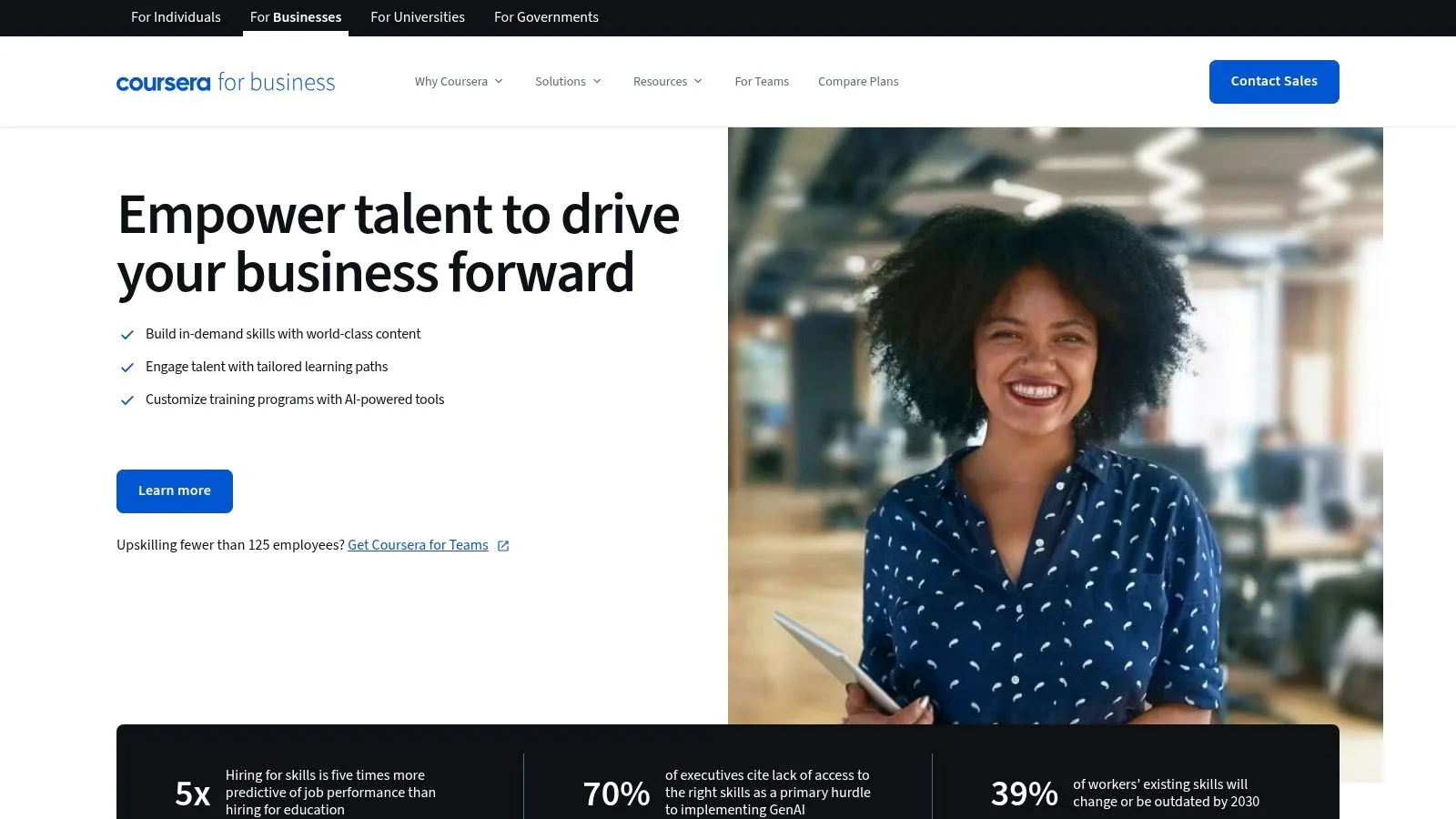
3. Coursera for Business
Coursera for Business brings the academic rigor of top universities and industry-recognized credentials directly to corporate training, making it a powerful choice for IT teams. It stands out by partnering with over 350 elite institutions and companies like Google, IBM, and leading universities to offer structured learning programs. This makes it an exceptional choice among online learning platforms for business, particularly for organizations that value validated expertise and formal Professional Certificates for high-demand IT roles in data science, cybersecurity, cloud engineering, and advanced business management.
The platform is built around depth and academic credibility, crucial for IT professionals seeking foundational understanding and verifiable skills. Its Team plan is designed for smaller IT groups (5-125 users) seeking access to high-quality courses and Professional Certificates, while the Enterprise plan provides a comprehensive solution for larger organizations, including advanced integrations with existing Learning Management Systems (LMS) for seamless management.
Key Features & Use Cases
Coursera for Business excels at providing structured, role-based skill development, which is particularly beneficial for IT career progression. An AI Coach helps personalize learning journeys, while new AI-powered tools assist administrators in building custom courses and learning paths tailored to specific company goals, such as preparing a team for an Azure DevOps Engineer role or a specialized data analyst position.
- Best For: Companies focused on deep IT upskilling, reskilling entire departments, and obtaining verifiable credentials from respected academic and industry partners. It's ideal for building foundational expertise in high-demand IT fields, such as the Google IT Support Professional Certificate, IBM Data Science Professional Certificate, or specialized programs in AI/ML from top universities.
- Unique Offerings: Access to 165+ Professional Certificates and specialized programs from world-class partners, offering formal validation highly valued in the IT industry. The platform also offers robust LMS and LXP integrations for seamless workflow incorporation, ensuring IT training is centralized and easily managed.
- Implementation Tip: Leverage "SkillSets" to benchmark your IT team's current capabilities against industry data. For instance, identify if your development team has gaps in cloud security practices or if your data engineers need advanced Python skills. This helps identify critical skill gaps and allows you to assign targeted learning programs, such as a "Cybersecurity Specialization" or "Advanced Python for Data Science," to close them effectively.
Reflection Prompt: Are your IT team's learning efforts translating into widely recognized and verifiable credentials that boost both individual careers and organizational capabilities?
| Feature Analysis | Assessment |
|---|---|
| Content Library | Excellent. Over 10,600 courses and specialized certificate programs from elite institutions and industry leaders. |
| Admin & Reporting | Very Good. Strong analytics and skill-tracking dashboards, with extensive integration capabilities on the Enterprise plan. |
| User Experience | Good. The platform is well-structured for guided learning, though some certificate paths demand a high time commitment. |
| Pricing Model | Mixed. The Team plan is a straightforward per-user subscription, but exact pricing is only shown at checkout. Enterprise is quote-based. |
Website: https://www.coursera.org/business
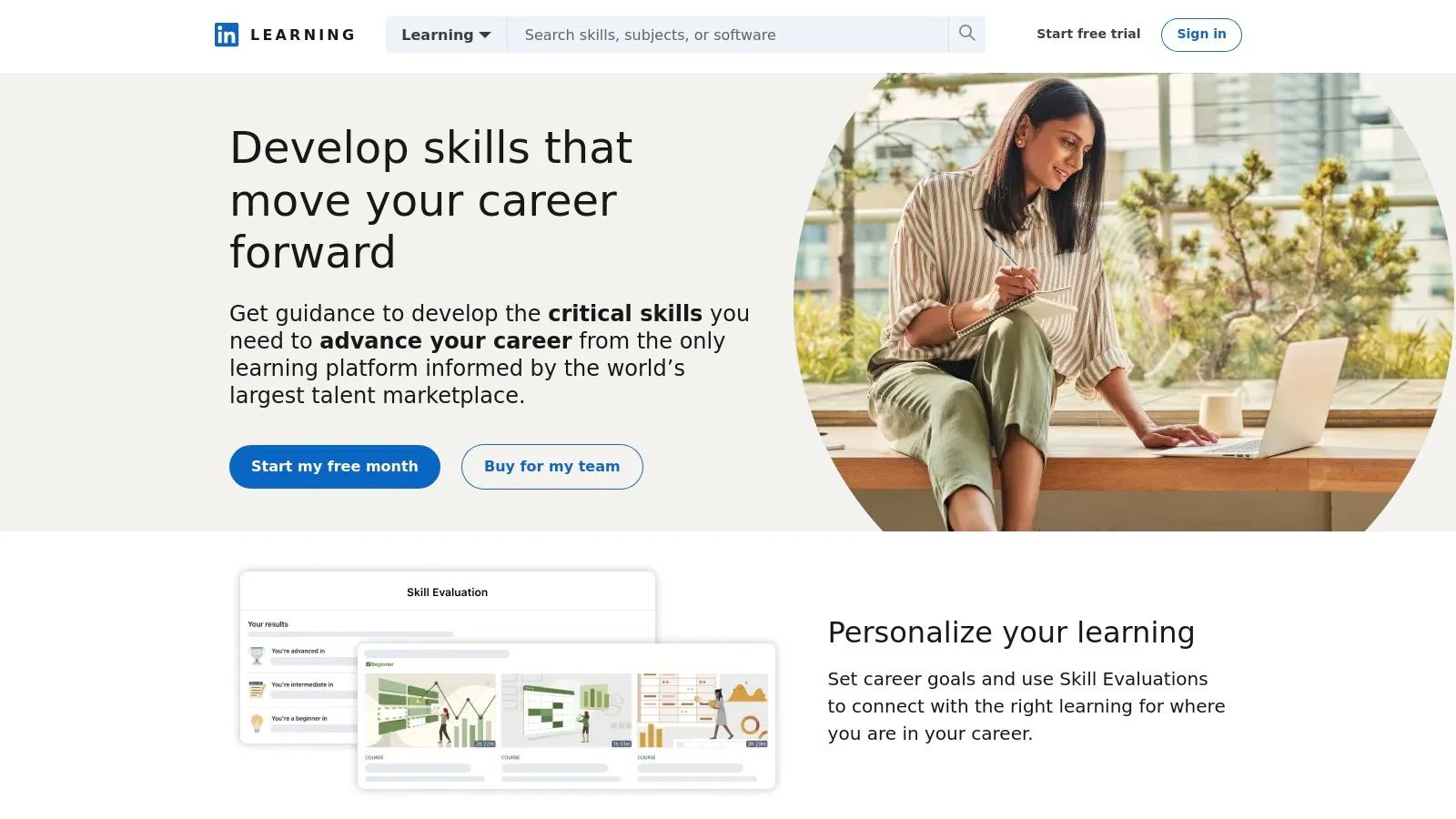
4. LinkedIn Learning (Teams / Enterprise)
LinkedIn Learning leverages its extensive professional network to deliver a highly engaging, video-centric learning experience focused on business, technology, and creative skills crucial for IT professionals. It stands out due to its familiar, user-friendly interface, which often leads to higher adoption rates, particularly for developing crucial soft skills like IT leadership, communication, project management, and agile methodologies. The platform is an excellent choice for organizations aiming to foster a culture of continuous learning by integrating it directly into the professional ecosystem their IT employees already use.
The platform's strength lies in its high-quality, expert-led video content and its seamless integration with the broader LinkedIn ecosystem. This integration is particularly valuable for IT professionals, allowing them to connect learning directly to their professional brand. The self-serve "For Teams" plan is ideal for small IT departments (2-20 employees) looking for a straightforward, transparently priced solution with a generous one-month free trial, allowing for a thorough evaluation before commitment.
Key Features & Use Cases
LinkedIn Learning offers a curated library of courses designed to meet the demands of the modern workforce, including specific tracks for IT professionals. Its data-driven insights suggest relevant courses based on industry trends (e.g., "Cloud Computing Fundamentals" or "Cybersecurity Best Practices") and an individual's professional profile, making it a powerful tool for personalized development within the IT sphere.
- Best For: IT organizations prioritizing the development of critical soft skills (e.g., stakeholder communication for project managers, emotional intelligence for team leads), leadership training for aspiring IT managers, and digital business skills. Its intuitive design and mobile accessibility make it perfect for IT companies with a diverse, on-the-go workforce, allowing learning on commutes or between tasks.
- Unique Offerings: The ability for IT employees to showcase completed course certificates directly on their LinkedIn profiles provides a powerful, built-in incentive for engagement and public skill validation, enhancing their professional brand.
- Implementation Tip: Encourage IT managers to create and share custom learning paths aligned with team goals. For example, a path on "Becoming a More Effective Scrum Master" or "Leading Technical Teams" can promote social learning and ensure training efforts are directly tied to business objectives and project success.
| Feature Analysis | Assessment |
|---|---|
| Content Library | Good. Over 22,000 expert-led courses with a strong focus on business, creative, and technology topics. |
| Admin & Reporting | Good. Provides clear dashboards for tracking learner progress and engagement, with more advanced features in Enterprise. |
| User Experience | Excellent. The familiar interface, high-quality video player, and mobile apps ensure a smooth, accessible experience. |
| Pricing Model | Good. The Teams plan has transparent per-user pricing, but the 20-license cap pushes larger teams to Enterprise sales. |
Website: https://www.linkedin.com/learning/
5. Pluralsight (Teams)
Pluralsight solidifies its position as a premier online learning platform for business by focusing intensely on technology skill development – a non-negotiable for any modern IT organization. It is engineered for tech-heavy teams that need to rapidly upskill in critical, in-demand areas like cloud computing (AWS, Azure, GCP), cybersecurity, software development, AI/ML, and DevOps. The platform goes beyond passive video learning, integrating robust assessments and hands-on labs to ensure IT skills are not just learned theoretically but effectively applied in practical scenarios.
Its core strength lies in its structured, role-based learning paths. Pluralsight helps organizations map out clear development tracks for specific tech roles, from a Cloud Engineer preparing for the Azure Administrator Associate certification to a Data Analyst aiming for a Power BI credential. It uses precise skill assessments to benchmark current knowledge and measure progress, making it a strategic tool for closing specific, high-priority technical skill gaps and preparing IT teams for key certifications.
Key Features & Use Cases
Pluralsight provides a comprehensive toolkit for technical upskilling that directly benefits IT managers. Its analytics dashboard gives leaders deep insights into team proficiency – for example, identifying collective weaknesses in secure coding practices or serverless architecture – allowing for targeted training interventions where they are needed most.
- Best For: Technology departments and engineering-focused companies needing to validate and deepen skills in specific IT domains like AI, data engineering, cloud platforms (AWS, Azure, GCP), and cybersecurity. It's particularly strong for teams aiming for certifications that require both theoretical knowledge and practical application.
- Unique Offerings: Hands-on labs and sandboxes provide a safe, real-world environment for IT professionals to practice complex tasks like configuring virtual networks, deploying containerized applications, or writing secure code, all without impacting production systems. This experiential learning is invaluable for certification prep and real-world job readiness.
- Implementation Tip: For IT teams, use the "Skill IQ" and "Role IQ" assessments before assigning learning paths. This establishes a precise baseline for each employee – for example, assessing their current proficiency in Python or AWS services – personalizes their learning journey, and helps demonstrate ROI by tracking measurable skill progression over time, directly correlating to project readiness or certification attainment.
Reflection Prompt: How effectively does your current IT training blend theoretical knowledge with hands-on practice, and can you clearly measure the practical skill progression of your team members?
| Feature Analysis | Assessment |
|---|---|
| Content Library | Good. Deeply focused on technology topics with excellent coverage in software, cloud, and IT, but limited for non-tech roles. |
| Admin & Reporting | Excellent. Advanced analytics on skill proficiency and team progress are a core strength of the platform. |
| User Experience | Good. The interface is clean and geared toward technical learners, prioritizing paths and hands-on practice. |
| Pricing Model | Good. Offers clear, published per-user pricing for its standard team plans, with Enterprise options requiring a quote. |
Website: https://www.pluralsight.com/teams
6. edX for Business
edX for Business brings the academic rigor and prestige of top universities and institutions directly into the corporate learning environment, offering significant value for IT professionals. It distinguishes itself by offering credential-bearing courses and programs, providing a strong signal of achievement that is invaluable for internal talent mobility, career development, and building a robust professional profile. This platform is ideal for organizations that prioritize deep, structured learning and want to offer IT employees access to foundational and advanced programs from partners like Harvard, MIT, Google, and IBM, particularly in emerging tech fields.
The platform's strength lies in its diverse learning formats, which accommodate different needs, from self-paced individual courses for specific IT skills to cohort-based executive education for senior IT leadership. The "Academies" feature offers expertly curated learning paths in high-demand IT areas like Data Science, AI/ML Engineering, Cybersecurity, and IT Leadership, providing comprehensive skill development. This makes edX one of the most credible online learning platforms for business seeking to build verified expertise and a strong academic foundation within their IT teams.
Key Features & Use Cases
edX for Business is structured to support everything from individual IT skill acquisition (e.g., Python programming) to strategic executive development for CIOs and CTOs. Its connection to over 260 world-class partners ensures the content is both authoritative and highly relevant to the evolving landscape of IT and technology.
- Best For: Companies focused on building deep, credentialed IT expertise and supporting formal career progression within technical roles. It excels in leadership development for IT managers and upskilling in technical fields with university-backed validation, such as specialized programs in quantum computing, advanced machine learning, or blockchain development, which often complement broader IT certifications.
- Unique Offerings: The blend of self-paced courses, Professional Certificate programs (e.g., from MIT in Data Science), and cohort-based executive education provides a flexible yet highly structured learning ecosystem that few competitors can match for IT professionals seeking both flexibility and formal recognition.
- Implementation Tip: Leverage the stackable credentials to create clear IT career pathways. For example, map a series of Professional Certificate programs (e.g., a "Cloud Architecture MicroMasters" followed by an Azure or AWS specific certification) to specific IT job roles, showing employees a tangible route for advancement within the company from junior to senior or specialist positions.
| Feature Analysis | Assessment |
|---|---|
| Content Library | Excellent. Content is sourced from elite universities and industry leaders, ensuring high quality and academic credibility. |
| Admin & Reporting | Good. Provides necessary tools for tracking progress and course completions, with more advanced analytics available on Enterprise plans. |
| User Experience | Good. The interface is clean and academic-focused, though some cohort-based programs have fixed start dates requiring careful planning. |
| Pricing Model | Mixed. No public pricing is available for Team or Enterprise plans, requiring a direct sales consultation for a custom quote. |
Website: https://business.edx.org/
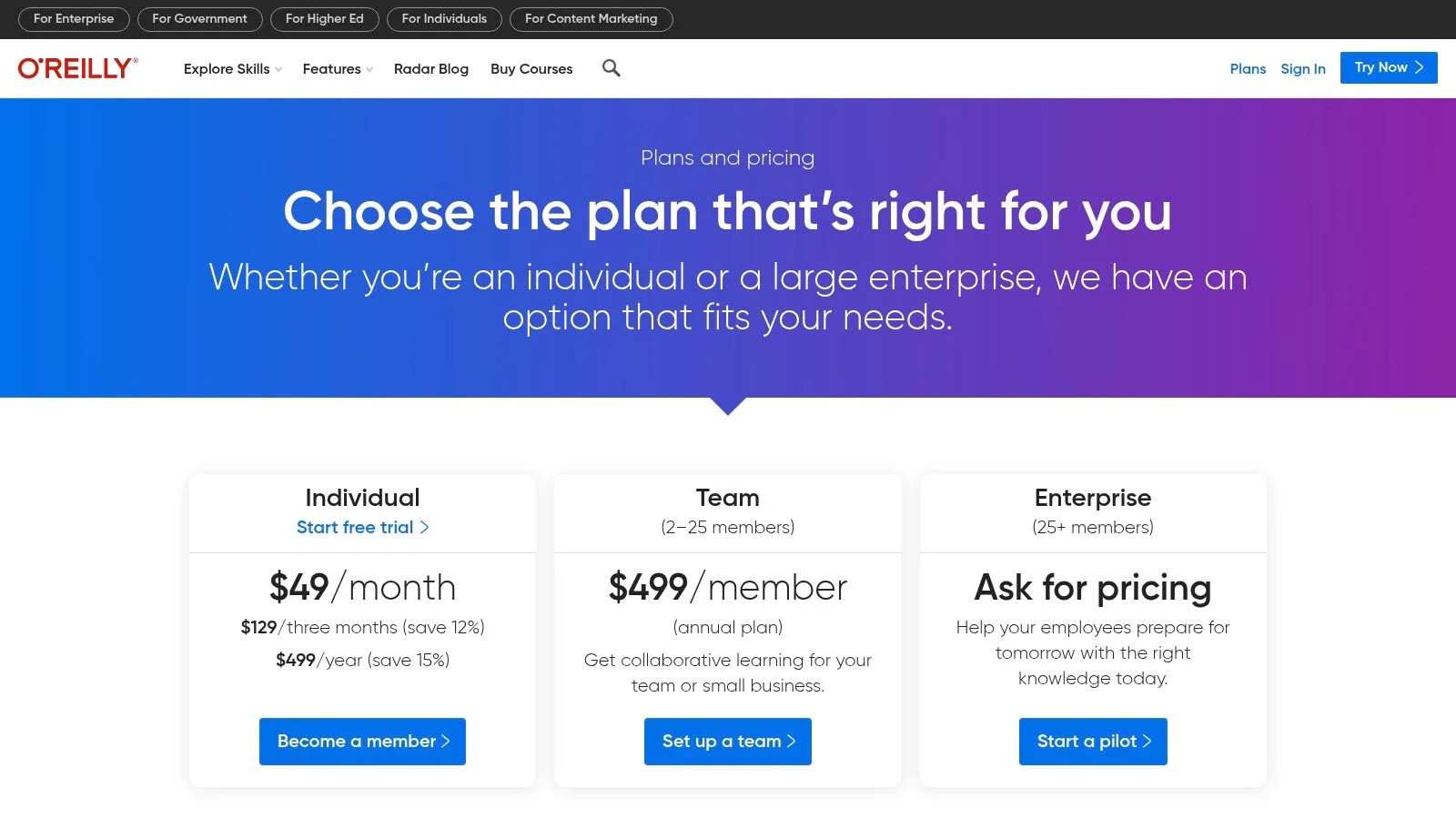
7. O’Reilly Learning (Teams & Enterprise)
O’Reilly Learning has built a sterling reputation as the go-to resource for in-depth technical knowledge, making it one of the most respected online learning platforms for business in the tech sector. It uniquely integrates a massive, continuously updated library of technical books, videos, and live online training with crucial hands-on learning tools like interactive labs and sandboxes. This platform is perfect for IT organizations that need to keep their technology and engineering teams not just skilled, but at the absolute cutting edge of innovation and emerging technologies.
The platform's strength is its unparalleled multi-format learning approach, ideal for diverse learning styles within an IT team. Users can read a chapter on, say, Kubernetes, watch a related video tutorial, and then immediately apply their knowledge in a live coding environment or sandbox, all without leaving the platform. Its transparent, self-serve pricing for smaller teams is a significant advantage for IT businesses that want to get started quickly, while enterprise plans offer more robust features for larger-scale upskilling initiatives, including deeper analytics and custom content curation.
Key Features & Use Cases
O’Reilly's platform is designed for deep, practical IT learning, especially for roles in advanced software development, cloud infrastructure engineering, cybersecurity, and data science. Its AI-powered search and expert-curated learning paths help guide employees to the most relevant and impactful content for their roles, including those preparing for highly specialized IT certifications.
- Best For: Technology-focused companies, engineering departments, and IT teams that require an authoritative blend of reference materials (e.g., definitive guides to Python, Java, or specific cloud services) and practical, hands-on skill development. This is invaluable for deep diving into technical specifications or troubleshooting complex systems, which often underpins success in higher-level IT certifications.
- Unique Offerings: The integrated interactive labs and sandboxes are a game-changer for IT professionals. They allow learners to practice complex coding challenges, experiment with system configurations, and deploy infrastructure in real-world scenarios, which is an incredibly powerful tool for skill validation and preparation for performance-based IT exams.
- Implementation Tip: Encourage IT team members to actively utilize the "live online training" events. These expert-led sessions offer a rare chance for interactive Q&A with industry leaders and provide timely insights on emerging technologies like serverless functions, quantum computing, or advanced cybersecurity threats, directly complementing structured certification studies.
| Feature Analysis | Assessment |
|---|---|
| Content Library | Excellent. Unmatched depth in technology, with access to O'Reilly's full catalog and content from 200+ publishers. |
| Admin & Reporting | Good. Provides solid analytics and usage dashboards, with more advanced customization available on enterprise plans. |
| User Experience | Very Good. The integrated multi-format experience is powerful, though the sheer volume of content can be daunting initially. |
| Pricing Model | Good. Transparent per-user pricing for teams is a major plus. Enterprise plans require a custom quote. |
Website: https://www.oreilly.com/pricing/
8. OpenSesame
OpenSesame operates as a comprehensive elearning marketplace, providing a unique alternative to single-provider online learning platforms for business. Instead of creating its own content, it aggregates and curates courses from hundreds of top publishers, allowing organizations to purchase exactly what their IT teams need, when they need it. This model is perfect for businesses that already have a Learning Management System (LMS) and want to supplement their existing training library with specialized, high-quality content on topics like IT security awareness, data privacy compliance (e.g., GDPR, HIPAA), project management best practices, and leadership development for technical leads.
The platform’s core strength is its flexibility. IT organizations aren't locked into one content style; they can mix and match courses from various publishers to build a truly customized learning program. Its powerful integration capabilities, supporting industry standards like SCORM and AICC, ensure that purchased courses can be deployed and tracked seamlessly within almost any existing corporate learning environment, making content delivery to diverse IT teams effortless.
Key Features & Use Cases
OpenSesame excels at simplifying content procurement and management for IT departments. Its curation tools and dedicated advisors help learning and development teams sift through the vast catalog to find the most relevant and impactful courses for specific IT needs, such as a specialized course on secure API development or a compliance module for handling sensitive customer data.
- Best For: Companies with an established LMS that need to fill specific IT content gaps, particularly in areas like cybersecurity compliance, data governance, or tailored professional development for different IT roles. It's also ideal for those who prefer a pay-per-use model over a full subscription, allowing targeted investment in niche IT training without commitment to a broad platform.
- Unique Offerings: The "OpenSesame Plus" subscription offers a curated collection of top courses for a flat fee, providing a blend of the marketplace model with subscription predictability for recurring IT training needs. Its deep integration roster, covering a wide array of LMS and HRIS systems, is one of the most extensive in the industry, simplifying deployment for IT teams.
- Implementation Tip: Utilize OpenSesame’s curation experts. Provide them with your IT competency framework (e.g., desired skills for a Senior Network Engineer or Cloud Security Specialist) or specific training goals, and they can build custom course lists, saving your L&D and IT administration teams significant time and ensuring content alignment with strategic technical objectives.
| Feature Analysis | Assessment |
|---|---|
| Content Library | Excellent. A massive catalog from hundreds of diverse publishers, offering a wide variety of styles and specializations. |
| Admin & Reporting | Good. Provides robust admin tools for curation and catalog syncing, but detailed learner reporting relies on the host LMS. |
| User Experience | Good. The experience is focused on the L&D professional as the primary user; the platform makes course discovery and purchase easy. |
| Pricing Model | Mixed. Offers excellent flexibility (pay-per-use, bundles, subscription) but is primarily quote-based and can be complex. |
Website: https://www.opensesame.com/
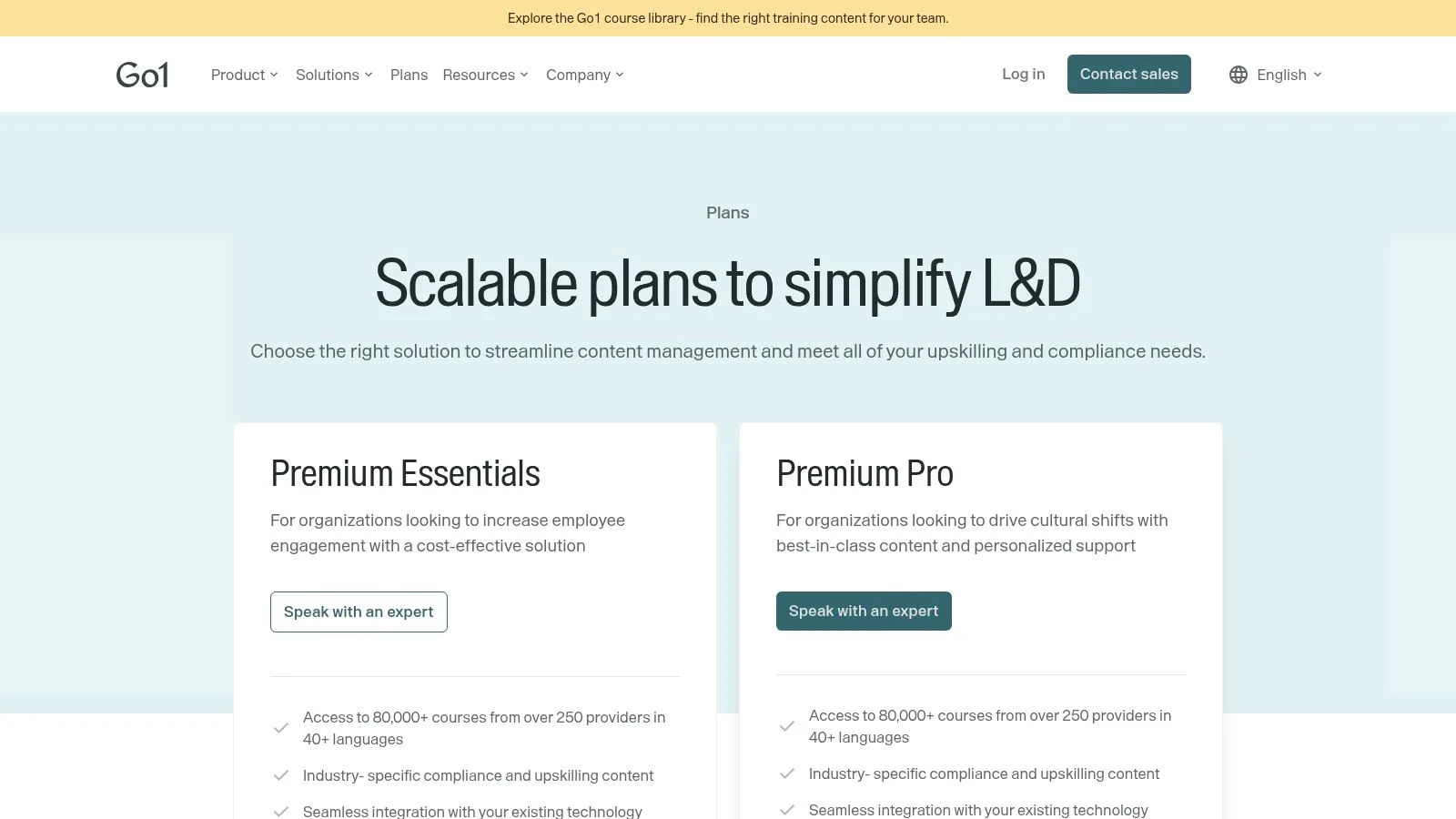
9. Go1
Go1 positions itself as a comprehensive content hub, aggregating an enormous library of courses from over 250 different providers into a single subscription. Instead of creating its own content, it provides a curated marketplace, making it one of the most flexible online learning platforms for business for IT departments. This approach is ideal for organizations that already have a Learning Management System (LMS) or Learning Experience Platform (LXP) and want to enrich it with a diverse, multi-publisher catalog – covering everything from foundational programming to advanced cloud security – without managing multiple vendor contracts.
The platform excels at simplifying content acquisition for IT professionals. It allows L&D teams to access over 80,000 courses covering everything from mandatory IT compliance training and data privacy best practices to leadership development for IT managers and specialized technical skills in new frameworks. Its strength lies in its extensive integration capabilities and curation services, helping businesses deliver relevant, high-quality content directly within their existing learning environments, minimizing disruption for IT teams.
Key Features & Use Cases
Go1’s feature set is designed to seamlessly integrate with and augment an organization's existing learning infrastructure, making it a powerful asset for IT departments. It offers powerful curation tools and supports over 70 HR and LMS systems, ensuring that diverse IT content – from Agile methodologies to Python development – is delivered where employees already are, simplifying access and adoption.
- Best For: Companies with an established LMS/LXP seeking to expand their content library for IT teams with a single, unified subscription. It's particularly strong for global organizations needing broad compliance training (e.g., regional data regulations) and professional skills coverage for their diverse IT workforce, across multiple languages and technical specializations.
- Unique Offerings: The aggregated multi-publisher catalog is its core differentiator, offering IT teams access to a vast array of specialized technical training. The inclusion of Blinkist for microlearning and specialized compliance content from top providers (e.g., for ISO 27001 or SOC 2) offers unique value for busy IT professionals.
- Implementation Tip: Leverage Go1's curation services to build playlists and learning paths aligned with your IT competency frameworks. For example, create a "Cloud Security Specialist Path" combining courses from different providers on AWS security, ethical hacking, and incident response. This ensures employees aren't overwhelmed by the vast library and can find relevant resources to effectively upskill and reskill for critical technical roles.
| Feature Analysis | Assessment |
|---|---|
| Content Library | Excellent. An aggregated catalog of 80,000+ courses from hundreds of world-class providers like Skillsoft, Pluralsight, and more. |
| Admin & Reporting | Good. Reporting capabilities are robust, but their depth often depends on the integration with your primary LMS/LXP. |
| User Experience | Good. The experience is heavily influenced by the delivery platform (your LMS vs. Go1's interface), but discovery tools are effective. |
| Pricing Model | Mixed. Pricing is not publicly available and requires a sales consultation, which may be a barrier for smaller businesses. |
Website: https://www.go1.com/plans
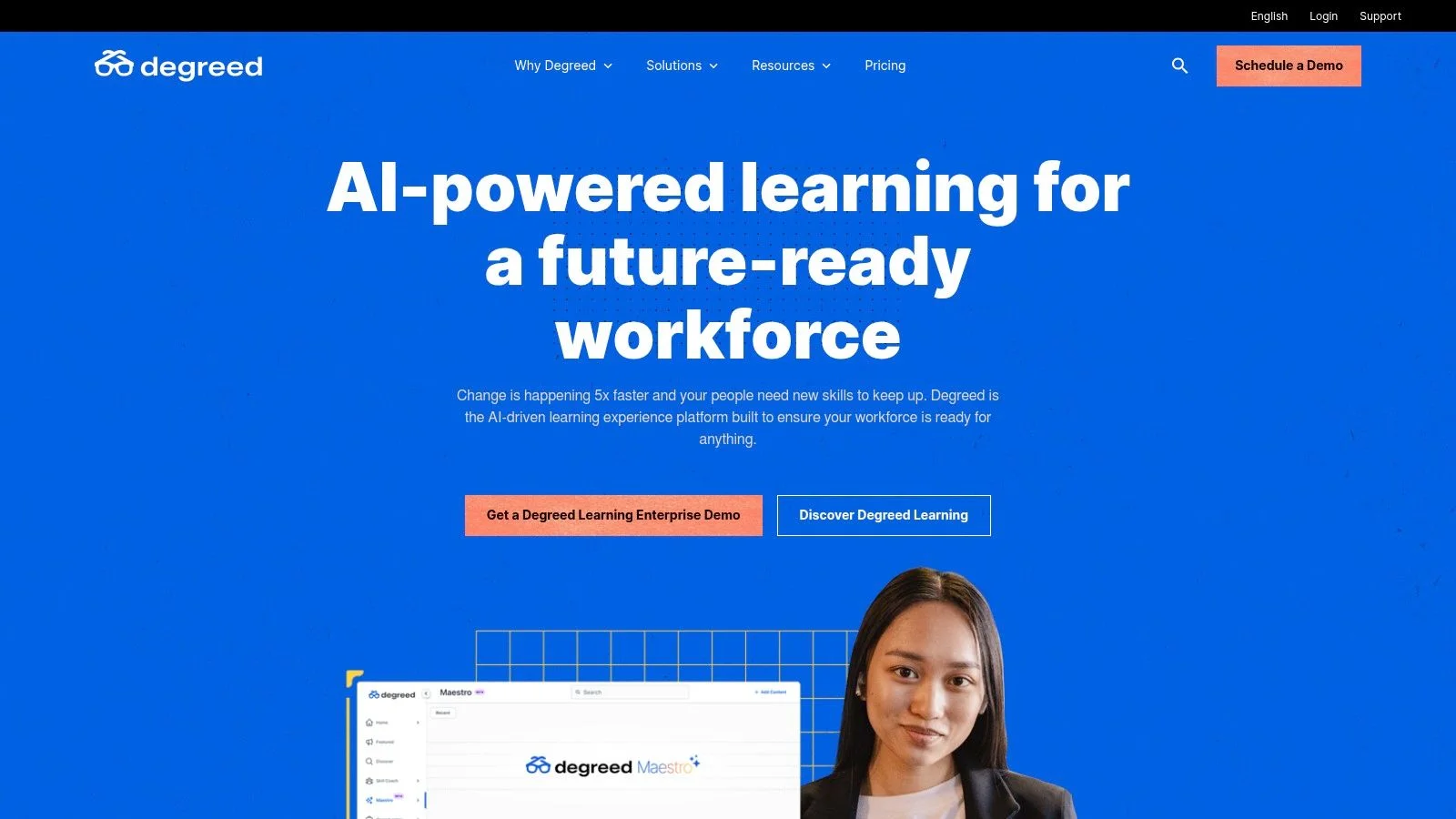
10. Degreed
Degreed positions itself as a Learning Experience Platform (LXP) rather than a traditional content provider. It excels at unifying an organization's entire learning ecosystem, pulling in resources from internal knowledge bases, external course catalogs (like Coursera, Pluralsight), articles, and videos into a single, personalized interface. This platform is built for large IT enterprises that already have multiple content sources but struggle to track specific IT skills (e.g., Python proficiency, Azure administration), measure the impact of learning on project outcomes, and deliver continuous learning in the flow of work.
Its core strength is its advanced skills intelligence engine, which maps individual employee skills and connects them directly to business objectives and IT strategic goals. By aggregating learning from hundreds of sources, Degreed helps organizations understand their collective technical capabilities and identify critical IT skill gaps across departments. The platform’s ability to integrate learning directly into collaboration tools like Slack and Microsoft Teams makes it a powerful choice for creating a seamless, continuous development culture within complex IT environments.
Key Features & Use Cases
Degreed focuses on connecting learning to opportunity through robust skill data and deep integrations, which is vital for IT career progression. Its AI-driven recommendations surface relevant content from any connected source – whether an internal wiki, a Pluralsight course, or a technical blog – moving far beyond a simple course catalog to provide truly dynamic learning pathways.
- Best For: Large IT enterprises aiming to unify a complex and fragmented learning technology stack (e.g., combining an LMS, specific cloud training platforms, and internal documentation) and gain deep analytical insights into specific IT workforce skills and capabilities. This is crucial for strategic talent planning in tech.
- Unique Offerings: The platform's skill analytics provide a real-time "skill profile" for every IT employee, detailing their proficiencies in areas like DevOps, cloud architecture, or cybersecurity. This enables data-driven decisions for promotions, strategic project staffing (e.g., finding the right PMP-certified project manager), and strategic IT workforce planning. Its vast integration library is a key differentiator for complex tech ecosystems.
- Implementation Tip: Start by integrating your most-used IT content libraries (e.g., your internal developer documentation, cloud provider training portals) and your HRIS. This will immediately enrich IT employee profiles with skill data and populate the platform with familiar learning resources, driving early adoption among technical teams.
| Feature Analysis | Assessment |
|---|---|
| Content Library | N/A. Degreed does not produce its own content; it aggregates content from sources the customer already owns or licenses. |
| Admin & Reporting | Excellent. Advanced skills analytics and reporting are core to the platform, connecting learning to business outcomes. |
| User Experience | Good. Provides a modern, consumer-grade experience for learners, though the admin side can be complex to configure initially. |
| Pricing Model | Custom. Pricing is entirely quote-based and tailored to enterprise needs, requiring consultation with their sales team. |
Website: https://degreed.com/
11. Skillsoft Percipio
Skillsoft Percipio is an enterprise-grade learning experience platform (LXP) designed for large organizations that require a comprehensive and multi-modal content library, making it highly valuable for diverse IT teams. It excels in providing a highly structured yet personalized learning environment, combining essential business skills, leadership development for IT managers, cutting-edge technology training (e.g., cloud platform certifications), and extensive IT compliance modules into a single, cohesive ecosystem. This makes it one of the most robust online learning platforms for business units needing to manage diverse IT training requirements at scale, from global security awareness to highly specialized technical upskilling.
The platform's strength lies in its diverse content formats, which include traditional courses, audiobooks for on-the-go learning, summaries, and crucial hands-on labs for IT professionals. Its AI-driven recommendation engine creates personalized "channels" and learning journeys for employees, guiding them through relevant content tailored to their IT roles or career goals (e.g., a "Cybersecurity Analyst Path" or "Advanced Azure Development Channel"). The administrative back-end is particularly powerful, offering deep analytics and reporting capabilities essential for large-scale enterprise deployments and for organizations focused on demonstrating learning ROI across their IT workforce.
Key Features & Use Cases
Percipio’s feature set is built to support a modern, continuous learning culture within IT organizations, with a blend of self-directed exploration and structured development. Its focus on frequent product updates ensures the platform remains competitive and aligned with evolving L&D trends and the rapidly changing IT landscape.
- Best For: Large IT enterprises seeking a single platform to manage all learning needs, from IT leadership development and cutting-edge tech upskilling (e.g., Google Cloud, Certified Ethical Hacker) to mandatory compliance training (e.g., data privacy regulations, acceptable use policies). It is ideal for organizations with a global IT workforce due to its localized experiences and multi-language content.
- Unique Offerings: A broad modality mix (courses, books, audiobooks for multitasking IT professionals) and integrated social learning features like study groups create a rich, engaging environment for collaborative learning. The AI assistant and skill benchmarks help personalize the experience and measure progress effectively, translating into tangible improvements for IT projects and team capabilities.
- Implementation Tip: Leverage the robust administrative dashboards from the start. To get the most value, measure training effectiveness by tying IT learner progress data in Percipio to specific departmental or business KPIs, such as faster deployment cycles, fewer security incidents, improved project delivery times, or increased certification rates for critical roles.
| Feature Analysis | Assessment |
|---|---|
| Content Library | Excellent. A vast, curated library covering business, tech, and compliance, with multiple formats like video, books, and audio. |
| Admin & Reporting | Excellent. Enterprise-grade analytics provide deep insights into learner engagement, skill development, and compliance tracking. |
| User Experience | Good. The rich feature set offers powerful capabilities but may require a dedicated onboarding process for learners and admins to fully leverage. |
| Pricing Model | Mixed. Pricing is not publicly available and requires direct engagement with the sales team, which is typical for enterprise solutions. |
Website: https://www.skillsoft.com/percipio
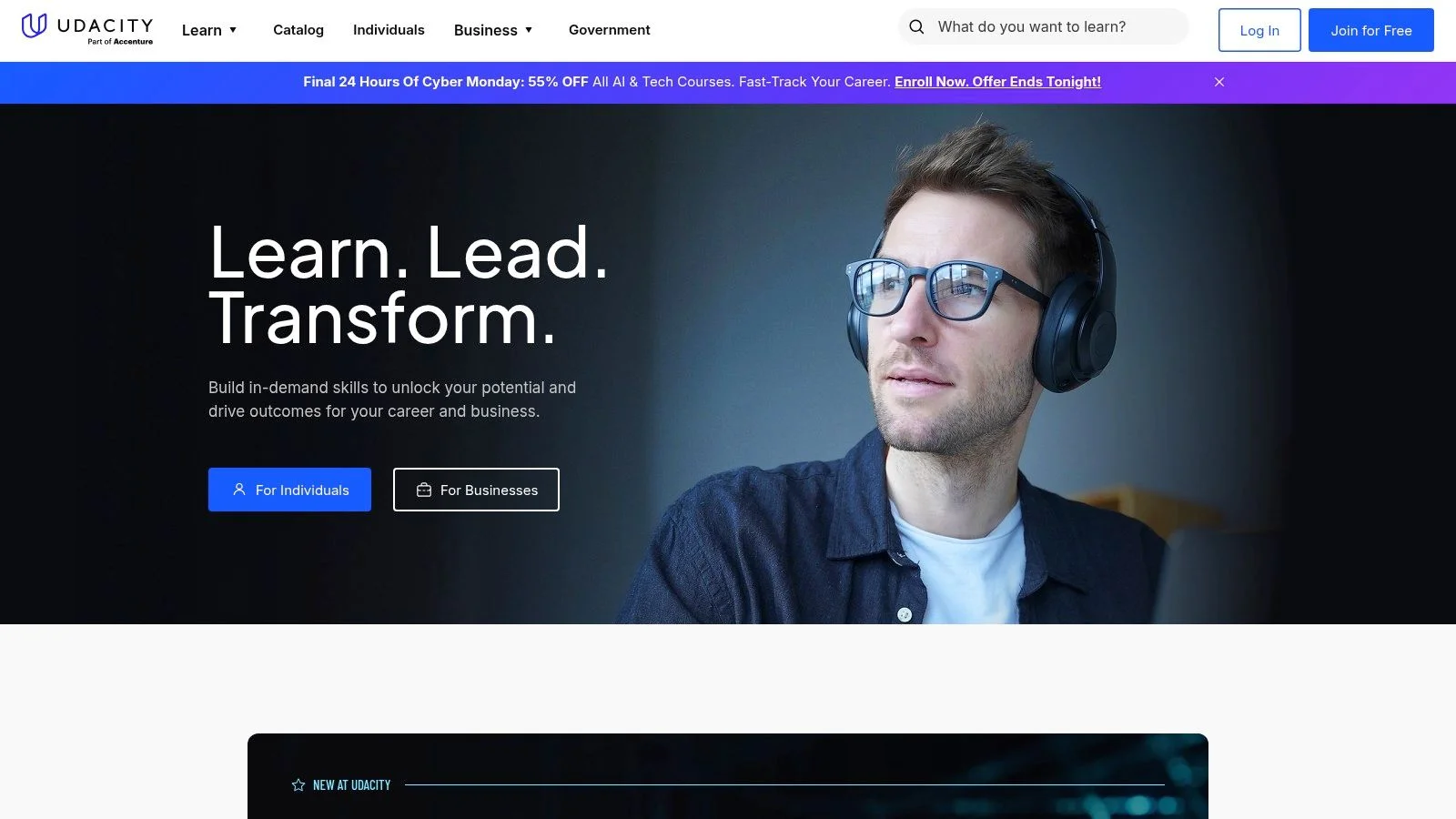
12. Udacity for Business
Udacity for Business carves out a distinct niche among online learning platforms for business by focusing on intensive, project-based learning for high-demand tech roles. It largely shuns the vast, general-purpose library model in favor of highly structured "Nanodegree" programs designed to produce job-ready skills in critical IT areas like AI/ML engineering, data science, cloud development (AWS, Azure, GCP), and autonomous systems. This platform is best suited for organizations committed to deep, measurable upskilling for transformative IT roles, rather than casual, on-demand learning.
Its core strength is the unwavering emphasis on practical application and expert human feedback. IT learners don't just passively watch videos; they actively build real-world projects (e.g., deploying a machine learning model, creating a serverless application) that are rigorously reviewed by human experts. They receive personalized, actionable feedback to ensure true mastery. This hands-on, mentored approach is ideal for companies looking to build genuine technical proficiency within their IT teams, particularly for driving complex digital transformation initiatives where theoretical knowledge alone isn't enough.

Key Features & Use Cases
Udacity’s model provides a structured, cohort-like experience with clear learning outcomes tied directly to IT business objectives. The platform's content is developed in close partnership with industry leaders (e.g., Google, IBM, Amazon), ensuring its relevance and practical value for cutting-edge IT roles and the skills required for advanced certifications.
- Best For: Companies needing to develop deep technical expertise in specific, in-demand IT roles, often leading to specialized certifications or direct job readiness. It is excellent for reskilling employees for critical positions like Cloud Architect, Machine Learning Engineer, Data Scientist, or DevOps Specialist, where hands-on experience is paramount.
- Unique Offerings: The combination of hands-on projects, expert human reviews, and dedicated mentor support creates a robust learning ecosystem that truly drives skill mastery for IT professionals, not just superficial course completion. This direct feedback loop is crucial for solidifying complex technical concepts.
- Implementation Tip: Identify key IT talent for strategic reskilling initiatives and enroll them in targeted Nanodegree programs. For instance, transition experienced system administrators into cloud architects by enrolling them in a "Cloud DevOps Engineer Nanodegree." Use the project-based outcomes to evaluate practical skill acquisition and readiness for new, highly specialized IT roles.
| Feature Analysis | Assessment |
|---|---|
| Content Library | Good. The library is highly focused and deep but not broad. It excels in AI, data, cloud, and product management. |
| Admin & Reporting | Good. Provides analytics focused on skill mastery and project completion, aligning learning to business outcomes. |
| User Experience | Excellent. The guided, project-based learning paths are well-structured and provide clear direction for learners. |
| Pricing Model | Mixed. Pricing is tailored for enterprise clients and requires a sales consultation; there is no public pricing. |
Website: https://www.udacity.com/
12 Business Learning Platforms Compared
| Platform | Core focus & methods | Content & coverage | UX & analytics | Best for | Pricing / procurement |
|---|---|---|---|---|---|
| MindMesh Academy | Memory-first Mastery Path; spaced repetition; adaptive learning; exam-style practice | Exam-aligned guides, flashcards, quizzes, full practice exams; AWS, Azure, CompTIA, ITIL, PMP, ServiceNow | Progress dashboard; weakness analytics; personalized paths | IT pros, students, career-changers seeking durable certification mastery | Not publicly listed — sign up or contact sales |
| Udemy Business | On-demand video courses, labs/workspaces, AI recommendations | 13k+ (Team) / 30k+ (Enterprise); cert prep & multi-language | Admin analytics & learner adoption reports | Small teams and broad skilling needs | Team self-serve; Enterprise via sales |
| Coursera for Business | University- and industry-led courses, Professional Certificates, AI tools | 10,600+ courses; 165+ Professional Certificates; structured Skill Tracks | LMS integrations; structured learning paths; AI Coach | Brand-name credentials and structured upskilling | Team pricing at checkout; Enterprise via sales |
| LinkedIn Learning | Video-centric business & soft-skills library | Extensive video catalog; mobile apps | Familiar UX; team admin, reporting, SSO | Soft-skills adoption and small teams | Transparent team price + 1-month trial; enterprise sales for large orgs |
| Pluralsight (Teams) | Role- and skill-based learning paths, assessments, hands-on labs | Strong tech coverage: AI, cloud, security, software | Advanced analytics and admin reporting | Technical teams needing role-based cert prep | Published business pricing; instant purchase flow |
| edX for Business | University credential programs, cohort & executive education | Content from 260+ partners; Academies (AI, Leadership, etc.) | Stackable credentials; cohort and self-paced options | Academic credibility and talent mobility | Pricing via sales; not publicly listed |
| O’Reilly Learning | Integrated books, videos, live training and interactive labs | Deep technical reference library + live events and labs | Interactive labs; AI recommendations; curated tracks | Tech teams needing references, live events, and labs | Transparent team pricing for small teams; enterprise via sales |
| OpenSesame | Course marketplace and curated bundles | Compliance and business-skills; publisher-varied catalog | Strong LMS/SCORM integrations; curation & dashboard tools | Flexible purchasing and fast LMS deployment | Quote-based; per-course/publisher pricing varies |
| Go1 | Aggregated multi-publisher catalog and curation hub | 80k+ courses from 250+ providers; compliance & leadership | 70+ HR/LMS integrations; curated bundles | One-subscription access to many publishers | Plan tiers; sales-assisted pricing |
| Degreed | LXP focused on skills intelligence and personalization | Unifies internal content and external catalogs (no primary content) | Skills analytics, AI personalization, 800+ integrations | Enterprises centralizing learning and measuring skills | Fully custom pricing; contact sales |
| Skillsoft Percipio | Broad-modality platform with AI assistant and channels | Courses, books, audiobooks, compliance modules, localized content | Enterprise analytics, study groups, mobile/offline | Enterprises needing comprehensive modalities and compliance | Pricing via sales; not publicly listed |
| Udacity for Business | Project-based Nanodegrees with mentor review | Nanodegree programs in AI, data, product; hands-on projects | Project reviews, mentor feedback, measurable outcomes | Intensive, role-aligned technical upskilling | Enterprise pricing via sales; cohort scheduling needed |
Empowering Your Workforce Through Strategic Learning
Navigating the dynamic landscape of online learning platforms for business can indeed feel overwhelming for IT leaders, but the journey to finding the perfect fit is a strategic, non-negotiable investment in your company’s future and your team's competitive edge. As we've explored, the "best" platform is never a one-size-fits-all solution; rather, it is the one that aligns precisely with your organization's unique goals, culture, and critical IT skill gaps. This choice is pivotal, directly shaping your IT team's ability to adapt to new technologies, innovate solutions, and lead in an increasingly complex and competitive digital market.
From the deep, specialized technical training offered by platforms like Pluralsight and O’Reilly Learning – crucial for cloud architecture or cybersecurity mastery – to the broad, diverse content libraries of Coursera for Business and Udemy Business, each tool serves a distinct purpose for IT development. For organizations focused on closing critical IT skill gaps and achieving industry-recognized certifications, a targeted solution like MindMesh Academy provides a direct path to measurable, durable expertise. Conversely, platforms like Go1 or OpenSesame act as powerful content aggregators, offering unparalleled choice but requiring a clear strategy for curation and seamless integration into your IT learning ecosystem.
From Selection to Successful Implementation
Choosing an online learning platform for business is only the first strategic step for IT leaders. True success lies in how effectively you integrate it into your organizational fabric. A seamless implementation requires more than just providing access; it demands a thoughtful, proactive strategy that truly fosters a culture of continuous learning and skill development among your IT professionals.
Here are the critical factors for IT leaders to consider as you move from selection to successful implementation:
- Define Clear Learning Objectives: Before committing, precisely identify what you want your IT team to achieve. Are you upskilling a specific department (e.g., cloud engineers, security analysts), onboarding new tech hires, fostering IT leadership skills, or preparing for a suite of CompTIA or Azure certifications? Your specific goals will dictate which platform’s content and features are most relevant and effective.
- Champion User Adoption: A new learning platform will only deliver ROI for your IT investment if it’s actively used. Develop an internal communication and "marketing" plan to generate excitement among technical staff. Appoint "learning champions" within IT teams and highlight success stories – perhaps a colleague who achieved their PMP or AWS certification – to build momentum and demonstrate tangible benefits.
- Integrate with Existing Workflows: The most effective online learning platforms for business don't exist in a vacuum. For IT teams, look for solutions that integrate seamlessly with your existing HRIS, communication tools like Slack or Microsoft Teams, your internal knowledge bases, and performance management systems. This makes learning a natural, accessible part of the daily IT routine, rather than an isolated activity.
- Measure and Iterate: Track key metrics beyond just course completion rates. For IT, focus on demonstrable skill acquisition (e.g., successful project completion, code quality improvements), application of knowledge in real-world scenarios, and the direct impact on business outcomes (e.g., reduced system downtime, accelerated feature delivery, increased security posture). Use this data to refine your learning pathways and concretely prove the value of your strategic investment in IT talent development.
Final Thoughts: Building a Future-Ready Team
Ultimately, investing in the right online learning platform for business is about strategically empowering your IT professionals. It’s about giving them the cutting-edge tools and opportunities to not only meet the immediate demands of their current roles but also to proactively anticipate and tackle the technological challenges of tomorrow. The right platform transforms IT training from a passive, often compliance-driven requirement into an active, engaging pursuit of growth and innovation. Empowering your IT workforce today also means equipping them with skills in emerging technological areas. For instance, understanding and utilizing AI-powered development tools or DevOps automation platforms can significantly boost productivity, accelerate innovation, and optimize operational efficiency within IT departments.
By carefully evaluating your IT team's specific needs against the diverse options available, you can build a robust, dynamic learning ecosystem. This ecosystem will not only close immediate skill gaps (e.g., achieving critical CompTIA Security+ or AWS Cloud Practitioner certifications) but also cultivate a resilient, adaptable, and highly skilled IT workforce, ready to drive your business forward for years to come in an ever-evolving tech landscape.
Ready to bridge your team's IT skill gaps with targeted, certification-focused training? MindMesh Academy offers specialized learning paths designed to deliver measurable expertise in critical tech domains. Explore how our focused approach can transform your team's capabilities by visiting MindMesh Academy today.

Written by
Alvin Varughese
Founder, MindMesh Academy
Alvin Varughese is the founder of MindMesh Academy and holds 20 professional certifications including Microsoft Agentic AI Business Solutions Architect, AWS Solutions Architect Professional, and Azure DevOps Engineer Expert. He's held senior engineering and architecture roles at Humana (Fortune 50) and GE Appliances. He built MindMesh Academy to share the study methods and first-principles approach that helped him pass each exam.