How to Prepare for PMP Certification Exam A Proven Study Guide
How to Master Your PMP Certification Exam: A Proven Study Guide
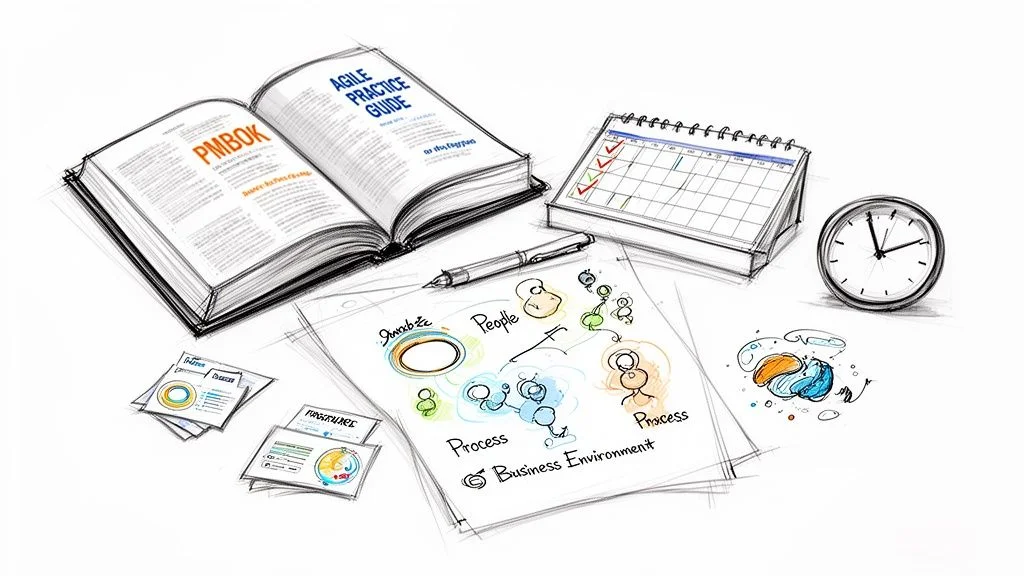
Earning the Project Management Professional (PMP) certification is a major project. For IT professionals, this globally recognized standard validates leadership expertise and improves career prospects. Preparing for the exam requires significant effort, but success follows a clear framework. First, confirm your eligibility. Then, start a dedicated 8-12 week study plan. Success requires committing at least 35 focused hours to master the current exam’s three core domains: People, Process, and Business Environment. By following this structured approach, you will pass with confidence and demonstrate your technical proficiency to your peers and the industry.
Your PMP Certification Exam Blueprint: A Strategic Approach
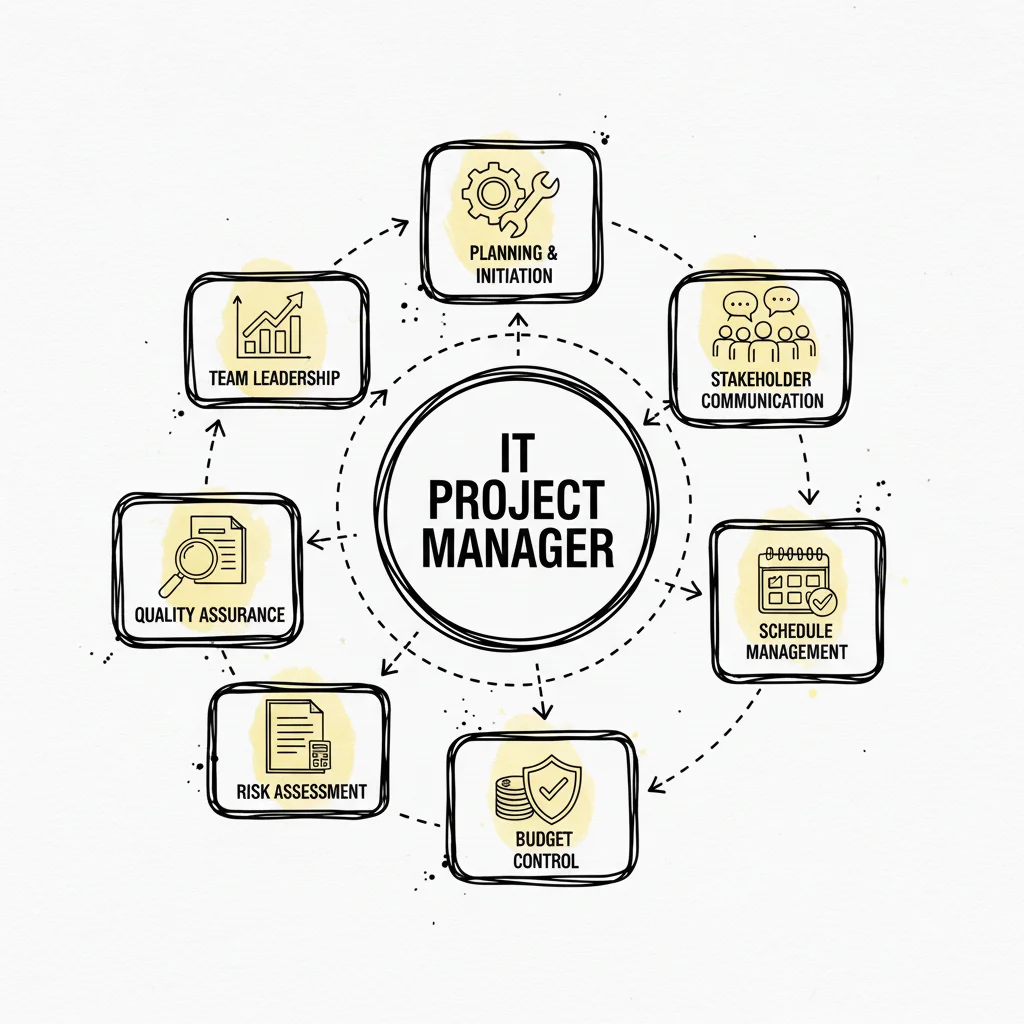
Approach your PMP preparation as you would a high-stakes professional assignment. Before cracking open a study guide, create a personal project charter. You must define your scope by reviewing the exam content, set a timeline with a firm study schedule, and define success as passing the exam with confidence. This preparation prevents aimless study and provides a clear, actionable roadmap from your first day.
Validating your eligibility early is a practical requirement that helps set your schedule. Gaining approval from the Project Management Institute (PMI) provides a morale boost and sets a concrete deadline for your study plan.
Confirming Your Eligibility Path
The PMI identifies two main routes to qualify for the PMP exam based on your academic background. Each path requires specific levels of project management experience and classroom training. Understanding these requirements early ensures the application process moves forward without surprises.
Use the following criteria to identify your specific path and gather the necessary records for your application.
Your PMP Eligibility and Application Checklist
This reference table summarizes the eligibility pathways to help you confirm your status and prepare for the application.
| Requirement Category | Four-Year Degree Holders | High School Diploma/Associate's Degree Holders |
|---|---|---|
| Project Experience | 36 months of leading projects | 60 months of leading projects |
| Formal PM Education | 35 contact hours | 35 contact hours |
| Experience Window | Must be within the last 8 years | Must be within the last 8 years |
Both pathways require 35 contact hours of formal project management education. A high-quality prep course typically meets this requirement. Detailed documentation is key during this phase. PMI frequently audits applications to verify that candidates meet the strict standards for certification. For this reason, you must ensure all your project experience is described accurately and thoroughly.
Pro Tip: Treat your PMP application like your initial project deliverable. Use PMI terminology. Explain how you actively led tasks across initiating, planning, executing, monitoring, controlling, and closing phases. By using the language found in the PMBOK® Guide, you demonstrate your familiarity with the global standard for project management. This tells reviewers you understand the foundational framework.
Reflection Prompt: Before you look at study materials, have you mapped out your personal "PMP Project Charter"? What are your specific milestones and deadlines?
The Modern PMP Exam Structure
Align your preparation with the current exam format, which changed significantly in January 2021. The updated version reflects how project managers actually work, emphasizing agile and hybrid methods alongside traditional predictive models.
The test contains 180 questions to be completed in 230 minutes. You receive two scheduled 10-minute breaks during the session. This format challenges your physical stamina and your ability to recall information under time constraints.
The questions fall into three specific categories:
- People (42%): This domain tests your ability to lead a team effectively. It covers conflict resolution, supporting virtual teams, mentoring, and ensuring team members have the necessary skills to succeed.
- Process (50%): This section measures your technical expertise in managing a project from start to finish. You will be tested on budget management, schedule creation, scope definition, and methodology selection across various project types.
- Business Environment (8%): This area focuses on the organizational context of project work. It includes compliance requirements, delivering organizational value, and supporting change within the company.
Agile and hybrid methods now make up roughly half of the exam questions. Memorizing the PMBOK® Guide is no longer enough to pass. Your preparation must include a clear understanding of agile principles and how they integrate into project delivery.
Setting a Realistic Timeline
An 8-12 week timeline works best for most students. This duration allows for thorough coverage of the materials without the risk of losing focus. Plan to spend about 10-15 hours each week on your materials. This usually involves a mix of weekday reading and longer practice sessions on weekends.
This disciplined approach helps you manage the heavy workload. The PMP exam has a reported failure rate that hovers around 40%. A structured plan protects you from becoming part of that statistic, ensuring you build knowledge systematically rather than relying on last-minute cramming.
To understand the mechanics of passing, you can review our detailed article on the PMP exam passing score. Combining a structured study plan with at least 35 hours of quality preparation is the most reliable way to succeed.
Building Your PMP Study Arsenal
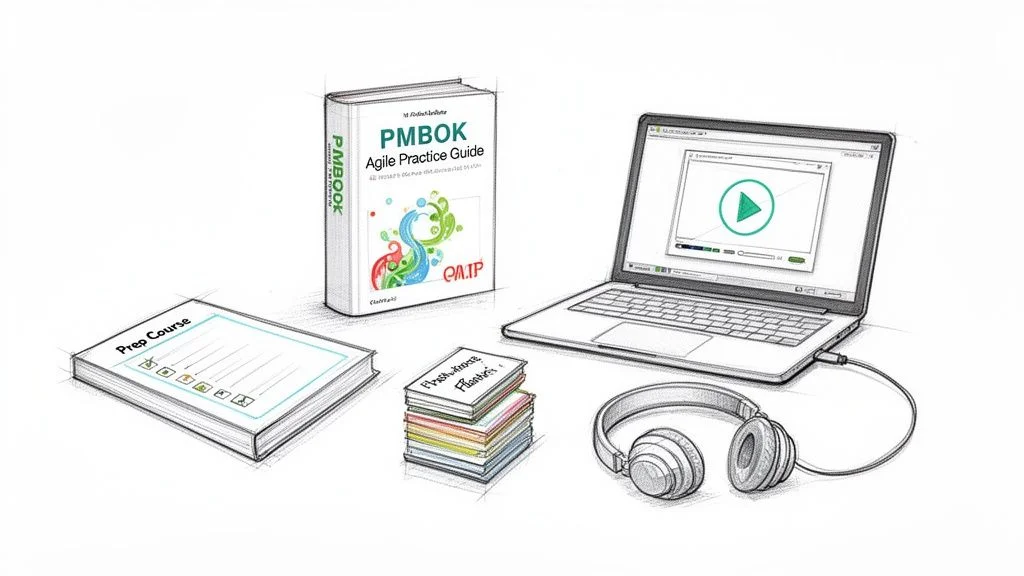
Selecting the right study materials is a critical decision in your preparation. Think of this process as assembling a specialized toolkit where each tool has a specific function. One common mistake candidates make is relying on a single textbook or a solitary video course. This often leads to gaps in knowledge and a fragmented understanding of how different project management principles work together.
You should aim to build a learning system where each resource supports the others. The foundation of this system must be the official materials from the Project Management Institute (PMI). Since PMI creates the exam, their guides serve as the definitive source of truth. Every other book or course you use should build upon the frameworks established in these primary texts.
Start with the Official PMI Texts
Two specific publications are necessary for any serious candidate. These are not merely suggestions; they are the primary documents that define the exam's content and perspective.
- The PMBOK® Guide – Seventh Edition: This guide serves as the authoritative reference for the principles and performance domains of project management. It explains the reasons behind effective management practices. The seventh edition moved away from strict processes to focus on a value delivery system that works across different project styles.
- The Agile Practice Guide: Approximately 50% of the current exam covers agile and hybrid methodologies. This guide is essential for understanding how traditional, predictive methods work alongside agile practices. It reflects the way projects actually operate in modern business environments where flexibility is often required.
Treat these two texts as your core documents. They provide the official PMI mindset. While they do not provide exact exam questions, every scenario you encounter on the test is viewed through the lens of these guides. Understanding the 12 principles and 8 performance domains outlined in the PMBOK Guide is vital for answering situational questions correctly.
Here is a recommendation: the PMP exam tests your ability to apply knowledge to specific situations, not just your ability to memorize definitions. While the PMBOK Guide provides the framework, a high-quality prep course teaches you how to use that framework to solve the difficult problems you will see on the test.
Reflection Prompt: How do you plan to actively engage with the PMBOK® Guide and Agile Practice Guide beyond just reading them? (e.g., note-taking, summarizing, discussing with peers).
Select a High-Quality Online Prep Course
Official PMI guides are necessary, but their formal language can be difficult to parse during long study sessions. A high-quality online prep course acts as a bridge. It translates formal theory into practical lessons that follow the structure of the exam.
Not all courses provide the same level of quality. You must evaluate options carefully to ensure they meet the current standards. An effective course does more than just deliver information; it organizes your study schedule. Platforms such as MindMesh Academy align their video modules and practice exams with the PMP Exam Content Outline (ECO).
The ECO is the blueprint for the test. It breaks down the exam into three domains: People, Process, and Business Environment. The People domain focuses on leading teams and managing conflict. The Process domain covers the technical aspects like budget and schedule. The Business Environment domain looks at how projects support organizational strategy and compliance. A course that maps directly to these areas ensures that every hour you spend studying is relevant to what you will face on exam day.
What to Look for in a Prep Course
Prioritize features that maximize your study time and help you remember what you learn. A good course should feel like a guided training program. Look for the following attributes when choosing your primary study tool:
- Direct ECO Mapping: The course must explicitly link its lessons to the tasks in the Exam Content Outline. This prevents you from spending time on topics that are no longer tested and ensures you cover every required skill in the People, Process, and Business Environment domains.
- Adaptive Learning Paths: A rigid study plan is often inefficient. Look for platforms that change the difficulty or focus of your lessons based on your quiz performance. These systems identify your weak spots and prompt you to review those specific areas, saving you from repeating material you have already mastered.
- Detailed Practice Questions: You need access to a large bank of situational questions that mimic the actual exam. These questions usually ask what a project manager should do next in a specific scenario. The most helpful courses provide explanations for every answer choice. Knowing why a wrong answer is incorrect is often more helpful than just knowing the right one.
- Performance Analytics: Visual dashboards help you track your progress. These tools show your mastery level across different topics. If your analytics show high scores in Process but low scores in People, you know exactly where to focus your attention in the final weeks before your test date.
Your study arsenal should combine official PMI resources with a structured online course. This approach provides the technical foundation you need and the practical application required to pass with confidence. Using multiple tools helps you see the material from different angles, which is the best way to prepare for a situational exam.
Mastering Concepts with Active Study Techniques
Reading the PMBOK® Guide from cover to cover is an inefficient way to prepare for the PMP exam. This test is not a simple memory quiz. Instead, it measures your ability to apply project management principles to situational problems. To pass with confidence, you must move away from passive reading and adopt active study techniques. These methods force your brain to construct connections and integrate knowledge into your professional toolkit.
Consider how a developer learns a new technical framework. Reading the documentation is a start, but true proficiency comes from writing code, failing, and debugging the errors. Active study techniques serve as your "coding practice" for project management. They place the information in long-term memory so it is ready for use when the exam clock is counting down.
Combat the Forgetting Curve with Spaced Repetition
One effective strategy is Spaced Repetition. This method fights the "forgetting curve," which is the brain's natural tendency to discard information that it does not use frequently. Instead of cramming a subject into one long session, you revisit it at increasing intervals. You want to review the material right at the point where you are likely to forget it.
For instance, if you study Earned Value Management (EVM) on a Monday, you might look at a related practice problem on Wednesday. You would then review the topic again on Sunday, and perhaps once more ten days after that. Every time your brain successfully retrieves that information, the neural pathway becomes stronger. This makes the data more accessible. You are not necessarily studying more hours; you are studying with better timing to ensure the information sticks.
Platforms such as MindMesh Academy are built around this logic. These systems monitor your scores on practice exams and digital flashcards. They use algorithms to decide when to show you a concept again. If you struggle with "Validate Scope," the system will show it to you more often. If you master "Project Charters," you will see that topic less frequently. This focuses your energy on your weakest areas.
Simplify Complex Ideas with the Feynman Technique
The Feynman Technique is another powerful tool, named after physicist Richard Feynman. It is based on the idea that if you cannot explain a topic in simple terms, you do not actually understand it. This method highlights the difference between knowing the name of something and knowing the thing itself.
You can apply this to PMP prep through a specific five-step process:
- Select a Concept: Pick a difficult area like "Perform Integrated Change Control" or the "Critical Path Method."
- Explain It Simply: Use a notebook or whiteboard to write down an explanation as if you were teaching it to a new project coordinator who has no experience. Avoid using technical jargon during this step.
- Identify Knowledge Gaps: You will eventually hit a point where your explanation fails or you rely on buzzwords you cannot define. These are your knowledge gaps.
- Revisit and Learn: Return to the PMBOK® Guide, the Agile Practice Guide, or your video lessons. Study those specific gaps until you can explain them clearly.
- Refine and Simplify: Review your explanation and remove any remaining complexity until the logic is undeniable.
This cycle forces you to tear down complex ideas and rebuild them. It ensures you have internalized the logic of the PMBOK® rather than just memorized its terms. To find more ways to improve your study habits, researching effective study methods can provide additional advantages during your preparation.
Visualize Connections with Mind Mapping
Project management is not a list of isolated tasks; it is a web of processes that interact with one another. A change in a project's scope will almost certainly impact its schedule, its budget, and its risk profile. Mind mapping is a visual technique that helps you see and understand these interactions.
To start, place a central theme like "Risk Management" in the middle of a blank page. From that center, draw branches for each of the seven risk processes: Plan Risk Management, Identify Risks, Perform Qualitative Risk Analysis, Perform Quantitative Risk Analysis, Plan Risk Responses, Implement Risk Responses, and Monitor Risks. From those branches, add the specific tools, inputs, and outputs. You should also draw lines to show how these processes connect to other areas. For example, you can show how "Identify Risks" provides necessary data for "Estimate Activity Durations."
A mind map acts as a visual blueprint of your knowledge. When you can see how "Stakeholder Engagement" impacts "Communications Management" and "Risk Management" on a single sheet of paper, you build a mental model that is much more useful than a linear list of definitions.
By using these three active techniques—Spaced Repetition, the Feynman Technique, and Mind Mapping—you move past the surface. You develop the deep comprehension needed to handle the situational questions on the PMP exam. This shift in how you study will help you approach the testing center with the confidence that you truly know the material.
Bringing Your Weekly Study Plan to Life
A PMP study plan is simply a document until you put it into action. Consistency and discipline are the actual drivers that turn your certification goals into a reality. You should treat your weekly schedule as a mechanism to manage your preparation. It allows you to break the extensive exam syllabus into small, focused blocks of effort.
Using a well-paced plan is your best way to avoid the stress of last-minute cramming. Instead of trying to learn everything at once, you will build your knowledge piece by piece across different domains. This methodical approach helps you master the material so you can walk into the test center with confidence.
How to Structure Your Weeks for Maximum Impact
Effective planning requires active engagement with the material. Reading chapter after chapter without a break often leads to exhaustion and poor memory retention. A good weekly schedule balances the time you spend learning new facts with the time you spend applying that knowledge.
Here is a sample structure you can use for an 8- to 12-week timeline. This follows the official PMP exam content outline (verify the current outline and requirements on the PMI website):
- Weeks 1-2: The People Domain. Start your preparation here. Focus your first two weeks on leadership styles, team-building strategies, and conflict resolution. You should also study how to engage with stakeholders effectively. This domain is significant because it covers 42% of the exam questions.
- Weeks 3-5: The Process Domain. This is the largest and most intense part of the syllabus. It makes up 50% of the exam. You will examine core project management processes like risk, schedule, budget, quality, and procurement. Plan to spend a large portion of your study hours on these topics.
- Week 6: The Business Environment Domain. While this section is only 8% of the exam, you should not neglect it. Topics include organizational compliance and how projects support business changes. Understanding these concepts often makes the difference between a passing and a failing score.
- Final Weeks: Integration and Practice. Use the final stretch to bring all your knowledge together. Shift your focus to taking full-length practice exams. Use your scores to find and fix weak spots. This is also the time to practice situational questions to see how the different domains overlap.
Active learning is essential. You must interact with the concepts rather than just reading them.
As shown in the image, techniques like the Feynman Technique, Spaced Repetition, and Mind Mapping create a cycle that strengthens your memory. Teaching a concept to someone else or drawing connections between processes helps you remember information much better than passive reading.
A Sample Week in Action
What does a typical week of PMP study look like? Imagine you are in Week 3, focusing on the Process domain with a specific look at Risk Management.
A practical schedule might include:
- Monday & Tuesday: Knowledge Acquisition. Spend these days with your primary study materials. Watch your PMP course videos on risk and read the relevant chapters in the PMBOK® Guide and the Agile Practice Guide. Take notes on inputs, tools, techniques, and outputs (ITTOs) for each process.
- Wednesday: Focused Application & Assessment. Take a 20-question quiz specifically on risk topics. The most important step is to analyze every answer choice. Look at the ones you got right and the ones you got wrong. This helps you understand the logic PMI uses to determine the best answer.
- Thursday: Conceptual Analysis. Try a more creative way to learn. Draw a detailed mind map that shows how risk management processes connect to other areas like budget or schedule. Then, use the Feynman Technique to explain a topic like Quantitative Risk Analysis out loud. Imagine you are explaining it to a colleague.
- Friday & Saturday: Integrated Practice. Expand your focus. Complete 50 mixed practice questions that cover all the topics you have studied so far. This reinforces what you learned in previous weeks and gets you used to how the real exam mixes different domains.
- Sunday: Review and Strategic Planning. Keep this day light. Look over your notes and review the questions you missed during the week. Use your performance data to decide what you need to focus on during the next week.
To manage your time better, you can explore expert time management strategies to improve your productivity and stay on schedule.
Tracking Progress and Making Smart Adjustments
Your study plan should be a flexible strategy that changes as you learn. It is not a static checklist. You must track your progress to see how well you are actually learning the material. The goal is to reach a state of readiness, not just to finish the books.
Using a data-driven approach is the best way to join the community of over 1.5 million PMP-certified professionals (verify current certification statistics on the PMI website). Experience shows that candidates who score 75% or higher on quality practice exams are usually ready to pass the test. The current exam consists of 180 mixed-format questions. These include multiple-choice, multiple-response, drag-and-drop, and hotspot questions. Your preparation needs to be thorough enough to handle all these formats.
A tool that includes a progress dashboard, such as the one provided by MindMesh Academy, is highly effective. It gives you a clear view of your performance in each domain and task. If your dashboard shows you are doing well in Process but struggling in People, you should change your focus. Spend more time on leadership and team dynamics in the coming week. By using data, you ensure your study time is always spent where it will have the most impact on your score.
For more detail on how to create a personalized plan that helps you succeed, see our guide on PMP exam prep.
Getting Inside the PMP Question Style with Practice Exams
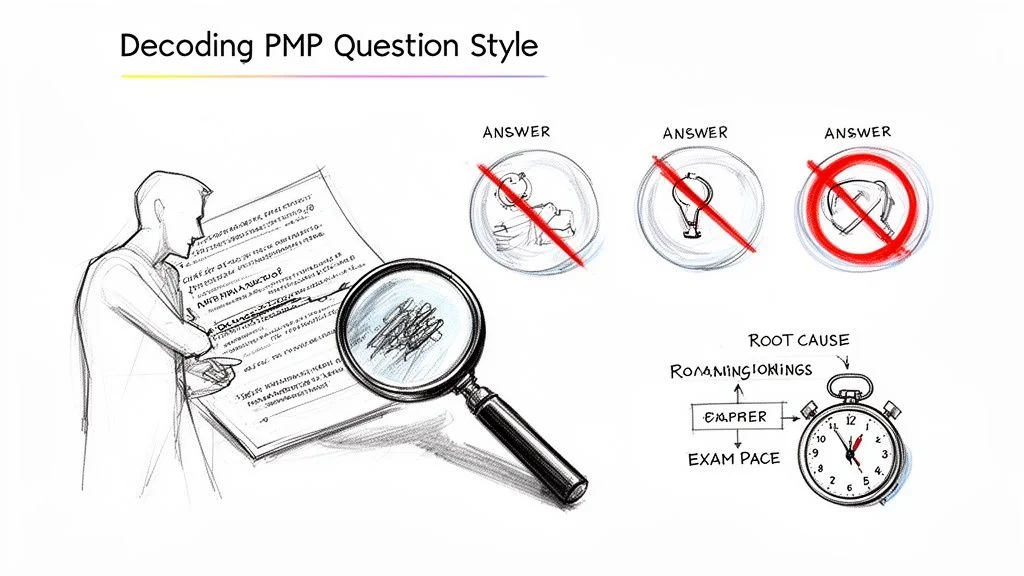
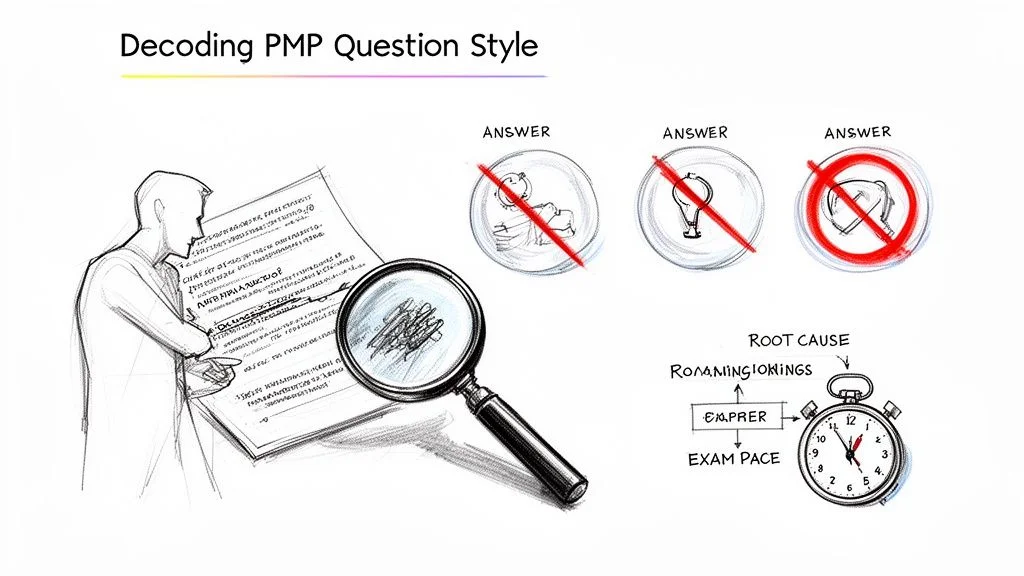
The PMP exam is known for its intricate and often difficult questions. It does not reward those who only memorize terms or definitions. Instead, the test requires you to internalize and apply the official PMI mindset to various project scenarios. This logic-heavy approach makes practice exams more than just a regular study tool. They are your primary training environment.
You must focus on the quality of your practice sessions. Simply clicking through hundreds of random questions will not prepare you for the actual experience. You need high-quality simulators that look and feel like the real testing environment. This means practicing with the same interface you will see at the test center. You should also face the same variety of question formats, including drag-and-drop, hotspot, multiple-choice, and multiple-response. Perhaps most importantly, you must practice under the pressure of the 230-minute timer. Building that specific mental endurance is the only way to stay sharp until the final question.
How to Dissect Those Wordy Situational Questions
The PMP exam is built around long, situational questions. These scenarios place you in the middle of a project conflict and ask you to choose the best next step. It is rarely about finding a perfect solution for an ideal world. Instead, you must find the answer that aligns most closely with PMI principles. This is where many experienced project managers struggle. They often answer based on how their specific company handles things, rather than how the PMI framework dictates a professional should act.
To stop over-thinking and start identifying the core issue, use this three-step process for every situational question:
- Identify the True Question: Look at the very last sentence first. The exam often provides several sentences of background noise or "red herrings" to distract you. Reading the actual question before the scenario helps you filter out the fluff and focus on what the test-writer is actually asking you to solve.
- Filter for Key Information: Once you know the goal, read the scenario to find the facts. Look for constraints, specific stakeholders, and the project's current phase. Is it an agile project or a waterfall one? Identifying these factors allows you to discard the irrelevant details that do not change the outcome.
- Adopt the PMI Mindset: Before reading the multiple-choice options, ask yourself what a project manager would do if they were strictly following the PMBOK® Guide or the Agile Practice Guide. This forces you to think about best practices and proactive problem-solving before you get distracted by the potentially tempting (but incorrect) answer choices provided.
Your Score Is the Least Important Part
The numerical score you see at the end of a practice session is actually the least useful piece of data you will get. True progress happens during the review process, not during the test itself. Answering 180 questions is the endurance training, but the detailed review afterward is where you actually learn the logic required to pass.
Do not just check if you got an answer right and move on to the next one. For every question, you should perform a detailed analysis:
- Why was the chosen option the best choice? You should be able to point to the specific process, ethical rule, or PMI principle that makes this answer the most professional response.
- Why were the other three options wrong? Understanding why the distractors are incorrect is vital. One might be too reactive, another might skip a formal change request, and a third might violate agile values.
- What was my knowledge gap? Determine if you missed the question because you didn't know a term, or if you simply misunderstood the context of the situation.
True PMP readiness isn't about scoring 100% on every practice test. It's when you can confidently analyze any question and articulate precisely why one answer embodies the PMI way, and why the others do not.
This level of analysis turns every mistake into a lesson. Use practice platforms that offer detailed analytics. They should show your performance across the People, Process, and Business Environment domains. This data shows you exactly where your weak points are, so you can spend your time where it matters most.
When you are ready to apply these strategies, use a high-quality PMP practice exam that provides in-depth feedback. This ensures you are learning to think like a professional project manager rather than just memorizing a question bank.
Final Preparations for Exam Day Success
During the final two weeks before your PMP exam, your strategy must change. You are no longer in the phase of gathering new facts or trying to memorize every specific process input and output. Instead, you are refining your existing knowledge and preparing your body and mind for a long, difficult day. This is the time to build the mental stamina required for a high-stakes professional assessment.
Treat this phase like a full-speed practice game. You must move away from short, 10-question quizzes and focus on simulations that mirror the actual test. You should take several 180-question mock exams to get used to the pace. A PMP candidate needs to remain focused for a 230-minute block of time. If you only practice in 15-minute bursts, you will likely struggle with fatigue once you reach the second half of the actual exam.
Replicate the testing environment exactly. If your exam is scheduled for 8:00 AM, take your practice tests at 8:00 AM. Sit at a desk, use a computer, and avoid distractions. Stick to the clock and only take the two allowed 10-minute breaks. This helps your brain stay sharp under pressure. It is the best way to ensure you can think clearly when you face difficult situational questions at the end of the session.
Managing Exam Day Anxiety and Logistics
Exam day nerves are common, but preparation reduces their impact. If you have a plan for the logistics, you can focus entirely on the questions. Much of your confidence comes from knowing the rules and the schedule. You have 230 minutes to complete 180 questions. This gives you roughly 76 seconds per question. This is not much time when you are reading long, complex scenarios involving stakeholders, budget changes, and schedule delays.
Do not let a single hard question ruin your schedule. If you find a question that makes no sense after 30 seconds of reading, mark it for review and select a temporary answer. Some questions will take 30 seconds, while others will take two minutes. Spending five minutes on one point is a bad trade-off. You might miss three easy questions at the end of the exam because you ran out of time.
Breaks are vital for success. The PMI provides two 10-minute windows that do not count against your testing time.
- First Break (after question 60): Take this break every time. Step away from the monitor and stretch your muscles. Use this time to eat a small snack and drink some water. Refreshing your mind here helps you maintain speed through the middle section of the exam.
- Second Break (after question 120): Use this break to prepare for the final 60 questions. Fatigue usually peaks during this last stretch. A short walk around the break room or your home can provide the energy boost needed to finish strong.
Your Essential Exam Day Checklist
Whether you go to a physical test center or use online proctoring, a checklist prevents small details from causing major problems. Minor oversights can disrupt your focus and lead to unnecessary stress.
For a Test Center Exam:
- Confirm Location and Time: Verify the address 24 hours before the exam. Check for any road construction or transit changes that could delay your arrival. Do not rely on your memory of the confirmation email.
- Pack Your IDs: Bring two forms of identification that have not expired. One must be a government-issued photo ID, such as a passport or a driver’s license.
- Dress in Layers: Testing centers are often kept cold to protect the computer hardware. Wear a sweater or light jacket that you can remove if the room gets warm.
- Plan Your Route: Give yourself a large time buffer. Arriving 30 minutes early is better than rushing through traffic and arriving at the center stressed.
For Online Proctored Exams:
- Prepare Your Space: Clear your desk completely. Remove all books, notebooks, electronics, and extra monitors. The proctor will ask to see your entire room through the webcam to ensure no study materials are visible.
- Test Your Equipment: Perform a system check three or four days before your appointment. Check your internet upload speed, your microphone, and your camera. Do not wait until exam day to find out your software is out of date.
- Inform Your Household: Tell everyone in your home that you cannot be interrupted. A person entering the room or a loud conversation in the hallway could lead the proctor to cancel your session. Put a sign on the door as a reminder.
Remember, the effort you invest now is about more than just a test score. It is about entering a field where project management expertise is highly valued but currently in short supply.
The global demand for these skills is growing. PMI projects that the world will need 65 million project professionals by 2035. This represents a 62% increase from current levels. Currently, data suggests that only 47% of projects are led by people with formal project management training. This creates a significant gap in the market. Discover more project management statistics for 2025 to see the growth trends in the industry. Passing this exam puts you in a position to fill that gap.
Your hard work will lead to rewards. With a clear plan and the right tools, you can approach the PMP exam and pass with confidence. MindMesh Academy provides the practice tests and performance data you need to reach your goals. Start your journey to PMP certification with MindMesh Academy today. You can also use our free PMP Project Management Professional Study Guide.

Written by
Alvin Varughese
Founder, MindMesh Academy
Alvin Varughese is the founder of MindMesh Academy and an enterprise architecture leader. An electrical engineer by training, he moved from factory automation in South Africa to cloud architecture at GE Appliances and Humana (Fortune 50), and holds 20 professional certifications including AWS Solutions Architect Professional, Azure DevOps Engineer Expert, and Microsoft Agentic AI Business Solutions Architect. He built MindMesh Academy after interviewing too many highly certified candidates who couldn't answer basic questions: the goal is prep that makes you better at the job, not just able to pass the exam.