Your Realistic PMP Exam Prep and Study Plan
Your Realistic PMP Exam Prep and Study Plan
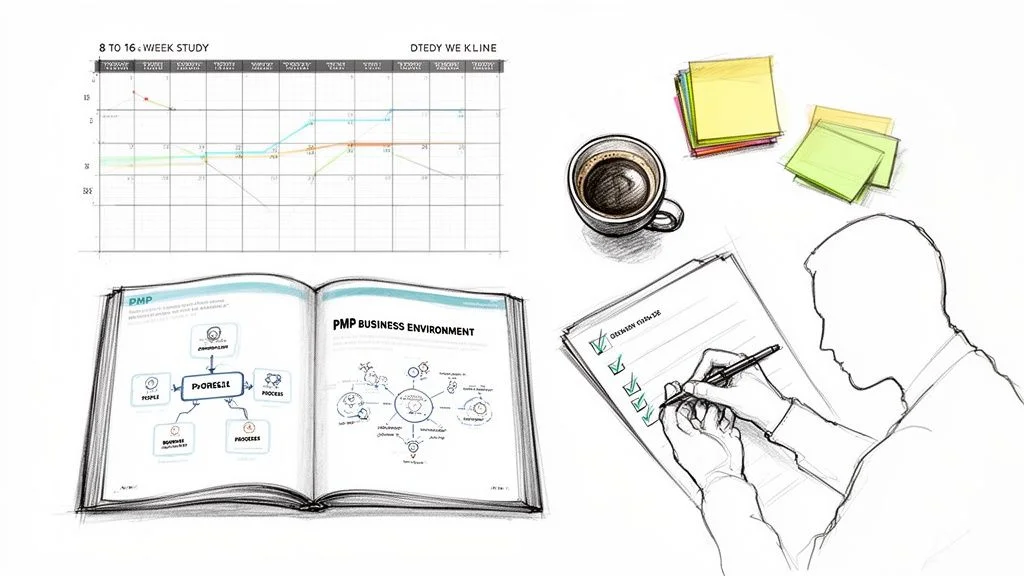
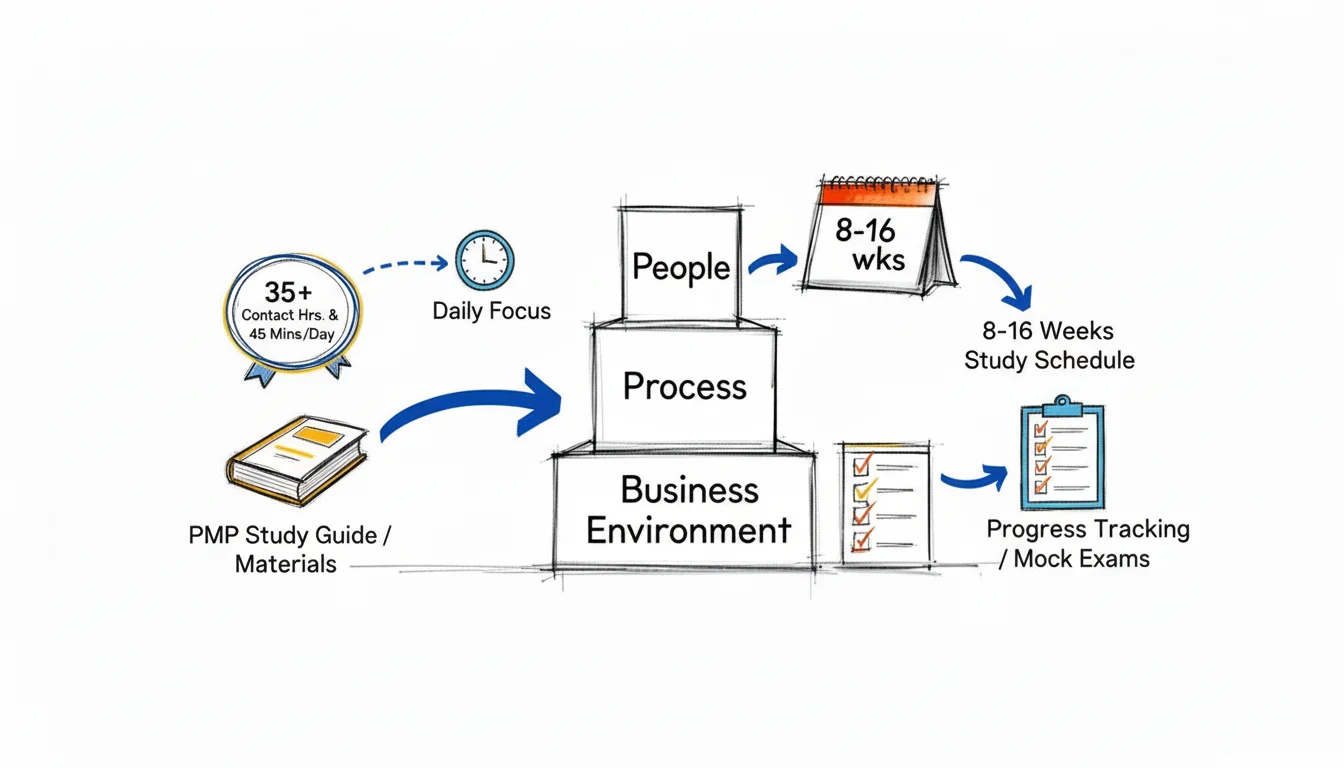
Treat PMP exam prep like a project to ensure you are well-prepared. Successful candidates typically invest between 80-120 hours (verify current estimates on the vendor site) of study. This effort usually spans 8 to 16 weeks. Before opening a textbook or attempting practice questions, create a solid plan. Establishing this groundwork is the most effective way to succeed on your current exam.
Building Your PMP Prep Foundation
Earning your PMP certification is about more than adding a line to your resume. It is a way to prove your technical knowledge and join a professional group that spans the globe. By 2025, over 1.58 million people across 211 countries have earned this credential. This high number shows why the certification remains the top choice for those who want to lead projects at a high level.
Experts predict a 62% increase in the need for project managers in the coming years. This shift could result in a demand for 65 million new professionals by 2035. Getting your PMP is a smart career choice. It puts you at the front of the line for new roles. You will be better prepared to handle big tasks, such as rolling out cloud systems in Azure or managing large teams for software development.
Assess Your Starting Point
Before you begin your PMP study plan, you need to look at your current knowledge. This is a practical step to see what you already know and what you need to learn. This assessment helps you spend your time on the topics that matter most. It is not about passing or failing; it is about making your study time as effective as possible.
Ask yourself these questions:
- What is my real-world project experience? Have you spent your career in Agile environments, or do you prefer the Waterfall method? Many people now work in Hybrid settings that use parts of both. The exam covers all three styles. If you usually work in Waterfall, you will need to spend extra time learning about Sprints, Backlogs, and Scrums. If you are an Agile expert, you may need to review how to manage a rigid project schedule or a formal procurement process.
- How much study time can I actually commit? Be honest about your schedule. It is better to plan for 5-7 hours every week and stick to it. If you try to do 15 hours a week but have a full-time job and a family, you might find it hard to keep going. Consistency is the most important part of this process. If you can only do one hour a day, plan for that and do not deviate.
- What are my most effective learning methods? Do you learn best by watching videos and looking at charts? Do you prefer to read a textbook from start to finish? Some people learn best by doing practice questions and seeing why they got an answer wrong. Choose study tools that fit your style. If you are a visual learner, focus on diagrams of the project lifecycle.
Get to Know the Exam Structure
The PMP exam does not ask you to just repeat facts from a book. It tests if you can use project management ideas in tough situations. The questions show you a problem and ask how a good project manager should solve it. This means you must understand the reasoning behind the rules.
The exam splits into three main areas:
- People (42%): This section covers how you lead a team. You will see questions about solving arguments between coworkers, helping a team feel more confident, and keeping stakeholders happy. It focuses on things like emotional intelligence, mentoring, and good communication. You will need to understand how to lead a team through the stages of development, such as forming, storming, norming, and performing.
- Process (50%): This is the biggest part of the test. It looks at the technical side of the job. You will answer questions about how to start a project, plan the work, manage the budget, and finish the job. This section covers Waterfall, Agile, and Hybrid ways of working. You must be able to identify risks and create plans to deal with them before they become problems.
- Business Environment (8%): This part asks how projects help a company reach its goals. You need to know about following government rules, showing the value of a project, and supporting the company as it changes. You need to think about the bigger picture. This means knowing if a project is still worth the investment or if the business goals have changed.
Key Takeaway: People and Process make up 92% of the exam. You should spend almost all of your study time on these two areas. If you ignore one of them, you will likely struggle to pass.
Lock In Your 35 Contact Hours
You must finish 35 hours of project management training before you can apply for the PMP. This is a strict rule from PMI. It ensures that everyone who takes the test has the same basic knowledge. You cannot simply skip this step, even if you have years of experience.
You can get these hours in a few ways. You can take a class from a PMI-authorized training partner or a university. You can also use a training provider that specializes in the PMP. When you pick a class, make sure it uses the most recent PMP Exam Content Outline. If you use an old class, you might miss new topics. For a full list of how to get these hours, our comprehensive PMP study guide provides more information. Getting these 35 contact hours is the first major step to getting your certification.
PMP Exam Study Timeline Options
You have to decide if you want to study fast or take your time. You can choose an 8-week plan or a 16-week plan. An 8-week plan is fast and requires a lot of focus. A 16-week plan is slower and easier to fit into a busy life. Neither choice is "right" for everyone. Pick the one that works for your daily routine.
| Study Aspect | 8-Week Intensive Plan | 16-Week Standard Plan |
|---|---|---|
| Weekly Study Commitment | 10-15 hours per week. This pace requires a very strict schedule. You will have to study almost every day. You should expect to spend most of your free time on the weekends reading and taking practice tests. There is very little room for breaks. | 5-8 hours per week. This plan is much more flexible. You can fit your study time into short sessions during the week. If you have a busy week at work, you can usually catch up later. It is a better choice for people with a lot of outside responsibilities. |
| Content Coverage | You will need to learn 2-3 major topics every week. This is a very fast way to learn. It works well if you already know a lot about project management or if you can take time off work to focus only on the exam. | You focus on 1 major topic per week. This gives you time to really understand the material. You can read the chapters more than once and take your time with practice questions. This leads to better long-term memory of the facts. |
| Practice Exams | You should start taking full practice tests around Week 5. Because the plan is so short, you have to start testing your stamina early. You will need to learn how to sit for a four-hour exam in a short amount of time. | You can wait until Week 10-12 to start full practice tests. This gives you more time to learn the content first. You can focus on small quizzes for each topic before you try to do the entire 180-question mock exam. |
| Review & Reinforcement | Your review sessions will be short. You might have to review what you learned the day before every morning. This keeps the information fresh, but it can be tiring. You have to stay very disciplined to keep everything in your head. | You use a method called spaced repetition. This means you review topics over several weeks. This helps the information sink in naturally. It is a less stressful way to make sure you remember the material for the actual exam day. |
| Ideal Candidate Profile | This is best for people who have a lot of free time or who need the certification quickly for a new job. It works well for people who are good at memorizing things fast and who do not mind a high-pressure schedule for two months. | This is perfect for people with full-time jobs and families. It is for those who prefer to learn slowly and avoid stress. This plan prioritizes being steady over being fast. It is the best choice if you want to ensure you are ready without burning out. |
Reflection Prompt: Looking at your calendar for the next few months, which timeline feels most sustainable for you, ensuring neither burnout nor insufficient preparation?
Creating a Study Routine That Actually Sticks
Generic study plans often fail because they ignore the daily pressures of a professional life. Passing the PMP requires more than just counting the hours you spend staring at a textbook. Success comes from building a study routine that fits into your existing schedule rather than trying to force a total life overhaul. A tailored approach prevents mental fatigue and helps you remember difficult project management principles over the long term.
Instead of trying to find large blocks of time on a busy calendar, look for your natural learning windows. Are you an early riser who can focus for 45 minutes before the workday begins? Do you have a quiet hour in the evening after your household responsibilities are finished? Even your daily commute is an opportunity to review digital flashcards or listen to an educational recording.
This shift in perspective changes everything. You stop searching for extra time and start using the time you already have. It turns preparation into a sustainable habit rather than a temporary, exhausting sprint.
Weaving PMP Prep into Your Week
Once you identify these available slots, you can build a flexible weekly rhythm. The goal is to balance the intake of new information with the review of older material. While a rigid daily schedule can fall apart after one late meeting, a flexible weekly template is built to last.
Many successful candidates use this structured yet adaptable approach:
- Micro-Learning (Daily): Use small 15-30 minute pockets of time for quick tasks. These short bursts are perfect for digital flashcards, a few practice questions, or a short video explaining a difficult topic. Focus on specific areas like Earned Value Management (EVM) formulas or critical path analysis.
- Focused Learning (2-3 times per week): Set aside a 60-90 minute block to engage with new material from the People or Process domains. This is the time for intensive reading and taking detailed notes. Try to connect these theories to your own work experience, such as how you handle conflict or manage project risks.
- Extended Practice (Weekends): Block out a larger 2-3 hour window on Saturday or Sunday. Spend the first half of this session on a major new topic. Use the second half for a longer practice quiz and a review of all the material you covered during the week.
This multi-level strategy ensures you keep moving forward without forgetting what you learned in previous weeks. Given the volume of the PMP curriculum, constant reinforcement is the only way to build reliable long-term recall.
The Power of Spaced Repetition
Re-reading your notes is one of the least effective ways to study. To master PMP content, you need a system that actively fights the brain's tendency to forget new information. This method is called spaced repetition.
The process is simple: you review information at increasing intervals. You might look at a new concept one day after learning it, then again three days later, and then one week after that. This specific timing signals to your brain that the information is vital. It helps move facts from your short-term memory into your long-term memory.
Spaced repetition works because it requires active recall. You must exert mental effort to pull information from your memory without looking at your notes. This effort builds stronger neural connections, making your knowledge much more permanent than passive reading ever could.
Modern learning platforms, like the ones provided by MindMesh Academy, use algorithms to handle this logic for you. They track your quiz scores and automatically show you the questions you missed more frequently to optimize your review. To see more about these evidence-based techniques, read our guide on the best study methods for exams.
Staying Organized and Consistent
A study plan remains theoretical until you put it into action. This is the time to apply your project management skills to your own certification path. Treat your preparation like a real project with a schedule, milestones, and the right tools.
A simple digital calendar is often enough to block out study time and keep you accountable. If you want a more advanced system to manage your notes and schedule, look into the best personal productivity apps. These tools can help you keep your tasks and deadlines in one place. Tracking your progress visually is a great way to stay motivated when the material gets challenging. Consistency is what separates those who feel ready on exam day from those who feel overwhelmed.
Breaking Down the PMP Domains
Treat your preparation for the PMP like a formal project. You would not start a massive technical implementation without first breaking the work into small, manageable packages. The PMP exam follows this same logic. Its content is organized into three distinct domains. Understanding how these categories interact—and knowing exactly how much each contributes to your score—is your first tactical advantage.

Success does not come from memorizing a glossary. You must develop the ability to recognize what type of problem a situational question is describing. Once you identify the category, you can apply the correct "PMI mindset" to find the right answer. Each domain requires you to look at project management through a different lens.
Mastering the People Domain (42% of the Exam)
Leadership and interpersonal skills are the focus here. The People domain accounts for 42% of the exam. This section tests the soft skills that define an effective manager. It evaluates your ability to lead, support, and mentor a team toward a common goal.
Think about a time when you had to resolve a disagreement. Imagine a security architect and a DevOps engineer arguing over access policies for an AWS environment. The exam uses scenarios like this to see if you can act as a servant-leader. Your goal is to create an environment where people feel safe to do their best work. You should resolve issues through collaboration rather than using your authority to end the argument.
Key areas to study include:
- Conflict Management: You must learn to resolve disagreements using techniques that produce positive results for the project. This involves knowing when to use styles like collaborating, compromising, or smoothing. The goal is to keep the project moving while maintaining team health.
- Team Building and Leadership: This involves building a safe, inclusive environment. In a technical setting, this means supporting experts so they can solve problems without fear of making a mistake. You must know how to mentor team members and grow their skills over the course of the project.
- Stakeholder Engagement: This requires identifying everyone who has an interest in the project. You must analyze their needs and keep them informed. This group includes everyone from the project sponsor and executive leadership to the end-users and outside vendors.
- Emotional Intelligence: You need to use self-awareness and empathy to manage team dynamics. Understanding your own emotions and the feelings of others helps you lead more effectively during high-pressure phases of the project.
Connect these ideas to your own career. When you read about a conflict resolution tool, remember a specific time you could have used it. This method makes the theory easier to recall during the test. It turns abstract concepts into practical knowledge that fits the exam format.
Conquering the Process Domain (50% of the Exam)
This is the technical heart of project management. The Process domain represents 50% of your total PMP exam score. This section tests your knowledge of the mechanics of moving a project from the start to the finish. It covers everything from initial planning and execution to monitoring progress and closing out the work.
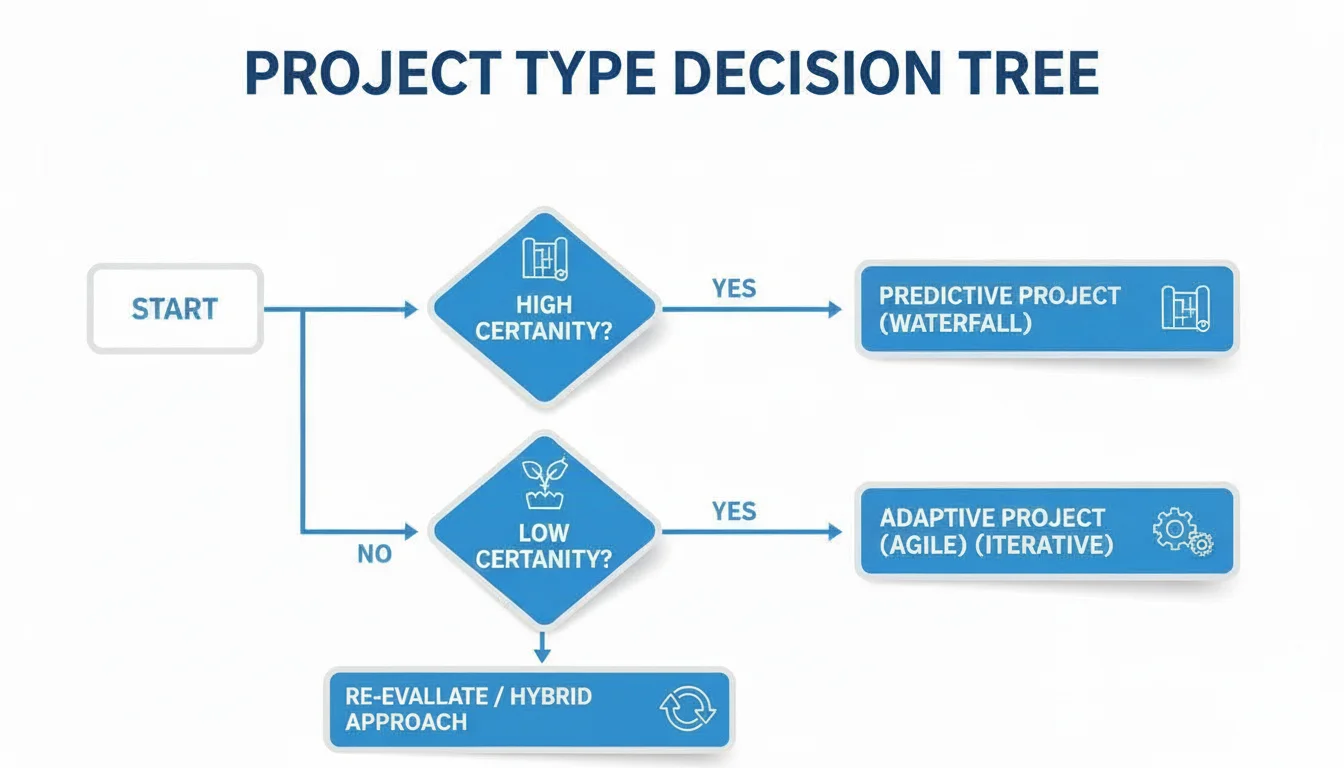
A common mistake is thinking the PMP only covers one way of working. The exam is methodology-agnostic. You must be skilled in predictive (Waterfall) methods as well as adaptive (Agile or Hybrid) methods. You cannot rely only on the way your current office operates. You must show you can use different frameworks depending on what the project needs.
For example, you might see a question about a project with a fixed budget and a set deadline. This is a classic Waterfall scenario. But if a stakeholder starts asking for weekly changes, you must know how to apply a hybrid model. This requires knowing every tool in your toolkit. You must know when to stick to a plan and when to be flexible.
Do not answer questions based on your current job. Your company might have its own internal rules that do not follow PMI standards. The exam wants the PMI mindset. Always choose the answer that follows the PMBOK® Guide and the Agile Practice Guide. Even if your boss does things differently, follow the PMI best practices for the test.
Focus your study on these core areas:
- Project Integration Management: This is the high-level process that coordinates all parts of the project. It ensures that the schedule, budget, and scope all work together. It is the thread that holds the entire project plan together.
- Scope, Schedule, and Cost Management: These are the three parts of the "triple constraint." You need to know how to manage them across different project types. This includes using agile estimation tools like planning poker or t-shirt sizing alongside traditional Gantt charts.
- Risk and Quality Management: You must find risks before they become issues. You also need to make sure the final product meets the standards set by the customer. Study how to use a risk register and how to perform quality audits.
- Procurement and Communications Management: This covers working with outside vendors and managing contracts. It also involves making sure the right information reaches the right people at the right time through a solid communication plan.
Think about a project you recently finished. How would you handle the scope differently if it were purely Agile? What if it were Waterfall? Comparing these two styles will help you understand the Process domain more clearly.
Understanding the Business Environment (8% of the Exam)
The Business Environment domain is only 8% of the exam, but do not ignore it. This section tests your strategic thinking. It asks if you understand how a project fits into the larger organization. Every project must provide value and support the mission of the company.
This domain explains the "why" behind your work. Projects do not happen in a vacuum. They must follow laws and regulations like GDPR or HIPAA. They must also help the company reach its long-term goals. If a project stays on budget but does not help the company, it is not a complete success.
A project can have a great team (People) and follow all the technical rules (Process). But if it fails to deliver the promised benefits, it is a business failure. This is why the Business Environment domain is important. Your PMP study plan must include topics like organizational change and compliance. You need to show that you understand the big picture. Make sure you can identify how a project supports the original business case and the overall strategy of the organization.
When you study these three domains, look for the overlaps. The way you lead people (People) affects how you execute the project (Process), which ultimately determines if the company reaches its goals (Business). Mastering these connections will help you pass with confidence. Keep your focus on these percentages as you plan your study hours. Allocate more time to Process and People, but do not neglect the strategic elements of the Business Environment.
How to Use Practice Exams to Win
Understanding the concepts in the PMP material is only the first step toward certification. I have seen many students who could recite every definition in the PMBOK® Guide but still failed to perform well during the actual test. This happens because the exam measures your strategic judgment and mental focus as much as your ability to remember facts.
This is why full practice exams are your most effective training tool.
A common mistake is jumping into full-length mock tests too early or treating them like casual quizzes. Imagine trying to run a marathon without ever running more than three miles at a time. The 230-minute PMP exam is a grueling test of your mental stamina. While daily practice questions are useful for building knowledge, full-length, timed mock exams act as the long-distance training runs that prepare your mind for the actual event.
Start by answering small sets of questions as soon as you begin your study plan. Doing this helps you adopt the "PMI mindset" immediately. However, you should save the full-length, timed mock exams for the final stage of your preparation. It is best to wait until you have finished 70-80% of the primary study materials. If you take them too soon, you might feel discouraged by low scores that don't accurately reflect your potential, and the data you gather won't be as helpful for identifying specific weak points.
Go Beyond the Score: Analyze Your Results
Earning a 75% on a mock exam is a good sign, but the percentage itself does not tell the whole story. The real value comes from a thorough review of your performance after the clock stops. Your goal is not just to see which questions you missed, but to examine the logic behind every mistake.
After you finish a full-length test, you should spend just as much time—if not more—reviewing your answers as you spent taking the test. This step is where you actually close your knowledge gaps. If you spent four hours testing, plan to spend at least four hours reviewing.
I suggest keeping a simple log to track every incorrect answer. This systematic approach reveals patterns in your thinking that you might not notice otherwise. Use these categories to classify your errors:
- Knowledge Gap: You did not know the specific concept, formula, or process required to answer the question. This usually involves technical details like Earned Value Management (EVM) formulas or specific process flows. The solution is to go back and study those sections in the PMBOK® Guide or the Agile Practice Guide.
- Question Misinterpretation: You understood the material but misread the prompt. Perhaps you missed a qualifier like "except," "least likely," "first," or "best." In other cases, the long, situational story might have distracted you from the actual problem the question was asking you to solve.
- Time Pressure Error: These mistakes happen when you feel the clock ticking and hurry through your choice. You might have known the right answer but clicked the wrong option or failed to read all the choices because you were worried about the time. These errors usually cluster at the end of the exam sections.
- Second-Guessing: This occurs when you choose the right answer initially but then change it. This is usually a sign of low confidence or over-analyzing a simple scenario until it becomes confusing.
Turning Analysis into Action
When you look at your log, the data will show you exactly where to spend your remaining study hours. If most of your errors fall under "Knowledge Gaps," you need more time with your textbooks and videos. If "Question Misinterpretation" is the main issue, you need to practice breaking down complex word problems into their core components. You can find examples of how to dissect these scenarios in our guide on PMP exam questions and answers.
Review the questions you got right, too. If you guessed or felt unsure about a correct answer, treat it as a missed question. Reviewing these reinforces your logic and helps you trust your instincts when you face similar situations on the actual test.
Beat Exam Fatigue and Build Real Confidence
The PMP exam is difficult because of the volume of information and the physical drain of sitting for nearly four hours. You have to treat your mock exams as dress rehearsals to prepare for this pressure.
Current data suggests that PMP pass rates are roughly 60-70% for the current exam. Many people fail on their first attempt because they aren't ready for the situational nature of the questions. The exam doesn't just ask you to define a term; it asks you what a project manager should do when a specific problem occurs.
To build the endurance needed for success, you must simulate the real testing environment during your practice sessions.
- Time Yourself Strictly: Do not pause the timer for any reason. You need to get used to the speed required to finish. On average, you have about 75 seconds per question. Mastering this pace is vital to ensure you don't leave questions unanswered at the end.
- Take Scheduled Breaks: The real exam includes two 10-minute breaks. You should take these during your practice exams as well. Use this time to move around and reset your focus. If you practice your break routine now, it will feel natural on the day of the test.
- Eliminate Distractions: Turn off your phone and put it in a different room. Tell your family or roommates not to disturb you. You want to recreate the quiet, isolated environment of the testing center so that you are not caught off guard by the silence and intensity of the actual exam.
By treating your mock exams with this level of seriousness, you are doing more than checking your knowledge. You are training your brain to stay sharp for the full duration of the test, refining your speed, and building the confidence you need to succeed.
Your Final Two Weeks Before the Exam
The final fourteen days before your PMP exam are the most critical for mental preparation. This period is not about learning new material from scratch. Instead, you are shifting from a student mindset to that of a ready test-taker. Think of this as the taper period before an athletic event. You have already finished the hard training. Now, you must focus on refining your strategy, reviewing core concepts, and building the stamina needed for a four-hour exam.
These last two weeks are for sharpening the tools you already have. Your objectives are specific: improve your information recall, increase your reading speed, and ensure you are mentally fresh. Avoid the temptation to buy new study guides or start different training courses now. Stick to the resources you have used throughout your study plan to avoid confusion.
Create and Master Your Brain Dump
One effective technique many PMP candidates use is the "brain dump" sheet. This is a personal, self-generated reference page. It is a single sheet where you quickly write down all the essential formulas, process flows, and definitions that you need to remember. This usually includes things like Earned Value Management (EVM) formulas, the Critical Path Method rules, and specific Agile ceremonies.
The value of this method lies in the act of creating the sheet from scratch. When you physically write out Cost Performance Index (CPI) formulas or sketch the stages of the Tuckman ladder—forming, storming, norming, performing, and adjourning—you force your brain to retrieve and organize that information. In the final days before your test, make it a daily habit to write this sheet from memory every morning. Work on this until you can reproduce the entire page in under 10 minutes.
This practice serves a functional purpose during the actual test. When you sit down for the exam, you can use the first few minutes to write this "brain dump" onto the provided scratch paper or digital whiteboard. This moves those formulas and data points out of your short-term memory and onto the paper. It frees up your mental energy so you can focus entirely on analyzing the situational questions without worrying about forgetting a specific calculation. Having this safety net often provides a significant boost in confidence.
The Final Week Checklist
Your last seven days should be calm and organized. You want to avoid surprises or last-minute panicking. A clear plan helps lower your stress levels and ensures you enter the testing center feeling in control of the situation.
Follow this daily schedule to stay on track:
- Daily Focused Review (60–90 mins): Every day, pick one specific knowledge area, such as Risk Management or Stakeholder Engagement. Quickly review the key concepts and terms. Immediately follow this with 20–30 practice questions focused only on that topic to keep your skills sharp.
- Formula & Concept Practice (15 mins): Every morning, write out your full brain dump sheet from memory. Use a stopwatch to ensure you stay under the 10-minute goal.
- Final Mock Exam (5–7 days out): Take one last full-length practice exam. Treat this like the real thing by using a quiet room and taking the allowed breaks. Spend the next day performing a detailed analysis of your results. Look at every question you got wrong and figure out if the error was due to a lack of knowledge or a misunderstanding of the question.
- Logistics Confirmation (3 days out): Check your exam appointment details. If you are going to a Pearson VUE testing center, drive the route during the time of your appointment to check for traffic or parking issues. If you are taking an online proctored exam, run the system check on your computer one last time to confirm your internet and webcam are working correctly.
- Light Review & Rest (2 days out): Look through your summarized notes or flashcards. This is not the time for long practice tests or learning new theories. Keep the information fresh, but do not push yourself to exhaustion.
- The Day Before the Exam: STOP STUDYING. This is a strict rule. Your brain needs time to rest and organize all the information you have learned. Do something relaxing. Go for a walk, watch a movie, or spend time with friends. Most importantly, go to bed early and get a full night of sleep.
Your mindset on exam day is just as important as your technical knowledge. The day before the exam is for rest, not for adding more stress. Trust the work you have put in over the last few months. Trying to cram at the last minute will only make you more anxious and tired.
Taming Exam Day Nerves
It is normal to feel nervous on the day of the exam. Almost every candidate experiences some level of anxiety. To manage this, try integrating a few minutes of quiet breathing or visualization into your routine during the final week. These simple actions can help settle your nervous system and help you stay focused during the long testing session.
Spend a few minutes each day visualizing yourself at the testing station. See yourself reading the questions clearly, managing your time well, and finishing the exam. Imagine the "Pass" result appearing on the screen. You have not just read about project management; you have built a solid strategy to pass this test. You have the skills to analyze your weak areas, manage the clock, and handle the mental pressure. Walk into the testing center knowing that you have done the necessary preparation to succeed.
Your PMP Toolkit: Must-Have Resources and Hard-Won Advice
Your PMP study plan relies on your chosen materials. Poor resources stall progress. The market offers many PMP guides, but excessive choices cause confusion. Use a focused toolkit built on official standards and advice from people who have already passed the exam.
The primary foundation for your preparation is the collection of official PMI publications. These books are not suggestions; they represent the source material used to write the actual exam questions. Concepts found in these guides are the test's basis.
- A Guide to the Project Management Body of Knowledge (PMBOK® Guide): This text acts as the main reference for predictive (Waterfall) project management. Do not spend all your energy trying to memorize every input, tool, technique, and output (ITTO). Instead, focus on the logic and flow of the 49 processes (verify current process counts in the PMBOK Guide). You must understand how these processes connect. Conceptual clarity results in more correct answers than simple memorization.
- Agile Practice Guide: This book is just as vital for the exam. Roughly 50% of the test questions (verify current exam content weightings on the PMI site) focus on agile or hybrid methodologies. You cannot pass without a strong grasp of these topics. You need to learn the servant leadership approach, iterative development, and continuous improvement cycles. Internalizing these principles is required to answer scenario-based questions correctly.
Lessons From the Trenches
Official guides provide facts, but successful PMPs provide strategy. One piece of advice comes up constantly: do not try to use every resource you find online. If you use too many different books, you will find varied explanations for the same concept. This often leads to wasted time.
Pick one PMP exam simulator and one prep course, like those from MindMesh Academy. Once you choose your tools, stay with them. Switching providers causes problems because authors use different styles. Consistency helps you build the mental rhythm needed for a long exam.
Experienced project leads must often forget how they manage projects at their current jobs. The PMP exam tests the PMI way, not your specific office habits. You must adopt their established best practices and ethical standards. If your employer skips planning phases to save time, ignore that reality. The exam requires you to choose the answer that aligns with formal PMI planning standards.
Smart Tools and Why It's Worth It
You can use more than just paper books and flashcards. Modern technology provides new ways to study complex topics. For example, using ChatGPT prompts for project management allows you to simulate specific project scenarios. You can ask for a breakdown of the critical chain method or request examples of how to handle a difficult stakeholder. These interactions make abstract concepts feel more concrete.
All this work leads to a significant career advantage. Statistics show that certified project managers earn 23% more (verify current salary data on the PMI site) on average than those without the PMP. In the United States, PMP holders usually get a 16% pay increase. This adds up to a 27% premium over uncertified project managers. When you feel tired, remember these numbers. The effort has a high return. You can discover more insights about PMP salary trends on ravetree.com.
Answering Your PMP Exam Prep Questions
As you get deeper into PMP prep, questions will naturally come up. This is a normal part of the process for every candidate. Let’s look at the most common questions to give you the clarity needed to move forward with confidence.
How Many Hours Does This Really Take?
There is no universal "magic number" for study time. However, data from successful candidates shows that most people spend between 80 and 120 hours on focused study. This timeframe accounts for reading the guides, taking notes, and completing practice questions.
If you spread this across a standard 8-to-12-week timeline, you are looking at a commitment of about 10-15 hours per week. Some people choose to do two hours each weekday and a longer session on Saturdays. The goal is not to cram facts at the last minute. You need to build a steady routine to internalize these project management concepts. Consistency is what makes the difference between simply memorizing terms and actually understanding the logic needed for the test.
Should I Focus More on the PMBOK or the Agile Guide?
Candidates often wonder which resource deserves more attention. The answer is that you should give them equal weight. The current exam requires fluency in both predictive and agile methods.
The test split is roughly 50% predictive (traditional Waterfall) and 50% agile or hybrid. The PMBOK® Guide covers the predictive side, while the Agile Practice Guide details the rest. Neglecting one guide puts your score at risk. You must apply these different mindsets to the specific, often ambiguous scenarios found in the exam questions. The test evaluates how you decide which method fits a specific situation, rather than asking for definitions.
What’s the Smartest Way to Use Practice Exams?
Do not view practice tests as just a way to check your score. They are your most effective diagnostic tool. You should spend as much time reviewing your results as you spent taking the exam itself.
For every single question you answer incorrectly, you must transform into a detective. Why did you miss it? Was it a fundamental knowledge gap regarding the process? Did you misread a detail in the scenario or ignore a keyword? Or did you rush because of the timer and make a simple error? Identifying these reasons is where your learning happens.
By tracking your mistakes, you will see clear patterns. Use those patterns to focus your study time on your specific weak areas. If you keep missing questions about risk management, you know exactly where to spend your next three hours of study. This targeted approach is the fastest way to turn a weakness into a strength so you can walk into the testing center ready to pass with confidence.
Ready to turn these strategies into a passing score? MindMesh Academy provides a structured, results-driven method for PMP exam prep. We offer adaptive tools and progress tracking to support you at every stage of your preparation. Start your path to certification today at PMP Practice Exams.

Written by
Alvin Varughese
Founder, MindMesh Academy
Alvin Varughese is the founder of MindMesh Academy and an enterprise architecture leader. An electrical engineer by training, he moved from factory automation in South Africa to cloud architecture at GE Appliances and Humana (Fortune 50), and holds 20 professional certifications including AWS Solutions Architect Professional, Azure DevOps Engineer Expert, and Microsoft Agentic AI Business Solutions Architect. He built MindMesh Academy after interviewing too many highly certified candidates who couldn't answer basic questions: the goal is prep that makes you better at the job, not just able to pass the exam.