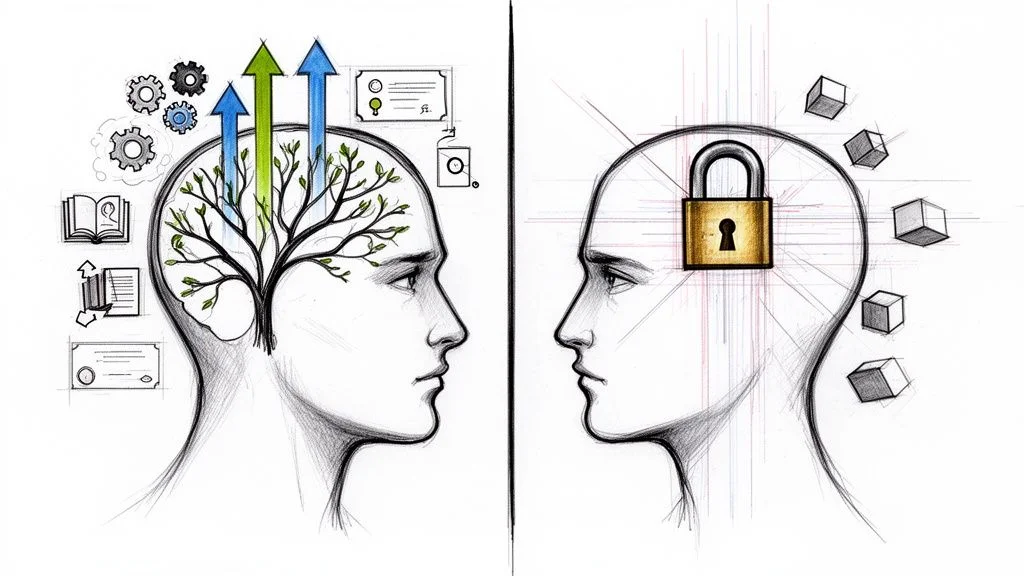
Growth Mindset Vs Fixed Mindset In Professional Development
Embracing a Growth Mindset for Unstoppable Professional Development in IT
Comparing a growth mindset vs fixed mindset reveals the internal beliefs that dictate how you handle learning, setbacks, and long-term career growth. A growth mindset centers on the idea that you can build skills and intelligence through hard work and steady practice. It suggests that your potential is not a finished product. In contrast, a fixed mindset assumes your natural talents and IQ are set in stone from birth. You either have it or you don't. For tech workers tackling difficult certifications or new tools, this difference is more than a psychological theory. It is a practical reality that leads to either consistent career advancement or long-term professional stagnation.
Deconstructing the Growth Mindset vs Fixed Mindset
Your mindset acts as a filter that shapes how you see your own technical skill. It affects how you handle hard projects and whether you believe you can reach your professional goals. This internal belief system influences every major career choice you make. It shows up when you are studying for a difficult AWS or PMP certification. It also guides you when you consider a move into a specialized field like cloud architecture. Understanding the difference between these two mindsets is the first step to improving your study habits and building a career in technology that you can be proud of.
Psychologist Carol Dweck brought these concepts to the mainstream, identifying two primary ways people think about their abilities.
- A fixed mindset is the belief that your intelligence and technical skill are set in stone. People with this outlook often care more about appearing smart than they do about learning. They might stick to legacy systems they know well because they are afraid that failing at a new technology will prove they lack natural talent.
- A growth mindset is the belief that you can improve your skills through focus, effort, and learning from mistakes. This perspective creates a drive for learning and provides the stamina needed to master difficult technical topics. Professionals with this mindset do not see a lack of knowledge as a permanent state. They see it as a starting point for improvement.
"As you begin to understand the fixed and growth mindsets, you will see exactly how one thing leads to another—how a belief that your qualities are carved in stone leads to a host of thoughts and actions, and how a belief that your qualities can be cultivated leads to a host of different thoughts and actions, taking you down an entirely different road." - Carol Dweck, Mindset: The New Psychology of Success
This difference in outlook changes results in the technical world. It explains why two engineers with the same years of experience might react differently to a failed system deployment or a difficult exam. One person sees a wall and stops, thinking they have reached the limit of their ability. This person is more likely to disengage or blame the tools. The other person sees a puzzle that requires more research. They treat the failure as a data point and use the setback as a chance to get better at their craft.
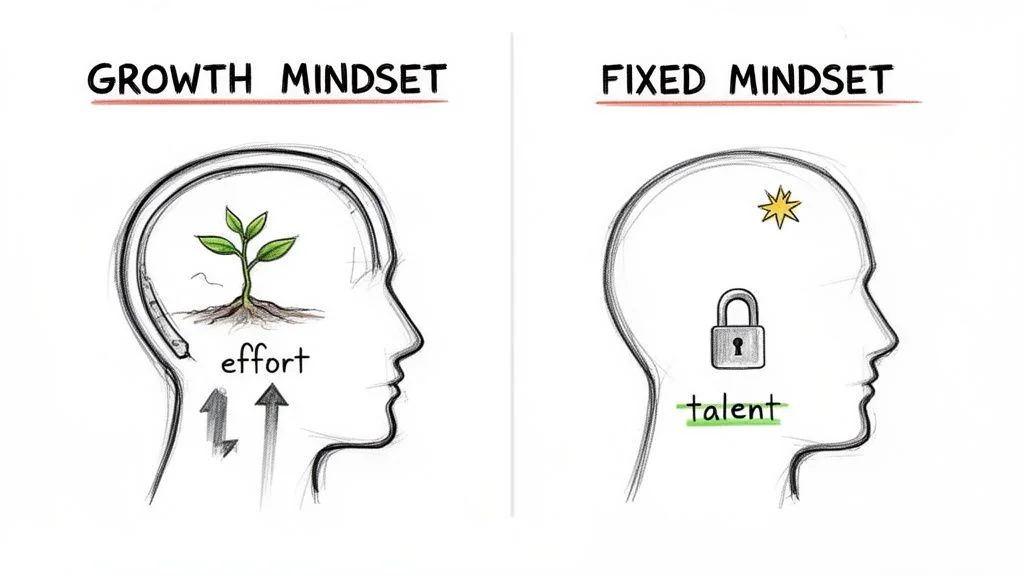 This illustration shows the difference: a growth mindset creates a cycle of improvement and professional development, while a fixed mindset leads to avoiding risks to protect one's ego, which limits long-term potential.
To understand how these mindsets work in your daily life, we can compare them across specific professional categories. This side-by-side view shows how your internal beliefs translate into the actions you take at work.
Core Differences Between Growth and Fixed Mindsets
This table compares the traits of both mindsets. These traits define how IT professionals handle their daily work and long-term career goals.
| Attribute | Growth Mindset Perspective (IT Professional) | Fixed Mindset Perspective (IT Professional) |
|---|---|---|
| Challenges | Sees new software or complex project requirements as the best way to build advanced skills. They welcome hard problems. | Avoids new tools or difficult tasks like cloud migrations to hide a lack of knowledge or to stay safe and appear competent. |
| Effort | Understands that hours spent in a lab, reading documentation, and troubleshooting are the only way to reach technical mastery. | Thinks hard work proves a lack of talent. They assume if you are good at IT, you shouldn't need to study or practice much. |
| Feedback | Asks for critiques in code reviews. They use certification score reports to find out exactly what they need to study next. | Becomes defensive during performance reviews. They ignore useful advice because they feel it is a personal attack on their intelligence. |
| Success of Others | Finds inspiration in the wins of colleagues. They ask successful peers for advice on study habits or career paths. | Feels threatened by the success of others. They worry that a coworker’s promotion or achievement makes them look bad. |
These differences explain why some people stay stuck in the same role for a decade while others constantly advance. Your response to a coding error or a failed certification attempt is a direct result of your mindset.
Reflection Prompt: Consider a recent technical challenge you faced. Did you approach it with curiosity and a desire to learn, or with worry about making mistakes? What does that tell you about your default mindset in that situation?
The Neurological Impact Of Your Mindset On Learning
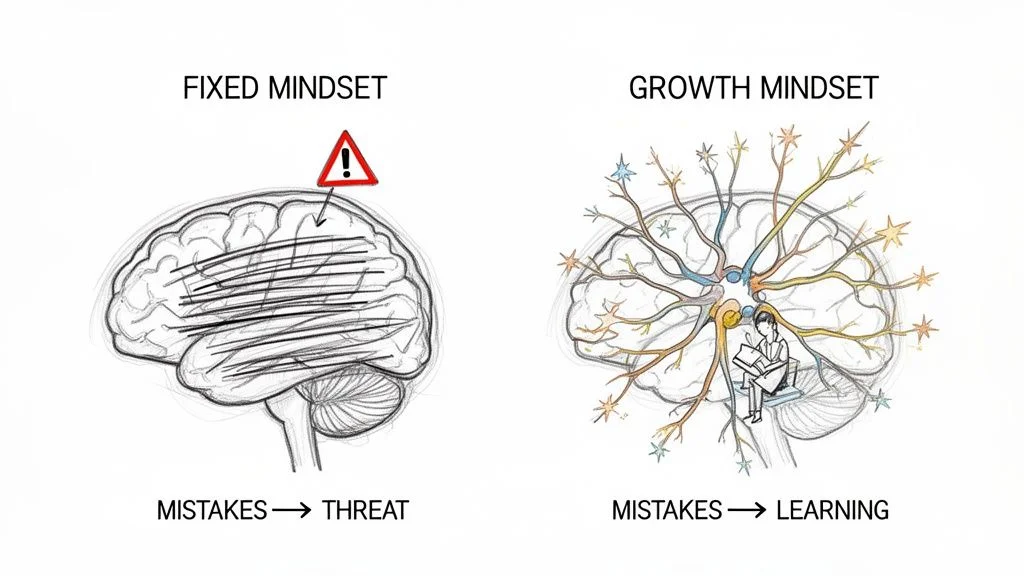 This image visualizes how a fixed mindset interprets mistakes as threats, leading to disengagement, while a growth mindset sees them as vital learning opportunities, activating more extensive brain processing.
The difference between a growth and fixed mindset is more than a psychological theory; it is a physical reality observable in brain activity. Real, measurable neurological responses change based on whether you believe your intelligence can be developed or is a static trait. These biological shifts have a significant impact on how well you pick up new skills, especially when you are studying for a difficult certification like the ITIL 4 Foundation or the Microsoft Azure Solutions Architect Expert (AZ-305). In these high-stakes environments, every wrong answer can feel like a setback, but your brain’s reaction determines if that setback becomes a step forward.
Imagine you are hitting a wall while preparing for a difficult cybersecurity certification. You are working through practice questions on complex encryption protocols and you get one wrong. What happens in your brain at that moment depends on your mindset. It separates people who find the lesson in an error from those who feel defeated by it.
Neuroscience researchers using brain imaging have seen these reactions in real time. People with a growth mindset show a massive surge of neural activity immediately after making a mistake. Their brains go into an active state of analysis. They aren't just noticing the error; they are trying to figure out why it happened. This specific type of brain activity is what allows for effective problem-solving and the creation of long-term memories. Scientists observe that when a growth-oriented student makes a mistake, the brain produces a signal associated with conscious attention to errors and a desire to correct them.
Your Brain On A Fixed Mindset
When you operate with a fixed mindset, making a mistake—such as failing a module in a cloud computing course or incorrectly setting up a server in a virtual lab—feels like a threat to your competence. Your brain does not respond with a "how do I fix this?" attitude. Instead, it enters a state of retreat. There is a very short burst of activity when the brain registers the mistake, but it is immediately followed by a total drop in engagement. You might find yourself closing your browser tabs or feeling a sudden urge to stop studying. This is your brain trying to protect your ego from the pain of being "wrong."
- Low Engagement: The brain uses the absolute minimum amount of energy to look at the mistake. It does not try to find the root cause because it views the error as a sign of failure rather than a piece of information.
- Threat Response: You interpret the error as a final judgment on your natural ability. This often triggers stress, anxiety, or feelings of imposter syndrome, making it harder to focus on the next task.
- Reduced Learning: Because your brain does not stay active to process the "why" behind the mistake, you miss the chance to learn. The information does not stick, and you are likely to make the same error when you take the actual exam.
This neurological shutdown is a huge obstacle for IT professionals who need to learn new technologies quickly. Every failed script or incorrect configuration doesn't turn into a lesson. Instead, it reinforces an internal story that you aren't smart enough for the job. Your focus shifts from improving your skills to judging your own character.
Your Brain On A Growth Mindset
A growth mindset does the opposite. It primes your brain for active learning, particularly when you face challenges. When an IT student with this outlook gets a question wrong or sees a system fail, their brain becomes highly active. They pay more attention to the feedback and process the technical details more deeply.
This spike in neural activity means the brain is treating the mistake as a useful chance to learn. It tries to reconcile the wrong information with the correct facts. This process builds stronger connections between your neurons, which makes it much easier to remember the material later.
This gives you a clear biological advantage in your career. Your brain becomes a tool that helps you during long study sessions and difficult troubleshooting tasks. When you try to understand a complex technical concept, you aren't just using willpower. You are preparing your brain to categorize and keep new information. This is necessary for remembering difficult syntax, complex architectural diagrams, or security protocols. For more tips on making information stick, read our guide on how to retain information when studying.
The scientific evidence is clear. Adopting a growth mindset is a practical strategy to make your studying more resilient and your troubleshooting more effective. It changes the inevitable mistakes you will face in your IT career into the foundation of your future success.
How A Growth Mindset Translates To Business Performance in IT
It is easy to categorize the growth mindset vs fixed mindset debate as a matter of personal self-improvement. However, the real impact occurs when these principles move beyond individual habits and define an entire organization. When a company culture truly supports a growth mindset, innovation and resilience become standard operating procedures. They stop being simple slogans on a corporate slide deck and start driving technical results.
Think about an IT department that practices this philosophy every day. In this environment, employees treat complex system integrations or unexpected server bugs as logic puzzles rather than impossible obstacles. If a software deployment fails to meet its initial performance metrics, the team does not view it as a total loss. Instead, they treat the failure as a source of raw data for the next version. A difficult client request is not a burden; it is a chance for creative problem-solving that might lead to a new service offering. This shift in perspective often separates the market leaders from the companies that are falling behind.
This outlook is also vital for business development in tech, particularly in consulting and managed services. Success here depends on continuous learning and the ability to change tactics quickly. Most IT business owners will tell you that the ability to test, learn, and improve service models is essential for survival. This is a principle frequently highlighted in guides covering strategies for growing a tutoring business or scaling a specialized IT firm. This constant cycle of improvement is what generates long-term growth.
Driving Innovation And Agility in IT Organizations
In a technical workplace where a growth mindset is standard, team members feel safe taking calculated risks. They know that a failed proof-of-concept or a minor deployment error is not a reason for termination. Instead, these moments are viewed as necessary steps toward a major breakthrough. This sense of security allows a team to develop new software features, improve IT services, and fix internal workflows without the fear of making a mistake.
For IT managers and directors, supporting this mindset leads to clear results. When you push for training or fund certification programs like the Microsoft Certified: Azure Administrator Associate or the AWS Certified Solutions Architect, you are doing more than helping an employee with their resume. You are making a strategic investment. You are building the capacity of your entire team to troubleshoot and solve technical issues as they change.
- PMP Certification: An IT project manager with a growth mindset does not view this as just another credential. They see it as a way to gain a versatile set of tools for managing agile sprints and learning from project debriefs. This leads to projects that deliver more value to the client.
- ITIL Certification: This moves from being a strict list of rules to a flexible system for improving how IT services are delivered. It gives teams the confidence to find and fix operational bottlenecks rather than repeating the same old processes.
By building a growth mindset, IT organizations create teams that look for solutions and stay strong during rapid technical shifts. These teams do not just react to new technology; they expect it and look for ways to use it to move the business forward.
This proactive approach helps the bottom line. It turns market changes into an advantage for the company. You can see how this works by looking at how specific certifications can power your career and company growth.
The Tangible Impact On Profitability And Engagement
The financial gains from a growth-oriented IT culture are real and measurable. Data shows a strong link between how an organization thinks and how much money it makes. When IT professionals believe that hard work and learning lead to better results, they stay more focused. They get more done, and they are less likely to quit for a job at a competitor.
A recent study on office dynamics provided some proof. A total of 80% of companies said that supporting a growth mindset helped increase their profits. This shows how much a mental approach can change business outcomes. Additionally, 64% of those companies saw higher productivity, and 58% reported better employee engagement. You can read the full report for more data on growth mindset in the workplace.
When you look at these numbers, the benefits for IT firms are clear:
- Higher Employee Retention: Tech professionals want to work in places that value their development. When they are encouraged to learn new skills, they stay longer. This saves the company money on recruiting and training new staff, which is expensive in the current market.
- Increased Innovation: When IT workers are engaged, they care more about the success of the project. They are the ones who find ways to save money on cloud hosting or build more secure applications. They don't just follow instructions; they look for better ways to work.
- Enhanced Customer Satisfaction: A team that focuses on learning and solving problems will always provide better service. This leads to happy customers and recurring revenue, which are the main drivers of business expansion.
Building a growth mindset in an IT company is not just a human resources project. It is a core business strategy. It changes how the company handles technical problems, how it manages its staff, and how it stays successful in a market that never stops changing.
The Career Risks Of A Fixed Mindset In Tech
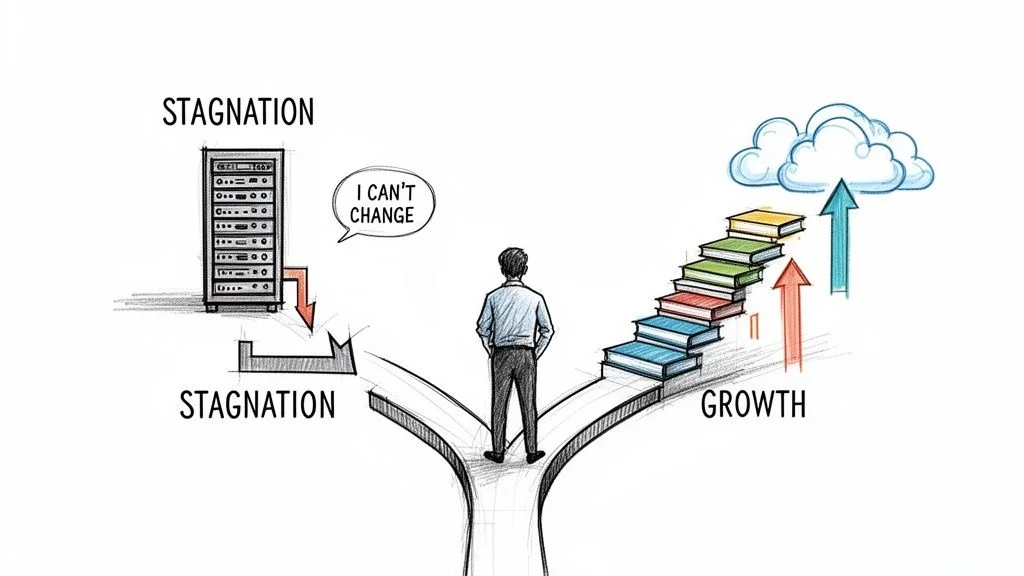 This illustration powerfully depicts the stark choice facing IT professionals: embrace new technologies and continuous learning for growth, or cling to outdated skills and risk professional stagnation.
We often highlight how a growth mindset helps build a thriving career. However, it is just as vital to understand how a fixed mindset can dismantle one. This is especially true in the technology sector where change is the only constant. In the technical world, a fixed mindset is not a minor personality trait. It is a critical vulnerability. This outlook leads to outdated skills, a stalled career trajectory, and eventual professional irrelevance.
Technology does not stand still. New frameworks, cloud platforms, programming languages, and security paradigms emerge every few months. If you cling strictly to what you already know and resist learning new skills, you are not staying in a comfortable zone. You are constructing a cage. This cage traps you while the rest of the industry moves forward at high speed.
Resistance to change is not always about stubbornness. Often, it is a defensive reaction. It stems from a deep fear of appearing incompetent or slow. When a professional identity is built carefully around being "the expert" in one specific, aging technology, the idea of becoming a beginner again feels like a direct personal threat. You might worry that your status will vanish if you cannot master a new tool instantly. This fear keeps many talented people stuck in roles that are slowly disappearing.
Resistance To New Technologies
This scenario plays out repeatedly across IT departments. Consider a seasoned systems administrator who has spent fifteen years mastering on-premises server management and physical virtualization. They know the hardware racks, the cabling, and the legacy hypervisors better than anyone else in the building. Suddenly, the organization announces a strategic shift to modern cloud platforms like Microsoft Azure or AWS.
Instead of expressing curiosity, the administrator reacts with overt resistance. They might publicly dismiss the cloud as a passing fad. They might highlight minor security risks or latency issues to sow doubt among the leadership team. This resistance is rarely about the technical merits of the cloud. It is the fixed mindset speaking. It is a protective mechanism for someone who does not want to feel like a novice again. Their internal monologue often sounds like this:
- Fixed Mindset: "I am the essential go-to person for our legacy data center systems. I have spent a decade becoming the top expert here. If I have to learn Azure or AWS from scratch, I will be a beginner again. My peers will see that I do not know everything, and I will lose my standing as a leader."
- The Critical Risk: This professional does more than just miss a chance to gain cloud skills. They become a literal roadblock to the team. As the company migrates its infrastructure, the specialized legacy knowledge becomes less valuable every day. Eventually, this person is relegated to maintaining old systems that no one else wants to touch. Their career hits a dead end while their colleagues move into high-paying cloud architecture roles.
This is a clear example of self-inflicted obsolescence. It comes from valuing the appearance of expertise over the necessity of continuous adaptation. A colleague with a growth mindset would see the same migration as a golden opportunity. They would accept that they will be "bad" at cloud management for a few months to become "great" at it for the next decade. They trade temporary discomfort for long-term career security.
A fixed mindset transforms learning into a high-stakes performance. In this view, any mistake is a definitive verdict on your intelligence and competence. This makes professionals in technical fields exceptionally vulnerable to being left behind. If you believe your talent is a capped resource, you will avoid any challenge that might reveal your limits.
Undermining Team Collaboration
A fixed mindset does not just hurt the individual; it can poison the collaborative environment for an entire IT team. When you believe that abilities are fixed, you start to view constructive feedback as a personal attack. Imagine a lead network engineer who presents a new architectural plan for a branch office. During the review, the team offers suggestions for improvement or alternative routing protocols.
Someone with a fixed mindset might interpret this feedback as a statement that they are bad at their job. The defensive walls go up immediately. They might shut down the discussion, become sarcastic, or harbor resentment against the person who offered the suggestion. This reaction makes open and honest technical communication impossible. When people are afraid to suggest better ways of doing things, the entire department suffers from suboptimal designs.
This behavior often leads to a culture of blame. When a complex project fails or a deployment causes an outage, a person with a fixed mindset looks for a scapegoat. They need to protect their reputation as someone who is "naturally gifted." Admitting a mistake would mean admitting they lack that innate talent. In contrast, a growth-oriented team asks what lessons they can learn from the failure. They focus on the process rather than the person.
The impact of this mindset is measurable. A study of over 500 employees at Fortune 1000 companies showed that organizations with a fixed-mindset culture had much lower levels of trust. In these companies, employees reported 20-30% less commitment and trust in their colleagues. They felt that the company only cared about "innate talent" rather than effort or collective improvement. This environment creates a "star system" where only a few people are valued, and everyone else feels disposable. You can examine the full study to see more on how mindset shapes corporate culture.
Stagnation And The Certification Journey
The most significant danger of a fixed mindset in technology is total stagnation. Your learning pace slows to a crawl while the rest of the world accelerates. Your skills become a snapshot of the year 2015. You become the person who is "very good with the legacy system," which is a dangerous place to be when that system is finally retired.
Pursuing a certification is a direct way to fight this stagnation. It is a declaration of a growth mindset. When you commit to a difficult path like the CompTIA Security+ or the ServiceNow Certified System Administrator, you are choosing to step out of your comfort zone. You are admitting that there are things you do not know yet.
Every practice test you fail is not a judgment on your brain. It is a diagnostic tool. It shows you exactly which areas of networking or security you need to study more. If you struggle with a topic like subnetting or cloud governance, it is not a sign of weakness. It is a signal that you are building new neural pathways. You are creating durable, in-demand expertise that will keep you employed for years to come.
Approaching your certification preparation with a growth-oriented attitude is the best way to future-proof your IT career. It protects you from the threat of becoming obsolete. When you stop worrying about looking smart and start focusing on getting better, you remove the ceiling on your professional potential. In a field that changes as fast as IT, your ability to learn is more valuable than any single piece of knowledge you currently possess. The choice is simple: grow with the industry or let a fixed mindset keep you anchored to the past.
Practical Ways to Cultivate a Growth Mindset for IT Success
Understanding the theory behind growth vs. fixed mindsets is useful, but putting these ideas into practice within your professional life is what generates results. It requires consistent, deliberate effort and the building of new mental habits. If you are preparing for a high-stakes IT certification or pushing for a promotion, these strategies are not just optional extras. They are the tools you need for effective learning, staying resilient when code fails, and achieving long-term career growth.
The goal is to move these psychological concepts from abstract ideas into concrete actions you can use during study sessions and technical tasks. This means changing how you think and how you act when you hit a technical wall or experience a professional setback. Instead of seeing a difficult problem as a sign of limited ability, you begin to see it as a puzzle that requires a different strategy or more time.
Change the Conversation in Your Head
Your first task is to learn how to catch fixed-mindset thoughts as they happen. That internal critic can drain your motivation and make it hard to recover when things go wrong. You must learn to "flip the script" and replace that negative internal dialogue with a perspective that focuses on growth and improvement.
For example, imagine you just failed a practice exam for an AWS Solutions Architect certification. A fixed mindset tells you the failure is a final judgment. A growth mindset sees that same failure as a specific map of what to do next.
- Fixed Mindset Internal Monologue: "I completely failed this practice test. I am clearly not meant to be a cloud architect. This material is just too hard for me to understand, and I’m wasting my time."
- Growth Mindset Reframe: "That test did not go well, but it gave me exactly what I need. Now I have a prioritized list of AWS services and security protocols that I need to study more closely. This score is a status report, not a permanent grade."
This shift changes your emotional reaction. Failure stops being a personal attack and becomes a source of clear, actionable data. You move from feeling defeated to feeling focused on a specific to-do list.
The most effective word you can add to your professional vocabulary is "yet." Think about how it changes a sentence. "I don't understand how to configure these Kubernetes clusters" sounds like a dead end. "I don't understand how to configure these Kubernetes clusters yet" sounds like a challenge you are currently meeting. It turns a perceived limitation into a promise of future mastery.
When you use this word, moments of frustration or hours spent debugging a complex script are no longer signs that you should quit. They are the starting points for a higher level of technical skill. To learn more about these methods, explore these additional strategies to develop a growth mindset.
Go Looking for Constructive Feedback
People with a fixed mindset often avoid criticism because they think it highlights their lack of natural talent. To succeed in IT, you must do the opposite and actively look for feedback. When you study for a certification or build a new project, don't just look to see if your answer was right or wrong. The real growth happens when you examine the logic behind the mistakes.
In a field like network engineering or software development, understanding the "why" behind a configuration error is more important than memorizing the correct command. Try using these specific approaches to get the feedback you need:
- Form Study Groups: Find peers who are also studying for certifications like the PMP, Azure Administrator, or CompTIA A+ (220-1201/220-1202). Talk through difficult concepts and work on practice problems together. When someone else has a different solution, don't just ignore it. Listen to their reasoning to see if their method is more efficient than yours.
- Use Your Tools Strategically: Learning platforms like MindMesh Academy provide progress trackers and data analytics. Do not treat that dashboard as a judgment on your intelligence. Instead, treat it as a GPS for your learning. If the data shows you are slow at answering questions about subnetting or IAM policies, use that information to change where you spend your study time.
- Request Specific Feedback: Avoid asking general questions like, "How am I doing?" That usually results in a general, unhelpful answer. Instead, ask a senior engineer or a mentor, "Can you look at how I handled this network security configuration? I want to know if there is a more efficient way to manage these firewall rules or if I have a gap in my understanding of the protocol."
By asking for and using this feedback, you speed up your learning. You stop guessing and start fixing the specific gaps in your technical knowledge. This proactive approach is the heart of continuous learning, a skill that is required in any technology role. We examine the steps for building this vital habit in our article on what is continuous learning.
Focus on the Process, Not Just the Prize
It is common to focus only on the final "pass" or "fail" result when you are preparing for a difficult IT exam. While passing is the goal, a growth mindset helps you find value in the daily work of studying. If you only care about the certificate, you may feel anxious and overwhelmed. If you focus on the process of learning, you build steady momentum that leads to that certificate anyway.
Shift your goals from things you cannot fully control (like a specific test score) to things you can control (like your study habits). This makes the journey feel more manageable and less like a high-stakes gamble.
| Process-Oriented Goal (Growth Mindset) | Outcome-Oriented Goal (Fixed Mindset) |
|---|---|
| "I will spend 60 minutes every day this week practicing Python script automation." | "I need to be an expert in Python by Friday so I don't look stupid in the meeting." |
| "I will complete 10 practice questions on cloud security and write down the logic for every answer I got wrong." | "I need to get a 90% on my next practice test to prove that I am smart enough for this job." |
| "I will explain how load balancing works to a teammate to see if I truly understand the concept." | "I need to memorize every single page of this study guide immediately." |
| "I will spend two hours on Saturday troubleshooting my home lab environment until the DHCP server works." | "I need my lab to work perfectly on the first try or I’ll never pass the exam." |
When you focus on consistent work and smart strategies, you build the habits that lead to expertise. It is important to acknowledge your progress as you go. If you finally understand a difficult topic—like regular expressions or complex AWS IAM policies—take a moment to recognize that your hard work paid off. If you stuck to your study schedule for a full week, that is a victory.
These small wins reinforce the fact that your success comes from your effort and your choices, not from an innate level of talent that you were born with. Integrating these strategies into your daily routine changes how you prepare for certifications. It turns the stress of an exam into a real opportunity for significant professional growth. You stop worrying about whether you are "good enough" and start focusing on how much better you can become through the work you do today.
Your 30-Day Growth Mindset Action Plan for Certification Success
Recognizing the distinct difference between a growth mindset and a fixed one is a useful start. However, the most significant progress happens when you apply that knowledge to your daily routines. This is how you change theory into actual results. This 30-day action plan provides a practical, step-by-step guide to help you build a resilient mindset. It is designed to be useful for any IT certification you are pursuing, including those for CompTIA, AWS, Azure, or ServiceNow.
The goal is not to master the entire certification syllabus in a single weekend. Instead, focus on small, consistent actions that build momentum and confidence over time. This plan turns abstract ideas into a concrete study routine. It helps you handle challenging technical material while building the mental strength needed to succeed. The system follows a simple, repeatable cycle: reframe the challenges you face, look for constructive feedback from others, and recognize the effort you put in every day.
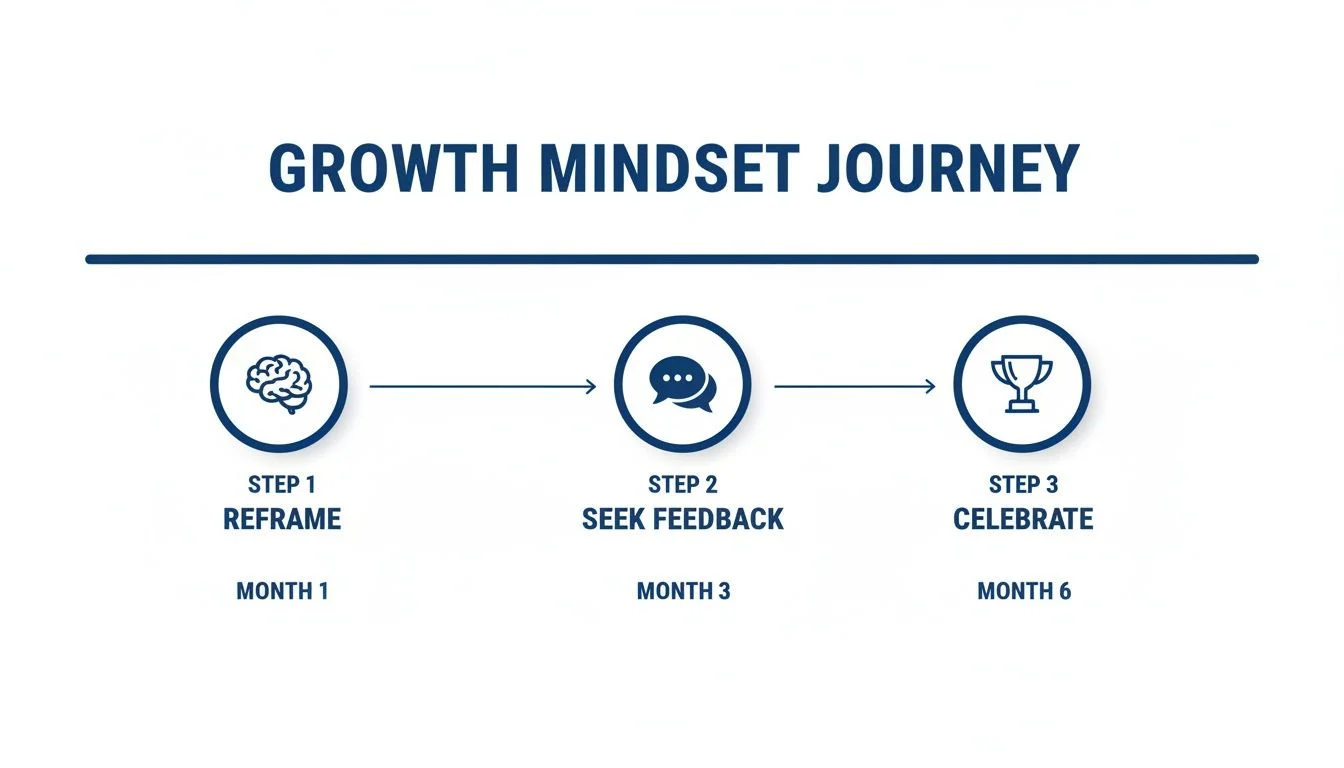 This visual shows the continuous engine of growth. It highlights the importance of reframing your perspective, gathering input to improve your efforts, and acknowledging the hard work that drives your learning. These three pillars are essential to this action plan and are key to changing how you learn and grow professionally.
Weeks 1-2: Focus On Process And Awareness
The first two weeks are for building a strong foundation. Your main objective is to move your attention away from the anxiety of the final result. Do not worry about whether you will pass the exam on your first try. Instead, focus on the consistency of your process. Tell yourself that you are committed to a productive study session today, regardless of how many concepts you master immediately. This shift helps reduce stress and keeps you focused on the task at hand.
- Daily Action: Set one small, process-driven goal for your certification study each day. Do not try to master an entire technical domain in one sitting. Instead, choose a specific task you can finish. For example, spend one hour reviewing the seven layers of the OSI model for the CompTIA Network+ exam. You can focus on how data moves from the Physical layer up to the Application layer. Alternatively, you could work through 15 practice questions focused on cloud security vulnerabilities. This makes your progress feel real and prevents you from feeling overwhelmed.
- Weekly Reflection: At the end of each week, spend a few minutes looking back at your progress. Ask yourself what technical concept was the hardest to understand. Think about what that struggle taught you about how you learn best. Write down one new tactic to try next week. You might watch a video from a different instructor to get a new perspective. You could draw a mind map to visualize how different parts of a complex cloud architecture connect. Another option is to explain a concept out loud to a friend to check your understanding.
Pay close attention to your internal self-talk during this period. When you catch a fixed-mindset thought, such as "I'm just not good at writing scripts," immediately reframe it. Say to yourself, "I haven't mastered scripting yet, but I have a plan and I am actively working on it."
This simple act of reframing is a powerful tool. It stops the cycle of self-criticism and helps your brain focus on solving problems. It turns a roadblock into a challenge you can overcome. A learning platform like MindMesh Academy is a great resource here. Do not look at its progress dashboard as a judgmental report card. Instead, use it as a diagnostic tool. It shows you exactly where to focus your study time for the best results.
Weeks 3-4: Embrace Challenge And Feedback
Once you have a steady study routine, it is time to push beyond what feels comfortable. This phase is about looking for difficult technical topics that you might normally avoid. Use feedback from others as a way to speed up your learning. By facing hard topics head-on, you build the resilience needed for high-level technical roles and more advanced certifications.
- Daily Action: Set aside at least 20 minutes every day for a topic that feels intimidating or complex. You might focus on advanced database normalization, such as moving from 2NF to 3NF. Or you could look at intricate serverless architectures in AWS or Azure. You might even spend time on obscure security compliance frameworks. Your goal is to engage with the material, not to master it instantly. You are building your ability to handle discomfort. This increases your mental toughness and helps you stay calm when you face difficult questions on the actual certification exam.
- Weekly Reflection: Find a study partner, a mentor, or an online community of learners. Post a specific question in a forum like Stack Overflow or a certification group on Reddit. Ask for feedback on your approach to a technical problem. Change your question from "Is this the right answer?" to "Is there a more efficient or effective way to do this?" Ask others where they see blind spots in your logic. Hearing how experienced professionals think through a problem can help you find better ways to learn and apply the material.
By the end of these 30 days, these actions will start to feel natural. They will become a part of your daily professional habits. You will have a routine where you approach difficult technical challenges with curiosity instead of fear. This is the core of a growth mindset. This process turns your certification preparation from a stressful sprint into a sustainable way to build your career. It leads to continuous skill development and long-term professional success in the IT industry.
Common Questions About Mindset and Achievement in IT
Understanding the theory of growth and fixed mindsets is one thing. Believing it will work for you is another, especially when you face a difficult IT certification exam like ITIL Expert or Google Professional Cloud Architect. These tests require more than just memorization; they demand high-level problem solving and critical thinking. Let’s look at the common questions and doubts that IT professionals often have about changing their mental approach to their careers.
Can You Really Change a Lifelong Fixed Mindset?
The answer is yes. It is a mistake to think a mindset is a permanent part of your personality that cannot be changed. A mindset is just a collection of beliefs you have built over many years. Because beliefs can change, your mindset can change too.
Changing your mindset is similar to building physical strength or learning a new syntax. Modern neuroscience shows that our brains have neuroplasticity. This means the brain is physically capable of forming new connections and pathways throughout our lives. To start, you must recognize when you are having a fixed-mindset thought. For example, if you see a complex bug and think, "I'll never understand this," you should pause. You then choose a better response. You might focus on the effort you have already put in or view the bug as a chance to learn a new tool. You should also treat feedback, even if it is harsh, as useful data you can use to improve. This change does not happen in a single day. However, if you practice this every time you face a challenge, you are rewiring your brain to handle difficulty with a growth-oriented focus.
Does This Mean Natural Talent Doesn't Matter in IT?
Natural talent exists, but we often give it too much credit. A person might have a natural feel for logic or math, which helps them start a career in IT. But talent is not a good way to predict who will become a leader or a top-tier architect in the long run. The tech industry moves too fast. A skill that is modern and highly paid today might be gone in five years.
The people who provide the most value in any technical field are rarely just "naturals" at coding or networking. The most successful people are those who never stop learning. Their success comes from hard work, smart study habits, and a real drive to master new technologies as they appear. This is the growth mindset in action. If you rely only on your natural talent, you are taking a risk. You might stop learning because you think you already know enough. In contrast, someone who enjoys learning and has the grit to work through tough problems will eventually surpass a talented person who stays static.
How Does a Growth Mindset Actually Help if I Fail an Exam?
This is where a growth mindset shows its practical value. If you have a fixed mindset and fail a certification exam, like the CompTIA Network+ or the Azure Developer Associate, it feels like a final judgment. You might tell yourself that you aren't smart enough for this level of work. This thought process makes you feel defeated and stops you from trying again.
A growth mindset sees that same failure as a source of information. Your internal dialogue changes to, "I haven't mastered this yet." Instead of quitting, you look at your exam performance report. You use that data to find your specific weaknesses. Maybe you struggled with network security protocols, identity management, or a specific database service. Once you know where the gaps are, you can change your study plan. You might find new practice labs or read different documentation. This way, you approach the next attempt with a better strategy. In this view, failure is not a wall that stops you. It is a signal that shows you exactly where you need to improve to reach your goal.
Ready to use these ideas and build a solid growth mindset for your next career challenge? MindMesh Academy provides high-quality content and tracking tools to help you learn complex concepts and master technical fields. Start your path to professional growth and see our Explore IT Certification Practice Exams to be well-prepared for your next test.

Written by
Alvin Varughese
Founder, MindMesh Academy
Alvin Varughese is the founder of MindMesh Academy and an enterprise architecture leader. An electrical engineer by training, he moved from factory automation in South Africa to cloud architecture at GE Appliances and Humana (Fortune 50), and holds 20 professional certifications including AWS Solutions Architect Professional, Azure DevOps Engineer Expert, and Microsoft Agentic AI Business Solutions Architect. He built MindMesh Academy after interviewing too many highly certified candidates who couldn't answer basic questions: the goal is prep that makes you better at the job, not just able to pass the exam.