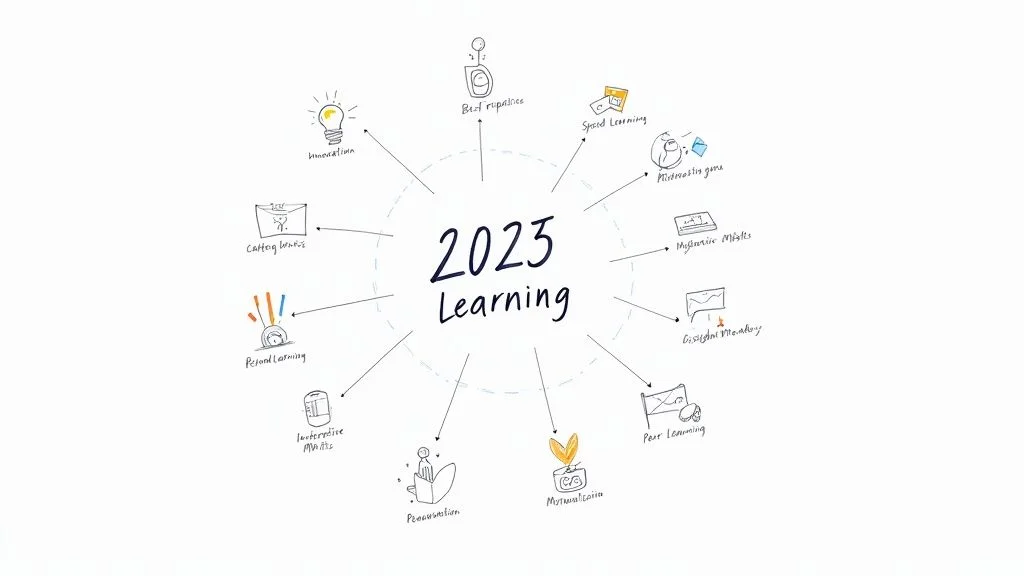
10 Employee Training Best Practices
Effective employee training in the IT sector is far more than a simple compliance checkbox; it's a strategic imperative that directly fuels productivity, engagement, and retention for a highly skilled workforce. In today's competitive and rapidly evolving technology landscape, organizations that prioritize developing their IT professionals gain a significant edge. They foster a more skilled, agile, and motivated team, capable of navigating complex systems and validating their expertise through crucial certifications like AWS, Azure, PMP, and ITIL. Moving beyond outdated, one-size-fits-all training models is essential for building a resilient IT team prepared for future challenges. To truly revolutionize your team's growth, consider how initiatives like upskilling as a key to advancing employee careers can fill critical skill gaps and demonstrate a deep commitment to individual professional development within IT. MindMesh Academy is dedicated to providing the resources and insights necessary for this transformation.
This guide moves past generic advice to provide a comprehensive roundup of actionable employee training best practices, specifically tailored for the needs of IT professionals. We will explore ten powerful, evidence-backed strategies that you can implement immediately to transform your learning and development programs. From integrating microlearning for just-in-time knowledge acquisition crucial for exam prep, to building robust peer-learning communities focused on certification study groups, each item offers a fresh perspective. You will find practical implementation details, real-world examples from the IT world, and specific tips to help you design, deliver, and measure training that genuinely drives results, cultivates a thriving continuous learning culture, and ultimately contributes to certification success within your organization. Let's dive into the methods that will make a tangible difference.
1. Microlearning
Microlearning transforms traditional IT training by delivering content in small, focused bursts, typically lasting between two and ten minutes. This approach breaks down complex subjects, often encountered in certification preparation, into digestible modules designed to meet a specific, immediate learning objective. Instead of lengthy seminars on an entire cloud platform, IT professionals can access short videos on a specific AWS CLI command, an interactive quiz on a single Azure Policy definition, or a quick-read article explaining an ITIL service management principle. These modules are available on-demand, often from mobile devices during natural lulls in the workday. This method aligns with modern work habits and cognitive science, which shows that spaced repetition and focused content significantly improve knowledge retention—a critical factor when preparing for high-stakes certification exams. It's an essential employee training best practice because it makes learning accessible, efficient, and less disruptive to daily productivity in demanding IT roles.
How to Implement Microlearning
To successfully integrate this strategy into your IT training, focus on precision and accessibility. Each module should target a single, clear-cut concept, much like a single objective within a certification blueprint. For instance, a cloud operations team could use a three-minute video demonstrating a specific Python function for automation, while a security department might use a five-minute interactive tutorial on configuring a new firewall rule or identifying a specific type of cyber threat.
- Adopt a Mobile-First Design: Ensure content is optimized for smartphones and tablets, allowing IT professionals to review concepts for their CompTIA Security+ or PMP exam while commuting, or quickly look up a command during a troubleshooting session, enabling true "just-in-time" learning.
- Create Learning Paths: Combine individual micro-modules into a structured sequence. A certification path for new Azure Administrators might include modules on provisioning VMs, configuring network security groups, and managing storage accounts.
- Incorporate Interactivity: Use short quizzes, polls, or simple drag-and-drop exercises to engage learners and reinforce key takeaways. Platforms like Duolingo and LinkedIn Learning master this by turning passive learning into an active experience, a principle highly effective for reinforcing concepts prior to a certification exam.
Reflection Prompt: How could microlearning help you grasp complex topics for your next certification exam, like breaking down the vast scope of an AWS Certified Solutions Architect Associate exam into manageable chunks, or mastering specific project management processes for the PMP?
2. Spaced Repetition
Spaced repetition is a powerful learning technique based on the psychological principle of the "forgetting curve." It involves reviewing information at strategically increasing intervals of time, reinforcing knowledge just before the brain is about to forget it. Instead of cramming complex IT concepts or certification facts into a single session, this method schedules reviews at optimal moments, transferring knowledge from short-term to long-term memory with far greater efficiency. This is one of the most effective employee training best practices for retaining critical IT information, such as intricate API parameters for an Azure Developer certification, recalling PMP formulas and ITIL definitions, mastering port numbers for CompTIA Network+, or understanding specific AWS service limits. It’s particularly vital for passing high-stakes certification exams that require deep and sustained knowledge retention.
How to Implement Spaced Repetition
The key to successful implementation in an IT context is automating the review schedule to make it seamless for busy professionals. For crucial company knowledge, such as internal compliance regulations (e.g., GDPR, HIPAA) or cloud service limits, you might set up automated email or Slack reminders with a quick quiz question. For a new software rollout or a critical certification study topic, a training platform could prompt users to revisit a feature or concept one day, three days, and then a week after the initial training.
- Automate the Schedule: Use learning management systems (LMS) or specialized apps to automatically schedule review sessions. Platforms like Anki and Quizlet are built on this principle, but many corporate systems now incorporate it for compliance and certification training.
- Combine with Active Recall: Don't just re-read the material. Prompt employees to actively retrieve the information through quizzes, flashcards (e.g., for AWS service characteristics or Azure resource properties), or real-world problem-solving scenarios directly relevant to their IT role or certification objectives.
- Establish a Baseline Interval: Start with a simple, proven schedule, such as reviewing new information at intervals of one day, three days, one week, and one month. You can master Spaced Repetition by tailoring these intervals based on content difficulty and individual performance, especially important for varied certification topics.
Reflection Prompt: Consider how spaced repetition could be integrated into your study routine for an upcoming certification. What specific concepts or facts, like the differences between AWS S3 storage classes or Azure compute options, or a list of PMP knowledge areas, would benefit most from this technique?
3. Blended Learning
Blended learning is a powerful employee training best practice that strategically combines traditional instructor-led training with modern digital learning methods, creating an optimal experience for IT professionals. This hybrid approach creates a flexible and comprehensive experience by integrating various formats, such as live virtual classrooms, self-paced online modules, in-person workshops, and hands-on projects. Instead of relying on a single delivery method, it leverages the strengths of each to cater to diverse learning styles and busy IT schedules. This model is exceptionally effective because it offers the direct interaction and guidance of an instructor (e.g., for complex PMP case studies or deep-dive AWS architecture discussions) alongside the convenience and scalability of on-demand digital content (e.g., foundational Azure concept videos), leading to deeper engagement and better long-term retention.
How to Implement Blended Learning
Effective implementation hinges on creating a seamless journey that thoughtfully maps IT content to the best delivery channel. The goal is to make the online and offline components feel like two parts of a cohesive whole, not separate, disjointed activities. For example, a program preparing IT professionals for the AWS Certified Solutions Architect – Professional exam might begin with self-paced online modules on advanced architectural patterns, followed by a virtual instructor-led session for deep-dive Q&A, and culminate in an in-person workshop focused on complex hands-on labs.
- Map Content to the Right Format: Use self-paced e-learning for foundational knowledge (e.g., basic cloud concepts, programming syntax), virtual instructor-led sessions for interactive discussions (e.g., complex cybersecurity scenarios, PMP risk management), and in-person workshops for hands-on skill practice (e.g., network configuration, serverless deployment on Azure).
- Integrate Technology Seamlessly: Utilize a robust Learning Management System (LMS) to host all content, track progress through certification paths, and facilitate communication between learners and instructors.
- Balance Structured and Self-Directed Learning: Provide a clear learning path for certifications but allow employees flexibility in how they complete self-paced components. Platforms like Salesforce's Trailhead excel by offering structured learning trails alongside a vast library of optional modules for independent exploration of IT skills.
Reflection Prompt: How might a blended approach, combining self-study with expert interaction and hands-on labs, enhance your preparation for a complex certification like the AWS Certified DevOps Engineer or an advanced cybersecurity certification?
4. On-the-Job Training (OJT)
On-the-Job Training (OJT) immerses IT employees directly into their work environment to learn through practical, hands-on experience. Instead of a classroom, the learning happens at the workstation, guided by an experienced colleague, mentor, or supervisor. This method connects theory to practice by allowing new hires or those transitioning roles to perform actual job tasks, ask questions in real-time, and immediately apply new skills in a relevant context—for instance, configuring network devices, troubleshooting a server issue, or deploying an application to a cloud environment (e.g., Azure or AWS) with real-time feedback. It is a cornerstone of employee training best practices in IT because it accelerates competency, ensures that training is directly applicable to job duties, and fosters a culture of mentorship vital for knowledge transfer.
How to Implement On-the-Job Training
Effective OJT in IT requires structure to avoid becoming an informal, inconsistent shadowing exercise. The goal is to build a replicable program that ensures all trainees acquire the same core competencies, which can also help validate practical skills needed for certifications. For example, a new cloud engineer could follow a structured OJT plan that starts with foundational cloud resource provisioning, moves to observing deployment pipelines, and culminates in supervised independent management of non-critical environments.
- Develop Standardized Checklists: Create detailed checklists outlining the specific IT skills, tasks, and knowledge areas (e.g., specific commands, troubleshooting steps, security protocols) the trainee must master. This ensures consistency and provides a clear roadmap for both the trainer and the trainee, often aligning with certification exam objectives.
- Select and Prepare Qualified Trainers: Not every IT expert is a good teacher. Choose experienced employees who have strong technical skills, excellent communication abilities, and a willingness to mentor. Provide them with basic "train-the-trainer" guidance on how to explain, demonstrate, and provide constructive feedback on technical tasks.
- Gradually Increase Complexity: Start trainees with simple, low-risk IT tasks (e.g., basic system monitoring) and progressively introduce more complex responsibilities (e.g., critical system configuration) as their confidence and competence grow. This builds a solid foundation and prevents overwhelm, mirroring the progression often found in IT career paths and certification levels. Successful apprenticeship programs and medical residencies are built on this principle of escalating responsibility.
Reflection Prompt: Think about a challenging technical task in your current IT role. How could a structured OJT approach, perhaps with a mentor, help you master it more quickly and confidently, perhaps even validating skills for a future certification like the CompTIA CySA+ or AWS Certified Advanced Networking?
5. Personalized Learning Paths
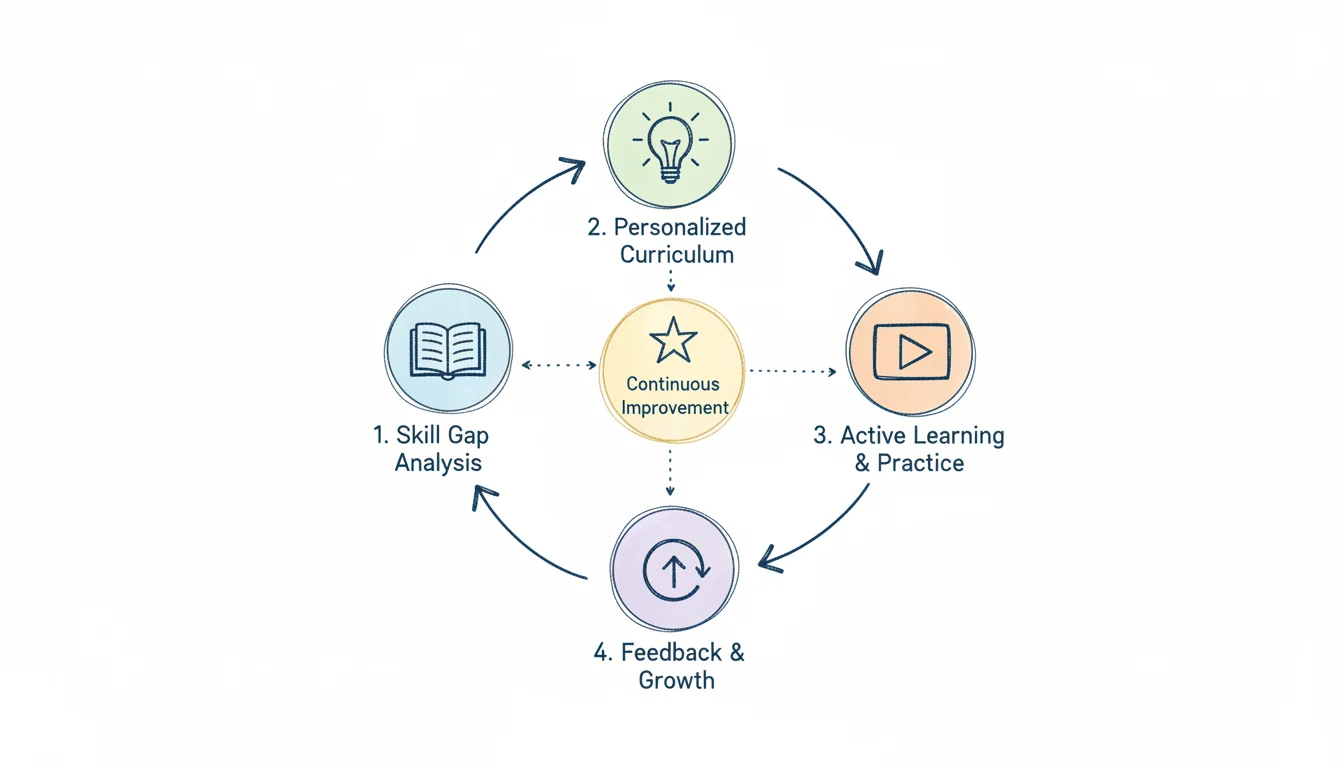
Personalized learning paths move beyond a one-size-fits-all model by tailoring training content, pace, and sequence to individual IT employee needs, existing skill sets, and specific career goals (e.g., achieving an AWS Certified Solutions Architect or a PMP certification). This approach uses data and sometimes AI to create a unique educational journey for each person, adapting in real-time based on their performance and preferences. Instead of forcing every IT professional through the same modules, it focuses on filling specific knowledge gaps (e.g., a developer needing to learn more about cloud security) and building on existing strengths. This is a crucial employee training best practice because it respects individual differences, boosts engagement by focusing on relevant skills, and accelerates skill development by focusing only on what is necessary for that learner's IT career trajectory.
How to Implement Personalized Learning Paths
To effectively implement this strategy for your IT team, start with data and maintain flexibility. The goal is to create a dynamic framework, not a rigid set of rules. Use initial assessments to establish a baseline, then leverage technology to guide learners toward content that aligns with both their current role and future aspirations. For example, an IT professional aspiring to become a certified AWS DevOps Engineer might have a path focused on CI/CD tools, infrastructure as code, and monitoring, while another aiming for a PMP certification would focus on project management methodologies, risk assessment, and stakeholder communication.
- Conduct Skills Gap Assessments: Use initial quizzes (e.g., on specific AWS services or Azure functions), self-evaluations, or manager feedback to identify each employee's starting point and define their specific learning needs, especially concerning certification domains. This data forms the foundation of their custom path.
- Balance AI with Human Input: Leverage learning platform algorithms to suggest relevant courses (e.g., for Python development, cloud networking), but allow managers and employees to collaboratively adjust the path based on project needs, changing technology trends, or evolving certification goals. This human touch ensures relevance and motivation.
- Provide Learner Agency: Empower employees to add or remove modules from their suggested paths. Platforms like Degreed and Coursera for Business excel by giving learners control over their development, which significantly improves buy-in and motivation for tackling new IT challenges or certifications. For a deeper understanding of building targeted skills, learn more about how to upskill employees on MindMesh Academy.
Reflection Prompt: Imagine your ideal IT career progression over the next three years. What certifications (e.g., AWS Certified Security, Azure Solutions Architect Expert, CISSP) or advanced skills (e.g., Machine Learning, Blockchain) do you envision needing, and how could a personalized learning path accelerate your achievement of those goals?
6. Peer Learning and Communities of Practice
Peer learning taps into the vast reservoir of technical knowledge already within an organization, creating a system where IT employees teach and learn from one another. This employee training best practice moves beyond top-down instruction by formalizing knowledge sharing through Communities of Practice (CoPs). CoPs are groups of IT professionals who share a common interest or professional domain (e.g., cloud security, DevOps, project management for PMP aspirants), coming together to troubleshoot complex problems, discuss new strategies, and share insights. Instead of relying solely on formal trainers, this model empowers experts at every level to contribute, fostering a culture of continuous, collaborative improvement and breaking down organizational silos in the IT department.
How to Implement Peer Learning
To build a thriving peer learning environment in your IT organization, focus on creating structure and providing the right tools. The goal is to make knowledge sharing a natural part of the workflow. For example, AWS Solutions Architects might form a CoP to dissect complex multi-cloud deployments, or a group preparing for their ITIL 4 Foundation exam could collaboratively review service lifecycle scenarios. Developers could use a dedicated Slack channel to solve coding challenges together, similar to how GitHub communities operate, while project managers might collaborate on strategies for the PMP exam.
- Define a Clear Purpose: Each IT-focused community needs a charter or mission statement. Is the goal to solve a specific business problem (e.g., optimize cloud costs), master a new technology (e.g., Kubernetes, serverless), or collectively prepare for a certification (e.g., Azure Data Scientist)?
- Designate Community Facilitators: Appoint or ask for volunteers from within the IT team to lead the groups. These facilitators are not bosses but guides who schedule meetings, spark conversations, and ensure the community stays on track, perhaps by curating relevant learning resources or inviting guest speakers.
- Provide Dedicated Collaboration Spaces: Create a digital home for each CoP, such as a Microsoft Teams channel, a Slack workspace, an internal wiki, or a dedicated forum within your LMS. This space is crucial for documenting discussions, sharing code snippets, and posting certification study materials.
- Recognize and Reward Participation: Acknowledge active members publicly, perhaps during team meetings or in internal newsletters. Highlighting contributions from peers, such as someone helping a colleague troubleshoot a complex network issue or successfully explaining a difficult PMP concept, encourages others to get involved and validates the time they invest in helping colleagues.
Reflection Prompt: Are you part of any IT-focused communities or forums, either online or in person? How could actively participating in or even creating a Community of Practice around a specific technology or certification topic (like a study group for the CompTIA Security+ exam or an Azure Administrator cert) enhance your learning journey?
7. Mentoring and Coaching
Mentoring and coaching move beyond standardized curricula to offer personalized, one-on-one development crucial for IT professionals. This approach pairs less experienced employees with seasoned professionals to foster targeted growth. While mentoring focuses on long-term career guidance (e.g., a principal architect guiding a junior cloud engineer on career milestones and advanced AWS best practices) and wisdom-sharing, coaching is more performance-oriented (e.g., a coach helping a project manager refine their PMP exam strategy or Agile sprint management techniques), concentrating on developing specific skills and achieving short-term goals. Both are powerful employee training best practices because they provide tailored support, build institutional knowledge within the IT department, and cultivate leadership from within. This method creates a strong support system that enhances engagement and accelerates career progression, especially for those aiming for leadership roles or advanced certifications like CISSP.
How to Implement Mentoring and Coaching
Successful programs are built on structure and clear expectations. The key is to facilitate meaningful connections that produce tangible outcomes, whether it’s for technical skill mastery or career advancement. For example, a junior software developer could be mentored by a principal engineer to navigate career milestones in cloud development, while a new IT project manager might receive coaching on team leadership and PMP-aligned performance management.
- Thoughtfully Match Participants: Pair individuals based on technical skills, career aspirations (e.g., interest in cybersecurity, data science, or project management), and personality. Use surveys or brief interviews to ensure a good fit, much like McKinsey does with its partner mentoring system.
- Establish a Clear Framework: Use structured models like the GROW (Goal, Reality, Options, Will) model to guide coaching conversations and ensure they are productive and action-oriented, helping mentees set specific goals for skill development or certification.
- Provide Mentor Training: Equip your mentors and coaches with the necessary skills for giving constructive feedback on technical performance, setting clear goals for professional development (including certification pathways), and guiding their mentees effectively. This ensures a consistent and high-quality experience for all participants.
Reflection Prompt: Who within your professional network could serve as a valuable mentor or coach for your IT career or certification goals? What specific areas – technical skills (e.g., Python, Kubernetes), leadership, or exam strategies (e.g., for your AWS or Azure cert)—would you most like to focus on?
8. Gamification
Gamification transforms employee training from a passive requirement into an engaging, interactive experience by applying game-design elements to learning modules, particularly effective for IT professionals. This approach incorporates points, badges, leaderboards, and challenges to boost motivation, participation, and knowledge retention, making even complex IT topics or certification study more appealing. It taps into our natural desires for achievement, competition, and recognition, making the learning process feel rewarding rather than tedious. This is a crucial employee training best practice because it directly addresses learner disengagement, turning mundane tasks—like reviewing compliance regulations or mastering cloud security best practices—into compelling activities that IT employees willingly pursue.
How to Implement Gamification
Effective gamification goes beyond simply adding points; it requires thoughtful design that aligns with clear learning objectives for IT skills or certification domains. The goal is to motivate progress, not just create a distraction. For instance, a cybersecurity training program could award badges for correctly identifying simulated phishing attacks or successfully configuring security groups in a cloud environment. A leaderboard could show top performers on practice exams for an Azure Administrator certification, while challenges could be set to master specific AWS security configurations.
- Align Games with Learning Goals: Ensure every point, badge, or challenge directly reinforces a key IT skill or piece of knowledge required for a role or certification. Salesforce Trailhead excels at this by awarding badges that correspond to specific, marketable skills and certifications within their ecosystem.
- Balance Competition and Collaboration: While leaderboards are effective, also include team-based challenges (e.g., a "capture the flag" exercise for cybersecurity teams or a collaborative coding challenge) to foster collaboration. This prevents disengagement among less competitive employees and builds team cohesion.
- Offer Meaningful Rewards: Combine virtual rewards like badges with tangible incentives, such as professional development opportunities (e.g., funding for a certification exam, access to advanced IT conferences) or extra paid time off, to maintain long-term motivation for continuous learning.
Reflection Prompt: How could gamification elements—like badges for completing a module on a new programming language (e.g., Go, Rust) or a leaderboard for successful practice exam attempts for a PMP or AWS cert—motivate you to engage more deeply with your professional development?
9. Scenario-Based and Experiential Learning
Scenario-based and experiential learning shifts IT training from passive listening to active problem-solving. This method immerses employees in realistic simulations, case studies, or role-playing exercises that mirror the complex challenges they face on the job. Learners must apply their knowledge to make decisions and see the direct consequences of their actions, all within a controlled, safe environment. For IT professionals, this could mean simulating a critical network outage and requiring them to diagnose and resolve it under pressure, troubleshooting a misconfigured Azure resource group, architecting a resilient AWS solution for a given business requirement, or role-playing a stakeholder meeting for a PMP project. This "learning by doing" approach, popularized by David Kolb's experiential learning cycle, bridges the gap between theoretical knowledge and practical application, making it a critical employee training best practice for developing complex skills like critical thinking, decision-making, and crisis management vital for any IT role and practical certification components.
How to Implement Scenario-Based Learning
Effective implementation requires creating authentic challenges that are directly relevant to the IT employee's role and potential certification scenarios. The goal is not just to test knowledge, but to build practical wisdom and confidence. Scenarios should be designed to provoke thought and encourage experimentation, moving beyond simple right-or-wrong answers.
- Base Scenarios on Reality: Work with subject matter experts (SMEs) from your IT team to design simulations based on real-world job situations, common customer interactions (e.g., explaining a technical issue to a non-technical stakeholder), or operational challenges (e.g., managing a cybersecurity incident) your teams have actually faced.
- Structure for Progressive Complexity: Start with simpler scenarios (e.g., basic server restart) and gradually introduce more variables and ambiguity (e.g., a multi-component system failure) as learners build competence. This prevents overwhelm and reinforces foundational IT skills.
- Incorporate Debriefing Sessions: The most crucial phase is reflection. After a scenario, facilitate a debriefing session to discuss what happened, why it happened, and what could be done differently. This is where deep learning occurs, helping IT professionals solidify their understanding for both practical application and certification knowledge. Platforms like Harvard ManageMentor use case studies to great effect, challenging leaders to navigate complex business dilemmas.
Reflection Prompt: Think about a past project or incident in your IT career. How might a scenario-based training that allowed you to practice troubleshooting or decision-making in a safe environment have better prepared you, especially for practical components of certifications like the AWS Certified Advanced Networking or CompTIA Server+?
10. Continuous Learning Culture and Self-Directed Learning
A continuous learning culture shifts the organizational mindset from scheduled training events to an environment where learning is an ongoing, integrated part of daily IT work. This approach empowers IT employees to take ownership of their development through self-directed learning, where they are encouraged to explore, experiment, and grow, constantly adapting to the rapidly evolving technology landscape. Instead of waiting for formal instruction, individuals proactively seek knowledge to solve problems, innovate, and maintain their professional certifications (e.g., renewing an Azure certification, staying current with ITIL practices). This is a crucial employee training best practice because it builds a resilient, agile IT workforce capable of adapting to constant change. Companies like Amazon with its "Day One" philosophy and Google with its famous "20% time" policy exemplify how this culture drives constant innovation.
How to Implement a Continuous Learning Culture
Fostering this environment requires structural support and genuine encouragement from leadership, particularly in IT. It involves providing the tools and, importantly, the psychological safety for employees to pursue new skills without fear of failure. You can learn more about what continuous learning is and how to implement it on MindMesh Academy.
- Allocate Dedicated Learning Time: Formally set aside time for learning, whether it's a few hours per week for exploring new features in Python libraries, delving into advanced network security protocols for a Certified Ethical Hacker (CEH) exam, or dedicated "learning days" for deep dives into new AWS or Azure services. This signals that development is a priority, not an afterthought.
- Provide Diverse Resources: Offer a rich library of on-demand resources, including online courses (e.g., for new programming languages, cloud platforms), technical articles, industry podcasts, and access to subject matter experts. Curate content relevant to certifications and current IT trends but also allow for open exploration.
- Recognize and Reward Learning: Acknowledge IT employees who acquire new skills, achieve certifications, or apply new knowledge to their work. Feature their successes in company newsletters or meetings to inspire others and reinforce the value of continuous growth and skill validation.
Reflection Prompt: Given the pace of change in the IT world, how can you personally foster a more self-directed learning approach? What new technologies (e.g., Quantum Computing, Web3) or certifications (e.g., Kubernetes CKA, Google Cloud Professional Cloud Architect) are on your radar, and how will you dedicate time to exploring them?
Employee Training Best Practices: 10-Point Comparison
| Approach | Implementation complexity | Resource requirements | Expected outcomes | Ideal use cases | Key advantages |
|---|---|---|---|---|---|
| Microlearning | Low–Medium — simple module design and sequencing | Low — short content, mobile delivery, modest authoring tools | Faster uptake, improved short-term retention, frequent engagement | Just-in-time IT training, certification refreshers, micro-skills, mobile learners | Quick to produce/update, mobile-friendly, fits busy IT schedules |
| Spaced Repetition | Medium — needs scheduling logic and content spacing | Medium — SRS software, content tagging, learner time commitment | Strong long-term retention and reduced re-learning | IT certification prep (AWS, PMP), high‑volume factual learning, security policies | Scientifically proven retention gains; efficient study time |
| Blended Learning | High — coordinates multiple modalities and workflows | High — LMS, instructors, content development, tech integration | Higher engagement and retention; flexible delivery | Comprehensive IT programs, cloud platform onboarding, leadership development | Combines strengths of online and face-to-face learning |
| On-the-Job Training (OJT) | Medium — requires planning, standardization of trainers | Low–Medium — mentors, checklists, supervision time | High transfer to job performance; immediate productivity | Technical IT skills, apprenticeships, frontline IT support roles | Real-world application; cost‑effective for hands‑on skills |
| Personalized Learning Paths | High — requires data, adaptive logic and mapping | High — advanced LMS/AI, analytics, large content library | Improved engagement, faster time-to-competency, targeted skill growth | IT career development, upskilling for certifications, heterogeneous learner groups | Tailored experiences; higher motivation and relevance |
| Peer Learning & Communities of Practice | Medium — needs facilitation and governance | Low–Medium — collaboration tools, facilitator time | Increased knowledge sharing, cultural alignment, sustained learning | Cross-functional IT problem solving, tacit knowledge transfer, certification study groups | Leverages internal IT expertise; low-cost and sustainable |
| Mentoring & Coaching | Medium–High — matching, governance and quality control | High — skilled mentors/coaches, dedicated time | Measurable performance gains; IT leadership pipeline development | Executive IT development, high-potential employees, career coaching for IT pros | Highly personalized development; strong ROI for leaders |
| Gamification | Medium — requires game design and behavioral alignment | Medium — platform features, design, rewards and analytics | Higher engagement and completion; improved practice frequency | IT onboarding, compliance refreshers, habit formation, certification practice | Increases motivation and participation; immediate feedback |
| Scenario-Based & Experiential Learning | High — intensive design, realistic scenario creation | High — SMEs, facilitators, simulation tech or spaces | Strong transfer to job performance, critical thinking development | IT incident response, security simulations, cloud migration planning, PMP case studies | Realistic practice with safe failure; memorable learning |
| Continuous Learning Culture & Self-Directed Learning | High — cultural change, leadership sponsorship needed | Medium–High — resources, time allocation, learning infrastructure | Long-term agility, innovation, retention; broad capability growth | Organization-wide IT upskilling, innovation-driven tech companies | Sustainable learning, IT employee empowerment and adaptability |
Putting Your Training Strategy into Action
Embarking on a journey to overhaul your employee training for IT professionals is a significant, yet profoundly rewarding, endeavor. We've explored a comprehensive toolkit of modern strategies, moving far beyond traditional, one-size-fits-all classroom sessions that often fall short in the dynamic IT world. The path to a more effective, certified, and engaged IT workforce is not paved with a single solution but with a dynamic blend of innovative approaches.
The core takeaway is this: effective IT training is not an event, it's an ecosystem. It thrives on personalization, continuous reinforcement, and a deep connection to real-world application and certification requirements. By integrating practices like microlearning and spaced repetition, you transform learning from a daunting task into a manageable, daily habit crucial for exam preparation. Blending these digital methods with the invaluable human touch of on-the-job training, mentorship, and peer communities creates a robust framework that supports every IT professional, no matter their role, specialization (e.g., cloud, security, development), or learning style.
Your Roadmap to Implementation for IT Training
To truly operationalize these employee training best practices within your IT department, you must shift your perspective from a program manager to a learning architect. This means designing experiences that are not only informative but also engaging, relevant to cutting-edge technologies and certification paths, and intrinsically motivating for tech-savvy individuals. The goal is to cultivate a culture where curiosity is currency, continuous skill validation through certifications is encouraged, and development is a shared responsibility.
Here are your actionable next steps:
- Audit Your Current State: Begin by evaluating your existing IT training programs against the principles discussed. Where are the gaps in addressing modern tech needs or certification pathways? Are you relying too heavily on a single, outdated method?
- Start Small and Iterate: You don't need to implement everything at once. Select one or two high-impact areas relevant to your IT team, perhaps by introducing personalized learning paths for a specific team (e.g., those pursuing an AWS Solutions Architect certification) or gamifying a mandatory cybersecurity compliance module for ISO 27001 or SOC 2.
- Empower Your People: Foster a culture of self-directed learning by providing access to high-quality technical resources, funding for certifications, and encouraging employees to take ownership of their growth. To effectively implement a modern training strategy, it's crucial to identify relevant development opportunities such as the best AI training courses available, giving your team the tools to stay ahead of the curve.
- Measure What Matters: Move beyond simple completion rates. Focus on metrics that demonstrate tangible impact for IT, such as performance improvements in code quality, successful cloud deployments, reduced incident response times, certification pass rates, and employee engagement with the learning materials.
Ultimately, investing in a sophisticated training strategy is an investment in your organization's most critical asset: its IT people. By building a program that is as dynamic, adaptable, and forward-thinking as your team, you are not just closing skill gaps; you are building a resilient, innovative, and highly capable IT workforce ready to meet the challenges of tomorrow and equipped with the validated expertise to prove it. The right approach transforms IT training from a business expense into a powerful driver of competitive advantage.
Ready to build a world-class IT training program with cutting-edge tools designed for IT professionals and certification aspirants? MindMesh Academy provides a comprehensive platform designed to implement these very best practices, from creating personalized learning paths tailored for specific certifications to deploying engaging microlearning modules on complex technical topics. Discover how you can elevate your IT team's potential at MindMesh Academy today.

Written by
Alvin Varughese
Founder, MindMesh Academy
Alvin Varughese is the founder of MindMesh Academy and an enterprise architecture leader. An electrical engineer by training, he moved from factory automation in South Africa to cloud architecture at GE Appliances and Humana (Fortune 50), and holds 20 professional certifications including AWS Solutions Architect Professional, Azure DevOps Engineer Expert, and Microsoft Agentic AI Business Solutions Architect. He built MindMesh Academy after interviewing too many highly certified candidates who couldn't answer basic questions: the goal is prep that makes you better at the job, not just able to pass the exam.