
The Comptia A+ Test Cost: 2026 Financial Guide
The Comptia A+ Test Cost: 2026 Financial Guide
The Comptia A+ test cost starts at $506 for the full certification if you buy both exams at $253 each. However, the total investment can land anywhere from lean and efficient to well over $1,000 once you factor in prep materials, retakes, and renewal.
That gap is what trips people up. They budget for the voucher price, then get blindsided by practice tests, a failed first attempt, or renewal costs three years later. If you treat A+ like a one-time checkout screen, you’ll probably overspend. If you treat it like a total cost of ownership decision, you can keep the investment tight and get much better return from it.
Most candidates don’t need the cheapest path. They need the smartest path. Cheap can turn expensive fast if it leads to a retake. Expensive can be wasteful if you buy training you’ll never use. The right strategy depends on how prepared you are, how disciplined you are, and whether someone else, like an employer or school, is paying part of the bill.
Your Total Investment for the CompTIA A+ Certification
About half of your A+ budget is often the part people notice first. The other half is where candidates either protect their return or waste money.
Treat A+ as a four-bucket purchase, not a single transaction. CompTIA confirms that the certification is earned by passing two exams, and the credential must later be renewed through continuing education or by earning a higher certification, as outlined on CompTIA’s continuing education page. That means your budget needs to cover the full life cycle of the certification, not just exam day.
Here are the four buckets that matter:
- Exam purchase: your initial vouchers
- Preparation: books, labs, practice exams, courses, or instructor-led training
- Retake exposure: the extra money you spend if weak prep forces a second attempt
- Renewal: future continuing education fees or the cost of recertifying another way
This framework matters because the cheapest path on day one often becomes the most expensive path overall. I have seen candidates save a little on prep, walk into the exams underprepared, then erase those savings with a single retake. I have also seen candidates overspend on training bundles they barely use. Both mistakes hurt your ROI.
Set a full-budget target before you buy anything.
If you want a practical roadmap for the Total Investment for the CompTIA A+ Certification, map each of those four buckets first, then decide where to spend and where to cut. That approach keeps you focused on what actually gets you certified at the lowest real cost.
A+ remains one of the strongest entry points into IT support. The smart move is to buy it like an investment with acquisition, operating, and renewal costs, not like a one-time checkout.
Deconstructing the CompTIA A+ Exam Price
The base exam fee is only the entry point. The key question is what that fee buys you, and where it can expose you to extra cost later.
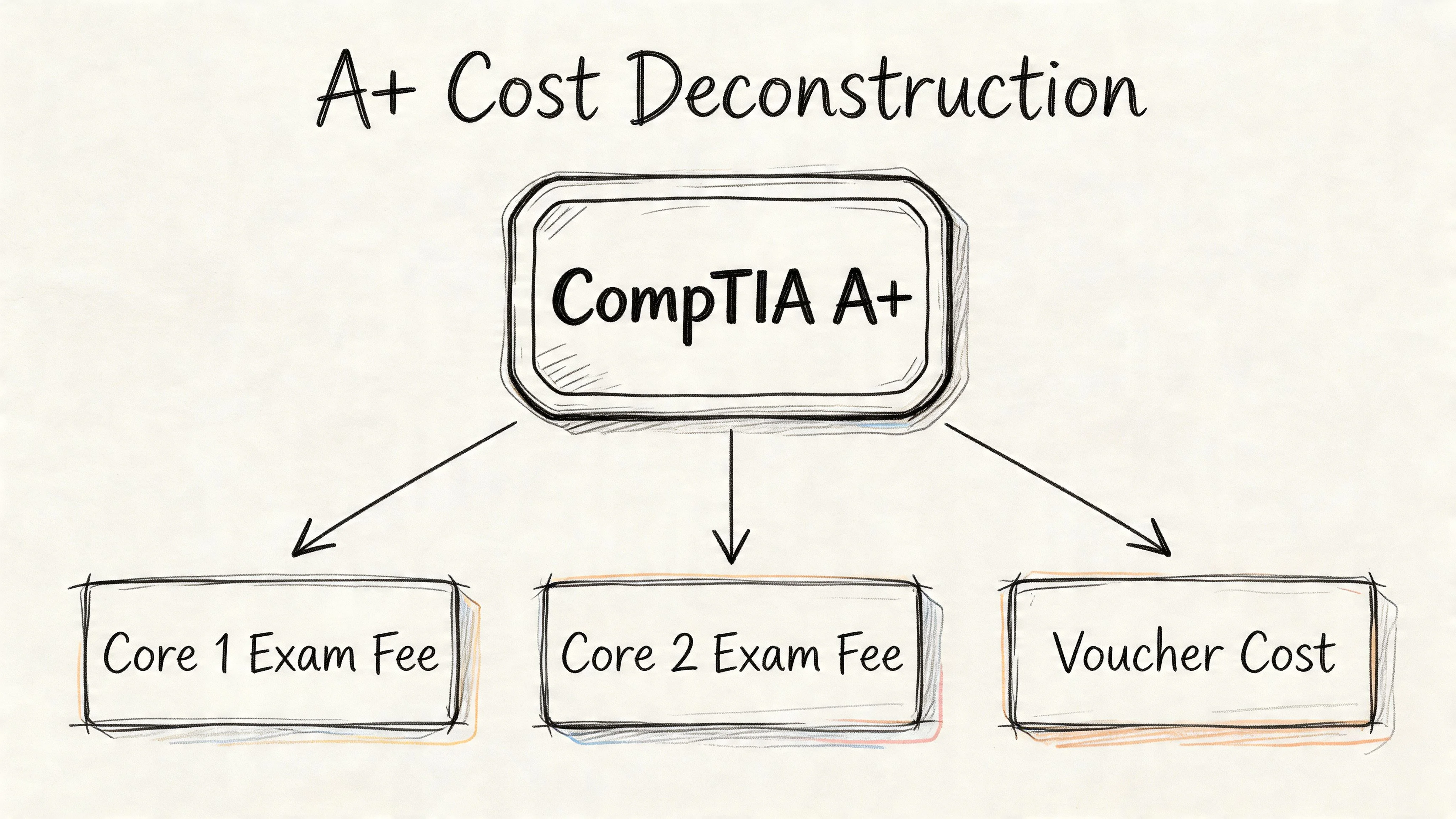
CompTIA splits A+ into two domains because entry-level IT support is two jobs at once. One side is device and connectivity work. The other is operating systems, security, and user support. Core 1 covers hardware, networking, mobile devices, and troubleshooting around physical tech. Core 2 covers Windows, security, software troubleshooting, and operational procedures. CompTIA outlines that split on its A+ certification exam page. That structure matters because your study plan, retake risk, and total cost all depend on which side is weaker.
What you are actually paying for
You are paying for proof of range.
Hiring managers do not value A+ because it tests one narrow tool or platform. They value it because it checks whether you can support a user, troubleshoot a machine, handle basic networking issues, and work safely inside standard IT procedures. That broad coverage is why A+ remains a credible entry-level credential, and it is also why weak candidates get surprised by one exam even after feeling confident on the other.
That is the pricing lesson many candidates miss. The voucher cost is fixed. Your risk is not.
If your hardware knowledge is solid but your Windows troubleshooting is weak, Core 2 becomes the expensive part of the process. If you have classroom knowledge but very little hands-on exposure, performance-based questions can punish shallow prep. The exam price itself is simple. The cost of being uneven is not.
Why the split drives your total cost
A+ is priced in a way that rewards balanced preparation and punishes shortcuts.
Here is where the total-cost view matters:
| Cost pressure | Why it increases spending |
|---|---|
| Uneven skills | One weak domain creates retake risk |
| Separate scheduling | Delays between exams can force re-study |
| Different question styles | Memorization alone often fails on practical items |
| Overconfidence on one core | Candidates under-budget time and prep for the other core |
Candidates who treat A+ like a single subject usually waste money. Candidates who diagnose their weak areas early usually keep costs under control.
My recommendation is simple. Before you buy anything else, decide which core is more likely to cost you a retake. Then spend your prep budget there first. That one decision improves ROI more than chasing a small discount on the voucher.
Current pricing and what to expect next
CompTIA posts current exam pricing through its official store and certification pages, and prices have increased over time. You should verify the live U.S. voucher price before checkout because CompTIA can update pricing without much warning. Based on that history, assume the 2026 price could be higher than the current price and build a little margin into your budget now.
Do not wait six months to save a small amount on the exam if that delay also pushes back your job search, help desk applications, or promotion timeline. The better move is to budget for today’s price, add a buffer for one mistake, and get certified on a schedule that improves your earning potential sooner.
Comparing Your Purchasing Options Vouchers vs Bundles
Buying A+ the wrong way is how candidates turn a basic certification into an expensive one. You’ve got two main paths. Buy standalone vouchers and source your own prep, or buy some kind of bundle that wraps training and retake coverage together.
Neither is automatically better. The right choice depends on whether you need structure, insurance against failure, or just the exam seat.
Standalone vouchers are best when you already know how to study
If you’re disciplined, comfortable building your own study plan, and you’ve passed technical exams before, standalone vouchers can keep your upfront cost lower. But that lower entry price is deceptive if you still need to buy practice tests, guides, or a retake later.
According to this breakdown of A+ costs and bundles, prep materials can add $50 to $200 to the base $492 to $500 for both exams. The same source notes that the Basic Bundle at $359 per exam includes a retake voucher, which can create meaningful savings for candidates who want a safety net.
Bundles are best when one failure would wreck your budget
A retake voucher changes the math. If failing one exam would force you to delay certification for months, the bundle can be the smarter buy even if the upfront price feels painful.
Here’s the comparison I’d use with a student or career changer.
CompTIA A+ Exam Purchase Options (2026 Estimates)
| Purchase Option | Includes | Estimated Cost (Per Exam) | Best For |
|---|---|---|---|
| Standalone voucher | Exam only | $249 to $253 | Self-starters who already have reliable study resources |
| Voucher plus separate prep | Exam, plus your own guides and practice tests | Higher than standalone once prep is added | Candidates who want flexibility and can compare resources carefully |
| Basic Bundle | Voucher, retake coverage, self-paced study support | $359 | First-time test takers who want protection against one bad exam day |
| eLearning or more complete bundle | Voucher plus broader training and labs | Higher than Basic Bundle | Career changers who need structure, not just an exam ticket |
My recommendation by candidate type
I don’t give the same advice to everyone.
- If you already work in IT support: Buy standalone vouchers if you can study from focused materials and you’re realistic about your weak areas.
- If you’re changing careers: Don’t try to save every dollar at purchase time. A bundle often prevents a more expensive mistake later.
- If your employer is paying: Push for the bundle. When someone else is funding the cert, reduce risk and get more support.
- If money is tight: Spend carefully, but don’t skip practice. Saving on prep and then paying for a retake is a bad trade.
Coach’s view: The cheapest path is only the best path if it still gets you through both exams on the first attempt.
Vouchers vs bundles comes down to risk tolerance
Think like a buyer, not a test taker. A voucher-only strategy is a bet that your prep plan is strong enough. A bundle is risk management.
For many candidates, the bundle isn’t about convenience. It’s about controlling total ownership cost. That matters more than shaving the first transaction down by a small amount.
The Hidden Costs Most Candidates Forget
Many individuals searching for comptia a test cost are asking the wrong question. They want the voucher price. They should be asking what the certification will cost after study materials, mistakes, and maintenance.
That’s where budgets break.
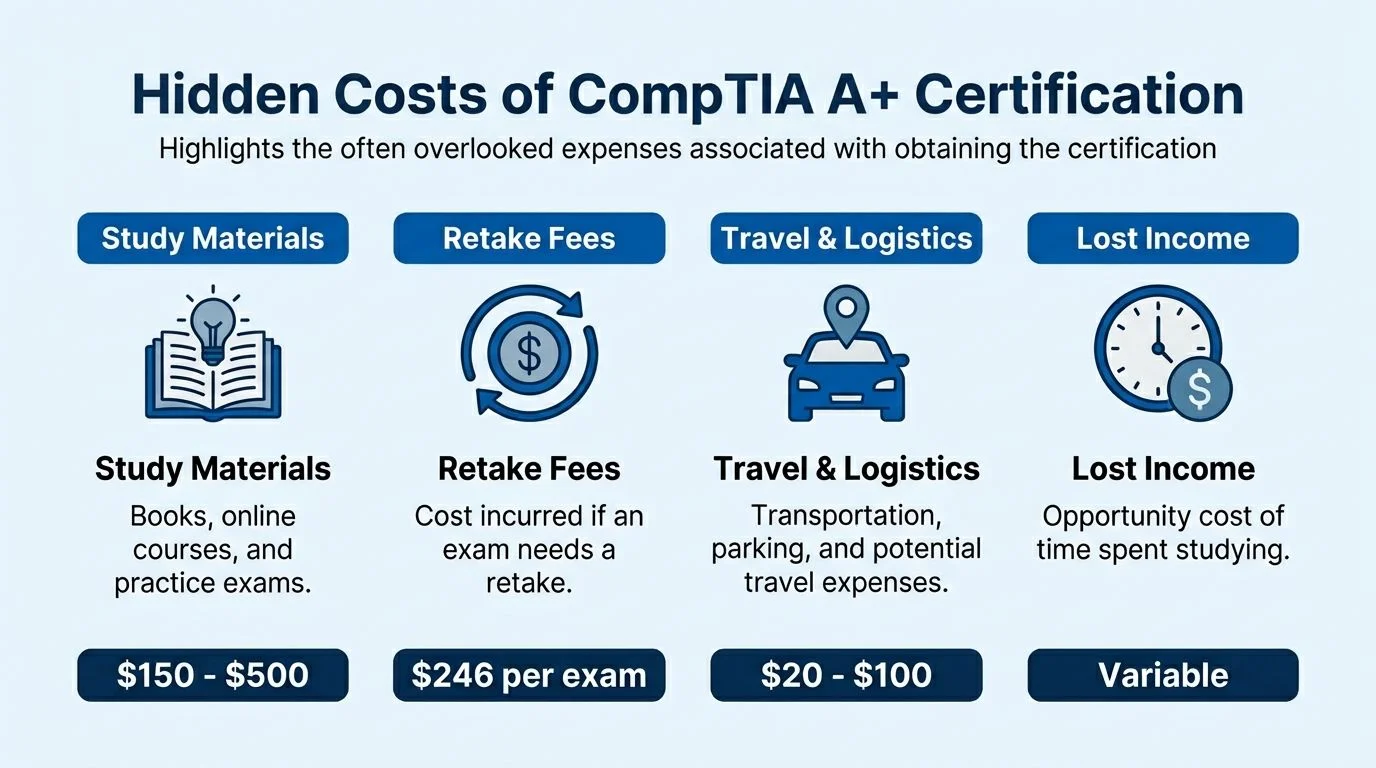
According to this analysis of hidden A+ expenses, the total cost can exceed $1,300 over three years when hidden costs are included. The same source says exam fees often fall in the $492 to $530 range, study materials can cost $30 to $500, and a single retake adds another $246+.
The costs that don’t show up on the first checkout page
The exam voucher is just the beginning. Real candidates usually pay for at least some of the following:
- Study tools: Books, practice exams, video courses, flashcards, or labs.
- Retakes: One weak exam day can reset part of your budget.
- Logistics: Travel, parking, time off work, or the friction of rearranging your schedule.
- Renewal: You don’t buy A+ once and keep it forever.
If you want to reduce those avoidable costs, start with The Hidden Costs. Good practice resources won’t guarantee a pass, but they can help you avoid the most expensive mistake in this process: paying retail twice for the same exam.
Retakes are the budget killer
The single biggest hidden cost is the one candidates try not to think about. Failing one exam means you pay again.
That risk changes how you should buy prep. Spending modestly on good study materials is usually smarter than gambling on underpreparation. I’d rather see a candidate buy targeted practice support than pay for the same exam twice.
Don’t compare the cost of study materials to zero. Compare it to the price of a retake.
Cheap prep can become expensive prep
Free resources can help, especially if you already have technical experience. But free and scattered is not the same as efficient. When candidates bounce between random videos, forum posts, and outdated notes, they often stretch their prep timeline and increase the chance of a failed first attempt.
That’s why total cost matters more than sticker price. The cheapest route on day one often becomes the costliest route by exam day.
Proven Strategies to Lower Your Certification Cost
One failed exam can turn a planned A+ budget into a much more expensive project. If you want the best return on this certification, manage the full cost, not just the voucher price.
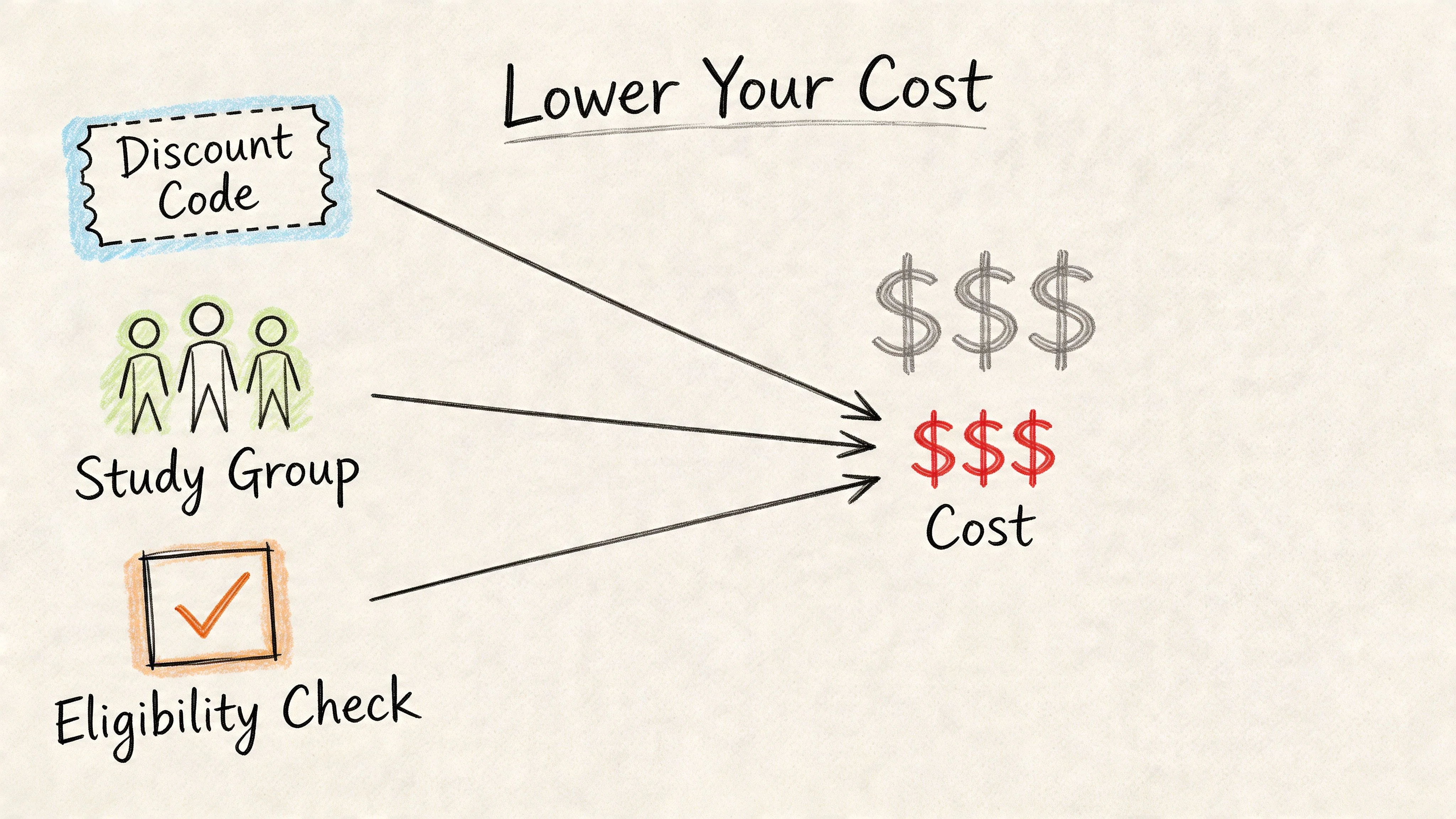
The smartest candidates treat A+ like a small investment portfolio. They control purchase timing, use every legitimate discount available, and spend on prep that lowers the chance of a retake. That approach protects your total cost of ownership, which is what matters.
Buy with a pass plan
Start by lowering the amount you pay out of pocket.
- Ask your employer first: Many companies reimburse entry-level certifications for help desk and support staff. Get a yes or no before you buy anything.
- Check student pricing: CompTIA offers academic options through its CompTIA Academic Store for eligible students, which can cut exam costs if you qualify.
- Use authorized sellers only: A bad voucher deal is not a deal. Restrictions, expiration issues, or invalid codes can wipe out any savings.
- Schedule only after your scores are ready: Booking too early pushes candidates into rushed prep and increases retake risk.
Cost control starts before checkout.
Choose prep based on retake prevention
Candidates new to IT usually waste money in one of two ways. They buy too little support and fail, or they buy five overlapping resources and use none of them well.
Pick one core study system, one reliable set of practice questions, and only add labs if you need hands-on repetition. That is usually enough. Random resource stacking drives up cost without improving your odds much.
If you need a tighter study plan, Proven Strategies can help you narrow your prep and avoid duplicate purchases.
Compare bundles to à la carte purchases like an adult budget decision
Bundles are not automatically cheaper. They are cheaper only if you will use what is inside them.
A voucher-only purchase makes sense for experienced technicians who already have strong fundamentals and do not need much prep. A bundle makes more sense for career changers, first-time test takers, or anyone who knows they need structure, practice exams, or a retake cushion. CompTIA's A+ product page is the right place to compare current voucher, retake, and bundle options before you commit: CompTIA A+ certification options.
The rule is simple. Buy the package that lowers your expected total spend, not the one with the lowest sticker price.
Free up cash without gutting your prep
If the budget feels tight, cut personal spending for a short window instead of stripping your study plan down to scraps. A few months of disciplined spending can cover better prep materials and reduce the chance that you pay for another exam attempt. This guide on how to reduce your monthly expenses is useful for that exact problem because it focuses on practical cuts, not fantasy budgeting.
That trade is usually worth it. Small recurring expenses disappear fast. A failed exam bill does not.
My recommendation
If you already work on PCs and solve tickets every week, keep your spend lean and focused. If you are starting from scratch, spend enough to pass the first time.
That is the savings strategy.
Planning for the Long Term A+ Renewal Costs
A+ is not a lifetime credential. If you’re serious about using it as a career foundation, you need a renewal plan before your first exam date.
According to this review of A+ renewal options, renewing CompTIA A+ every three years costs a minimum of $75 through Continuing Education Units. The same source notes that earning a higher certification such as Network+ for $358 can automatically renew A+ at no added renewal fee.
The cheapest renewal isn’t always the smartest one
Paying the renewal fee keeps the credential active. That’s fine if all you need is to maintain your status.
But if you’re building an IT career, I usually prefer the stacking approach. Earning Network+ doesn’t just renew A+. It also gives you another marketable certification and moves you past entry-level support knowledge into stronger networking fundamentals.
Long-game move: If you’re going to spend money renewing A+, ask whether that same money could buy your next credential instead.
Think in certification paths, not isolated fees
A+ works best as the first rung, not the final destination. If you know you’ll keep moving into networking, systems, or security, then the long-term cost conversation changes.
Use this decision filter:
| Renewal choice | Best when |
|---|---|
| Pay the minimum renewal cost | You only need to maintain A+ and don’t plan to certify further right now |
| Earn Network+ | You want a stronger resume and a renewal strategy that also advances your skill set |
That’s the kind of decision that separates a one-off exam buyer from someone building a career stack. The second person usually gets better return from every dollar spent.
FAQ Answering Your Top A+ Cost Questions
Do I have to pay for two separate exams
Yes. A+ requires two exams, Core 1 and Core 2. They are purchased separately, scheduled separately, and passed separately.
If I fail one exam, do I only repay for that one
Yes. You don’t need to repay for the exam you already passed. But you do need to buy a new voucher for the exam you failed, which is why retake risk matters so much in your budget.
Does the exam code change the price
The current exam codes identify which version of A+ you’re taking, but the bigger cost issue is timing. When CompTIA updates exams over time, candidates who delay too long can end up repurchasing materials or reworking their study plan. That’s another reason not to drag the process out.
Are bundles worth it
They are for many candidates. If you need study support and want retake protection, a bundle can reduce the chance that your total cost spirals upward. If you already have strong skills and a solid prep system, standalone vouchers can be enough.
How much should I budget in real life
Don’t budget only for vouchers. Budget for the full certification path, including prep and the possibility of a retake. That gives you a realistic number instead of a fantasy number.
Do A+ costs vary internationally
Yes, regional pricing can vary. U.S. pricing is often used as the benchmark, but candidates outside the U.S. should verify local voucher pricing and taxes before buying. The safest move is always to check the official or authorized purchase channel for your region.
Should I buy the voucher first and then start studying
No. That’s backwards for many people. Start with the exam objectives and a realistic prep plan. Buy when you know how you’re going to study, when you’re likely to sit the exam, and whether a bundle or standalone voucher fits your situation better.
If you want to earn A+ without wasting money on bad prep, random resources, or avoidable retakes, Mindmesh Academy has Core 1 and Core 2 courses built for exactly that. It gives you structured certification prep, adaptive learning, and study tools designed to help you learn the material efficiently and pass with confidence.

Written by
Alvin Varughese
Founder, MindMesh Academy
Alvin Varughese is the founder of MindMesh Academy and an enterprise architecture leader. An electrical engineer by training, he moved from factory automation in South Africa to cloud architecture at GE Appliances and Humana (Fortune 50), and holds 20 professional certifications including AWS Solutions Architect Professional, Azure DevOps Engineer Expert, and Microsoft Agentic AI Business Solutions Architect. He built MindMesh Academy after interviewing too many highly certified candidates who couldn't answer basic questions: the goal is prep that makes you better at the job, not just able to pass the exam.