How Hard Is CISSP? A Realistic Prep Guide
How difficult is the CISSP exam? To be blunt: it is one of the hardest certifications to earn in the industry. The exam has a reputation for being demanding, but the difficulty usually stems from factors beyond memorizing technical facts. You cannot simply cram your way to a passing score.
The main challenge lies in adopting a risk-management mindset. Success requires you to think like a manager rather than a technician. This specific approach remains a vital skill for any aspiring security leader.
How Challenging Is The CISSP Exam, Really?
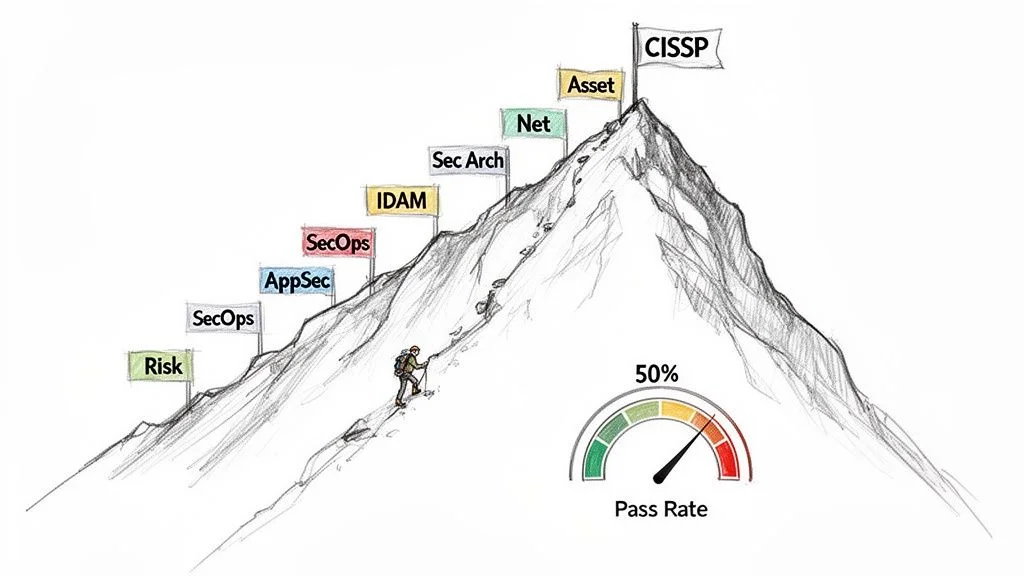
The CISSP has a reputation that often intimidates even seasoned professionals, and there are valid reasons for this. This certification exam rarely tests how fast you can configure a firewall or how well you write scripts. Instead, it serves as a rigorous evaluation of your strategic judgment. To pass, you must prove you can act as a cybersecurity leader who understands the bigger picture. The biggest obstacle for most is the mental shift required to stop thinking like a technical specialist and start thinking like a risk-aware security manager.
Imagine you are preparing for a cybersecurity decathlon. You do not need to be the single best world-record holder in one specific event, such as sprinting or long jump. However, to succeed, you must show steady proficiency and strength across every single event. The CISSP operates on this same principle. It demands that you show expertise across eight distinct domains. These subjects range from the high-level concepts of risk management to the technical details of software security. If you focus too much on one area while ignoring others, you will struggle.
The Statistics Speak Volumes
Hard data provides a clear look at how difficult this test is for most people. Industry reports show that global first-time pass rates for the CISSP are roughly 50% (verify current pass rate trends on the official (ISC)² website).
This means about half of the people who sit for the exam on their first try fail to meet the passing standard. This statistic shows why the certification is so respected in the field. It is not an exam you can pass by simply memorizing definitions. It requires you to understand how to apply those definitions in complex scenarios.
The CISSP exam does not look for the solution that is the most technically advanced. It expects you to choose the solution that best aligns with business goals and manages risk effectively. This change in perspective is exactly why many expert engineers and technicians find the exam difficult.
To understand the specific obstacles you will face, look at the summary below of the factors that define the difficulty of the CISSP.
CISSP Difficulty At A Glance
| Factor | Details |
|---|---|
| Pass Rate | Roughly 50% for those taking the exam for the first time, showing the high standard required (verify current stats on vendor site). |
| Primary Challenge | The requirement for "mile wide, inch deep" knowledge across 8 domains. |
| Exam Format | Uses Computerized Adaptive Testing (CAT) to change the difficulty of questions based on your previous answers. |
| Thinking Style | Moves away from engineering and toward a managerial, risk-focused approach. |
| Study Commitment | Most people who pass spend 3-6 months on a structured study plan (verify recommended hours based on your experience). |
This summary highlights the heart of the challenge. You are dealing with a massive amount of information combined with an adaptive testing format that tests your limits.
It's All About Breadth, Not Just Depth
The CISSP mirrors the real-world duties of a Chief Information Security Officer (CISO). One hour, a CISO might engage in a technical analysis of encryption protocols with an engineering team. An expert with an AWS Certified Security - Specialty (SCS-C03) certification would handle this well. The next hour, that same CISO might be in a boardroom explaining a risk analysis and a budget request to the CEO. This is a task that a PMP-certified manager or an ITIL practitioner would recognize. The CISSP forces you to be comfortable in both of those worlds.
To pass, you must show that you are fluent in several broad topics, including:
- Security and Risk Management: You must understand the core principles of security governance, how to comply with regulations, and the legal requirements for data protection.
- Asset Security: This involves knowing how to classify and handle data throughout its entire life, ensuring that the most sensitive information in an organization stays protected.
- Security Architecture and Engineering: You will need to understand the concepts used to design and build secure systems, including how to handle hardware and software vulnerabilities from the start.
- Identity and Access Management: This covers the systems and processes used to control who can get into specific resources and what they are allowed to do once they are inside.
This wide range of requirements is why being an expert in only one area, like Azure cloud security or network hardware, is not enough. The exam is strictly designed to find any gaps in your knowledge across the entire field of security. If you want to see how these concepts look in a testing environment, check out our guide on CISSP sample questions to see the managerial mindset in action.
Reflection Prompt: How will you adjust your current professional habits, whether in cloud platforms or network engineering, to meet this "mile wide" CISSP requirement?
Understanding The Adaptive Exam Format
The CISSP exam is not a traditional static test where every candidate answers the same set of questions in the same order. Instead, it uses a format called Computerized Adaptive Testing (CAT). This method is a primary reason why the exam has a reputation for being difficult. View the CAT format as a live conversation with an experienced professional who is testing the limits of your expertise. The exam begins by giving you a question of moderate difficulty to establish a baseline.
If you answer correctly, the next question will be harder. If you answer incorrectly, the next question will be slightly easier. This adjustment process does not exist to trick you. It is the testing engine’s way of constantly narrowing down your actual level of competence across the eight domains. This dynamic approach allows the system to evaluate your skills much faster than a standard linear exam.
Pinpointing Your Competency Level
The goal of the CAT format is to determine if you meet the minimum passing standard with the highest possible efficiency. After every answer you submit, the system updates its evaluation of your ability. The exam ends when the system reaches 95% statistical confidence regarding whether you have achieved the required proficiency level. This adaptive logic is why the length of the exam can vary between 125 to 175 questions.
- High performance: If you show a strong grasp of the material, the system will reach that confidence threshold early. This allows the test to finish quickly, often at the 125-question mark. This indicates a passing result.
- Low performance: If you struggle with the questions, the algorithm can also become certain that you will not reach the passing standard. In this case, the test ends early with a failing result.
- Inconsistent performance: If your performance stays near the passing line, the system needs more data to make a final decision. The exam will continue to provide questions, up to the 175-question maximum, to reach a definitive assessment.
This testing method creates specific pressures. You cannot go back to previous questions, skip a question to answer it later, or review your work at the end of the session. Once you submit an answer, it is final. This forces you to be decisive and careful with every choice you make. For more details on this methodology, you can read our guide on what is adaptive learning.
The Scoring System and Time Limits
To pass the CISSP, you must earn a score of 700 out of 1000 points (verify current requirements on the official (ISC)² site). This is a scaled score, not a simple percentage. You do not pass by merely getting 70% of the questions right. Because the questions vary in difficulty, they are weighted differently. Getting a hard question right adds more to your score than answering an easy one. The system calculates your final standing based on the difficulty level of the items you handle successfully.
You have four hours to complete the exam. For most people, this is enough time to finish the required questions. The real difficulty is not the timer but the mental endurance required to stay sharp. Because the exam is adaptive, it will keep challenging you as long as you are doing well. You will not get easy questions that allow you to rest your brain. You must maintain focus while the system targets your weak spots for the entire duration.
The exam includes 25 unscored pre-test questions. These are experimental items used to gather data for future exams, and they do not affect your final score. You will not know which questions are unscored. Because of this, you must treat every question as if it counts toward your result.
The CAT algorithm is a logical system designed to prove with statistical certainty that your score is above the 700-point mark. Even with this logic, the exam remains a major hurdle. Global pass rates for first-time candidates are often around 50% (verify recent data on (ISC)² or official provider sites). This high failure rate shows how rigorous the test is. If you want to see more data, this detailed breakdown from Balanced Sec offers more context on the numbers. Knowing how this format works is the first step in your preparation. You are preparing for a test that will probe your knowledge until it knows exactly how much you understand.
Why the 8 CISSP Domains Are Your Biggest Hurdle
The sheer breadth of the CISSP curriculum is the primary challenge for most candidates. This is not a certification where you can succeed by cramming one or two technical subjects. It is famous for being "a mile wide and an inch deep." This requires you to build a broad understanding across the entire cybersecurity field. When people ask about the difficulty of the CISSP, the answer usually centers on the requirement to master eight distinct domains.
You are not training to be a specialized cryptographer or a network engineer focused solely on AWS Networking. Instead, the (ISC)² expects you to function as a security executive. You must understand how different security pieces fit together to protect the business. This role requires a broad view of the organization.
This perspective is often called the manager’s mindset. The exam does not prioritize your ability to remember technical specifications or CLI commands. It tests your judgment. You will often be placed in the role of a risk advisor. The questions will ask you to determine the best decision for the company while considering various constraints.
You will encounter questions where multiple answers are technically accurate. Your job is to choose the option a senior manager would pick. This usually means choosing the answer that follows established policy, protects the business mission, and reduces risk most effectively. The most advanced technical solution is not always the correct one on this exam.
A Tour of the CISSP Battleground
To understand the scale of this exam, you must look at the scope of the material. Each of the eight domains is a complex professional field. The CISSP requires you to show proficiency in all of them. If you fail to meet the minimum standard in even one domain, you fail the entire exam.
Here is an analysis of the first four domains:
- Security and Risk Management: This domain serves as the foundation for the entire certification. It covers governance, compliance, and legal issues. You must understand frameworks like GDPR or HIPAA and how they impact security posture. It involves creating security policies and business continuity plans. If you hold a PMP certification, you will recognize the focus on governance. ITIL experts will see similarities to service strategy.
- Asset Security: This domain focuses on the protection of data throughout its entire lifecycle. You are responsible for identifying what the organization owns and how to protect it. This includes information classification, data handling procedures, and privacy protections. You must know how to secure data while it is being created, stored, used, shared, and destroyed.
- Security Architecture and Engineering: Think of this as the design phase of a digital fortress. You must understand the principles of building secure systems. This involves the application of cryptography and the study of secure models like Bell-LaPadula and Biba. You will also learn to identify common vulnerabilities in system hardware and software.
- Communication and Network Security: This area covers the pathways that information travels. You must secure the network infrastructure and the communication channels themselves. This involves understanding the OSI model, securing wireless networks, and defending against network-based attacks.
Many candidates find Security and Risk Management to be the most difficult area. It focuses on business strategy rather than hardware. This transition can be hard for people who have spent their careers in technical roles. If you struggle with these concepts, you may want to look at ways to Fix Your Technology Risk Management Framework to see how these theories work in a real business environment.
The exam uses an adaptive format rather than a static list of questions. The testing engine adjusts the difficulty of the questions based on your previous answers.
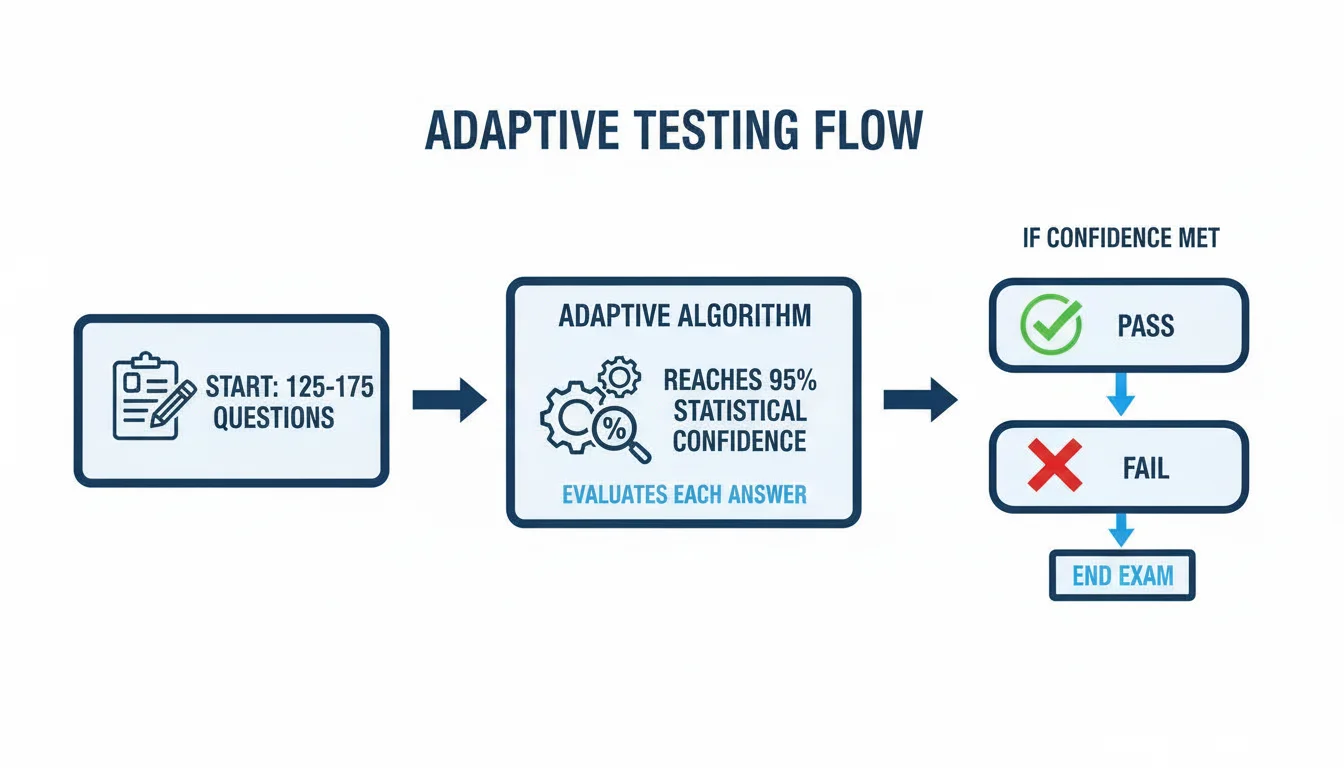
As the chart shows, the Computerized Adaptive Testing (CAT) format aims for 95% statistical confidence in your score. The exam can end after just 125 questions if you are performing exceptionally well or very poorly. Because the system is trying to find your exact limit, every answer you give changes the path of the exam.
The Final Four Domains
The second half of the curriculum focuses on security operations and the development of new tools.
- Identity and Access Management (IAM): This domain covers how users are identified and how they gain access to resources. You must design systems for authentication and authorization. You will learn about multi-factor authentication, single sign-on, and managing the identity lifecycle. You might apply these concepts to an Azure Active Directory or an AWS IAM setup. The goal is to ensure that people and machines have only the access they need to do their jobs.
- Security Assessment and Testing: You cannot know if your security works until you test it. This domain focuses on finding weaknesses before an attacker does. It involves security audits, vulnerability scans, and penetration testing. You must know how to analyze the results of these tests and use them to improve the organization's security posture.
- Security Operations: This is the day-to-day work of a security team. It covers incident response, disaster recovery, and digital forensics. You will study how to monitor for threats and how to manage patches across the organization. This domain is where the policies created in Domain 1 are put into practice to keep the business running safely.
- Software Development Security: Security must be part of the software creation process. This domain covers the Software Development Life Cycle (SDLC). You will learn how to include security requirements at the beginning of a project rather than at the end. It touches on secure coding practices and modern methods like DevSecOps.
The list of eight domains is long, but it provides a clear map for your study. You can use the weights of each domain to decide where to spend your time.
Breakdown Of The 8 CISSP Domains
The following table shows the eight domains, their weights on the exam, and the main topics you need to study. Use this to organize your preparation.
| Domain | Exam Weight | Core Concepts Covered |
|---|---|---|
| Security and Risk Management | 16% | Governance, Compliance, Legal & Regulatory Issues, Policies, Business Continuity. |
| Asset Security | 10% | Information Classification, Data Handling, Privacy Protection, Data Lifecycle Management. |
| Security Architecture and Engineering | 13% | Secure Design Principles, Cryptography, Secure Models (e.g., Bell-LaPadula), System Vulnerabilities. |
| Communication and Network Security | 13% | Secure Network Components, Secure Communication Channels, Network Attacks. |
| Identity and Access Management (IAM) | 13% | Access Control Techniques, Authentication Methods, Identity as a Service (IDaaS). |
| Security Assessment and Testing | 12% | Vulnerability Assessments, Penetration Testing, Security Audits, Log Reviews. |
| Security Operations | 13% | Incident Response, Disaster Recovery Planning, Digital Forensics, Patch Management. |
| Software Development Security | 10% | Secure Coding Practices, SDLC Integration, Application Security Testing (SAST/DAST). |
Memorization is not enough to pass this exam. You must understand how these domains interact. For example, a failure in Software Development Security (Domain 8) can lead to a data breach that requires an Incident Response (Domain 7) and triggers a legal notification requirement (Domain 1). The CISSP tests your ability to see these connections and apply security principles to solve complicated business problems. That understanding is the most important part of your preparation.
The exam covers a massive amount of information. You might find yourself switching from a discussion on the legalities of the Wassenaar Arrangement to the technical specifics of Kerberos authentication within three questions. This mental agility is what makes the CISSP difficult. You must remain calm even when the exam asks about a topic you haven't reviewed in weeks.
Because the CAT format focuses on finding your weaknesses, you should expect the questions to get harder as you answer correctly. If the questions feel like they are becoming impossible, it often means you are doing well. The system is pushing you to see if you can still apply the manager's mindset under pressure. Focus on the core concepts of each domain and keep the business mission in mind. If you can do that, you will be in a strong position to pass.
Common Reasons Even Experienced Professionals Fail
It is a scenario that happens often. A seasoned cybersecurity professional with years of real-world experience approaches the CISSP with confidence, yet they often leave feeling blindsided. This occurs because the CISSP does not strictly evaluate technical skill. Instead, it assesses your ability to think like a senior security manager or a risk advisor.
Your daily work might involve building secure networks, similar to the work of an Azure Network Security Engineer, but the exam expects you to identify the most cost-effective and business-aligned solution. The exam focuses on risk mitigation rather than just technical implementation. This shift in perspective is the greatest hurdle for most technical experts. You must stop thinking like a fixer and start thinking like a decision-maker who balances security with business needs.
Over-Reliance On Technical Knowledge
Many candidates fall into the trap of relying too much on narrow technical expertise. You might be an expert with firewall configurations and routing protocols. You might be a master of specific cloud security services, like an AWS Certified Security Specialist. However, specialized depth does not prepare you for questions about the software development lifecycle, global legal frameworks, or complex governance models.
The CISSP is famously described as "a mile wide and an inch deep." It probes for gaps across the eight domains (verify current domain structure on the (ISC)² site), which include Security and Risk Management, Asset Security, Security Architecture and Engineering, Communication and Network Security, Identity and Access Management, Security Assessment and Testing, Security Operations, and Software Development Security. If your professional background focuses on only one or two of these areas, the exam exposes those weaknesses.
Consider a senior network architect with 15 years of experience (verify professional experience requirements on the (ISC)² site). They encounter a question about securing a new web application. Their immediate technical instinct might be to deploy a next-generation firewall with an advanced Intrusion Prevention System. However, the best CISSP answer might be to verify that the application was built according to a secure coding policy and underwent proper testing. This exemplifies the classic technician-versus-manager dilemma inherent in the exam.
The CISSP prioritizes process, policy, and governance over specific products. It is not about selecting the most expensive security tool. It is about understanding how to implement the right procedures to manage organizational risk effectively.
Technically brilliant individuals often fail because they select answers that are correct in a vacuum but strategically wrong for the exam. They focus on how to solve the problem immediately rather than how to manage the risk long-term.
Underestimating The Scope And Format
Underestimating the curriculum volume or the mental strain of the adaptive format is another major mistake. Many professionals believe their expertise in a few domains will be enough to pass. This is rarely true. You must show competence across all eight domains to succeed. You cannot simply use your strengths to compensate for a lack of knowledge in other areas.
The Computerized Adaptive Testing (CAT) format adds psychological pressure. As you answer, the exam adjusts the difficulty of the questions. A string of incorrect answers can be frustrating because you cannot revisit or change a previous answer. Every click is final. This increases the stakes for every single question you face. You must remain calm even when the questions seem to be getting harder, as that is often a sign that you are doing well.
This combination of a massive curriculum and a high-stakes format leads to a low success rate for first-time testers. Industry estimates often place the first-time CISSP pass rate at around 20-30% (verify current statistics on the (ISC)² site). The complexity of the exam is well-documented and requires a serious, structured study plan.
Other common mistakes include:
- Vendor-Specific Thinking: Practical knowledge of a particular vendor's products, such as Cisco, Palo Alto, or specific cloud platforms, is not helpful. The exam is vendor-neutral. You must understand the underlying concepts rather than specific command-line interfaces or proprietary features.
- Ignoring "Weak" Domains: You cannot gloss over domains you dislike or have less experience in. You must demonstrate proficiency across every single domain to pass. If you are weak in encryption or legal regulations, you must dedicate extra time to those subjects.
- Failing to Adopt the Managerial Mindset: This is the most critical error. You must answer every question from the perspective of a risk advisor or a Chief Information Security Officer (CISO). Do not answer as a hands-on engineer or a technical specialist.
Passing the CISSP is less about the volume of technical facts you recall and more about how you apply that knowledge through a managerial lens. A strategic study plan and a consistent effort to think like a CISO will be more effective than raw technical talent alone. Focus on the "why" and the "how much" rather than just the "how."
Building Your Realistic CISSP Study Plan
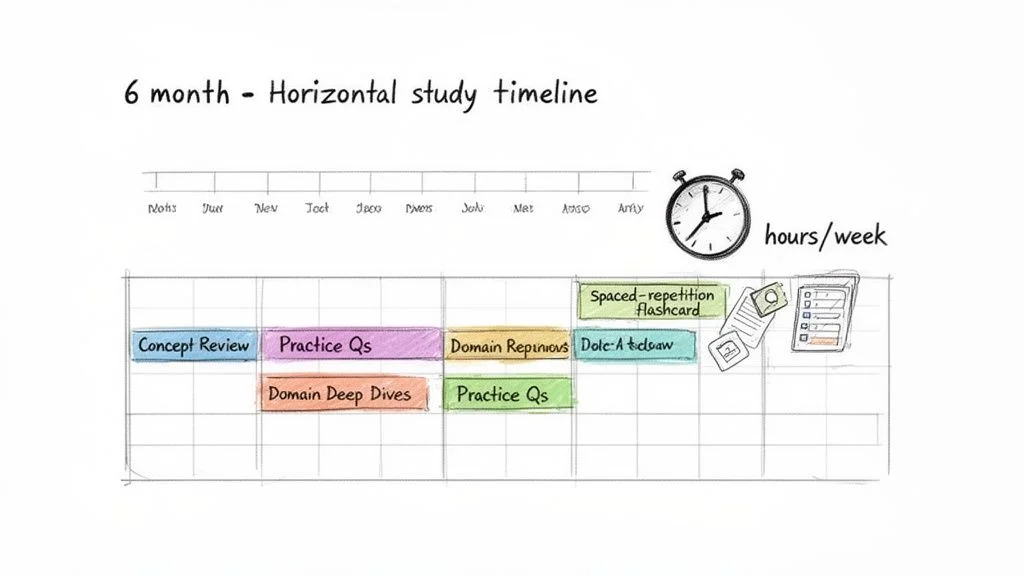
Acknowledging that the CISSP is a difficult hurdle is the first step toward passing; the second is deciding exactly how to clear it. When candidates ask, "How hard is the CISSP?" the answer usually depends on the structure of their preparation. Attempting to take this exam without a specific plan makes the material feel impossible to master. However, if you use a solid, well-structured study schedule, this intimidating test becomes a goal you can actually reach.
Your best study timeline depends on two main things: what you already know and how much time you can commit each week. Most people who pass the exam find their rhythm within a 3-to-6-month window. During this time, they usually dedicate 10-15 hours per week to study. If you try to spend less time than this, you run the risk of "cramming." Cramming is a failed strategy for an exam that covers such a wide range of technical and managerial topics. You need time to let the concepts sink in.
The 6-Month Marathon Plan (For Busy Professionals)
This plan is for people who have full-time jobs, families, and other daily responsibilities. The goal of the marathon plan is to make steady progress every day. This prevents burnout and gives your brain time to move information from short-term memory into long-term understanding.
- Months 1-2: Detailed Domain Reviews. Spend your time looking at one or two domains each week. Your main goal here is to understand the concepts, not just to memorize words. You should read the official study guides and watch high-quality video lessons. As you go, write down notes on core ideas like risk management frameworks or identity and access management.
- Months 3-4: Reinforce and Identify Gaps. At this point, you should stop just reading and start testing what you know. This is when you begin using practice questions to find your weak spots. Do not worry about getting a perfect score yet. Use these questions as a tool to see which of the eight domains require more of your attention.
- Month 5: Build Exam Stamina. The CISSP uses a Computerized Adaptive Testing (CAT) format. This means the exam adjusts its difficulty based on your answers. To prepare, you need to take full-length, timed practice tests. This helps your brain get used to the pressure of a long exam. After every test, you should spend time carefully analyzing every incorrect answer. You need to understand why you got a question wrong and which specific concept you misunderstood.
- Month 6: Final Polish and Review. In the last few weeks, do not try to learn entirely new topics. Instead, focus on your weakest areas. Drill the facts, formulas, and process steps that you find hardest to remember.
This slow-and-steady approach works because it builds a strong foundation. Trying to speed-read a thousand pages in a single month rarely leads to success. To make the most of your time, you should also focus on how you take notes. You can find ways to take notes faster and smarter to ensure your study sessions are as effective as possible.
The 3-Month Sprint Plan (For Dedicated Learners)
If you can spend more time studying—around 20-25 hours per week—the 3-month sprint is a viable option. This path requires a high level of discipline and the ability to focus on security topics for hours at a time without many distractions.
The sprint follows the same basic structure as the marathon plan but moves twice as fast. You will need to finish a new domain every three or four days. Immediately after finishing a domain, you should take practice quizzes to lock in the information. This strategy works best if you can fully immerse yourself in the material and stay away from outside interruptions.
No matter which timeline you pick, consistency is essential. Studying for one hour every single day is much better than trying to study for seven hours straight on a Sunday. This is a proven learning principle. Regular, daily exposure to the material is the best way to remember the complex information required for the CISSP.
Your Secret Weapon: Spaced Repetition
The CISSP Common Body of Knowledge is huge. It is very easy to forget what you learned in Domain 1 by the time you finish Domain 8. This is where a technique called spaced repetition becomes your best tool.
Spaced repetition does not involve reading your notes over and over at random. Instead, it uses a schedule to show you information right before you are likely to forget it. It acts like a tutor who knows exactly which parts of the syllabus are getting fuzzy in your mind. By reviewing those specific topics at the right time, you strengthen your memory of them.
This scientific method is how platforms like MindMesh Academy help you learn. The system uses spaced repetition and adaptive paths to create a review schedule just for you. It tracks your progress and finds your individual weak spots. Then, it shows you the most relevant flashcards and practice questions at the best times. This process ensures you are not just memorizing facts for a week, but truly mastering them for the long term.
A Sample Weekly Schedule
This table shows a typical week for someone on the 6-month plan. It balances different types of learning so you don't get bored or overwhelmed.
| Day | Activity | Duration | Focus |
|---|---|---|---|
| Monday | Concept Review | 2 Hours | Read chapters on Domain 3 (Security Architecture and Engineering) |
| Tuesday | Active Learning | 1.5 Hours | Watch video lectures and create flashcards for Domain 3 |
| Wednesday | Practice Questions | 2 Hours | Complete a 50-question quiz on Domain 3 |
| Thursday | Spaced Repetition | 1 Hour | Review flashcards from previously studied Domains 1 and 2 |
| Friday | Detailed Review | 2 Hours | Research and review incorrect answers from Wednesday's quiz |
| Saturday | Mixed Review | 2.5 Hours | Take a mixed-domain practice test covering multiple topics |
| Sunday | Rest | - | Rest and recharge to let your brain process what you learned |
Reflection Prompt: How can you change your current daily routine to include spaced repetition and ensure you remember the details of all eight CISSP domains?
A clear study plan takes the mystery out of the CISSP. By breaking this massive exam into smaller, manageable tasks and using smart learning methods, you turn a difficult certification into a series of achievable steps. Success on the CISSP is not about being a genius; it is about having the discipline to follow a plan every day until you are ready.
Frequently Asked Questions About The CISSP
A solid study plan is the first step, but specific questions always come up as you work through the eight domains. Clear answers help you stop worrying about the process and let you focus on the technical details. We have gathered the most common questions from CISSP candidates to help you understand what to expect during your preparation.
How Much Experience Do I Really Need For The CISSP?
The official (ISC)² requirement is five years of cumulative, paid, full-time work experience in at least two of the eight domains. This is a baseline for the full CISSP certification.
You can shorten this timeline if you meet certain criteria. A relevant four-year college degree or an approved security certification provides a one-year experience waiver. This reduces your required work history to four years.
If you lack the required experience, do not be discouraged. You can take the exam now and become an Associate of (ISC)². This designation proves to employers that you have the knowledge to pass the test. You then have a six-year window to earn the work experience needed for the full certification. This is a common path for career changers or recent graduates who want to demonstrate their commitment to the profession.
Is The CISSP Harder Than CISM Or Security+?
Yes, it is widely accepted that the CISSP is more difficult than both the CISM and Security+.
CompTIA Security+ is an entry-level exam. It is great for people starting out because it focuses on basic security principles and terminology. The CISM from ISACA is a management-focused credential. While highly respected, it is more narrow. It looks specifically at governance, risk management, and incident response from a manager's view.
The CISSP is harder because it is so broad. People call it "a mile wide and an inch deep" for a reason. You are tested on technical details and high-level strategy at the same time. You must be able to switch from thinking about encryption protocols to thinking about enterprise-wide risk management. This range is what makes it a top-tier certification. If you are comparing your options, our cybersecurity certifications guide provides a side-by-side look at these paths.
What Is The Best Way To Use Practice Exams?
Practice exams are a tool for diagnosis, not a way to memorize facts. Use them to find exactly where you are struggling. They also help you get used to the specific way (ISC)² words their questions. The exam often uses phrasing that forces you to choose the "best" answer among several correct-sounding options.
Do not just look at your score when taking a practice test. You need to look at why the correct answer is right and why the other options are wrong. In the CISSP, an answer might be technically correct but wrong because it does not follow a risk-based management approach. Analyze the logic of every question. If you understand why a choice was incorrect, you are less likely to make that mistake on the real test. Developing this analytical skill is how you build the CISSP mindset and ensure you are ready for exam day.
Spend your time studying the logic behind the answers. Learning how to analyze a problem will help you more than memorizing definitions. This is the best way to turn practice sessions into real improvement and ensure you feel ready for the testing center.
At MindMesh Academy, we build these learning strategies into our platform. We use adaptive learning paths and spaced repetition to help you study efficiently. Our technology creates a personalized plan that highlights your weak areas and helps you remember difficult concepts long-term. This approach helps you master the eight domains without wasting time on things you already know. Stop guessing and start using a system designed to help you pass with confidence.
Ready to Get Certified?
Prepare with expert-curated study materials at MindMesh Academy:
- CISSP Study Guide — Master all eight CISSP domains using this guide to prepare for the current exam.
- CISSP Practice Exams — Test your readiness with scenario-based practice questions to verify your knowledge.

Written by
Alvin Varughese
Founder, MindMesh Academy
Alvin Varughese is the founder of MindMesh Academy and an enterprise architecture leader. An electrical engineer by training, he moved from factory automation in South Africa to cloud architecture at GE Appliances and Humana (Fortune 50), and holds 20 professional certifications including AWS Solutions Architect Professional, Azure DevOps Engineer Expert, and Microsoft Agentic AI Business Solutions Architect. He built MindMesh Academy after interviewing too many highly certified candidates who couldn't answer basic questions: the goal is prep that makes you better at the job, not just able to pass the exam.