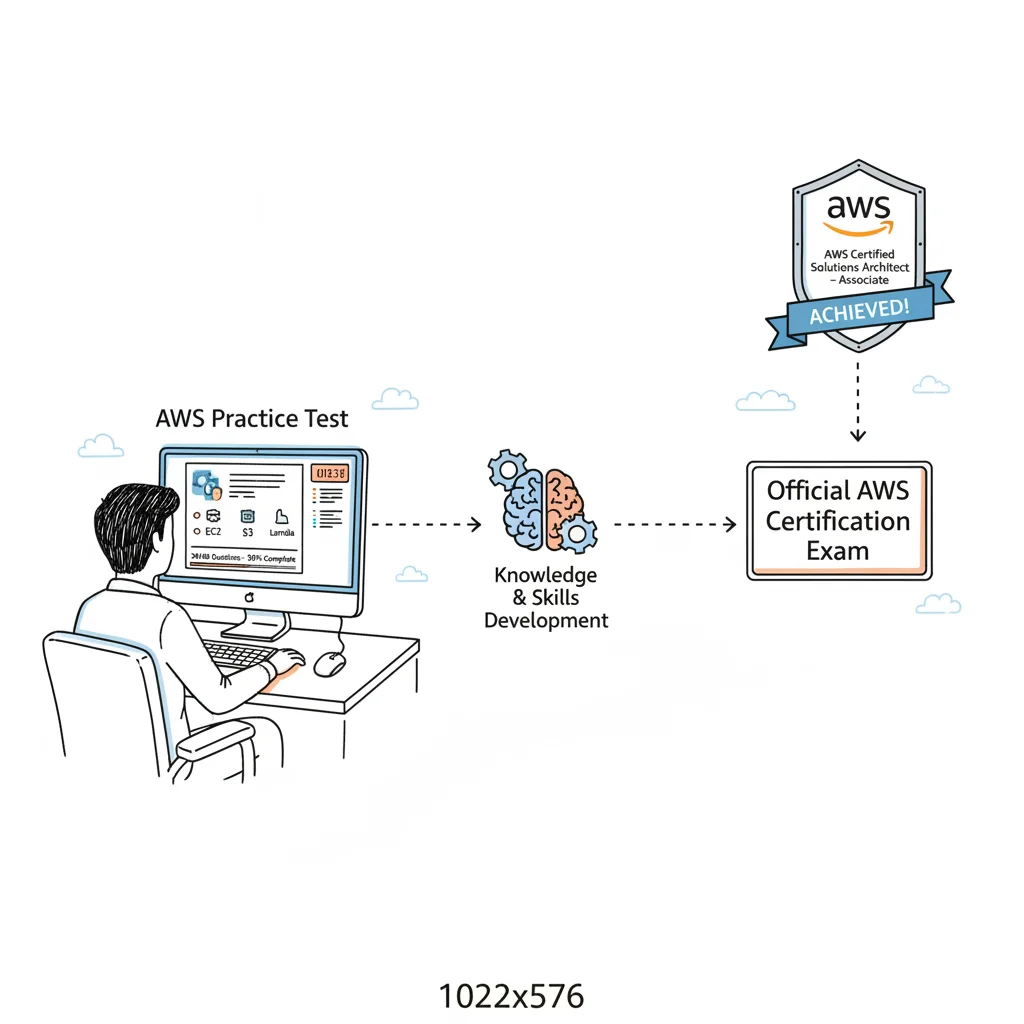
Master the AWS practice test to ace AWS Certification
Master the AWS Practice Test to Ace Your AWS Certification
Facing an AWS certification exam often feels like preparing for a high-stakes mission. For many IT professionals, the pressure is intense. A high-quality AWS practice test changes your preparation from a stressful cram session into a strategic, confidence-building process.
This tool functions like a flight simulator for your technical skills. It provides a safe, realistic environment where you can confront difficult scenarios and master time management. Using these tests helps you find specific knowledge gaps long before you arrive at the testing center. This active approach ensures you are prepared for the actual exam format and question types. At MindMesh Academy, we know that true mastery requires active engagement instead of passive reading. Practicing with these simulations allows you to walk into your exam appointment ready to pass with confidence.
Why an AWS Practice Test Is Your Most Important Study Tool

Consider a scenario that plays out for many IT professionals. You have spent years working with cloud infrastructure. You have built VPCs, managed S3 buckets, and successfully debugged complex Lambda functions. You might even feel like you can navigate the management console with your eyes closed. However, when you sit down for an official AWS Certification exam, you find yourself struggling. This happens because high-stakes exams for AWS, PMP, ITIL, or Azure require more than just technical knowledge. They test your ability to apply that knowledge under extreme pressure, interpret specific question phrasing, and manage a strict time limit.
Reading documentation or watching a series of video lectures is a passive way to learn. While these methods provide the raw information, they do not prepare you for the mental fatigue of a long exam. A high-quality AWS practice test changes your preparation from passive reading to active problem-solving. By facing scenario-based questions in a timed environment, you simulate the actual exam. You are no longer just memorizing service limits; you are training your brain to perform the specific tasks required to earn your certification.
From Niche Tool to Essential Strategy
Ten years ago, a practice test was often viewed as an optional extra for those who had extra time. That is no longer the case. Today, these tests are a vital part of a successful study plan. This change is driven by the massive growth of AWS. In the first quarter of 2024, AWS held roughly 32% of the global cloud infrastructure market. Because AWS dominates the industry, companies are constantly looking for people who have verified skills.
The data regarding career growth is clear. Professionals who hold an AWS Certification often see 20–25% higher salaries compared to their peers who are not certified (verify current market rates in your specific region). This financial incentive is a major reason why the competition for these credentials has increased. To stay ahead, you need a study strategy that produces results. You can find more details on these trends by looking at the latest industry insights regarding the future of cloud computing.
A practice test offers advantages that traditional methods cannot match. The table below outlines how these simulations bridge the gap between knowing the technical facts and being ready for the exam room.
Key Advantages of AWS Practice Tests
| Key Benefit | How It Prepares You for the Exam | The Traditional Study Alternative |
|---|---|---|
| Pinpoints Specific Weaknesses | These tests identify the exact AWS services or domains where you struggle. If you keep missing questions on IAM policies or VPC peering, you know exactly what to review. | You may have a vague feeling that you are "not ready," but you lack the specific data needed to fix your knowledge gaps effectively. |
| Builds Mental Stamina | Most AWS exams take several hours to complete. Practice tests train your focus so you do not burn out or lose concentration during the final hour of the actual test. | Passive study like watching videos does not prepare you for the sustained concentration required to answer 65 difficult questions in a row. |
| Demystifies the Exam Format | You become familiar with how AWS phrases its questions and how to spot "distractor" answers that look correct but fail to meet specific requirements. | You enter the testing center unprepared for the structure of the exam, wasting time trying to understand the question style instead of the technical content. |
| Reduces Test-Day Anxiety | Working through realistic simulations builds a sense of routine. This familiarity keeps you calm, helping you avoid the second-guessing that leads to simple mistakes. | Uncertainty often leads to stress. High anxiety can cause mental blocks and prevent you from recalling information you actually know. |
Using these tests allows you to optimize every hour you spend studying. You stop guessing if you are ready and start using data to guide your progress. This approach ensures you spend your time on the topics that will have the biggest impact on your final score.
The real value of an AWS practice test is not just the content of the questions. It is the experience of the pressure, the tricky wording, and the ticking clock. Think of it like pilot training. You can read every manual ever written about the principles of flight, but you still need hours in the cockpit before you fly solo. Practice tests are your cockpit time. They give you the experience needed to walk into the exam center with genuine confidence.
Reflection Prompt: Think about a time you took a difficult exam. Did the format or the time limit cause more stress than the actual subject matter? How would a realistic simulation have changed your approach?
What Makes a Great AWS Practice Test

It is easy to assume all practice resources offer the same quality, but following that logic is a costly mistake. Think back to the flight simulator comparison. A basic simulator might help you memorize where the dials are located, but a professional-grade version forces you to handle unexpected engine failures, severe weather, and difficult air traffic control instructions. A high-quality AWS practice test functions as a professional simulator for your certification path.
Official AWS exams do not prioritize the rote memorization of facts or service names. Instead, they test your ability to fix difficult problems by applying technical logic. Because the real test focuses on these abilities, your preparation material must go beyond simple multiple-choice questions. It must place you inside the technical challenges you will encounter on the day of the exam. If your study tools do not mirror this difficulty, you are not truly preparing for the test environment.
The Anatomy of an Effective Practice Exam
A high-quality practice tool is much more than a list of questions and answers. It is a structured environment designed to sharpen your logic and build your technical stamina. If the right components are missing, you are simply taking a quiz rather than training for a professional credential.
Effective study platforms offer different formats for different parts of your schedule. You might begin with short, focused quizzes that target one service at a time to build your foundational knowledge. As your exam date gets closer, you should shift toward full-scale simulations that cover the entire syllabus.
Here is what you should look for in an AWS practice test:
- Realistic Scenarios: Questions should look and feel like short case studies. They usually describe a specific technical roadblock or a business requirement. To get the answer right, you must identify the best AWS solution from a list of choices that often look very similar. This mimics the style of the actual exam.
- Detailed Explanations: This is a required feature for any serious student. Every answer choice—the correct one and all the incorrect ones—needs a clear explanation. This is where you actually learn. You need to know why a specific architecture is the right choice and why other options are less efficient or more expensive. This helps you learn how to think like a cloud architect.
- Up-to-Date Content: The AWS platform changes constantly. New services and features are released every week, and old ways of doing things become obsolete. A high-quality practice test is updated frequently to match the current exam blueprint. Using old material can lead you to learn incorrect patterns that will hurt your score on the real test.
When a practice test includes these three elements, you move past memorizing definitions. You begin to build a functional understanding of AWS architecture and the best practices used in the industry.
Simulating the Real Exam Environment
The pressure of the testing center is a major factor in whether a candidate passes or fails. The constant countdown of the clock and the mental energy required to read dozens of technical paragraphs can cause fatigue. This fatigue often leads to mistakes on questions that you would otherwise get right. This is why full-length, timed simulations are a mandatory part of your preparation.
Answering 65 to 75 difficult questions in a 130-minute window (for Associate-level exams like the AWS Certified Solutions Architect - Associate) or even longer for Professional-level tests requires significant mental stamina. You should verify the current question counts and time limits on the official AWS website before you schedule your appointment.
By practicing under these exact time limits, you improve your time management skills. You learn how to quickly find the main problem in a long question and how to ignore the filler text that exists only to distract you. You also learn how to pace yourself so you do not run out of time on the final ten questions. If you are targeting a specific credential, looking at a high-quality AWS Solutions Architect practice test from MindMesh Academy shows how a professional simulation should look and feel.
Finally, a useful practice test provides more than a simple pass or fail result. A percentage score does not tell you where you need to improve. You need a detailed report that breaks down your performance across the specific AWS domains listed in the exam guide, such as:
- Networking and Content Delivery
- Security, Identity, and Compliance
- Compute and Storage
- Cost Management
- Database Services
This data creates a feedback loop that shows you exactly where your knowledge is lacking. Instead of reviewing the entire book again, you can spend your limited study time on the specific topics where you are weakest. Without this data, your study sessions are essentially a guessing game.
Reflection Prompt: How does understanding the specific exam domains (like Security or Networking) change your approach to studying versus just a general "AWS knowledge" mindset?
How Practice Tests Give You a Strategic Advantage
Attempting to prepare for an AWS Certification exam by reading AWS documentation from start to finish is a slow and often frustrating strategy. Using an AWS practice test does more than show you potential questions; it changes your study approach entirely. It replaces the vague feeling that you need to study more with a clear, data-driven plan based on your actual performance. Instead of guessing where your knowledge stands, you use results to guide your path.
The most immediate advantage is finding exactly what you do not know. It is one thing to feel unsure about a specific service, but it is far more effective to see a report showing which AWS services and exam terms are causing you trouble. This provides the feedback you need to make actual progress toward your certification goals.
Pinpoint Weaknesses and Focus Your Efforts
Fixing a complex engine problem by guessing is a waste of energy. You might spend hours polishing the exterior or tightening random bolts, but without a diagnostic tool, you are unlikely to find the internal failure. Studying for an AWS Certification without practice tests works the same way. You end up working without data, hoping that your effort hits the right spots. This often leads to over-studying familiar topics while neglecting the ones that will determine your final score.
A high-quality practice test acts as that diagnostic tool. When you finish a simulation, the results should show more than a simple percentage. A good test breaks down your score across every exam domain, such as Compute, Storage, Networking, Security, Database, Analytics, and Machine Learning. You might find you excel at S3 and EC2 but struggle with VPC networking, IAM policies, or database scalability.
This clarity is helpful because it stops you from wasting time on topics you have already mastered. You can focus on the specific gaps that will improve your score. It is the difference between working long hours and working on the right things. For more help choosing study methods for IT exams, see our guide on the best study methods for exams.
Reflection Prompt: How would a detailed performance breakdown (e.g., "50% in Networking, 90% in Storage") change your next study session compared to just knowing your overall score?
Master the Clock and Build Mental Stamina
The AWS Certification exam is long and demanding. You face a ticking clock while trying to answer dozens of scenario-based questions within a strict time limit. Knowing the technical details is only half of the requirement; the other half is performing under constant pressure. If you cannot maintain your focus for over two hours, your technical knowledge may not be enough to carry you through to the end.
Timed practice tests are the best way to learn this. They force you to find a rhythm. You learn to read wordy questions quickly, find the core requirement, and decide when to skip a difficult question to avoid getting stuck. This prevents a single hard problem from ruining your timing for the rest of the test.
You might be an expert on every AWS service and feature, but if you cannot manage your time, you will leave points behind. You might rush through the last sections and make mistakes on things you actually know. Practice tests build the mental stamina and pacing you need to stay sharp from the beginning to the end of the session.
This ability to perform under a timer cannot be taught by a video course or a manual. Training providers report that students who use structured practice tests often see double-digit increases in their first-time pass rates. Because official exams for AWS, Azure, or the PMP change frequently, these simulations provide the closest look at how current questions are phrased and how the timer affects your thinking process.
Reduce Exam Day Anxiety
Preparation through practice tests also provides a psychological benefit. Walking into a testing center without having seen the format causes stress. High anxiety leads to second-guessing and mental blocks. When you are nervous, you are more likely to misread a question or forget a basic concept you reviewed just the night before.
Every practice run you complete removes some of that fear. You become used to the question formats, the look of the testing interface, and the pressure of the countdown. By solving difficult scenario-based questions in a low-stakes environment, you build the confidence needed for the real thing. You learn to trust your instincts because you have seen those instincts work during your practice sessions.
On exam day, the setting will feel familiar. It will feel like another simulation you have already passed multiple times. This familiarity helps you use your brainpower to solve technical problems rather than managing your nerves or trying to understand how the exam software works. Being well-prepared is the best way to ensure you can think clearly and pass with confidence when it matters most.
Integrating Practice Tests Into Your Study Plan
Using a high-quality AWS practice test is very much like using a professional flight simulator. It provides a safe environment to test your technical skills, but without a clear and structured training plan, you will likely struggle to see real progress. Simply taking exams at random often leads to frustration and burnout. A truly effective study plan changes as you do. It shifts its focus as you move from learning basic concepts to reaching total exam-day readiness.
This step-by-step approach ensures that every study session has a clear goal. You will build your technical skills one layer at a time, making sure every hour you spend at your desk counts toward your final score. You can break this process down into several connected phases. This model works whether you are preparing for an AWS exam, an Azure certification, or any other professional IT certification path.
Phase 1: The Foundation Stage
When you first start your AWS Certification preparation, your goal is to confirm you actually understand the material you just read or watched. As soon as you finish a module on a specific AWS service or exam domain, you need to test yourself. If you just learned about the different S3 storage classes—such as S3 Standard, S3 Standard-Infrequent Access, and S3 Glacier Deep Archive—you should immediately take a quiz on them. The same applies after studying the basic structure of IAM policies, including how versioning and effects work for users and roles.
In this early stage, you should stick to short quizzes that focus on one topic at a time. Do not try to mimic the full exam experience yet. The purpose here is simple: get immediate feedback on your recall. If you answer correctly, you know your study method is working. If you get it wrong, you have found a specific weak spot. It is much easier to fix a small misunderstanding now than to wait until it becomes a major problem later in your study schedule.
Running these small, controlled drills is like a pilot practicing basic takeoffs. You would not try a cross-country flight on your first day of lessons. You would practice the basics until they become second nature. These short quizzes are your basic takeoffs for every AWS concept or certification topic. This method forces you out of a passive state. You are not just reading words on a screen or watching a video. You are applying that knowledge to solve a specific problem. This shift is a major factor in how well you remember information over the long term.
This timeline shows how practice tests build your skills over several weeks. It starts by finding your gaps, moves into improving your time management, and ends with the confidence you need to pass.
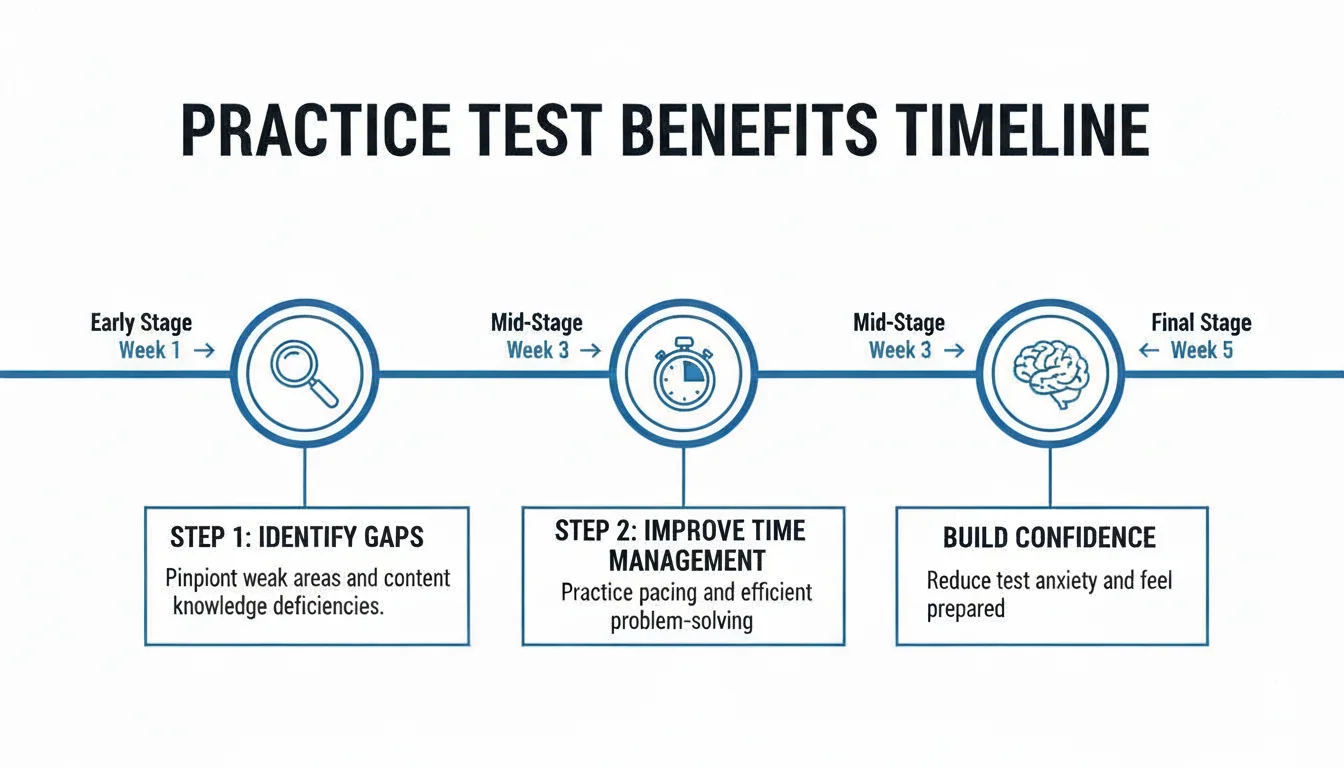
The progression is logical. You start with a diagnosis of what you do not know. Then you tune your performance and speed. Finally, you reach the level of self-assurance needed to walk into the testing center and succeed.
Reflection Prompt: After studying a new AWS service, how quickly do you typically test yourself? How might immediate, short quizzes enhance your retention?
Phase 2: The Mid-Preparation Stage
Once you have a firm grip on individual services, you need to see how they work together. Your goal now is to connect the dots and build mental endurance. In this middle stage, stop taking short quizzes and start taking half-length practice exams. These tests should cover several exam domains at once. This prepares you for the way the actual AWS Certification exam mixes different topics together in a single question.
You have two main goals during this phase:
- Find Systemic Weaknesses: Half-length exams show you patterns in your thinking. You might realize that you understand
computeandstoragewell, but you struggle when a question asks you to integrate those withnetworkingandsecurity. For instance, you might know how an EC2 instance works but falter when asked to configure a Security Group within a specific VPC subnet to allow RDS traffic while keeping the database private. - Build Cognitive Stamina: Answering sixty or seventy
scenario-based questionsis tiring. You need to train your brain to stay sharp for a long time. This stage helps you build that focus without requiring you to sit for a full three-hour block.
A typical scenario might involve an application that requires high availability across two Availability Zones. It might ask you to choose between using an Application Load Balancer with an Auto Scaling group or a Network Load Balancer. You have to consider the protocol (HTTP vs TCP), the health check requirements, and the cost. These questions test your ability to look at the big picture rather than just memorizing a list of features.
This is also the time to work on your test-taking strategy. You will start to learn your own pace. You will get better at reading a long, wordy question and finding the few words that actually matter. You will also learn how to manage the clock so you do not spend too much time on a single difficult problem.
Phase 3: The Final Approach
In the last one to two weeks before your exam date, you must switch to full simulation. You should take full-length, timed AWS practice tests. These must match the real exam environment as closely as possible. For example, if you are taking the AWS Certified Cloud Practitioner (CLF-C02) or the AWS Certified Security - Specialty (SCS-C03), ensure your practice exam matches the current question count and time limit. The CLF-C02 exam currently costs $100 USD, while the SCS-C03 costs $300 USD (verify current pricing on the vendor site).
To get the most out of these sessions, act like it is the real thing. Turn off your phone. Close every other tab on your computer. Make sure no one will interrupt you. You are practicing your time management under pressure. You need to know exactly how much time you can spend on a question before you have to mark it for review and move on. If you are taking the exam at a physical testing center via Pearson VUE, remember that they have strict rules about what you can have at your desk.
This final phase builds the confidence you need to pass with confidence. If you have already sat through several three-hour simulations, the actual exam day will feel like just another practice run. You will know the format. You will know how the timer looks. You will know how your brain feels after two hours of technical problem-solving. For more help with these final steps for AWS, Azure, or PMP certifications, look at our guide on prepare for AWS certification strategies. It provides many useful tips for the final stretch of your study.
The Art of the Post-Test Review
The biggest mistake students make is looking at their score and then closing the laptop. Your score is just a number. The real learning happens during the post-test review. This is where you actually improve your chances of success. You must look at every single question on the test, even the ones you got right.
As you go through your results, ask yourself these three questions for every item:
- Why was the right answer the best choice? You should be able to explain the exact
AWS principleor service feature that makes that answer correct. If you cannot explain it, you do not fully know it yet. For example, why is S3 Standard-IA better than S3 Glacier for data that needs to be accessed once a month? Is it the retrieval time or the cost per gigabyte? - Why were the other choices wrong? AWS designers use distractors. These are answers that look appealing but are slightly off. Maybe the service mentioned does not exist, or it is not the most cost-effective choice for that specific scenario. Understanding why an answer is wrong is just as helpful as knowing why one is right. For instance, a question about low-latency data access might offer an EFS solution and an S3 solution. If you only know that both store files, you might pick the wrong one. You have to understand that EFS is for file system access via NFS, while S3 is object storage accessed via an API.
- Did I just guess? If you got a question right because you flipped a coin or eliminated two obviously wrong answers, you still have a knowledge gap. Treat these "lucky guesses" as wrong answers. Review the official documentation until you actually understand the logic behind the solution.
As you follow this plan, consider how modern learning management systems can help you. A reliable platform provides data on your performance. It can show you if you are consistently missing questions about Identity and Access Management or if you are taking too long to answer database questions. This data lets you spend your time where it is needed most. When you use this phased approach, your AWS practice tests stop being a simple way to check your score. They become the most important part of your learning process.
Reflection Prompt: When reviewing practice tests, do you typically focus more on what you got wrong or on understanding why the correct answers were right? Which approach do you think is more effective for deep learning?
Common Mistakes to Avoid When Using Practice Tests
AWS practice tests are powerful tools, but they can be a double-edged sword. Use them correctly, and they clear the path to your AWS Certification. Fall into a few common traps, however, and you will build a false sense of security that quickly breaks on exam day. You do not want to realize you are unprepared only after the official timer starts.
The most frequent error for AWS-certified candidates is answer memorization. It is tempting to take the same practice test multiple times, watching your score climb from 70% to 95% with each attempt. This feels like progress, but usually, you have learned nothing new about cloud architecture. You have simply memorized the specific letter associated with the correct answer for that particular question.
The official AWS Certification exam will not include these exact questions. Real mastery happens when you investigate the reasoning behind every answer. You must understand the core AWS principles and the specific exam terminology used in each question. If you only know that choice "C" is correct for a specific scenario, you will fail when the exam asks a similar question with different variables.
The goal is not to know the answer to a specific practice question, whether it is for
AWS,Azure, orPMP. The goal is to understandAWS principlesand concepts so well that you can solve any variation of that question the real exam presents.
This mindset separates those who pass their AWS Certification on the first try from those who find themselves paying for repeated retakes. It is about building a mental framework to solve problems using the actual tools AWS provides.
Forgetting the Clock
Another mistake is only taking practice tests in study mode without a timer. Untimed practice is helpful when you need to explore complex concepts or read long explanations for the first time. But if you only work this way, you are in for a shock on exam day. The pressure of a ticking clock changes how you read and process information.
Official AWS exams are a sprint. You have a limited amount of time to analyze and answer a high volume of scenario-based questions. You must be fast and accurate. If you spend too long on one difficult question because you never practiced under pressure, you lose the chance to answer easier ones later in the session.
Practicing without a timer is like training for a marathon by only taking long walks. You are moving and learning the route, but you are not building the stamina, pacing, or focus needed to finish the race within the time limit. You need to know how you perform when the clock is counting down and your heart rate is up.
Skipping the Most Important Part
The worst mistake is finishing a practice test, checking the total score, and moving on immediately. The real value and the chance for improvement come during the review after the test ends. This is where the actual learning happens. If you skip this, you are throwing away the most useful part of your entire study session.
Your post-test review must be a thorough investigation of your performance. You need to break down every part of the results to see where you truly stand.
- Your incorrect answers: Start here to find your
knowledge gaps. Did you misunderstand anAWS serviceor miss a specific piece ofexam terminology? Perhaps you failed to apply asolution architecture principlecorrectly. Write down these topics and go back to the documentation to fill those holes. - Your correct answers: Did you know the answer for sure, or did you narrow it down to two options and get lucky? Be honest. If it was a lucky guess, you do not know the concept yet. Treat these guesses the same as incorrect answers to ensure you are ready for the real thing.
- The distractor options: Look at why the wrong answers were wrong. Analyzing these distractors clarifies common mistakes and highlights the small, technical differences between similar
AWS services. This prevents you from being tricked by similar-sounding options on the actual test.
Avoid cheap "exam dumps." These are often full of old or wrong information and they encourage bad memorization habits. Instead, use a reputable platform with high-quality scenario-based questions and clear explanations. This is the only way to build the real AWS knowledge needed to pass with confidence and earn your certification.
Your Top Questions About AWS Practice Tests, Answered
As your AWS Certification exam day approaches, you will likely find yourself with several lingering questions. Finding clear and authoritative answers to these common concerns can change your preparation strategy entirely. Instead of facing the test center with anxiety, you can walk in with a sense of clarity. We will examine the questions IT professionals ask most often when they start using an AWS practice test to prepare for their exams.
What Score Should I Be Aiming For?
This is the most frequent question candidates ask during their study period. While the official passing score for most AWS exams, such as the AWS Certified Cloud Practitioner (CLF-C02), usually falls between 70% and 75%—or 700 to 720 points on a 100-1000 scaled score—you should not aim for the bare minimum. Barely passing a practice run is a sign that you are not ready for the actual testing environment. Your goal is to achieve a reliable and steady performance that shows you understand the material.
A single high score on one AWS practice test might happen by chance or because you happened to know those specific questions. Real readiness comes from hitting 80-85% or higher across multiple different exams from a high-quality provider. This level of consistency proves that you have mastered the underlying AWS concepts and the specific exam terminology, rather than just memorizing a single set of answers.
Think of a target score of 80-85% as a necessary buffer. This safety margin accounts for the difficult, strangely worded, or confusing questions you will encounter on the real AWS Certification exam. By scoring higher in your practice sessions, you ensure that even if you miss several unexpected or difficult questions on the day of the test, your final score will remain safely within the passing range.
How Many Practice Tests Do I Really Need to Take?
Many students believe that taking as many tests as possible is the fastest way to pass. However, that is a common mistake. Quality is far more important than quantity when you are preparing for a technical exam. If you rush through a dozen different practice tests but fail to analyze why you missed certain questions, you will gain very little. It is much better to take three or four tests and spend significant time reviewing every answer choice.
The most important part of your preparation happens after you finish the practice test. A good rule for effective certification preparation is to spend twice as much time reviewing the exam results as you spent taking the test itself. You must examine every question, including the ones you answered correctly, the ones you missed, and the ones where you felt unsure.
A balanced and effective strategy for most AWS Certification candidates looks like this:
- Complete 3-5 full-length, timed simulations: These help you build the mental stamina needed for a long exam, improve your time management skills, and prepare you for the pressure of the testing environment.
- Use shorter, topic-specific quizzes: Integrate these into your daily study routine to strengthen specific areas where you struggle. For example, if you find that you consistently miss questions about Amazon S3 bucket policies or VPC peering, focus your quizzes on those services.
This combined strategy helps you find and fix your knowledge gaps. It ensures that you are making targeted improvements to your understanding rather than simply repeating the same mistakes over and over.
Are the Free Practice Tests Good Enough to Pass?
It is tempting to rely on free resources, but you must be careful when your AWS Certification is on the line. Free practice tests can work as a starting point to see how questions are formatted, but they often have major flaws. Many free options are outdated, containing information that no longer applies to the current exam. They may also include poorly written questions that do not match the rigor or the technical style used by AWS.
The biggest problem with free resources is that they usually do not provide the detailed explanations you need to learn from your mistakes. Without an explanation of why a specific answer is correct and why the others are wrong, you cannot improve your understanding of AWS principles or exam terminology.
If you want to be well-prepared to pass your AWS Certification on your first attempt, you should consider purchasing a premium AWS practice test from a reputable source. Paid resources offer content that aligns with the current exam blueprint, such as the SCS-C03 for the Security Specialty. They provide realistic scenario-based questions and analytics that show you exactly which topics require more study. Using a high-quality practice exam is the difference between guessing your way through your studies and using a clear, data-driven map to reach your goal.
Ready to stop guessing and start building a data-driven study plan? MindMesh Academy offers adaptive AWS practice tests with detailed analytics and spaced repetition. These tools ensure you are not just ready for your AWS Certification, but truly prepared to pass with confidence. Start your journey to certification today.
Ready to Get Certified?
Prepare for your exam with study guides, practice exams, and spaced repetition flashcards at MindMesh Academy:

Written by
Alvin Varughese
Founder, MindMesh Academy
Alvin Varughese is the founder of MindMesh Academy and an enterprise architecture leader. An electrical engineer by training, he moved from factory automation in South Africa to cloud architecture at GE Appliances and Humana (Fortune 50), and holds 20 professional certifications including AWS Solutions Architect Professional, Azure DevOps Engineer Expert, and Microsoft Agentic AI Business Solutions Architect. He built MindMesh Academy after interviewing too many highly certified candidates who couldn't answer basic questions: the goal is prep that makes you better at the job, not just able to pass the exam.