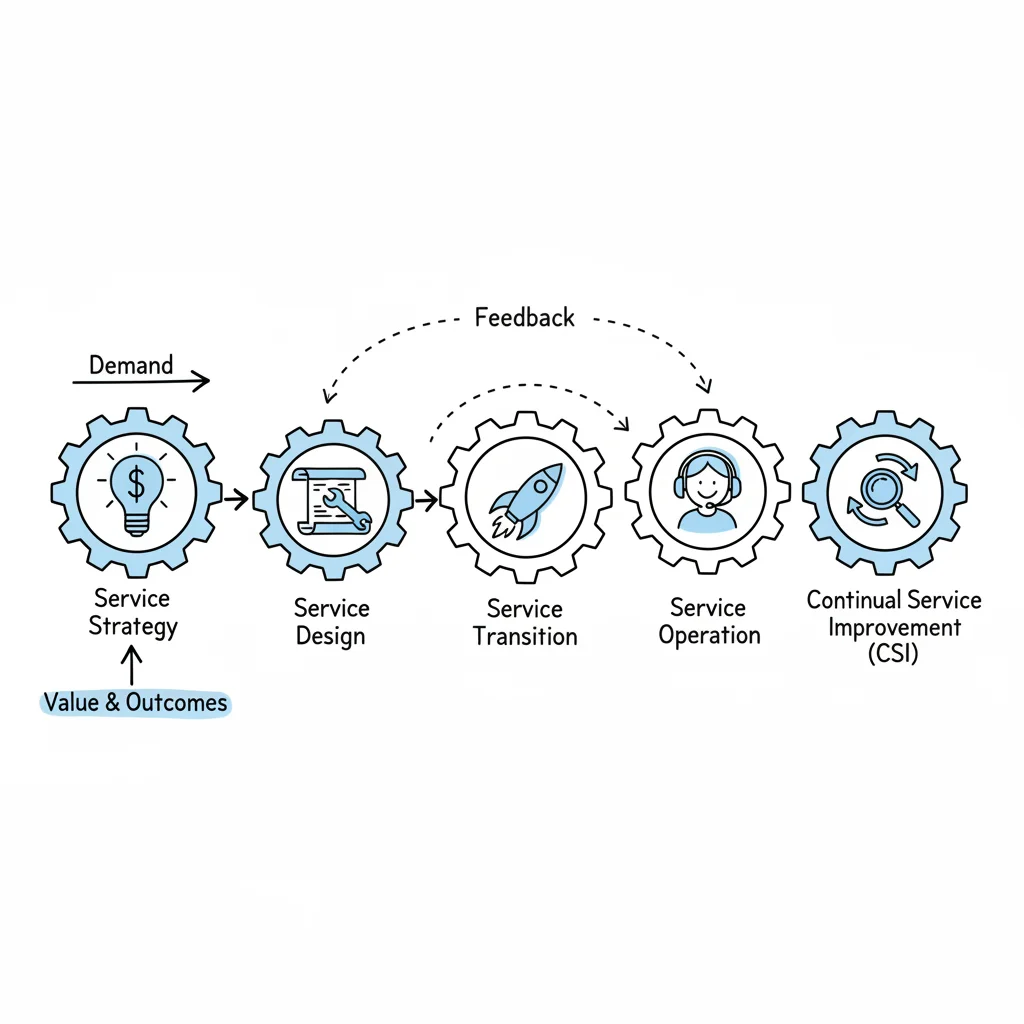
What Is ITIL Service Management Explained
What Is ITIL Service Management? Explained: A Framework for Modern IT Professionals
ITIL (Information Technology Infrastructure Library) Service Management provides a globally recognized set of best practices for delivering IT services that meet business goals. Learning ITIL is about more than memorizing rules. It involves adopting a tested methodology to manage technology. This framework creates a reliable playbook for managing technical operations consistently so they support and drive long-term organizational success. At MindMesh Academy, we view mastering ITIL as a significant step for career growth. It offers a standardized language and a structured approach to service delivery that employers across the world value. By following these established guidelines, teams improve efficiency and help internal technical departments function as strategic partners within their organizations.
Understanding the Core of ITIL
 Caption: ITIL encourages a structured, proactive approach to IT service delivery, moving beyond reactive "firefighting."
At its heart, understanding what is ITIL service management requires a shift in how you view daily IT operations. Most departments start in a reactive state, addressing technical failures only after they disrupt the workflow. ITIL moves your team away from constant emergencies and toward a proactive model focused on value. It provides a set of steps to plan, build, deliver, and improve the services you offer to both customers and internal staff.
Instead of treating IT as a collection of separate hardware and software parts, ITIL views IT as a provider of services. This framework gives technical teams a common vocabulary. When every member of the staff uses the same terms, communication becomes much more effective. An AWS cloud engineer building new infrastructure and an IT director planning the annual budget can finally align their efforts toward the same goals. This shared understanding leads to IT operations that are more predictable and stable. It ensures that every technical task helps the company reach its long-term objectives. Mastering these concepts is a vital step for any professional seeking an IT certification.
The Business Impact of ITIL
Adopting ITIL best practices leads to a significant and measurable change in how a company operates. This shift affects both daily efficiency and the bottom line. It is no surprise that the global IT Service Management (ITSM) market is growing so quickly. Experts estimate the market value will hit approximately $22.1 billion by 2028 (verify current figures on the research site). This growth highlights the fact that companies are putting real money into structured management to stay ahead of their rivals. You can look at ITSM market trends for more context.
Why do organizations spend so much on this framework? The returns are clear:
- Improved Service Quality: ITIL provides the tools to meet and exceed what users expect. Systems stay up longer and run better when you follow a standard, tested process for delivery.
- Reduced Operational Costs: By finding and removing waste in your daily workflows, you save money. Efficiency allows your team to do more with the same amount of resources.
- Enhanced Customer Satisfaction: Reliability makes users more productive. When IT services work without interruptions, customers and employees can focus on their own work instead of technical errors.
- Better Risk Management: You can find and fix potential problems before they lead to a system crash. This proactive stance keeps your data safe and prevents expensive service outages.
ITIL changes the reputation of the IT department. Instead of being seen as a cost center that drains the budget, IT becomes a partner in growth. It helps the business innovate.
By focusing on creating value through better processes and resource management, ITIL ensures every technical task helps the business reach its targets. It is a vital tool for organizations and a necessary skill for technical staff.
To begin learning about ITIL, look at these basic building blocks. This table shows the main components of the framework. These are the same concepts you will encounter while preparing for the ITIL Foundation certification.
ITIL At a Glance: Core Components
| Component | Brief Explanation |
|---|---|
| Guiding Principles | The universal recommendations and core beliefs that steer an organization's decisions and actions within ITIL. |
| Service Value System | A model showing how all parts of the organization work together to create value for the stakeholders. |
| Four Dimensions | A broad perspective that looks at people, technology, partners, and value streams to create services. |
| ITIL Practices | Specific sets of organizational resources designed for performing work or accomplishing an objective. |
This overview defines the basic structure of the framework. These concepts explain why ITIL remains the global standard for service delivery.
Reflection Prompt: Consider your current role or a past project. How much of your team's effort is reactive versus proactive? How might these principles change the way you manage your daily tasks?
The Four Dimensions of Successful Service Management
 Caption: The Four Dimensions Model ensures a balanced, holistic perspective on IT service management, preventing critical aspects from being overlooked.
Successful service management requires a wide-angle view. If you focus only on isolated components, you miss the connections that make a service actually work for a business. To provide services that offer real utility and warranty, IT teams must evaluate every factor contributing to operational success.
The Four Dimensions Model creates this structure. It acts as a framework to keep your approach balanced and all-encompassing. By using this model, you can ensure that no critical element is ignored during the design, transition, or operation of a service.
Imagine a project manager overseeing the launch of a new AWS cloud service. Success depends on more than just configuring EC2 instances or setting up S3 buckets. You have to evaluate the team's technical skills, the internal security policies, the way third-party APIs integrate, and the speed of the deployment pipeline. Every piece is required for a high-performing and reliable service. ITIL applies this same rigor across the entire organization, insisting that four specific dimensions work together.
1. Organizations and People
This dimension focuses on the human side of the equation. It includes the formal authority tracks within a company, the organizational culture, and the specific roles individuals play. It also covers the competencies and communication styles of your staff. A culture that promotes transparency and constant improvement is just as important as having a certified Azure architect or a specialized DevOps engineer.
If a company has a strong Organizations and People dimension, its incident response team remains effective even when systems go down. They communicate clearly, utilize shared knowledge bases, and understand their specific responsibilities. Without this focus, even the most expensive technology can fail because of a breakdown in human processes. This dimension reminds us that people are the actual drivers of value in any IT service.
2. Information and Technology
This is the dimension most people think of when they hear the word "IT." It includes the physical and digital tools used to provide a service. We are talking about hardware, software, data assets, and cloud platforms like AWS or Azure. It also includes the information itself: the customer records, the technical manuals, the performance metrics, and the security protocols that keep data safe.
The goal here is to ensure that your technology actually helps you meet business objectives. An outdated ticketing system that does not sync with your monitoring tools will create bottlenecks, no matter how talented your staff is. The right technology should improve efficiency rather than creating more manual work. For those earning certifications in cloud platforms, it is vital to understand how these tools fit into a broader service delivery model.
The Four Dimensions Model ensures that no single aspect of service management is overemphasized or neglected. By considering all four dimensions together, organizations can create a resilient system that delivers consistent value to stakeholders and stands up to the rigors of modern IT environments.
3. Partners and Suppliers
Very few IT departments do everything themselves. This dimension covers your relationships with outside entities. This includes cloud providers like AWS and Azure, software vendors, internet service providers, and outsourced support teams.
Managing these external relationships is a requirement for uninterrupted service delivery. For example, a reliable Service Level Agreement (SLA) with your network provider is necessary if you want to promise high availability to your own users. You cannot meet your internal goals if your external partners are not meeting theirs. This dimension ensures that the goals of your suppliers align with your own business objectives to create a mutually beneficial arrangement.
4. Value Streams and Processes
This dimension looks at the actual mechanics of the work. It defines the workflows and procedures that turn a request or an opportunity into a finished product. The objective is to map these workflows to find and remove any steps that do not add value.
- Value Streams: These are the end-to-end sequences of activities. A value stream represents the total work an organization does to create a product for a customer. For instance, the "New Employee Onboarding" value stream might start with a request from HR and end when the new hire has a working laptop and access to the network.
- Processes: These are the smaller building blocks. A process is a specific set of activities meant to achieve a single goal, such as "incident resolution" or "change enablement."
By looking at these workflows regularly, organizations can find delays and fix them. This leads to a better experience for both the people doing the work and the customers receiving the service.
To explore this core concept further, the official ITIL 4 Foundation guidance covers the Four Dimensions Model in full.
Key Takeaway: The Four Dimensions provide a lens for analysis. Before you start a major IT project, ask yourself: How does this change affect our staff and their skills? What technology and data are needed? Are our vendors ready to support this? How will this fit into our current workflows?
How the ITIL Service Value System Creates Value
How does every component within ITIL function as a unit to produce results? The unifying element is the ITIL Service Value System (SVS). This serves as the complete operational model for any IT-enabled organization. Its primary purpose is to take an opportunity or a demand—such as a request for a new software feature, a PMP-managed project, or an AWS infrastructure update—and convert it into measurable value for the business.
The SVS is more than a simple collection of isolated processes. It functions as an integrated framework where every component has a specific purpose and operates in coordination with the others. This ensures the entire organization moves in a unified, value-focused direction. This method is vital for IT professionals working toward certifications that prioritize strategic IT management and operational efficiency.
The Key Components of the SVS
The SVS gains its strength and flexibility from several interconnected parts. Each plays a distinct role in the progression from initial input to a valuable outcome. These components must work together to ensure that IT services meet both technical requirements and business needs.
- Guiding Principles: These provide universal recommendations that guide an organization's decisions and actions. They act as a steady reference point, keeping IT teams aligned with best practices even when goals or internal strategies shift. Examples include "Focus on Value" and "Collaborate and Promote Visibility." These principles help teams stay focused on the end-goal during complex technical transitions.
- Governance: This component establishes the framework for how an organization is directed and controlled. It ensures all IT activities align with business objectives, meet regulatory requirements, and manage risk effectively. For IT leaders and managers, governance provides the necessary oversight to ensure investments yield the expected returns.
- Service Value Chain: This is the operational core of the SVS. It consists of a set of interconnected activities that an organization performs to create and deliver products or services. By following these activities, teams can ensure that nothing is missed during the development or deployment phases.
- Practices: These function as specialized toolkits for accomplishing specific work. They consist of sets of resources, including personnel, defined processes, information, and technology. Each practice addresses specific objectives, such as incident management for restoring service, service request management for handling user needs, or change enablement for managing technical updates.
- Continual Improvement: This is a recurring activity performed at every level of the organization. It ensures that performance is reviewed and enhanced to meet stakeholder expectations. This mindset is necessary in fields like cloud computing where AWS and Azure services change frequently, requiring constant adjustments to maintain high performance.
When these components operate together, they form a system capable of responding to business needs or technological shifts. For a detailed breakdown of how these elements fit together, our guide offers a big-picture view of the ITIL Service Value System.
The Service Value Chain in Action
The Service Value Chain sits at the center of the SVS. This is not a rigid or linear sequence. Instead, it is a flexible operational model made up of six activities that can be combined in different orders to create "value streams."
The model functions like an agile production line. A demand for a new service, such as an Azure-hosted application, enters as raw material. The delivered value is the finished product. The Service Value Chain activities are the different stations along that line. Depending on the service being developed, you might use these stations in a different order, repeat certain steps, or bypass others to make the process more efficient.
The six core activities are:
- Plan: Establishes a shared understanding of the vision, current status, and direction for all four dimensions and products. This activity creates a unified strategy that ensures every department works toward the same organizational goals.
- Improve: Drives the constant enhancement of products, services, and practices using feedback and performance data. By analyzing metrics, the organization identifies areas where efficiency can be increased or costs can be reduced over time.
- Engage: Focuses on understanding what stakeholders need and maintaining transparency. This activity involves building strong relationships with customers, users, and suppliers to ensure their requirements are understood before work begins.
- Design & Transition: Ensures that new and changed services meet expectations for quality, cost, and speed. This stage involves planning how a service will be operated effectively once it is released to the users.
- Obtain/Build: Ensures that all service components are acquired or built to the correct specifications. This activity manages the procurement of hardware or the development of software code so that resources are available when needed.
- Deliver & Support: Concentrates on the daily delivery and support of services to meet agreed-upon expectations. This involves managing incidents, handling service requests, and ensuring that users can use the technology as intended.
For example, implementing a new feature in an AWS application might involve Engage to gather requirements, Design & Transition to architect the solution, and Obtain/Build to develop the code. Finally, Deliver & Support is used to deploy the feature and provide assistance to users. Throughout this process, the Plan and Improve activities run concurrently to keep the project on track.
When these activities are optimized, the business impact is visible through significant gains in IT performance. The infographic below illustrates the results an organization can achieve through this structured approach.
 Caption: A well-implemented ITIL Service Value System directly translates to measurable improvements in efficiency, cost savings, and enhanced customer experience.
A functioning Service Value System leads to measurable wins in efficiency, lower costs, and better customer experiences. By using these six activities, IT departments can move away from reactive troubleshooting and toward a more proactive, value-driven model of service delivery.
Reflection Prompt: Consider a recent IT project or service delivery challenge you faced. Which Service Value Chain activities were involved? Could a more structured approach using these activities have improved the outcome or efficiency?
The Real-World Benefits of Adopting ITIL
IT professionals and business leaders often view theoretical frameworks with skepticism. The most practical question to ask is why an organization should bother with ITIL at all. The answer does not involve organizing IT for the sake of internal order. Instead, it focuses on the measurable improvements ITIL brings to the business and the positive impact it has on an individual's career path.
Adopting ITIL service management provides a blueprint for creating stable, predictable, and efficient IT operations. It gives your teams a specific roadmap to handle everything from a simple password reset to a major system overhaul, such as migrating an on-premises data center to AWS or Microsoft Azure. This structure ensures that every action, regardless of size, stays aligned with what the business wants to achieve.
The certification paths provided by AXELOS, the official body for ITIL, demonstrate the range of expertise this framework provides.
 Caption: AXELOS ITIL certification paths provide a structured way for IT professionals to develop deep expertise in service management.
As the chart indicates, there are specific modules built to develop expertise, ranging from Foundation to Strategic Leader. Earning these certificates is more than adding a line to a resume. It is a method for building your organization's internal capabilities and your own technical skills. This makes you a more valuable asset within the IT industry.
Driving Business Performance
ITIL establishes a common language and standardizes processes to ensure every team member stays on the same page. Consider the practical impact of these practices. When your Incident Management workflow is highly effective, you reduce the duration of expensive downtime for critical systems, such as an e-commerce platform running on Azure. When your Change Enablement process is reliable, you minimize the risk that a new software update or infrastructure change will crash a vital business service. This proactive approach to managing risk defines high-performing technology teams.
This structured method generates positive results across the department. Team productivity often increases because clear, documented steps remove the need for guesswork or wasted effort. Customer satisfaction improves because the services people use every day become more reliable and responsive to their needs. ITIL helps transition an IT department from a reactive cost center that only fixes broken hardware into a strategic partner that helps create business value and innovation.
"Implementing ITIL isn't just an IT project; it's a fundamental business improvement initiative. It provides the essential structure needed to effectively manage risk, control costs, and ultimately deliver more strategic value from all your technology investments."
Measurable Improvements and Cost Savings
The advantages of ITIL are visible in hard data. A detailed ITSM Academy Report showed clear results, noting that 80% of organizations (verify current data trends on the vendor site) saw a drop in service-related issues after they integrated ITIL into their workflows. This change creates a more stable and responsive environment, which supports business continuity.
Additionally, 73% of IT organizations (verify current metrics on the vendor site) saw better service quality and an improved user experience. Regarding financial performance, 70% of these organizations successfully lowered their operational costs by more than 10% (verify current pricing and savings trends on the vendor site). These statistics make a strong case for using ITIL to improve both efficiency and budget management. You can review the details in the full report on ITSM trends.
Investing in ITIL is an investment in the long-term health and resilience of a company. The main advantages for professionals and their organizations include:
- Better Risk Management: You gain the ability to spot and stop service interruptions before they hurt business operations.
- Increased Service Availability: Standardized ways to manage incidents and problems lead to less downtime and faster recovery when issues occur.
- Improved Resource Utilization: Your team spends time on high-value projects and technical innovation instead of spending all day reacting to emergencies.
- Alignment with Business Goals: A clear structure ensures that every IT task supports the company’s primary objectives and helps the organization succeed.
Common ITIL Practices in Action
Theory provides a necessary starting point, but understanding the actual impact of ITIL service management requires looking at how these concepts function in daily operations. The framework consists of 34 practices. You can view these as specialized playbooks or sets of organizational resources designed for performing work or accomplishing an objective. By examining the most frequent practices, we can see how they create a structured environment for IT teams to manage complex tasks.
Incident Management: Putting Out the Fire
Picture a scenario where a company’s primary e-commerce application, hosted on AWS, suffers a total crash during a major holiday sale. Revenue stops immediately. Customer support lines fill up. In this high-pressure situation, Incident Management becomes the primary focus of the technical team.
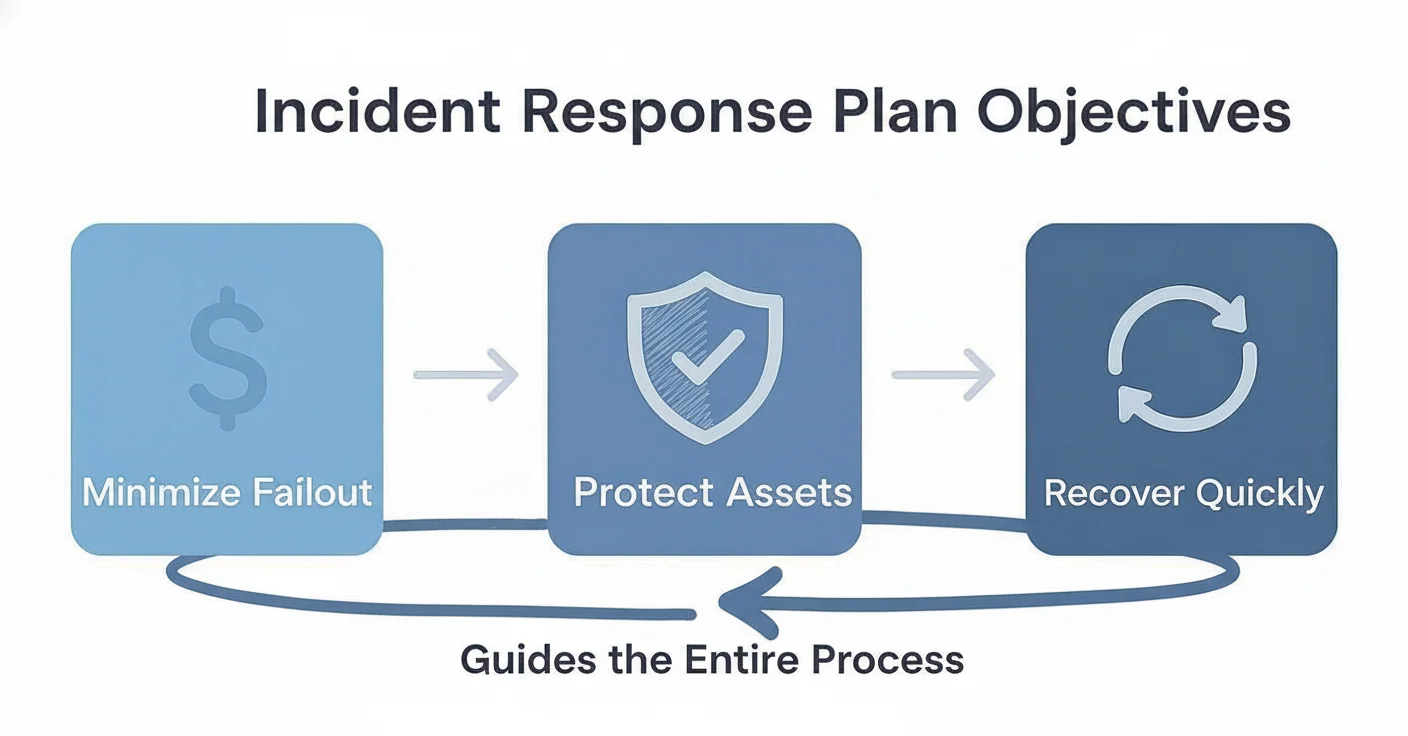
The goal of this practice is to restore normal service operation as fast as possible while minimizing the negative impact on business operations. In this context, "normal service operation" refers to the service level defined in the Service Level Agreement (SLA). The priority is speed and service availability, not the long-term investigation of why the failure happened in the first place.
A standard Incident Management workflow often follows these steps:
- Detection: An automated monitoring system like Amazon CloudWatch identifies that the application is unreachable and automatically logs a high-priority incident ticket.
- Response: The on-call support staff, typically Tier 1 or Tier 2 technicians, receive a high-priority alert and begin an immediate investigation to triage the failure.
- Resolution: The team applies a temporary fix or workaround. This might involve restarting a container, rolling back a recent code deployment, or shifting traffic to a redundant server to get the storefront back online.
- Closure: After verifying that users can once again complete purchases, the team closes the incident and documents the specific steps taken to resolve the outage.
This practice centers on immediate recovery. It ensures that the business can continue to function even if a permanent fix is not yet available. For those who want to study the mechanics of effective response, MindMesh Academy provides a detailed breakdown of ITIL incident management.
Problem Management: Finding the Root Cause
The e-commerce site is back online, and the immediate panic has subsided. However, the temporary workaround used by the incident team didn’t actually fix the defect that caused the crash. That vulnerability still exists in the system and could cause another outage tomorrow. This is where Problem Management takes over.
The objective here differs significantly from Incident Management. While incidents focus on speed, problems require a methodical, analytical approach. The goal is to identify the actual root cause of one or more incidents and find a permanent solution to prevent them from happening again.
The Problem Management team examines logs, reviews performance telemetry, and looks for patterns across historical data. They might discover that a specific software patch created a memory leak that only triggers when traffic exceeds a certain threshold. Instead of a quick restart, the output of this practice is often a "Known Error" record or a formal Request for Change (RFC) to update the application code. By eliminating the underlying cause, the team reduces the total number of incidents over time, leading to higher system stability.
Change Enablement: Deploying Fixes Without Breaking Things
Once the development team creates a permanent fix for the memory leak identified by Problem Management, the organization faces a new risk. Applying a patch to a live production environment can often cause unexpected side effects. If the update is handled poorly, it might break other features or conflict with the underlying operating system.
Change Enablement (referred to as Change Management in older versions of ITIL) manages these risks. This practice ensures that all changes to IT services are recorded, evaluated, authorized, prioritized, planned, tested, and implemented in a controlled manner. It acts as a gatekeeper for the production environment.
Effective Change Enablement usually involves several key components:
- Risk Assessment: The team evaluates how the change might affect other connected services or user groups.
- Authorization: For significant updates, a Change Advisory Board (CAB) reviews the plan to ensure all stakeholders agree with the timing and the potential impact.
- Scheduling: Changes are often scheduled for "maintenance windows"—times when business activity is low—to reduce the risk to the company.
- Back-out Planning: Every change must include a plan to revert the system to its previous state if the implementation fails.
By following these steps, the organization can improve its services and infrastructure without causing self-inflicted outages. This balance of agility and stability is essential for maintaining a reliable service environment.
Comparing Key ITIL Practices
Newcomers to ITIL often find it difficult to distinguish between these three practices because they are so closely linked. The easiest way to tell them apart is to look at their primary objective and what triggers them to start. This table summarizes the differences.
| Practice | Primary Goal | When It's Used (Trigger) |
|---|---|---|
| Incident Management | Restore normal service operation as quickly as possible. | An unexpected interruption, degradation, or outage of a live service occurs. |
| Problem Management | Identify, understand, and eliminate the root causes of incidents. | A major incident occurs, or patterns of recurring incidents are identified. |
| Change Enablement | Maximize successful IT changes by assessing and minimizing risk. | A change is needed to add, modify, or remove anything from the IT environment. |
These three practices function together as a system. Incident Management handles the immediate fire, Problem Management identifies the "arsonist" or the faulty wiring, and Change Enablement ensures the repairs are made safely without burning the building down again. This transition from reactive firefighting to proactive management is why ITIL remains a standard in the industry. For those interested in optimizing a support team, exploring these service desk best practices provides a clear path forward.
How ITIL Is Evolving with AI and Automation
ITIL functions as an adaptable guide rather than a collection of static rules. It continuously adjusts to incorporate new technologies. Currently, artificial intelligence (AI) and automation are reshaping the IT sector. These technologies move service management away from a reactive "wait-for-it-to-break" style toward a predictive approach that anticipates issues before they impact the user.
This shift produces practical results. AI-powered analytics identify subtle indicators of system failure, such as abnormal loads on an Azure VM, long before an actual crash. If a team receives an alert about an unusual memory pattern on a server, they gain hours to fix the issue proactively. This happens before it turns into a critical incident that halts operations and requires emergency response.
For IT staff, the change is significant. Automated service desks, using chatbots and virtual agents, now resolve common requests like password resets, software access, or basic troubleshooting instantly. This provides users with immediate results. More importantly, it removes the weight of repetitive, low-impact tasks from skilled technicians. This shift lets them focus on complex troubleshooting and long-term organizational strategy that benefits the company.
Smarter Operations with AI
AI integration goes beyond simple automation. Modern ITSM tools use machine learning to scan large volumes of incident data. These tools identify patterns that reveal the root causes of recurring problems and suggest specific fixes. This capability improves Problem Management by turning historical data into clear, actionable information for the team, allowing for more effective incident prevention.
This is a widespread shift in the industry. A survey from ITSM.tools involving 176 professionals found that AI represents the single largest technological influence on service desks today, especially with the growth of generative AI. You can review more details on these trends to see how they change the way IT departments function and manage their daily workload.
By automating routine work and providing data-driven insights, these tools allow IT teams to prioritize tasks that generate the most business value.
Rather than spending every shift firefighting, IT professionals can apply their expertise to projects that drive innovation. This includes optimizing cloud services, building new applications to gain a competitive edge, or strengthening cybersecurity protocols across the organization.
Preparing for the Future of ITSM
This evolution shows that ITIL prepares organizations for upcoming changes instead of just solving current problems. The core ITIL Guiding Principles—focusing on value, improving continuously, and collaborating—remain the foundation. The primary shift is that the tools used to apply these principles are becoming more capable and intelligent every year, making the framework even more effective.
To see how this integration works in practice, look into the role of AI for ITSM. Using the ITIL framework creates a strong base for adopting new tech as it appears. This ensures IT operations stay efficient and stay aligned with business objectives. Using both ITIL and new technology provides a clear path for professional growth in any technical role while maintaining high service standards.
A Few Common ITIL Questions
As you begin integrating ITIL concepts into your professional skill set, specific questions often surface. We will address the most frequent inquiries here to clear up confusion and strengthen your understanding of how the framework functions in practical environments. These clarifications help bridge the gap between theory and actual implementation in an IT department.
What's the Real Difference Between ITIL and ITSM?
Distinguishing between these two terms is a frequent challenge for those new to the field, but the distinction is clear when viewed through a professional lens. ITSM (IT Service Management) refers to the actual discipline of managing IT as a service. It represents the "what"—the total effort to design, deliver, manage, and improve how technology creates business value. This includes everything from high-level strategic planning to daily operational support and continuous improvement efforts across all areas of technology.
By contrast, ITIL (Information Technology Infrastructure Library) functions as a collection of blueprints or a proven manual. ITIL does not create the concept of service management; instead, it provides a globally recognized set of methods for performing ITSM. It offers the practical "how" by documenting specific techniques and proven practices. While ITSM defines the overall business goals, ITIL provides the structured guidance to reach them. It is the most popular and thorough framework used to achieve service management objectives today.
Do I Absolutely Need an ITIL Certification to Use It?
You do not need a formal certificate to apply ITIL concepts. The framework's core principles are public, and any IT professional can use them to improve incident management or service requests immediately. If you see a way to clarify how your team handles hardware failures based on ITIL ideas, you can implement those changes without a license or official credential.
That said, earning a certification serves as a major career catalyst. Learning ITIL through a structured program is more effective than trying to piece together information from scattered sources. Certification creates a unified language for your team. When every member understands that "Change Enablement" follows a specific set of rules, communication becomes faster and errors decrease. For individuals, these credentials prove expertise to employers and peers. They often lead to new opportunities in service management, project management (as a supplement to the PMP), and high-level operations. A certified team works from a shared, proven playbook, which leads to more predictable and successful results.
While a certification is not a prerequisite for using ITIL, it functions as a catalyst for professional growth and organizational efficiency. It establishes a common vocabulary and standardized processes, which leads to more reliable and faster implementations.
Is ITIL Just for Giant Corporations?
This is a common misconception that often prevents smaller teams from improving their workflows. While ITIL is a central part of how Fortune 500 companies manage their AWS or Azure environments, the framework is intentionally flexible. The guiding principle is to "adopt and adapt." You should never follow the books blindly; instead, take what works for your specific situation.
A small startup does not need the same heavy Change Enablement process or large advisory boards as a global bank. Forcing that level of detail on a five-person team would create unnecessary bureaucracy. Instead, a smaller team can use specific parts of ITIL that solve their current problems. They might focus only on Incident Management to stop reactive "firefighting" or improve Service Request Management to keep staff productive with faster access to hardware. By selecting only the relevant practices, small and agile teams can get significant value from ITIL without adding complexity. The framework scales to fit the needs of the business, regardless of the number of employees or the size of the IT budget.
Ready to master ITIL concepts and prepare for your certification exam? MindMesh Academy provides study guides, practice tests, and learning tools designed to help you succeed. Prepare for your exam with confidence and advance your IT career at ITIL 4 Foundation Practice Exams.

Written by
Alvin Varughese
Founder, MindMesh Academy
Alvin Varughese is the founder of MindMesh Academy and holds 20 professional certifications including Microsoft Agentic AI Business Solutions Architect, AWS Solutions Architect Professional, and Azure DevOps Engineer Expert. He's held senior engineering and architecture roles at Humana (Fortune 50) and GE Appliances. He built MindMesh Academy to share the study methods and first-principles approach that helped him pass each exam.