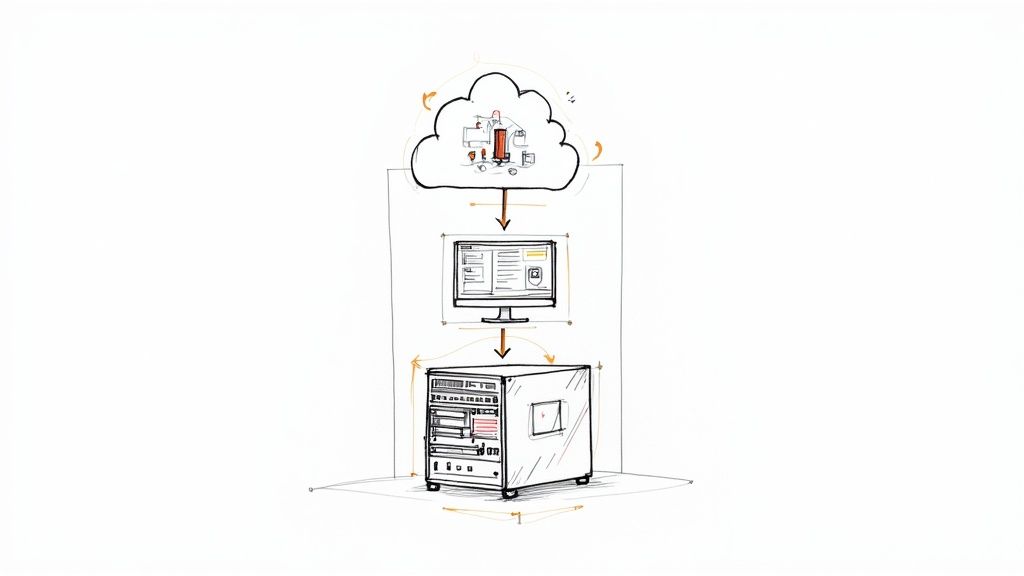
The Difference Between IaaS, PaaS, and SaaS Explained
When you boil it down, the real difference between IaaS, PaaS, and SaaS comes down to one thing: control. What do you manage, and what does the cloud provider manage for you?
- IaaS gives you the raw infrastructure—servers, storage, and networking. Maximum control, maximum responsibility.
- PaaS gives you a ready-made development platform. The provider manages infrastructure and runtime, you just bring the code.
- SaaS delivers finished applications. You simply log in and use the software.
Think of it as a spectrum: IaaS = land to build on, PaaS = a workshop with tools, SaaS = a hotel that’s already furnished.
Comparing the Cloud Service Models
Choosing the right service model isn’t just a technical decision—it’s a strategic one that balances control against convenience. Each model represents a different layer of the cloud stack, and knowing when to use which is essential.
The cloud market reached $330B by 2024, with SaaS leading growth toward an estimated $390.5B in 2025 (CloudZero report).
Quick Overview: IaaS vs PaaS vs SaaS
| Aspect | IaaS (Infrastructure) | PaaS (Platform) | SaaS (Software) |
|---|---|---|---|
| What You Manage | Apps, Data, Runtime, Middleware, OS | Apps, Data | Nothing—vendor manages all |
| Core Offering | Virtualized resources (servers, storage, networking) | Dev & deployment environment (databases, tools) | Ready-to-use software via browser/API |
| Best For | Admins/DevOps needing full control | Developers building apps | End-users needing turnkey solutions |
| Examples | AWS EC2, Google Compute Engine | Heroku, AWS Elastic Beanstalk | Salesforce, Google Workspace, Dropbox |
Breaking Down Each Cloud Model

IaaS: Infrastructure as a Service
- What it is: Virtual servers, networking, and storage—the digital foundation.
- What you manage: Everything above virtualization (OS, runtime, middleware, apps, data).
- Best for: Teams needing maximum control (e.g., legacy migrations, DR, big data analytics).
- Examples: AWS EC2, Google Compute Engine.
Market note: By 2025, AWS leads with 31% share, Azure at 24%, and GCP at 11%.
Learn more in our IaaS guide »
PaaS: Platform as a Service
- What it is: A full development environment with databases, tools, and runtime included.
- What you manage: Applications and data only.
- Best for: Developers building apps quickly without infrastructure overhead.
- Examples: Heroku, AWS Elastic Beanstalk, Google App Engine.
Key benefit: accelerates development, reduces operational headaches, and powers API-first strategies.
SaaS: Software as a Service
- What it is: Ready-to-use applications delivered over the web.
- What you manage: Nothing beyond user access and data.
- Best for: Standard business functions (CRM, HR, collaboration).
- Examples: Salesforce, Google Workspace, Trello.
SaaS delivers immediate value and predictable costs—no setup, no maintenance.
Shared Responsibility: Who Manages What?
| Component | IaaS | PaaS | SaaS |
|---|---|---|---|
| Applications | ✔️ | ✔️ | ✖️ |
| Data | ✔️ | ✔️ | ✖️ (vendor manages most) |
| Runtime | ✔️ | ✖️ | ✖️ |
| Middleware | ✔️ | ✖️ | ✖️ |
| OS | ✔️ | ✖️ | ✖️ |
| Virtualization | ✖️ | ✖️ | ✖️ |
| Servers | ✖️ | ✖️ | ✖️ |
| Storage | ✖️ | ✖️ | ✖️ |
| Networking | ✖️ | ✖️ | ✖️ |
The higher you go (from IaaS → SaaS), the fewer responsibilities you own.
Real-World Scenarios
- IaaS: Disaster recovery setups, big data analytics clusters, legacy app migrations.
- PaaS: Startups launching apps quickly, agile teams adopting API-first strategies.
- SaaS: CRM, project management, HR—ready-to-use solutions with no custom build needed.
Pricing Models and Total Cost
| Model | Pricing Structure | Predictability | Key Cost Drivers |
|---|---|---|---|
| IaaS | Pay-as-you-go | Low–Medium | Compute, storage, networking, staff |
| PaaS | Hybrid (base + usage) | Medium | App instances, services, data |
| SaaS | Subscription (per user/month) | High | User count, feature tier |
- IaaS: flexible but volatile bills, plus hidden staffing costs.
- PaaS: balanced, faster time-to-market offsets cost.
- SaaS: predictable, often cheaper once you factor in TCO (staffing + maintenance avoided).
How to Choose
- IaaS = Control: Best for IT-heavy teams replicating or lifting on-prem systems.
- PaaS = Creation: Best for dev teams needing to ship apps fast.
- SaaS = Consumption: Best for business functions where building custom adds no value.
Decision framework: Control (IaaS) → Creation (PaaS) → Consumption (SaaS).
Common Questions
Can you combine models?
Yes. Most organizations mix all three (IaaS for core, PaaS for dev speed, SaaS for everyday business).
Which is most secure?
None by default. Security depends on shared responsibility and proper configuration.
How do migrations differ?
- IaaS: lift-and-shift VMs.
- PaaS: re-architect apps for the platform.
- SaaS: migrate data + retrain users.
Final Word
Knowing the difference between IaaS, PaaS, and SaaS isn’t just theory—it’s a practical guide to matching cloud models with your team’s skills, your business needs, and your budget.
Ready to master these concepts for your next certification? MindMesh Academy provides expert-led study guides and evidence-based learning tools.
These cloud service models are foundational topics on both major cloud certifications:
- AWS Cloud Practitioner Study Guide – Covers IaaS, PaaS, SaaS and the AWS shared responsibility model
- AZ-900 Azure Fundamentals Study Guide – Microsoft's take on cloud service models and deployment types

Written by
Alvin Varughese
Founder, MindMesh Academy
Alvin Varughese is the founder of MindMesh Academy and an enterprise architecture leader. An electrical engineer by training, he moved from factory automation in South Africa to cloud architecture at GE Appliances and Humana (Fortune 50), and holds 20 professional certifications including AWS Solutions Architect Professional, Azure DevOps Engineer Expert, and Microsoft Agentic AI Business Solutions Architect. He built MindMesh Academy after interviewing too many highly certified candidates who couldn't answer basic questions: the goal is prep that makes you better at the job, not just able to pass the exam.