
Your Ultimate Guide to ITIL 4 Foundation Training in 2026
ITIL 4 Foundation marks your essential entry into the dynamic world of modern IT service management (ITSM). This isn't just another certification; it's the bedrock knowledge that equips IT professionals to speak the language of value co-creation, enabling technology-driven services that directly contribute to genuine business success. Think of it as the universal operating manual for any IT professional aiming to make a significant impact.
Why ITIL 4 Is Your Gateway to IT Service Management
For anyone navigating the IT landscape, ITIL is a name you’ve undoubtedly encountered. A common misconception paints ITIL as a rigid, bureaucratic framework. With ITIL 4, this couldn't be further from the truth. Instead, envision it as an adaptable, strategic playbook—a practical framework that empowers organizations to leverage technology effectively to achieve their strategic business objectives.
The core purpose of ITIL 4 Foundation training is to instill this modern, value-centric approach. You’ll learn to shift focus from merely "keeping the lights on" to actively participating in co-creating value with customers and the broader business. This certification serves as a powerful launchpad for a career in ITSM, providing you with the fundamental understanding required to drive meaningful change in any technology-driven enterprise.
Who Benefits from ITIL 4 Foundation Training?
The universal applicability of ITIL 4 Foundation is one of its greatest strengths. It's not exclusive to service managers; its principles are invaluable across a vast spectrum of roles, and critically, no prior experience is required to begin.
This training is an ideal fit for:
- IT Support and Service Desk Staff: Learn to approach incident and request management with a relentless focus on delivering value and positive customer experiences.
- Project and Product Managers: Align your initiatives with robust service management practices, ensuring seamless transition from project completion to ongoing, supported service delivery—a critical skill for PMP-certified professionals.
- Aspiring IT Leaders: A solid understanding of ITIL 4 provides the strategic foundation necessary to build effective IT strategies and lead high-performing teams, whether in cloud environments (AWS, Azure) or traditional data centers.
- Career Changers: This globally recognized certification offers a clear, respected, and highly sought-after entry point into the demanding yet rewarding IT industry.
- DevOps and SRE Professionals: Understanding ITIL's principles of continuous improvement and value streams enhances your ability to streamline operations and ensure service reliability.
ITIL is more than theoretical; it underpins operations at a remarkable 85% of Fortune 500 companies, creating immense demand for skilled professionals. It’s no surprise that 82% of IT professionals report heightened confidence in pursuing ITSM careers post-certification, opening doors across tech, finance, healthcare, and more.
Reflection Prompt: Consider your current role or your ideal future role. How do you see the principles of ITIL 4 directly enhancing your ability to deliver value or manage services effectively?
Understanding the Core Framework
At the heart of your ITIL 4 Foundation training is the ITIL Service Value System (SVS). The simplest way to conceptualize the SVS is as the operational engine for your organization’s service delivery. It's the integrated framework that transforms opportunities and demand from the business environment into tangible value for customers and stakeholders.
We'll delve deeper into the specific components of the SVS—such as the Guiding Principles and the Service Value Chain—shortly. For now, understand that your training is meticulously designed to make this powerful, interconnected system both accessible and practical for real-world application.
Comparing ITIL 4 Foundation Training Options
Embarking on your ITIL 4 journey begins with selecting a learning format that aligns with your personal style and schedule. Here's a concise comparison of the most prevalent training options to guide your choice.
| Training Method | Typical Cost Range (USD) | Best Suited For |
|---|---|---|
| Self-Paced Online | $400 - $800 | Highly independent learners who require maximum flexibility to study at their own pace and schedule. |
| Live Virtual Classroom | $800 - $2,500 | Individuals who thrive in interactive, instructor-led environments with structured class sessions and real-time Q&A. |
| Corporate/In-Person | $1,500 - $3,000+ | Organizations seeking customized training solutions for teams, delivered on-site or in a private setting. |
Ultimately, selecting an ITIL 4 Foundation training course is your pivotal step toward mastering a globally recognized standard. To gain further context on the strategic importance of this framework, you can learn more about what ITIL service management is in our detailed article.
Getting to Grips with the Core Ideas of ITIL 4
When you immerse yourself in ITIL 4 Foundation training, you're not merely memorizing terms; you're cultivating a fundamentally new approach to how IT generates and delivers value to a business. It’s less about adhering to rigid mandates and more about embracing a set of interconnected, pragmatic concepts that you can immediately apply in your professional role.
The true objective is to perceive ITIL 4 as a cohesive, integrated system. This value map visually represents how the framework translates its principles into tangible benefits, both for your personal career trajectory and for the organizational success of your company.
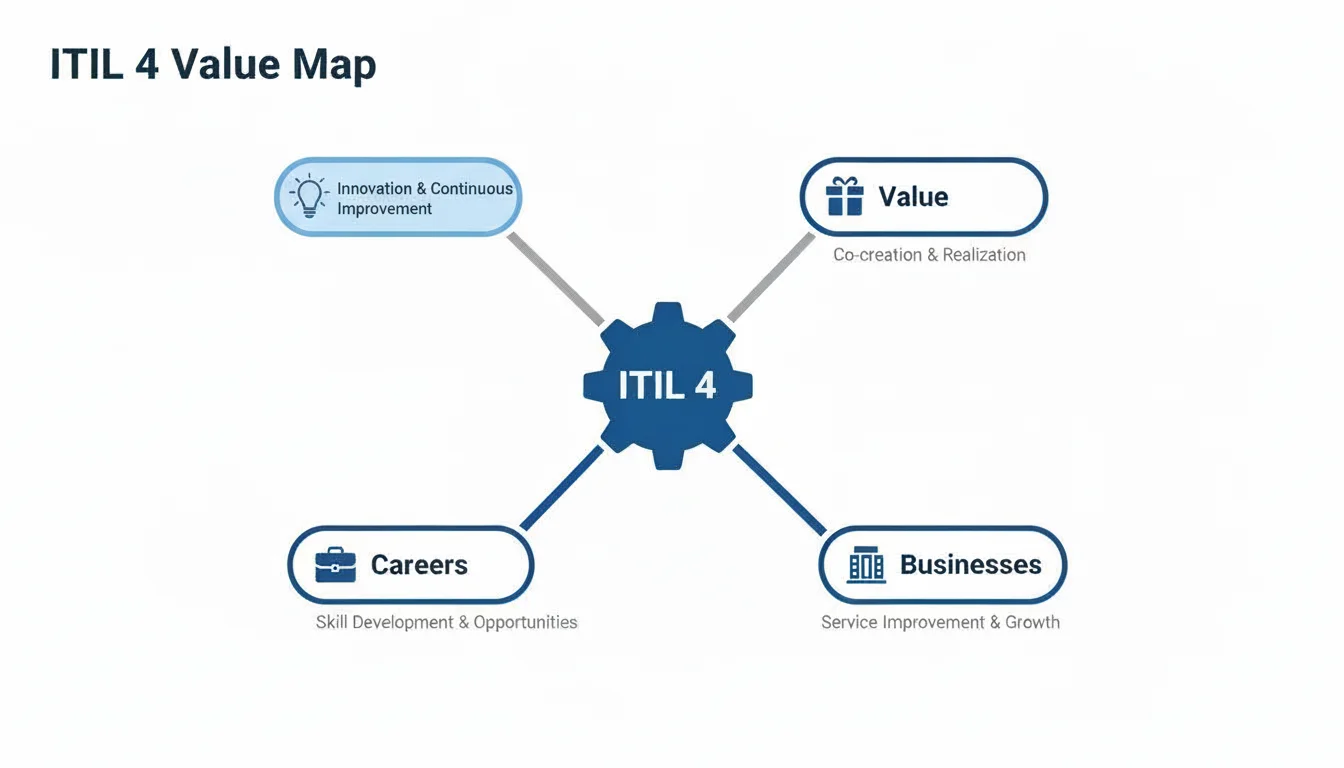
As illustrated, ITIL 4 functions as a central engine, driving quantifiable results. Let's now explore the critical components that power this engine.
The Four Dimensions of Service Management
To consistently deliver exceptional service—whether you’re deploying a new application in AWS or managing an internal Azure help desk—you must adopt a holistic perspective. ITIL 4 structures this comprehensive view into the Four Dimensions of Service Management. Imagine them as the four foundational pillars supporting a strong structure; if any pillar is weak or absent, the entire system becomes unstable.
- Organizations and People: This dimension addresses the human and cultural aspects. It encompasses your company's culture, leadership styles, team structures, and the collective skills and competencies of your workforce. The most advanced technology is ineffective without the right talent and a supportive organizational environment.
- Real-world Example: In an Agile development team, this dimension focuses on cross-functional collaboration, clear roles (e.g., Scrum Master, Product Owner), and continuous learning to improve skillsets.
- Information and Technology: This covers the actual technological assets and data that enable your services. It includes all hardware, software, databases, network infrastructure, and communication tools. This is the "what" you utilize to accomplish your tasks.
- Real-world Example: For a cloud architect, this means selecting the right AWS EC2 instances, Azure SQL Databases, or Kubernetes clusters, along with ensuring robust data encryption and network security.
- Partners and Suppliers: In today's interconnected world, isolation is rare. This dimension emphasizes managing relationships with external vendors, contractors, and partners who contribute to the creation, delivery, and ongoing support of your services. Effective vendor management is key.
- Real-world Example: A company relying on a third-party managed service provider (MSP) for its cybersecurity or a SaaS vendor for its CRM needs to manage these relationships carefully to ensure service level agreements (SLAs) are met.
- Value Streams and Processes: This dimension brings everything together, outlining the workflows and sequential steps that transform a customer's demand or request into a valuable outcome. It represents the "how" of service delivery, mapping the journey from concept to consumption.
- Real-world Example: For an Incident Manager, a value stream might involve a process like "detect incident -> escalate -> diagnose -> resolve -> communicate -> close." Optimizing each step directly impacts service restoration time.
A crucial aspect of your ITIL 4 Foundation training is developing the habit of constantly considering these four dimensions. Neglecting even one is a direct path to service delivery challenges and potential failure.
Key Takeaway: The Four Dimensions provide a lens to analyze any service or IT capability, ensuring no critical aspect is overlooked.
The Seven Guiding Principles
If the Four Dimensions define "what" to consider, the Seven Guiding Principles articulate "how" you should think and act. They serve as a universal compass—a set of fundamental beliefs that inform sound decision-making in any IT service management scenario or project.
The Guiding Principles are truly the heart and soul of ITIL 4. They give you a practical, strategic mindset to solve problems and build a culture of continuous improvement, no matter what challenge you’re up against, much like the values that guide successful PMP-certified project managers.
These principles are characterized by their elegant simplicity, yet their power is profound. They consistently encourage you to:
- Focus on value: Always, always begin with the customer. What are their true needs, and how will this action or service genuinely benefit them? (e.g., For a new AWS service, focus on how it solves a business problem, not just its technical features.)
- Start where you are: Avoid the temptation to overhaul everything. Assess your current state, leverage existing assets and processes that work well, and build upon them incrementally. (e.g., Before implementing a new ITIL practice, review current operational procedures and identify strengths.)
- Progress iteratively with feedback: Eschew large, high-risk "big bang" deployments. Instead, implement small, manageable changes, gather feedback continuously, and adapt your approach based on what you learn. (e.g., Deploying a new feature in Azure DevOps using small sprints and user acceptance testing.)
- Collaborate and promote visibility: Break down organizational silos. Foster cross-functional teamwork and ensure transparent communication so everyone understands the "what" and "why" of activities. (e.g., IT Operations and Development teams collaborating openly on a new software release.)
- Think and work holistically: Avoid tunnel vision. Understand how all components of the service value system interconnect and how your work influences other teams and services. (e.g., Understanding how a database change impacts application performance and user experience.)
- Keep it simple and practical: Seek the most straightforward and effective path to achieve an outcome. Unnecessary complexity is detrimental to efficiency and agility. (e.g., Automating a simple task with a PowerShell script rather than building a complex custom application.)
- Optimize and automate: Utilize technology to streamline repetitive, manual tasks, freeing up human talent to focus on more creative, strategic, and high-impact work. (e.g., Automating infrastructure provisioning using AWS CloudFormation or Azure Resource Manager templates.)
Reflection Prompt: Choose one of the Guiding Principles. How could you apply it to a current challenge or opportunity in your professional life this week?
The Service Value Chain
Finally, we arrive at the Service Value Chain (SVC). This is the operational engine room of ITIL 4, a flexible operating model that illustrates the key activities an organization must perform to realize value from demand.
Envision it like a high-performance professional kitchen. A customer's order (demand) arrives. A precise sequence of activities then commences to transform that raw order into a meticulously prepared meal (value). The Service Value Chain comprises six core activities:
- Plan: This involves establishing the overarching strategic vision, objectives, and direction for products, services, and IT service management as a whole.
- Example: Defining the strategic roadmap for migrating on-premises applications to a hybrid cloud environment.
- Improve: This activity is dedicated to ensuring the continuous enhancement of services, products, and all ITIL practices across the organization.
- Example: Conducting post-incident reviews to identify root causes and implement changes that prevent recurrence.
- Engage: This focuses on cultivating strong relationships with all stakeholders—customers, users, suppliers, and partners—to understand their needs, foster trust, and gather feedback.
- Example: Regular meetings with business unit leaders to understand their evolving technology requirements.
- Design & Transition: This ensures that new or modified services meet stakeholder expectations for functionality, performance, quality, cost, and seamless integration into the live environment.
- Example: Developing a new application architecture and then planning its deployment and user acceptance testing.
- Obtain/Build: This involves acquiring or developing the necessary service components, whether they are new software, hardware, infrastructure elements, or third-party cloud services.
- Example: Procuring new server hardware, subscribing to an Azure SaaS solution, or developing a custom microservice.
- Deliver & Support: This is the day-to-day operational work, ensuring services are provided and supported according to agreed specifications and customer expectations.
- Example: Managing network operations, resolving user incidents, or performing routine system maintenance.
The crucial insight here is that these activities are not a rigid, linear pipeline. Just as a chef might need to retrieve additional ingredients (Obtain/Build) mid-preparation, these activities can be combined and sequenced in various ways to create flexible "value streams" that precisely respond to specific types of demand.
Building Your Winning ITIL 4 Study Plan
Let's be direct: passing the ITIL 4 Foundation exam isn't about rote memorization. It’s about cultivating a smart, sustainable study strategy that transforms a seemingly daunting amount of information into a series of manageable, logical steps. This ensures you truly internalize the concepts for lasting career benefit, not just for the test. Most successful candidates find a 2-to-4-week timeline to be optimal, providing ample time for deep learning without losing momentum.
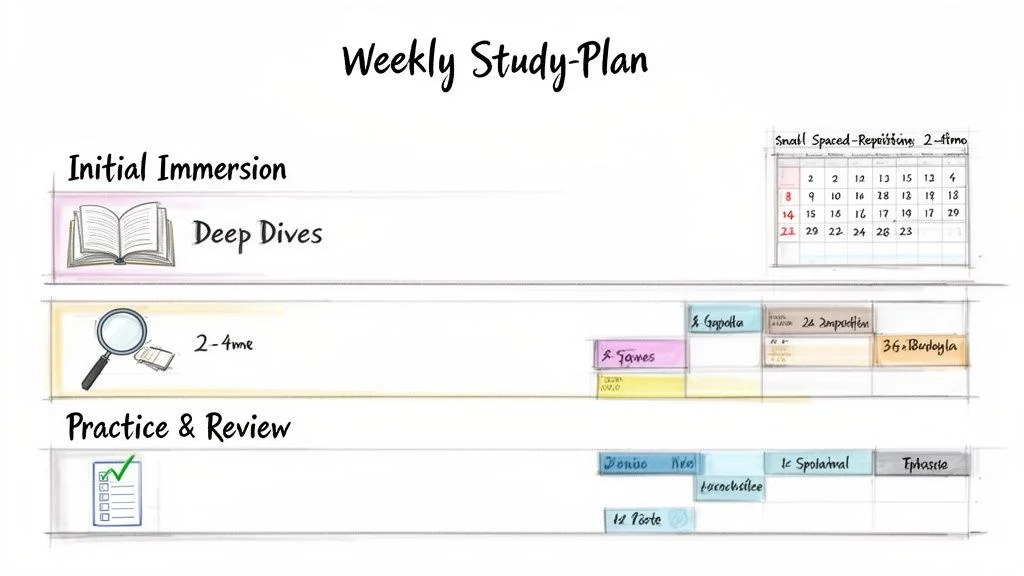
The key is to segment your study into distinct phases. This structured approach prevents overwhelm and builds your knowledge foundation logically, ensuring each new concept rests upon a solid understanding.
Phase 1: Initial Immersion
Your initial few days should be dedicated to grasping the overarching landscape. Resist the urge to dive into intricate details. The primary goal here is to comprehend how the major elements of ITIL 4—such as the Service Value System and the Four Dimensions—interconnect.
Think of it as reviewing a map of a new city before exploring its streets. You want to familiarize yourself with the major districts and their relationships. Engage with introductory videos, skim your official study guide, and concentrate on understanding the framework's overall purpose and structure.
Phase 2: Deep Dives and Active Learning
Once you have established a mental map, it’s time to zoom in. This will constitute the most extensive and intensive phase of your plan, where you systematically tackle each core concept. Here, you'll delve into the Seven Guiding Principles, the Service Value Chain activities, and the key ITIL practices outlined in the Foundation syllabus.
However, passive reading alone will not suffice. Genuine understanding emerges from active learning techniques that compel your brain to process and integrate the information.
- Create Your Own Notes: Transcribing concepts into your own words, rather than just highlighting, is an exceptionally potent method for retention.
- Draw Diagrams: Grab a notebook and physically sketch the Service Value Chain, the relationships within the Four Dimensions, or the flow of a specific ITIL practice. Visualizing these frameworks significantly enhances recall.
- Use Flashcards: Whether utilizing digital apps or traditional index cards, flashcards are excellent for drilling key terms and definitions until they become second nature.
An effective study plan prioritizes efficiency over mere hours logged. Learning how to process information faster can significantly aid your absorption of ITIL's concepts, preparing you more effectively for the exam.
Phase 3: Practice and Review
In the final week leading up to your exam, your focus should transition from acquiring new knowledge to solidifying existing understanding. This phase is entirely dedicated to practice, reinforcement, and refining your exam strategy.
This is where true mastery begins. Consistent, spaced-out review moves information from your short-term working memory into long-term retention. It’s the critical difference between cramming for a temporary pass and genuinely internalizing the material for lasting application in your career.
A highly effective technique for this phase is Spaced Repetition. Instead of intensively studying one topic for extended periods, you revisit it in brief, targeted bursts over several days. For instance, after studying the Guiding Principles on Monday, you might conduct a quick 15-minute review on Wednesday and another on Friday. This method is scientifically proven to dramatically improve retention.
Your ITIL 4 Foundation training should always conclude with full-length practice exams. These simulations acclimatize you to the actual exam environment, question formats, and time constraints. Crucially, analyze your results thoroughly—every incorrect answer is a valuable insight, pinpointing precisely where your understanding needs further attention.
Here’s a sample schedule for a two-week plan, assuming you commit 1-2 hours per day.
| Day | Focus Topic | Review Topic |
|---|---|---|
| Week 1 | ||
| Day 1 | Intro & Service Value System | - |
| Day 2 | Guiding Principles (1-4) | Service Value System |
| Day 3 | Guiding Principles (5-7) | Guiding Principles (1-4) |
| Day 4 | Service Value Chain | All previous topics |
| Day 5 | Key Practices (e.g., Change Enablement) | Service Value Chain |
| Day 6 | Key Practices (e.g., Incident Management) | All previous topics |
| Day 7 | Rest or Light Review | - |
| Week 2 | ||
| Day 8 | Key Practices (e.g., Problem Management) | All previous topics |
| Day 9 | Full Practice Exam 1 | Analyze Results |
| Day 10 | Focused review of weak areas | Key Practices |
| Day 11 | Full Practice Exam 2 | Analyze Results |
| Day 12 | Focused review of weak areas | All previous topics |
| Day 13 | Final comprehensive review | - |
| Day 14 | Rest & Light Mental Prep | - |
This structured approach ensures you build, reinforce, and test your knowledge systematically, positioning you optimally for success.
Mastering Your ITIL 4 Foundation Exam
You've dedicated the hours, absorbed the concepts—now, the final hurdle separating you from your ITIL 4 Foundation certification is the exam itself. While it can feel like a significant challenge, approaching it with the right strategies will cultivate confidence and preparedness.
Here’s a concise overview of what to expect on exam day.
The exam format is quite straightforward, which is good news for test-takers. It's a closed-book, multiple-choice test consisting of 40 questions that must be completed within 60 minutes.
To achieve a passing score, you need to answer at least 26 questions correctly, equating to a 65% passing score. This is highly achievable for anyone who has engaged with a quality training course and committed to a focused study regimen.
The Exam Format and Logistics
One of the most reassuring statistics surrounding the ITIL 4 Foundation exam is its consistently high success rate. While PeopleCert does not publish official global pass rates, accredited training organizations routinely report rates well over 90%. For candidates who prepare diligently, it's common to see this figure rise to 95% or even higher.
When you're ready to schedule, you'll typically book your exam through your chosen training provider, who acts as an accredited PeopleCert partner. You have the flexibility to select the testing environment that best suits your preference:
- Online Proctored Exam: This is the most popular choice, offering the convenience of taking the exam from your home or office under the remote supervision of a live proctor via webcam.
- In-Person at a Test Center: If you prefer a formal, distraction-free testing environment, you can schedule your exam at a local, authorized test center.
Both formats adhere to the exact same test content and rules, making your choice purely a matter of personal comfort and preference.
Proven Strategies for Answering Questions
Effective time management is paramount. With 60 minutes for 40 questions, you have an average of 90 seconds per question. This provides sufficient time for thoughtful consideration but not enough to become stuck on any single item.
Consider employing this three-pass strategy, which has proven effective for countless candidates:
- First Pass (The Easy Wins): Methodically go through the entire exam and confidently answer every question you are 100% certain about. This builds confidence and secures valuable points early on. If a question is tricky, flag it and move on without lingering.
- Second Pass (The Educated Guesses): Revisit the questions you flagged. Read them carefully, and leverage the process of elimination. Even if you don't immediately know the correct answer, you can often rule out two clearly incorrect options, thereby increasing your odds from 25% to 50%.
- Third Pass (The Final Review): Utilize any remaining time to review your flagged answers one last time. If you're still undecided on a question, make your best-educated guess.
Remember, the ITIL 4 Foundation exam does not penalize you for incorrect answers. It is always advantageous to make an educated guess rather than leaving a question blank.
Deconstructing a Sample Question
The most effective way to become comfortable with the exam's style is by understanding how questions are formulated. While your ITIL 4 Foundation training imparts the core concepts, practice questions illuminate how those concepts are assessed. For comprehensive preparation, ensure you work through high-quality practice ITIL exams.
Let's dissect a representative question:
Question: Which ITIL concept is best described as the 'mindset' that guides an organization's decisions and actions?
- A) The Service Value Chain
- B) The Four Dimensions of Service Management
- C) The Guiding Principles
- D) A service offering
Analysis: The critical keyword in this question is "mindset." Consider what each option fundamentally represents:
The Service Value Chain (A) represents an operating model—a sequence of activities. The Four Dimensions (B) provide the essential contexts or perspectives to consider (similar to a checklist). A service offering (D) describes the actual package of goods and services delivered to customers.
None of these represent a "mindset." This leaves C, The Guiding Principles, which are explicitly defined as the core recommendations and philosophical tenets that shape an organization's culture, decision-making, and operational approach. Utilizing this logical process of elimination clarifies the correct answer. This analytical skill is precisely what you will develop through dedicated practice.
Choosing the Right ITIL Training Provider
Selecting a partner for your ITIL 4 Foundation training is a more critical decision than many realize. It transcends merely finding a course that enables you to pass the exam. The right provider fundamentally differentiates between temporarily memorizing definitions and truly comprehending a robust framework that you can apply throughout your entire career.
Consider this analogy: anyone can give you a generic workout plan. A truly exceptional personal trainer, however, understands your specific fitness goals, teaches you correct form to prevent injury, and helps you build real, functional strength for lasting results. That is the caliber of partner you need for your ITIL training—one focused on long-term competency and application, not just a transient passing grade.
What to Look For in a Training Provider
So, how do you distinguish excellence from mediocrity? Avoid being swayed by flashy websites or empty promises of a guaranteed pass. Instead, concentrate on these foundational criteria that genuinely matter for your educational investment.
- Official Accreditation: This is your absolute first point of verification. Is the provider an Accredited Training Organization (ATO) with PeopleCert? If not, proceed with extreme caution. ATO status is your sole assurance that the course content, instructors, and associated exam vouchers are legitimate and adhere to stringent quality standards.
- Instructor Experience: Who will actually be delivering the instruction? Seek out instructors with extensive, hands-on experience in the IT service management trenches. The most impactful educators are not merely academics; they are seasoned professionals who can vividly bring theoretical concepts to life with real-world scenarios and hard-won lessons.
- Quality of Study Materials: A 500-page PDF and a few recorded lectures do not constitute a modern, effective course. Look for a dynamic blend of engaging video lessons, interactive quizzes, and high-fidelity practice exams that genuinely simulate the actual test. The materials should be meticulously designed for active learning, not just passive information transfer.
- Genuine Student Reviews and Pass Rates: What are actual students saying about their experience? Seek out reviews on independent platforms, not just the curated testimonials displayed on the provider’s homepage. A consistent pass rate exceeding 90% is a strong indicator of effective teaching methodologies and quality content.
The MindMesh Academy Approach
A significant portion of ITIL training approaches learning with outdated methodologies, often centered around passive consumption—requiring you to endure hours of PowerPoint slides and dense textbooks. While this might enable you to cram sufficiently to pass the exam, that knowledge tends to dissipate rapidly. We recognized a profound need for a superior approach.
Your ultimate goal isn't just to pass the certification exam next week. It's about confidently remembering how to solve a real service management problem six months or even a year from now. Achieving that requires a more intelligent, science-backed way to learn.
At MindMesh Academy, we’ve engineered our platform around proven active learning principles. We fundamentally reject the notion of a one-size-fits-all education. Our system employs adaptive learning technology to intelligently pinpoint your strengths and identify areas where you need additional focus. This personalized approach empowers you to concentrate your study time most effectively, targeting areas that require the most reinforcement rather than re-reading information you’ve already mastered.
You gain access to a personal dashboard that provides a clear, visual representation of your progress, showing you precisely how close you are to achieving exam readiness. This represents a significant advancement from the traditional method of simply progressing linearly through a course. Once you’ve established your Foundation, you might even consider your next steps. We're here to help you explore advanced certifications after the Foundation and strategize your long-term career path. Our commitment is to be your enduring partner, providing the essential tools and guidance for success at every stage of your professional journey.
What Your ITIL Certification Really Means for Your Career
Earning your ITIL 4 Foundation certification is far more than simply adding another bullet point to your professional profile. View it as a direct, strategic investment in your professional development and, unequivocally, in your earning potential. When you understand this framework, you inherently speak the same language as the world's most successful organizations—indeed, 85% of Fortune 500 enterprises leverage ITIL to govern their IT operations.
This shared understanding serves as your key to unlocking new roles, accelerating your career progression, and enhancing your leadership capabilities.
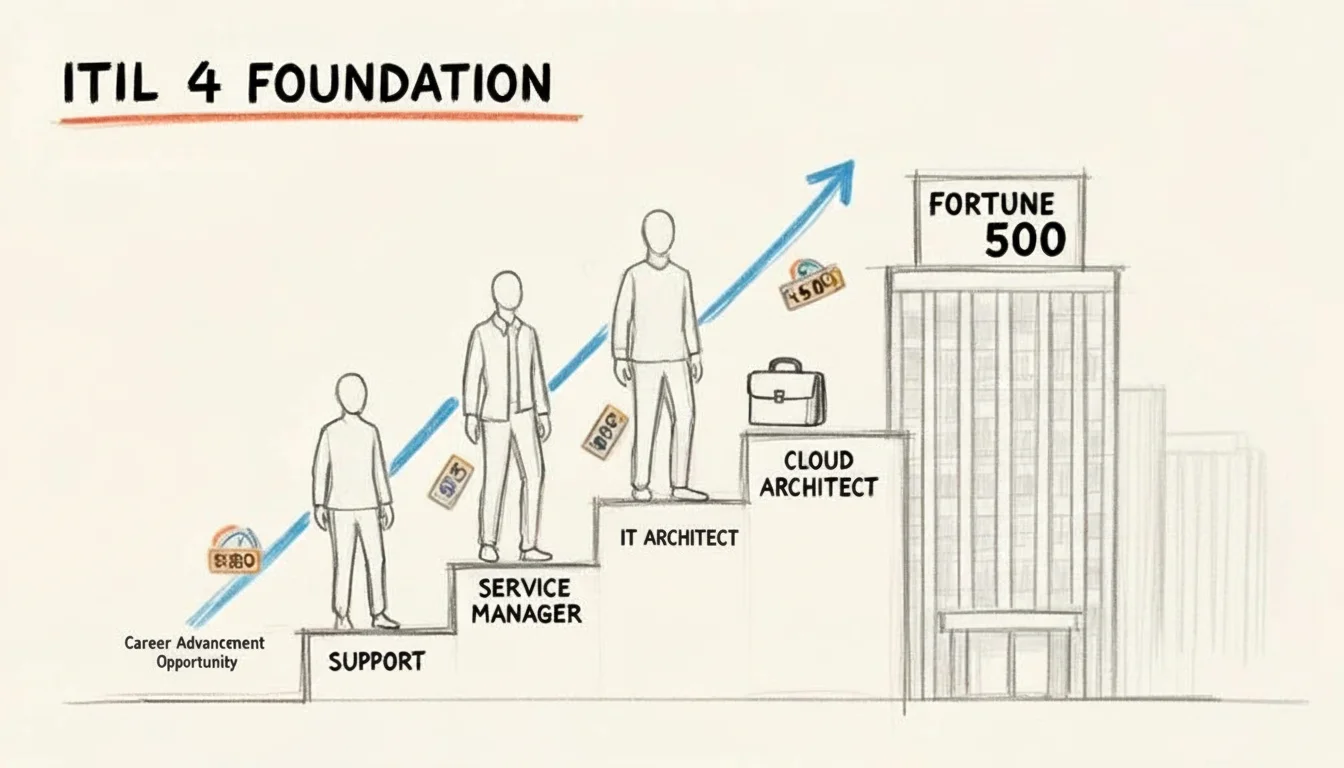
This certification sends a clear, compelling signal to hiring managers. It unequivocally demonstrates that you are not merely a technician focused on isolated tasks, but a professional who comprehends how IT directly contributes to and drives genuine business value. That fundamental understanding marks the crucial difference between being perceived as a cost center and being recognized as a strategic organizational asset.
The Salary Bump is Real
Let's address the numbers. Professionals holding ITIL certifications consistently command higher salaries than their non-certified counterparts. The reason is clear: they possess the knowledge and skills to design, build, and manage services that are inherently more efficient, reliable, and perfectly aligned with the actual needs of the business. This tangible impact has a direct and quantifiable dollar value.
Industry reports frequently highlight ITIL Foundation as one of the highest-paying entry-level certifications. On average, certified professionals often experience a salary premium of 11%, with some top-tier earners reaching $154,500 per year. Other data indicates potential salary increases ranging from 15-25% post-certification. This financial benefit underscores the significant return on investment of an ITIL certification.
An ITIL certification does more than just teach you a framework; it validates your proven ability to create and meticulously preserve business value. This is precisely what companies are willing to invest in, making it one of the most astute career moves you can make.
Forging New Career Paths
Beyond immediate salary enhancements, the ITIL 4 Foundation certificate acts as a powerful launchpad for diverse career trajectories. Because its universal principles are applicable across a vast spectrum of organizations—from agile startups to sprawling global enterprises—it significantly enhances your versatility and attractiveness as a candidate.
This single certification can be your direct ticket to a wide array of well-compensated roles across various industries.
Potential Roles and Average US Salaries (Approximate):
- IT Service Manager: You will lead service delivery teams, ensuring IT services are strategically aligned with and robustly support business objectives. The average salary is approximately $115,000.
- Incident Manager: Your core mission is to swiftly restore services to normal operation when disruptions occur, minimizing business impact. This critical role typically pays around $95,000.
- Change Manager: You'll oversee all planned IT changes, guaranteeing they are implemented smoothly, with minimal risk, and without disrupting vital business operations. Expect an average salary of $108,000.
- Cloud Operations Engineer/Analyst: Leveraging ITIL principles, you’ll manage and optimize cloud environments (e.g., AWS, Azure) to ensure reliable, cost-effective service delivery. This role can average $120,000+.
- Service Desk Analyst: Often an entry point, this role benefits immensely from ITIL, focusing on efficient resolution of user issues and a strong customer service mindset, with salaries around $60,000.
Ultimately, ITIL 4 Foundation training cultivates a strategic, value-driven mindset. It empowers you to perceive the broader organizational context and contribute directly to your organization’s overarching goals, thereby solidifying your reputation as an invaluable player in its sustained success.
Your ITIL 4 Foundation Questions Answered
Alright, let's address the practical considerations head-on. You're likely weighing the tangible aspects of certification: its cost, the perceived difficulty of the exam, and its genuine impact on your career trajectory.
These are common and entirely valid questions. Here are the straightforward answers you need to make a well-informed, confident decision.
How Much Does ITIL 4 Foundation Training Cost in 2026?
The pricing for ITIL 4 Foundation training primarily depends on your preferred learning style. If you possess strong self-discipline and effective time management skills, a self-study course presents a highly economical option. You can typically find comprehensive packages, often including the official PeopleCert exam voucher, for under $500.
Conversely, if you thrive with live instruction, interactive engagement, and the opportunity for real-time questions, a virtual classroom setting is ideal. These instructor-led courses typically range between $800 and $2,500. A crucial tip: always, always confirm that the official PeopleCert exam voucher is explicitly included in the advertised price to avoid any unexpected additional fees.
Is the ITIL 4 Foundation Exam Difficult?
With dedicated and structured preparation, the ITIL 4 Foundation exam is highly passable. The key to success isn't about memorizing every definition by rote, similar to cramming for a history exam. Instead, it's about genuinely understanding the core concepts and appreciating how they interlink within the ITIL framework. Think of it as a test of your newly acquired service management mindset and practical application, rather than solely a memory recall challenge.
Accredited training providers consistently report impressive pass rates exceeding 90% for candidates who prepare thoroughly. This compelling statistic alone should reassure you that with the correct approach, achieving success is entirely within reach.
The optimal strategy involves enrolling in a high-quality training course, truly internalizing the Seven Guiding Principles, and then diligently practicing with realistic exam simulations. Familiarizing yourself with the question formats and managing time under pressure accounts for a significant portion of the battle.
How Long Does the ITIL 4 Foundation Certification Last?
Here's excellent news: the ITIL 4 Foundation certification itself does not have an expiration date. Once you earn it, it is yours permanently.
However, there is an important nuance. PeopleCert, the administering body for the exam, implements a renewal policy to ensure that certified professionals maintain current and relevant skills. You will need to renew your ITIL certification every three years to keep it formally active on your professional record. This can typically be achieved by earning professional development points through continuing education or by successfully passing another examination within the ITIL certification scheme.
Can I Get a Job with Only an ITIL 4 Foundation Certification?
Yes, absolutely. While it is considered an entry-level certification, it holds significant value and recognition among employers globally. It instantly communicates to a hiring manager that you are conversant in the modern language of IT service management and possess a foundational understanding of how IT can proactively create business value—moving beyond merely reactive problem-solving.
This certification serves as an excellent "foot in the door" for a variety of in-demand roles, including:
- IT Support Specialist
- Service Desk Analyst
- Junior Project Manager
- IT Coordinator
- Cloud Support Engineer
For a multitude of organizations, ITIL 4 Foundation represents the baseline knowledge they expect from any professional working within or closely collaborating with their technology teams.
Ready to cultivate a career founded on globally recognized and highly valuable skills? MindMesh Academy delivers evidence-based ITIL 4 Foundation training meticulously designed for deep comprehension and first-time exam success. Explore our adaptive learning course today and discover how our innovative platform can significantly accelerate your journey to certification.
Ready to Get Certified?
Prepare with expert-curated study materials at MindMesh Academy:

Written by
Alvin Varughese
Founder, MindMesh Academy
Alvin Varughese is the founder of MindMesh Academy and an enterprise architecture leader. An electrical engineer by training, he moved from factory automation in South Africa to cloud architecture at GE Appliances and Humana (Fortune 50), and holds 20 professional certifications including AWS Solutions Architect Professional, Azure DevOps Engineer Expert, and Microsoft Agentic AI Business Solutions Architect. He built MindMesh Academy after interviewing too many highly certified candidates who couldn't answer basic questions: the goal is prep that makes you better at the job, not just able to pass the exam.