Difference Between Public and Private Cloud: Quick Guide
IT professionals must understand deployment models to make informed architectural choices. At MindMesh Academy, we focus on the specific distinctions that drive cloud strategy. Public cloud and private cloud differ based on two factors: ownership and tenancy. These elements influence costs, security, and scaling ability.
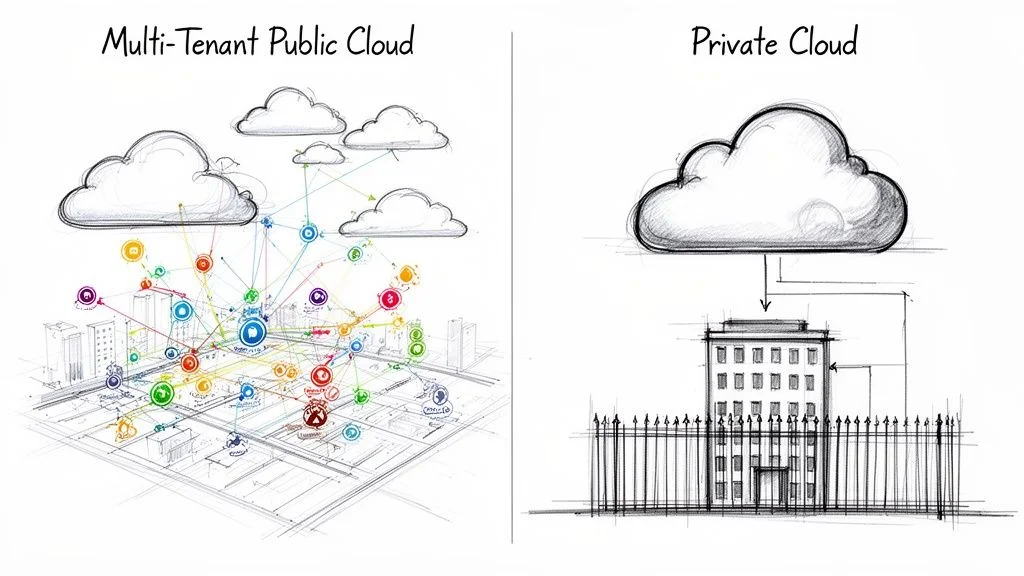
A public cloud functions like an apartment complex. A third-party provider owns the hardware, while you rent resources alongside other tenants. In contrast, a private cloud acts like a standalone house. Your organization either owns the hardware or leases it for exclusive use. All resources belong to your business alone; you do not share hardware with others.
This distinction—multi-tenant versus single-tenant—affects every part of the computing environment. It determines how you handle data security and how much control you have over the hardware. Understanding these concepts is vital for passing the AWS Certified Cloud Practitioner or the Azure Administrator exam.
Public clouds offer scale and lower entry costs. Private clouds prioritize privacy and compliance requirements. Knowing who manages the hardware is the first step toward a functional strategy.
Getting the Definitions Straight
Establishing precise definitions for public and private cloud is the first step before comparing them in detail. IT professionals need these foundations to evaluate which model meets organizational needs or to answer certification questions. For more background, read about the cloud computing vs. on-premise debate. That resource explains the history and strategy behind current cloud adoption trends.
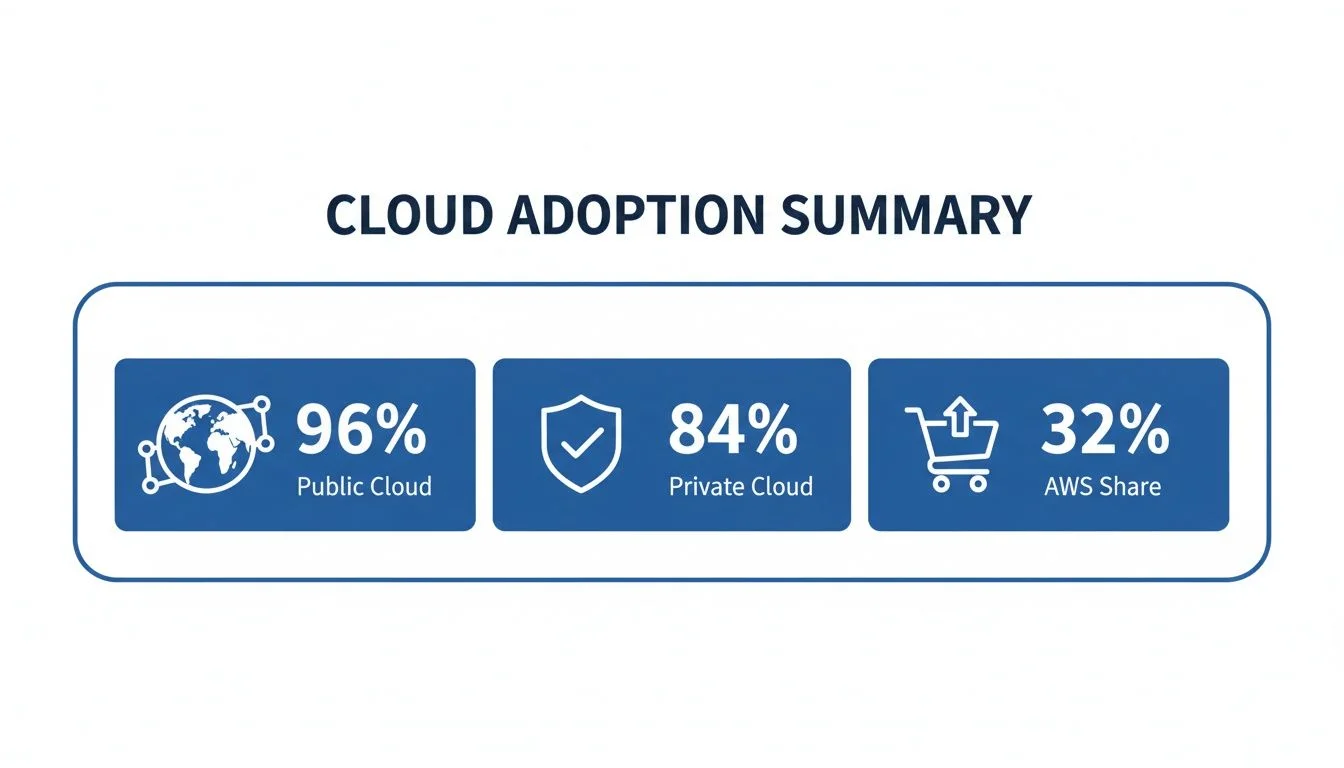
Figure 1: Visualizing the core difference: multi-tenant public cloud (shared) versus single-tenant private cloud (dedicated).
What Is a Public Cloud?
A public cloud is a computing environment where a third-party provider owns and manages all underlying hardware and software. You do not own the equipment; you pay to use it. Providers like Amazon Web Services (AWS), Microsoft Azure, and Google Cloud Platform (GCP) dominate this space. These companies provide a wide range of resources over the internet, including virtual machines, storage, serverless functions, and AI services.
The defining trait of a public cloud is its multi-tenant architecture. This means your data might sit on the same physical server as data from other companies. While you share the physical hardware, the provider uses software to keep your workloads logically isolated and protected from others. This model works because it scales quickly to meet demand. You do not have to buy hardware in advance. Instead, you use a pay-as-you-go pricing structure, which shifts costs from capital expenses to operational expenses (OpEx).
What Is a Private Cloud?
The private cloud offers cloud services that only one organization uses. This setup creates a single-tenant environment where all infrastructure belongs to you or is reserved for your exclusive use. This eliminates the "noisy neighbor" problem, where another company’s high traffic might slow down your own performance. In a private cloud, you do not share resources with any other tenants.
You can deploy a private cloud in several ways. It can sit inside your own physical data center on-site, or you can pay a third-party provider to host a dedicated environment for you off-site. The main reason companies choose this model is for the control it provides over security, data governance, and specific compliance rules. Industries like finance, healthcare, and government often require this level of isolation to satisfy strict regulations. To learn more about this and other deployment options, check the MindMesh Academy study guide on cloud deployment models.
The Bottom Line: The public cloud is a shared utility that emphasizes flexibility and lower initial costs. The private cloud is a dedicated resource that focuses on control and strict security above other factors.
Reflection Prompt: Look at a past project you completed. Based on the initial budget or the security needs, which cloud model seems like the better fit? Why does that model stand out for that specific use case?
Key Characteristics: Public Cloud vs. Private Cloud
This table summarizes the core differences between public and private clouds to help with your certification studies. Choosing a model is a strategic choice, not a technical one. You must align the technology with your business goals, your comfort with risk, and your financial planning. Every model involves trade-offs that IT professionals must weigh before migrating workloads. Use this summary as a quick reference when comparing the two options.
| Attribute | Public Cloud | Private Cloud |
|---|---|---|
| Tenancy | Multi-tenant (shared resources) | Single-tenant (dedicated resources) |
| Ownership | Owned by a third-party provider | Owned by the organization or a third party for the org's sole use |
| Accessibility | Over the public internet | Over a private network or the internet |
| Control Level | Limited to provided services | High degree of customization and control |
| Cost Model | Operational Expenditure (OpEx) - Pay-as-you-go | Capital Expenditure (CapEx) - Upfront investment |
A Look at Market Adoption and Industry Trends
Market share and adoption rates reveal the strategic drivers behind actual business decisions. For IT professionals, these insights help explain why organizations choose one cloud model over another and how those technology choices influence specific business outcomes. The data shows a clear pattern in how modern companies manage their infrastructure and scale their digital operations.
Adoption rates show a preference that depends on how companies balance cost against administrative control. Recent studies indicate that 96% of organizations use at least one public cloud service. Meanwhile, 84% use a private cloud for some portion of their workloads. This difference is due to the accessibility and low entry points offered by major public cloud providers. Currently, AWS holds 32% of the market share (check current vendor reports for the latest data). Azure follows at 23%, and Google Cloud accounts for 11% of the total market.
Public cloud adoption grows because of its flexibility and rapid deployment capabilities. It offers a lower barrier to entry than building physical data centers. Startups, small to medium-sized businesses (SMBs), and large enterprises use the pay-as-you-go model (OpEx) as a financial advantage. This allows for rapid innovation without spending massive upfront capital expenditure (CapEx) on servers, storage, and networking hardware. Companies can test new ideas and scale them globally without long-term hardware commitments.
Why Public Cloud Is So Dominant
The dominance of the public cloud involves more than just market size. It is also fueled by fast-paced innovation from hyperscale providers. These companies launch new services constantly, including serverless computing, machine learning tools, and container orchestration platforms. This makes the public cloud a primary platform for building and deploying modern applications that require high availability and scale.
Several specific factors explain why this model has become the standard for many:
- Speed to Market: Development and operations teams provision or shut down resources in minutes rather than weeks. This speed accelerates project timelines and helps businesses react to market demands. Agility remains a core concept in many cloud certification exams.
- Global Reach: Organizations deploy applications across dozens of data centers located around the world. This puts services closer to end-users, which reduces latency and improves performance for international customers. It allows a small team to maintain a global footprint.
- Cost Efficiency (OpEx): Under an OpEx model, businesses pay only for the compute and storage resources they consume. They do not need to invest in physical hardware, cooling, physical security for facilities, or long-term maintenance contracts. This creates significant financial flexibility.
The growth of the public cloud represents a fundamental shift in IT strategy. Businesses prioritize agility and use cloud providers to handle infrastructure management so they can focus on their own software and services.
Understanding these trends requires looking at the transformative cloud computing benefits that drive businesses toward these platforms.
The Private Cloud's Essential Role
The public cloud leads in total volume, but the private cloud remains vital for specific sectors. Its growth is steady, especially in industries where security, compliance, and total control are mandatory. Regulated sectors like finance, healthcare (HIPAA compliance), and government agencies (data sovereignty) use private clouds to meet strict legal mandates. These environments require a level of data isolation and hardware control that only a private cloud can provide.
Organizations in these sectors accept higher initial costs and ongoing management tasks to minimize risk and ensure they meet every regulatory requirement. They need granular control over the entire environment to satisfy compliance frameworks like GDPR, PCI DSS, or SOC 2. For these entities, a private cloud is a requirement for operations. Large enterprises with predictable, mission-critical workloads and strict security needs maintain the private cloud's position in the industry. These organizations often use a private cloud for their most sensitive data while using public resources for less critical tasks.
A Detailed Analysis of Core Cloud Attributes
To understand the public versus private cloud debate, IT professionals must look beyond simple definitions. You need to analyze how the core attributes of each model impact business operations and architectural decisions. We will examine four areas where these two approaches diverge: security, cost, scalability, and management. This analysis provides the technical clarity needed to make a strategic choice for your infrastructure.
Current data on cloud adoption shows a complex environment where different models often coexist. Statistics indicate that 96% (verify current percentage on industry report sites) of companies use public cloud services in some capacity. This high number highlights how common the model has become. At the same time, 84% (verify current percentage on industry report sites) of organizations also use a private cloud. This suggests that the private model remains a standard for many enterprises. In terms of market dominance, AWS holds a 32% (verify current market share on financial data sites) share of the public cloud market. This figure illustrates the massive scale of their operations.
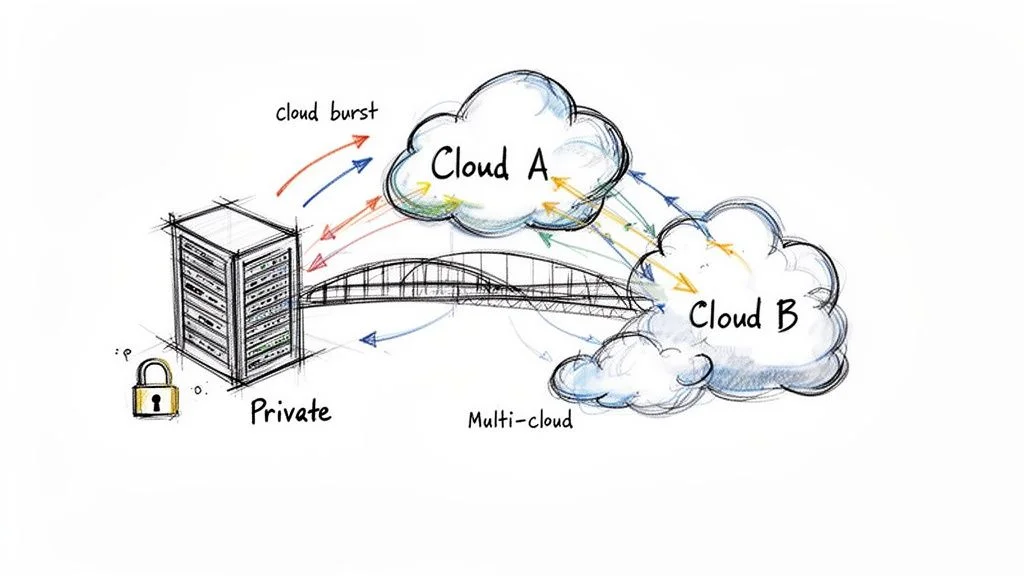
Figure 2: Cloud adoption trends indicating widespread use of both public and private cloud models.
The data reveals that the public cloud is everywhere, but the private cloud is not obsolete. It remains a critical component for many large organizations. Most enterprises use a mix of both to meet different business or regulatory needs. While the public cloud offers speed, the private cloud offers a level of physical isolation that some industries still require.
Security and Compliance
Security is usually the first priority for IT teams. The main difference between public and private clouds is not about which one has better firewalls. Instead, the difference lies in who carries the responsibility for security and compliance. This distinction is a major part of professional certifications, such as the AWS Certified Security - Specialty (SCS-C03) (verify current exam code on vendor site).
In a public cloud, you operate under a shared responsibility model. The provider, such as AWS or Azure, is responsible for the security of the cloud. This means they secure the physical buildings, the hardware servers, the networking cables, and the hypervisor software that runs the virtual machines. You, as the customer, are responsible for security in the cloud. This includes protecting your data, your applications, and your operating systems. You must configure your own network settings, such as security groups and access control lists. You also manage identity and access management (IAM) to ensure only authorized users can reach your resources. If a data breach occurs because of a weak password or an open database port, that falls under your responsibility.
A private cloud gives your organization full control over the security stack. You own the entire environment from the physical door locks of the data center to the application code. This setup allows for highly specific security policies. You can choose the exact hardware firewalls and intrusion detection systems you want to use. This level of direct oversight is often a requirement for industries with strict regulations. For example, healthcare providers following HIPAA, companies handling European data under GDPR, or financial firms following PCI DSS often prefer this model. They need to show auditors exactly where data is stored and how it is physically protected.
Example Scenario: A financial services firm handling sensitive trading data might choose a private cloud. They can build a custom architecture with specific intrusion detection systems and physical audit trails. This allows them to show regulators exactly how they protect every byte of data. On the other hand, a media streaming startup might use the public cloud. They can rely on the provider to handle the heavy lifting of physical security. This lets the startup focus on building their app and delivering content, knowing the underlying infrastructure is protected by the provider’s global security teams.
Reflection Prompt: If you were moving a sensitive database to AWS or Azure, how would the shared responsibility model change your daily tasks? Think about which parts of the stack you would no longer need to manage and which parts would require more focus.
Cost Models and Total Cost of Ownership
The financial structures of public and private clouds are very different. These differences change how companies plan their budgets and long-term spending. IT professionals who work in strategy or cost optimization must understand these details.
The public cloud uses an Operational Expenditure (OpEx) model. This is a pay-as-you-go system. You get a bill every month for what you actually used, similar to a water or electricity bill. This model is great for avoiding big upfront costs. It gives businesses the agility to test new ideas without buying expensive servers first. If a project fails, you simply turn off the resources and stop paying. This reduces the financial risk of innovation. However, costs can grow quickly if you do not monitor your usage. Unused resources that stay running can lead to high bills at the end of the month.
A private cloud follows a Capital Expenditure (CapEx) model. This requires a large investment at the start. You have to buy servers, storage arrays, networking gear, and software licenses. You also need a physical space with power, cooling, and security. While this costs a lot on day one, it can be cheaper over a long period. For stable workloads that do not change much, a private cloud can have a lower Total Cost of Ownership (TCO) over three to five years. Once the hardware is paid for, your ongoing costs are limited to maintenance, electricity, and the staff who run the center. You are not paying a third-party service fee or a markup on the resource usage.
Comparing Financial Models
| Factor | Public Cloud (OpEx) | Private Cloud (CapEx) |
|---|---|---|
| Initial Cost | Low; you do not buy hardware or rent a building. | High; requires buying hardware, licenses, and facility space. |
| Ongoing Costs | Variable; changes every month based on how much you use. | Predictable; mostly power, cooling, and staff salaries. |
| Best For | New projects, startups, and apps with spikes in traffic. | Large companies with steady, predictable workloads. |
This financial split often dictates a company's cloud strategy. An e-commerce site expects massive traffic during a holiday sale. They benefit from the public cloud because they can scale up for one week and then scale back down. They only pay for the extra capacity when they need it. A manufacturing plant with a steady data processing task might prefer a private cloud. Their resource needs stay the same every day for years. In that case, buying the hardware and depreciating it over five years is often the more economical choice.
Scalability and Performance
Cloud computing promises the ability to change your resource levels whenever you want. However, the speed and method of this scaling differ between the two models. You can review these concepts in more detail by looking at key cloud characteristics like on-demand scalability. This is a core topic for the AWS Certified Cloud Practitioner (CLF-C02) (verify current exam code on vendor site).
The public cloud offers nearly infinite scalability that is available almost instantly. A developer can start hundreds of virtual machines in minutes using an API or a web console. Services like AWS Auto Scaling or Azure Scale Sets can add or remove resources automatically based on how much traffic is hitting the application. This elasticity allows a company to handle a viral social media moment or a sudden news event without any manual work. You never have to worry about running out of server racks because the provider has massive data centers all over the world.
A private cloud can also scale, but it is limited by the hardware you own. If your servers are at 90% capacity and you need more power, you have to buy more hardware. This involves a long process: getting budget approval, ordering the gear, waiting for delivery, and then installing it in the rack. This can take weeks or months. Because of this, private clouds are less agile. They are better for workloads where you know exactly how much performance you need. You get the benefit of dedicated resources that are not shared with anyone else, which ensures consistent performance.
Scalability at a Glance
- Public Cloud: Scales up or down automatically and quickly. It handles fluctuating workloads very well.
- Private Cloud: Scales slowly and manually. It is restricted by physical hardware limits and procurement cycles.
One performance issue in the public cloud is the "noisy neighbor" problem. Since you share the physical server with other customers, their heavy traffic could potentially slow down your application. While providers use advanced software to keep workloads separate, the risk still exists. A private cloud removes this risk. Your organization is the only one using the hardware, so you have full access to the CPU, memory, and disk speed at all times.
Management and Control
The last major difference is how much work your IT team has to do every day. This choice affects your staffing needs and how much you can customize your environment.
In a public cloud, the provider manages the heavy infrastructure. They handle the hardware repairs, the cooling systems, and the firmware updates on the servers. They also manage the virtualization layer. This takes a lot of work off your team’s plate. Your IT staff can spend their time building better software or improving the customer experience rather than fixing broken hard drives. The downside is that you have less control. You must use the tools and versions the provider offers. You cannot walk into their data center and change a cable or install a custom piece of hardware.
A private cloud offers total control. Your team can change any part of the hardware or network to fit your specific needs. This is helpful if you run old applications that require a very specific server setup. However, this control comes with a high workload. Your staff is responsible for everything. They must monitor the hardware for failures, apply security patches to the servers, and manage the virtualization software like VMware or OpenStack. This requires a team with specialized skills in hardware maintenance and data center networking. You are the builder, the operator, and the repair person for the entire system.
Choosing the Right Cloud for Your Workload
Selecting between a public and private cloud is more than a technical detail. It is a fundamental strategic decision and a primary topic in cloud architect certification exams. The most effective cloud for your organization depends on the specific requirements of your applications. A standard approach rarely fits every situation. The right choice depends on how a workload functions regarding performance, security, compliance, cost efficiency, and scalability.
The goal is to match the infrastructure environment to the specific needs of the workload. For example, a new startup often finds the public cloud’s agility and low initial cost a major advantage for rapid prototyping and deployment. In contrast, an established enterprise handling mission-critical operations or strict regulatory demands will choose the controlled, predictable environment of a private cloud.
Where the Public Cloud Shines
The public cloud is the best choice when flexibility, speed to market, and an operational expenditure (OpEx) model are your main goals. These platforms are built specifically to handle variable demand and fast development cycles. This makes them the standard choice for many modern applications and business use cases.
Here are common examples where this model works best for IT staff:
- Development and Testing Environments: There is no reason to spend capital on hardware for temporary projects. Using the public cloud, development teams spin up isolated sandboxes and shut them down quickly once they finish their work. This method speeds up innovation, supports CI/CD pipelines, and ensures that experimentation costs remain low.
- Customer-Facing Web Applications: An e-commerce site might experience a massive traffic surge during a holiday sale or a special promotion. Public cloud features, such as AWS Auto Scaling or Azure Virtual Machine Scale Sets, are designed to handle these peaks. This ensures the site stays responsive for customers without requiring the company to pay for that high capacity throughout the rest of the year.
- Startups and SaaS Products: Companies operating with tight budgets rely on the pay-as-you-go model. It allows them to launch products quickly and scale their infrastructure only as their customer base grows. This approach turns large capital expenses into manageable monthly operating costs, reducing the financial risk of a new launch.
- Big Data Analytics and Machine Learning: Public cloud platforms provide specialized, scalable services like AWS EMR, Azure HDInsight, and Google BigQuery. These services are built to process massive datasets and train complex machine learning models. They provide the necessary compute power without requiring an organization to invest in permanent on-premises hardware.
Key Takeaway: If a workload is dynamic, has unpredictable traffic patterns, or must serve a global audience with rapid deployment, the public cloud is almost always the best place to start.
When to Go with a Private Cloud
A private cloud is the better choice when you require total control, strict compliance, and guaranteed performance. It is designed for workloads that are too sensitive or critical to run in a shared, multi-tenant public cloud environment.
Industry data shows how organizations split their resources. Companies typically run about 50% of their workloads in public clouds and 32% in private clouds. These percentages change based on the industry sector. The telecommunications industry shows a high preference for private clouds, with a 64% adoption rate. These firms use private infrastructure to secure proprietary network systems and sensitive customer data. Only about 5% of companies worldwide move workloads back from the public cloud to on-premises solutions once they have migrated. This suggests that cloud adoption is usually permanent once the initial transition occurs. You can find more details in the private cloud market and its trends report.
The preference for private infrastructure is most common in these specific areas:
- Financial Services and Banking: Core banking platforms, trading systems, and payment processing engines handle sensitive financial transactions every second. These systems require the physical isolation, auditable security layers, and data sovereignty that only a private cloud can provide. This ensures that financial data is never co-mingled with data from other organizations.
- Healthcare and Government: Any organization following regulations like HIPAA for patient data or GDPR for European privacy laws must often use a private cloud. This setup ensures that patient records, classified information, or citizen data stay within specific physical and legal boundaries. It allows the organization to maintain direct control over the security stack to meet strict legal mandates.
- Legacy and Custom Applications: Some older applications are essential to a business but were not built for modern cloud architectures. A private cloud provides the flexibility to build a custom environment. IT teams can set the exact hardware configurations and network settings needed to keep these systems running reliably without needing to rewrite the code.
By analyzing what a workload needs—including user patterns, data sensitivity, and regulatory requirements—you can make a strategic decision that aligns your infrastructure with your business goals. This ensures you are picking the specific tool that matches the operational job.
Understanding Hybrid and Multi-Cloud Strategies
Modern IT departments rarely view the choice between public and private cloud as a simple fork in the road. Most organizations, especially at the enterprise level, now use strategies that combine the strengths of both models. This evolution moves your architecture away from a basic binary choice and toward an adaptable system design. By using both environments, companies build resilience and flexibility into their core operations. These designs allow for a custom approach to data management and application hosting.
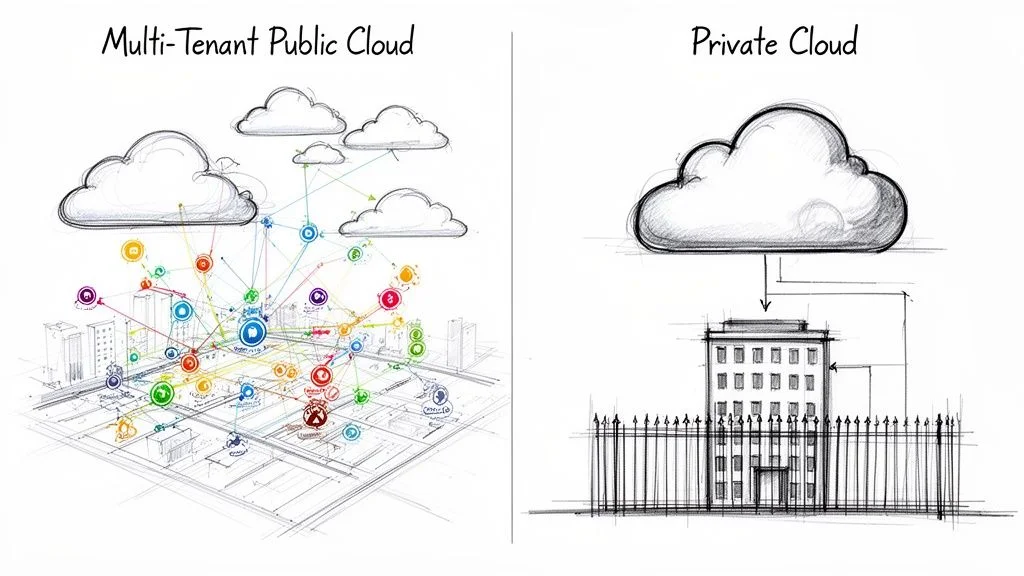
Figure 3: An illustration of hybrid and multi-cloud architectures, showcasing how private data centers integrate with multiple public cloud providers.
Two specific terms appear most often when discussing these advanced setups: hybrid cloud and multi-cloud. People frequently use these names interchangeably, but they represent two different technical strategies for managing cloud assets. After you understand the basic differences between public and private clouds, the next logical step for an architect is learning how to blend them to solve specific business problems. Each approach has distinct strengths that cater to different organizational needs and technical requirements.
Defining the Hybrid Cloud Approach
A hybrid cloud goes beyond just owning a private server and a public cloud subscription. It requires integration where these two environments work together as one functional system. The critical elements are orchestration and connectivity. This setup allows data and application workloads to flow between on-premises hardware and public cloud instances without needing manual intervention. The objective is to build a unified environment where every workload runs in its most efficient location.
This configuration lets a company keep its sensitive records and mission-critical applications inside a private cloud for higher security. At the same time, the business can use the massive scale of public providers for other tasks. You can find more specific technical details on the hybrid cloud model in our official study materials.
A practical application of this strategy is cloud bursting.
Example: Consider an e-commerce company that handles its day-to-day sales and private customer databases on its own hardware. This setup ensures they have full control over data privacy and consistent performance for daily tasks. However, when a holiday shopping rush creates a massive spike in user traffic, the local servers might hit their capacity limits. Instead of the site crashing, the application automatically pushes the excess web traffic to the public cloud. The system spins up extra virtual servers on AWS or Azure to handle the load. Once the shopping event ends and traffic returns to normal levels, the system shuts down those public instances and moves the workload back to the private environment. This process manages costs because the company only pays for the extra capacity during the high-demand window.
This method provides the protection of a private environment for base operations while using the elastic nature of public resources exactly when they are required. It is an effective way to control operational costs while ensuring the system remains responsive under pressure. It provides the security of the private cloud and the scalability of the public cloud in one package.
Understanding the Multi-Cloud Strategy
A multi-cloud strategy takes a different path by using services from two or more public cloud providers. While a hybrid setup always includes a private data center component, a multi-cloud architecture might consist entirely of public cloud resources. The main driver here is the desire to avoid being tied to one single vendor. It allows technical teams to pick specific services from different providers based on performance, cost, or features.
For example, a company might use Amazon Web Services (AWS) to handle its primary compute and networking needs because of its global infrastructure. That same company might then use Google Cloud Platform (GCP) for projects that require machine learning tools. Finally, they might use Microsoft Azure to manage their office software and identity management systems.
Key Motivations for a Multi-Cloud Strategy
-
Avoiding Vendor Lock-In: Putting all your data with one provider creates a heavy dependency that is difficult to break. If that provider raises prices or changes its service terms, the company has very little room to negotiate. Using multiple clouds keeps the power in the hands of the customer, making it easier to move workloads if a provider no longer meets the needs of the organization.
-
Access to Specialized Services: Cloud providers do not offer identical features. Each major vendor has its own strengths. By using a multi-cloud approach, an organization can use the best tool for every job. This might mean choosing GCP for data analytics and artificial intelligence, AWS for serverless computing through Lambda, or Azure for connecting to existing Windows-based enterprise tools.
-
Improved Resilience and Disaster Recovery: Running applications across two different cloud companies protects the business from major outages. If one cloud provider suffers a regional failure, critical business services can fail over to the other provider. This level of redundancy ensures that the company remains operational even during a technical crisis at a major data center.
Ultimately, hybrid and multi-cloud strategies prove that modern infrastructure is not a "one size fits all" solution. By combining public and private resources, organizations create a custom environment that fits their specific technical goals and risk tolerance. This prepares the business to handle changing market demands with a system that is both stable and scalable.
A Practical Framework for Making Your Decision
Selecting between public and private cloud models is a business strategy rather than just a technical checklist. The choice must fit your organization's specific operational context. Use this framework to help your IT team clear away the noise and identify the cloud model that serves your actual goals.
Before you compare features, perform an internal audit. Define your real budget limits. Do you have enough internal engineering talent to build and maintain infrastructure, or should your staff focus on building application code? Answering these questions honestly creates the base for a functional cloud strategy.
Evaluating Your Core Requirements
Look at the specific needs of your workloads. Ask clear questions to build a profile of your necessary cloud setup. You do not need to find one perfect vendor. Instead, identify which model has the specific strengths that align with your requirements.
Analyze these four areas because they determine the architecture of your solution:
- Security and Compliance: Do your operations fall under strict regulatory rules like HIPAA, GDPR, PCI DSS, or SOC 2? Does the sensitivity of your data, such as private user records or financial history, require isolation on hardware that no other company uses?
- Cost and Budget: Does your finance team prefer predictable, upfront capital expenses (CapEx) to own assets over time? Or does a flexible, pay-as-you-go operational expense (OpEx) model fit your cash flow better, allowing you to pay only for what you use?
- Scalability and Performance: Do you deal with sudden, massive traffic surges, such as holiday shopping seasons, that need resources to spin up and down in seconds? Or are your workloads steady and predictable, making fixed performance a higher priority than rapid elasticity?
- Management and Control: How much control does your team need over the stack? Do you want to manage every layer of hardware and software for deep customization? Or would your IT team provide more value if a provider handled the infrastructure, allowing them to focus on software features?
Reflection Prompt: Think about your most critical application. Weigh these four requirements against each other. Which one is the priority? Are there any non-negotiable factors that force you toward one specific model?
Your answers will help clarify the right direction. If you need granular control, specific compliance settings, and predictable long-term costs, a private cloud is likely the best fit. If your business values speed, fast deployment, and high elasticity, the public cloud is usually the better choice.
Aligning with Business and Market Realities
You must also consider broader market trends. Public cloud services continue to grow as a massive force in the tech industry. Research indicates that end-user spending on public cloud services will likely hit $723.4 billion globally in 2025 (verify latest spending forecasts with Gartner or IDC). This represents a 21% increase from the $595.7 billion recorded in 2024 (check current industry reports for updates).
Market dominance remains concentrated. The "big three" providers—AWS (32%), Azure (23%), and Google Cloud (11%)—controlled 66% of the total market as of Q3 2023 (verify current market share percentages with Canalys or Synergy Research). This growth highlights how much of the global economy now runs on shared infrastructure.
Private clouds still fill a vital, high-end role for industries that cannot compromise on data locality or hardware control. Organizations that want to see what drives this sector can look at the private cloud market and its drivers to see why it remains a preferred option for many enterprise-level firms.
Base your final selection on your actual use case and long-term business goals. A fintech startup might use public cloud for testing new features to stay fast, but keep its payment processing on a private cloud to meet security standards. This framework is a map to connect your goals to the right technical strengths. It helps you make a strategic move that sets your organization up for success.
Common Questions, Answered
Even after breaking down the technical differences, specific questions come up when IT professionals evaluate cloud options. Let's look at some common misconceptions to clarify which model fits your organization.
Is a Private Cloud Automatically More Secure?
The answer is no. This is a frequent misunderstanding in the industry. While a private cloud offers control and isolation over your hardware, its actual security is only as strong as the processes and people you hire to manage it. A misconfigured server in a private data center is just as much of a liability as a public one.
Major public cloud providers like AWS or Azure invest billions of dollars every year into their security infrastructure. They employ thousands of security experts to monitor threats around the clock. The main concept to understand here is the shared responsibility model. In a public setting, the vendor handles security of the cloud. This includes the physical buildings, the power supply, and the software layer that runs the virtual machines. You remain responsible for security in the cloud, which covers your data, your applications, and your firewall settings.
In a private cloud, you are responsible for everything. You have to manage the physical locks on the server room door, the cooling systems, and the application-level security patches. Instead of asking which is more secure, ask who is better equipped to manage security for your specific needs. For many businesses, a well-built environment on a public provider is much safer than an under-funded or poorly managed private data center.
Are Private Clouds Only for Big Companies?
For the most part, yes, but there are exceptions. The primary barrier for small businesses and startups is the high upfront cost, known as capital expenditure or CapEx. To build a private cloud, you must buy servers, storage arrays, and networking hardware before you even start. You also need a facility with high-end power backups and cooling systems. This requires a large budget and a dedicated IT staff, which is why large enterprises are the typical users.
However, a middle ground exists for smaller firms with strict data rules. A specialized law firm or a research lab handling sensitive records might use a hosted private cloud. In this model, a third-party provider builds and manages dedicated hardware just for you. This gives you the isolation of a private cloud without the need to buy your own building or hire a massive internal team. You get the benefits of dedicated resources without the full CapEx burden of building a data center from scratch.
Does the Public Cloud Always Cost Less?
For new companies or those with changing traffic, the public cloud is usually the cheaper option. It uses an operational expenditure or OpEx model. You pay only for the resources you use each month. There is no hardware to buy, which makes it easy to scale up during a busy season and scale down when things are quiet. Your costs stay tied to your actual consumption.
The math changes when your workload is steady and massive. If your organization runs large, predictable workloads 24 hours a day, a private cloud can become more cost-effective over a three-to-five-year horizon. Once you pay for the hardware, your main costs are power, cooling, and staff salaries. Public providers charge a premium on top of the resource costs to make a profit. If you utilize your own hardware at a high rate for several years, you eventually bypass the markup of the public cloud. The choice depends on how predictable your resource needs are and whether you have the capital to invest upfront.
Ready to master cloud concepts and be well-prepared for your certification exams? MindMesh Academy provides expert-curated study materials and evidence-based learning methods to accelerate your career. Prepare for AWS, Azure, and more with a platform designed for deep understanding. Explore our courses today.

Written by
Alvin Varughese
Founder, MindMesh Academy
Alvin Varughese is the founder of MindMesh Academy and an enterprise architecture leader. An electrical engineer by training, he moved from factory automation in South Africa to cloud architecture at GE Appliances and Humana (Fortune 50), and holds 20 professional certifications including AWS Solutions Architect Professional, Azure DevOps Engineer Expert, and Microsoft Agentic AI Business Solutions Architect. He built MindMesh Academy after interviewing too many highly certified candidates who couldn't answer basic questions: the goal is prep that makes you better at the job, not just able to pass the exam.