
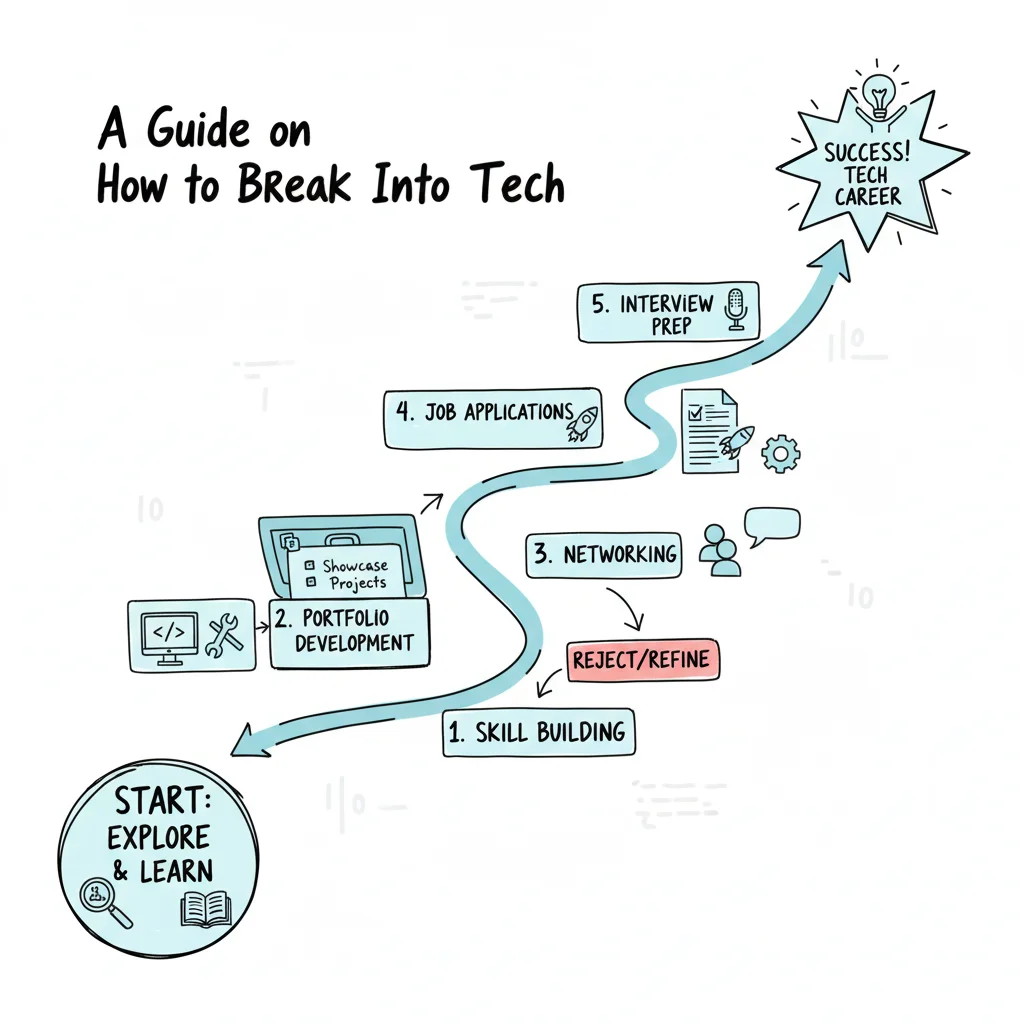
A Guide on How to Break Into Tech
A Guide on How to Break Into Tech
Breaking into the tech industry now requires more than just foundational knowledge; you need a concrete plan. Aspiring career changers and IT professionals must focus on mastering high-demand skills. Build a portfolio that demonstrates your ability to solve real problems and prioritize networking with active industry peers. This targeted approach provides a direct route to relevant positions while avoiding the crowded, traditional entry routes others often take.
The Reality of Breaking Into Tech Today
Finding your first role in the technology sector is more difficult than it used to be. You are not alone if the process feels slower or more demanding. The market has shifted significantly over the last few years. Previously, a certificate from a coding bootcamp or a short course might have served as a fast track into a high-paying role. Today, the environment is far more competitive. Companies are more selective and have raised the bar for what they expect from entry-level candidates.
Most organizations now operate with smaller, more efficient teams. Their priority is finding professionals who can make an immediate impact. They want people who can use job-ready skills to solve actual business problems rather than those who only have a theoretical understanding of the field. This change means you must be able to prove your practical abilities before you even get an interview.
Navigating the New Normal
If you are a recent graduate or a professional trying to switch careers, you are facing a steeper climb than those who entered the field five years ago. Hiring data confirms this shift. New graduate hires at major technology firms have dropped significantly. They now represent just 7% of all hires. This is a sharp decline from the 25% share they held in 2023. The contrast is even more visible when looking at the 50% rate observed before the pandemic changed the hiring market. These figures show that the traditional entry path for newcomers has narrowed.
This data is not meant to discourage you. Instead, it provides a clear view of the current market so you can build a better strategy. Success now requires a more deliberate approach. You must focus on four specific areas that we call the pillars of a successful career transition. The following table outlines these strategies and why they are necessary in the current hiring climate.
| Pillar | What It Involves | Why It Matters Now |
|---|---|---|
| Choose a High-Demand Niche | You must identify and commit to a specific, growing field such as cybersecurity, cloud computing, or data engineering. | The market for generalists is crowded. By specializing in a specific area, you reduce your competition and become a more valuable prospect for companies looking for expert help. |
| Build Practical, Job-Ready Skills | You need to move beyond basic tutorials. Focus on building projects that solve real-world problems and validate those skills with recognized certifications. | Employers want proof that you can perform the job duties on day one. They value demonstrable expertise over a simple list of completed online courses. |
| Create a Professional Portfolio | You should curate your best work into a professional showcase that explains your technical skills and how you think through problems. | Your portfolio is your most important asset. It serves as your resume and your evidence. It is often the primary reason a recruiter decides to call you for an interview. |
| Network with Intention | You must build genuine professional relationships with people already working in the industry long before you need to ask for a job referral. | Referrals remain the most effective way to get hired. A recommendation from a trusted employee is much more powerful than a cold application submitted through a job board. |
These pillars work together. They help you build a strong case for why a company should hire you. This method is supported by current market dynamics where specialization and proven skills are the keys to accessing new opportunities.
Key Takeaway: The current IT environment requires more than just academic knowledge. You cannot simply learn a skill; you must apply it in a way that is visible to potential employers. A high-quality project is more than a line on your resume. It is proof of your capabilities and is often the result of preparing for a professional certification.
Where should you begin? Your first step is to pick a high-demand field that matches your interests. Professional certifications are an excellent way to validate your skills in a specific niche. They show potential employers that you are committed and have reached a specific level of proficiency.
To see which areas offer the best returns, you can read our guide on the top 10 high-paying IT certifications in 2025. The rest of this guide will help you choose your specialization and build the skills that will help you get hired.
Reflection Prompt: Based on the current market data, which of the four pillars is your strongest asset right now, and which one needs the most work?
Find Your Footing: Choosing Your Niche in the Tech World
The old advice to "just learn to code" does not work anymore. If you want to enter the tech industry now, your first move must be to specialize. Companies do not look for vague "tech workers." They hire a Cybersecurity Analyst to stop data breaches or a Cloud Engineer to manage AWS infrastructure and keep costs low.
When you focus on one specific skill set, you are no longer just another generalist applicant. You become the solution to a specific business problem. This focus is how you stand out. While tech is growing, the growth is mostly in a few specific areas. Recent data shows the U.S. had a 1.2% increase in tech jobs, which means about 72,500 new positions. The most activity is in cybersecurity, cloud computing, and data analysis. You can see more details on these trends at CompTIA.org.
Picking the right niche from the start is your biggest advantage. It determines what you learn and who hires you.
Where the Action Is: Exploring High-Growth Career Paths
Specific roles often match with specific certification paths. Here is a look at what these jobs actually involve every day.
Cybersecurity Analyst
A Cybersecurity Analyst acts like a digital detective and a security guard. Your main job is to keep an organization's networks and systems safe from hackers. You are on the front lines. You watch for strange activity, find weaknesses before someone uses them, and react quickly to security threats.
A normal day involves checking many security alerts and looking for patterns. You will run vulnerability scans on the network and write reports for managers about potential risks. You will use tools like Security Information and Event Management (SIEM) systems, firewalls, and intrusion detection software. This role is a good fit if you like solving puzzles and stay calm when things go wrong.
- Skills You'll Need: You must understand how networks work and how to use Windows and Linux operating systems. You need to know how to use security tools. Most people start with the CompTIA Security+ (the current version is SY0-701) to pass with confidence and get an entry-level job. Later, you can look at the Certified Ethical Hacker (CEH).
- What to Expect Salary-Wise: Entry-level pay is usually between $65,000 - $85,000 (verify current salary data on the vendor site or through local job market research).
Cloud Engineer
A Cloud Engineer builds and runs the systems on platforms like Amazon Web Services (AWS), Microsoft Azure, or Google Cloud Platform (GCP). You make sure applications run well, grow when more people use them, and stay within the company budget.
Your work might include setting up virtual servers or configuring databases. You will write scripts in Python or Bash to automate tasks. This allows new software to go live with less manual work. As companies stop using their own servers and move to the cloud, this job has become essential.
Expert Insight: Demand for cloud skills is moving fast. Companies in every industry want to make their cloud setups better and need skilled people to do it. This is a very stable career choice. You can start with the AWS Certified Cloud Practitioner (CLF-C02) or Microsoft Azure Fundamentals (AZ-900).
If you want to be a cloud engineer, certifications help you a lot. The Azure learning paths and certifications at MindMesh Academy show you exactly what skills hiring managers want to see.
- Skills You'll Need: Focus on one major cloud platform first. You should also learn how to write scripts in Python or Bash and understand how networking works in a virtual environment.
- What to Expect Salary-Wise: New cloud engineers can expect a starting salary between $75,000 - $95,000 (verify current salary data on the vendor site or through local job market research).
Reflection Prompt: Which of these roles sounds more interesting to you? Why do you think that specific path fits your skills?
So, How Do You Choose?
Do not just pick a job because it pays well. Find the place where your interests meet what the market needs.
If you like finding hidden problems and thinking ahead, Cybersecurity might be your best choice. If you like building large systems and making things run better, Cloud Engineering could be the right fit. If you like organizing projects and helping teams meet deadlines, you might look at roles that require PMP (Project Management Professional) or ITIL (Information Technology Infrastructure Library) certifications. These roles use technical management to keep projects on track.
Take time to think about yourself. What kind of problems do you like to solve? To help you choose, look at the comparison below for some of the most common roles for people switching to an IT career.
Comparing In-Demand Tech Career Paths
This table shows what you need to start in several key roles and where those roles are going in the future.
| Role | Core Skills | Entry-Level Friendly? | Long-Term Outlook |
|---|---|---|---|
| Cybersecurity Analyst | Threat detection, network security, risk assessment | Yes, with current certifications like CompTIA Security+ SY0-701 | High demand as threats change and grow |
| Cloud Engineer | AWS/Azure/GCP, automation, Python/Bash, cloud networking | Yes, if you have projects and current certs like AWS CLF-C02 | Very strong as companies move away from physical hardware |
| Data Analyst | SQL, Python/R, data visualization with Tableau, basic statistics | Yes, a strong portfolio is better than just a degree | Very good as companies use data to make every decision |
| IT Project Manager | Project planning, managing risk, talking to stakeholders | Yes, if you get a PMP or Scrum Master certification | Strong, because tech projects are getting more complicated |
| IT Service Management (ITSM) | Delivering service, managing incidents, using the ITIL framework | Yes, the ITIL Foundation certification is a common start | Stable, because every large company needs to manage its IT services |
This choice is the most important one you will make at the start. It gives you a focus for your studies. It tells you what kind of projects to build for your portfolio. It also makes you a much better candidate when you talk to recruiters because you know exactly what job you want.
Specialization removes the confusion from your job search. Instead of applying to every job with "tech" in the title, you can target the specific roles that match your training. This saves time and helps you get hired faster. If you are coming from a different industry, look for ways your old skills match these new paths. A manager might find a natural path into IT Project Management, while someone who likes fixing things might prefer Cybersecurity.
Once you pick a path, stay with it. It is better to be very good at one thing than to be average at five things. Focus your energy on the certifications and projects that matter for your chosen niche. This plan is the most direct way to a new career in the technology sector. Use the current exam versions and verify all pricing on vendor sites as you begin your training. With a clear goal, you can move forward with a specific plan for success.
Building Job-Ready Skills Without a CS Degree
You do not need a four-year computer science degree to start a career in technology. While university programs offer structure, modern employers focus on what you can actually do rather than where you went to school. This key shift in how companies hire creates room for anyone willing to focus on hands-on learning and practical skills. In the past, a degree was often a strict requirement, but now it is frequently treated as just one of many ways to prove your intelligence and dedication.
Success in this field comes from showing results. Your primary goal is not just to read books or watch videos. You need to build applications that work, solve technical problems, and earn certifications that show you can handle the daily tasks of the job. These concrete examples of your work often carry more weight with a hiring manager than a diploma. If you can prove your technical expertise through work you have already completed, the lack of a traditional degree becomes less of an obstacle.
Choosing Your Path: Bootcamps vs. Self-Study
If you decide to skip the university route, you generally face two choices: a structured coding bootcamp or a self-directed learning plan. Neither option is perfect for everyone. Your choice depends on how you learn best, how much money you can spend, and how quickly you want to find a new job. Both routes require a high level of commitment, but they organize your time and resources in different ways.
A coding bootcamp acts as an accelerator. These programs are fast and difficult, designed to turn a beginner into a worker in a few months. You follow a set curriculum and learn from instructors while working alongside other students. This structure is helpful if you need an environment that provides high levels of accountability and immediate feedback.
- The Upside: Bootcamps are the fastest route to a job. They focus entirely on the skills you need to get hired and usually provide career services like interview practice and resume reviews to help you find a position. Many programs also have networks with local companies to help with job placement.
- The Downside: These programs require a large investment. Costs usually range from $10,000 - $20,000 (verify current pricing on the vendor site). The schedule is often so intense that you cannot keep a full-time job while enrolled. You must also research carefully because the quality of instruction and the currency of the curriculum varies between different providers.
Self-directed learning puts you in complete control of your own education. You can use resources like freeCodeCamp, The Odin Project, Coursera, and Udemy. You set the schedule and pick the topics that fit your specific goals. This path requires a high level of discipline, but it offers the most freedom for those who need to balance study with other life responsibilities.
- The Upside: This method is very cheap. Many of the best tools and tutorials are free or very low cost. You can learn while keeping your current job and spend as much time as you want on the specific topics that interest you most.
- The Downside: You are responsible for everything. There is no teacher checking your progress or classmates to help you when you get stuck on a difficult technical concept. You must find your own answers, build your own network, and stay motivated without external pressure.
Real-World Analogy: A marketing manager who wants to move into a business intelligence role has two main ways to get there. They might join a 12-week data analytics bootcamp for an intensive education in SQL, Tableau, and Python. Alternatively, they could keep their current position and study at night. They might start with free SQL tutorials, then take a data visualization course on Coursera, building their skill set one step at a time. Both paths lead to success, depending on whether the person has more time or more money to invest in the transition.
Getting Certified: Proof That Actually Matters
In technical fields like cloud computing, cybersecurity, and IT management, certifications are often the standard currency. These certificates serve as official proof from the industry that you know how to use a specific technology. For many employers, these credentials are just as valuable as a college degree because they show you have met a recognized standard of competence.
Consider this: a certification shows you have mastered a particular tool or process. Earning an AWS Certified Solutions Architect – Associate from Amazon Web Services tells recruiters you can design and run systems on a major cloud platform. Similarly, an ITIL Foundation certification shows you understand how to manage IT services efficiently. These credentials remove the guesswork for employers and prove you have the expertise required for the role.
Here are several certifications that carry weight with hiring managers, organized by technical area:
- Cloud Computing:
- AWS Certified Cloud Practitioner (a strong starting point for understanding basic cloud concepts and infrastructure)
- Microsoft Azure Fundamentals (AZ-900) (learn.microsoft.com/en-us/credentials/certifications/azure-fundamentals/) (essential for companies using Microsoft cloud services)
- Google Associate Cloud Engineer (proves you can deploy applications and monitor operations on Google Cloud)
- Cybersecurity:
- CompTIA Security+ (comptia.org/certifications/security) (a foundational credential covering general security principles and risk management)
- Certified Ethical Hacker (CEH) (for those who want to specialize in finding security holes and testing defenses)
- (ISC)² SSCP (Systems Security Certified Practitioner) (focuses on the hands-on operational side of keeping systems safe)
- IT Support & Networking:
- CompTIA A+ (the entry-level standard for technical support and help desk roles)
- CompTIA Network+ (proves you understand how to build, manage, and troubleshoot networks)
- Project Management & Service Management:
- PMP (Project Management Professional) (highly valued for anyone leading technical teams or managing project timelines)
- ITIL 4 Foundation (covers the best practices for managing IT services and operations)
These are more than just badges for a LinkedIn profile. They act as keywords that help your resume pass through automated Applicant Tracking Systems (ATS) filters to reach human eyes. If you are looking to plan your certification path, read our guide to the best online courses for IT certification in 2025 at MindMesh Academy.
Stop Learning, Start Doing: The Project-Based Approach
The most important advice for any tech student is to stop passive learning and start active building. You can watch tutorials for years, but you only truly learn when you start your own project from scratch. Real learning happens when you run into a problem and have to find a way to fix it. This process of trial and error is what builds the practical knowledge needed for a professional career.
This is where you build true proficiency. Working on a project forces you to solve real problems, fix your own bugs, and make your own technical decisions. This is the difference between memorizing a recipe and knowing how to cook. These projects also show that you can apply what you learned while studying for your exams. For example, after learning about servers, you could build a personal home lab to show you understand how they work in practice.
You should aim to build a portfolio with 2-3 strong projects. These must show the specific skills needed for the job you want to get. If you want a job in IT support, build a network lab using virtual machines. If you want to be a developer, build a tool that solves a specific problem. You will list these projects on your resume and talk about them during your interviews. Your portfolio is the ultimate proof that you are ready for a professional role in technology.
Creating a Portfolio That Proves Your Worth
When you are starting a career transition into tech, your portfolio is your strongest asset. It provides the concrete evidence needed to answer any doubts about a non-traditional background. A well-constructed portfolio does more than list your skills; it shows hiring managers that you can deliver results.
Many people follow a basic tutorial to create a to-do list app or a simple calculator. The problem is that recruiters see these same projects every day. To stand out, you need two or three projects that solve a real-world problem. This approach demonstrates your technical ability and your initiative. It also allows you to apply the practical skills you learned while studying for certifications.
Moving Beyond Tutorial Projects
The most effective portfolios tell a story. Hiring managers want to see that you can identify a challenge, choose the right tools, and build a solution. Your portfolio should be a collection of these problem-solving efforts.
Instead of building another weather app, think bigger. Move away from asking what you can build and start asking what problem you can solve. This change in perspective leads to better projects and better interviews.
Here are some ideas to help you get started:
- Aspiring Data Analyst? Avoid using clean, pre-made datasets. Instead, find messy, public health data from a government website. Your project could involve scraping that data, cleaning it thoroughly, and building a dashboard that shows trends in your local area. This proves you can handle the kind of difficult data work found in professional certifications.
- Future Web Developer? Find a local small business or a charity with a broken website or a slow manual process. Build them a modern booking system or a donation portal that actually works. This shows you can talk to a "client" and build a tool that meets their specific business needs.
- Budding Cybersecurity Expert? Set up a home lab. Document how you identified vulnerabilities in a test system, how you set up a honeypot to watch traffic, and how you wrote an incident response report. This work directly mirrors the skills required for the CompTIA Security+ or Certified Ethical Hacker exams.
These projects show you can do more than just follow a video. They prove you think like an engineer or a security professional.
Documenting Your Work and Your Thought Process
Building the project is only half the battle. How you present it matters just as much. Treat your GitHub repository as a professional product. This is often the first thing a technical recruiter will look at when they see your resume.
The README.md file in your repository is your best tool. It is where you show the communication and documentation skills that tech companies value.
A great README does more than explain what the app does. It explains why you built it, the technical hurdles you hit, and how you fixed them. It turns a pile of code into a case study of your ability to solve problems, reinforcing the things you learned during your certification training.
Make sure every project has a clear README that includes these four parts:
- Project Motivation: Explain the problem you wanted to solve.
- Tech Stack: List the languages and tools you used, such as Python, SQL, or AWS.
- Key Features: Use a list to show the most important things the project can do.
- Challenges & Solutions: This is the most important part for an interview. Describe a hard bug or a logic problem you faced and how you solved it.
Writing clear documentation puts you in a much better position when you start your job search. For those learning how to write a resume with no prior experience, these project descriptions provide the best bullet points for your experience section.
Articulating Your Value in an Interview
A good portfolio gets you the interview, but your ability to talk about it gets you the job.
Interviewers will almost always ask you to talk about a project you are proud of. They aren't just looking for a list of technologies. They want to understand how you think and how you handle stress. You should be ready to walk them through your work while highlighting the specific skills they are looking for in a new hire.
Use the projects in your portfolio to answer technical and behavioral questions. Frame your answers so they see the value you bring to the team.
| If They're Asking About... | Frame Your Story This Way |
|---|---|
| Technical Skills | "I used React to build a responsive interface and Node.js for the API. This allowed me to apply the cloud concepts I learned while studying for the [specific certification, e.g., Azure Developer Associate]." |
| Problem-Solving | "The hardest part was making sure two people couldn't book the same slot at once. I solved this by writing a validation script on the server, which is a method I learned while preparing for my [relevant certification]." |
| Business Impact | "The non-profit used to track everything on paper. My tool automated the schedule, saving them about five hours of work every week. This showed them a clear return on the time invested." |
When you can talk about your work this way, your portfolio stops being a simple list of links. It becomes a tool that proves you are a professional. You are no longer someone trying to change careers; you are a person who solves problems and creates value for a business. That is exactly what employers are looking for when they hire for entry-level tech roles.
By focusing on these real-world applications, you close the gap between "learning" and "doing." A portfolio that shows you can take a project from an idea to a finished, documented product is more persuasive than any list of keywords on a resume. Keep your projects updated, keep your code clean, and be ready to explain the "why" behind every technical choice you make.
How to Network and Navigate the Job Hunt

You have spent months building your skills and assembling a portfolio that shows what you can do. Now you face the part of the process that many career changers find the most difficult: the job search. If your plan is to send resumes to every posting you see on a job board, you will likely find the process slow and discouraging.
A better way to get hired is to build real connections that get your resume to the top of the pile. You do not need to be an outgoing person to do this well. Networking is not about talking to everyone in a crowded room. It is about building professional relationships based on common interests. This is a goal that anyone can reach with a bit of practice and consistency.
Optimize Your Digital Handshake
Before you start reaching out to people, you must fix your online presence. Your LinkedIn profile is your digital handshake. For many recruiters, this is the only chance you get to make a first impression. Your profile should tell a story about where you are going next, not just where you worked in the past.
- Rethink Your Headline: Do not use your old job title if it does not match your new goals. Change your headline to show the role you want. Using a phrase like "Aspiring Cloud Engineer | AWS Certified | Ex-Project Manager" tells recruiters what you do and what certifications you have right away. It makes you appear in searches for those specific roles.
- Craft a Substantive "About" Section: This is the place to explain your career change. In a few clear sentences, talk about why you are switching fields. List your new technical skills. Mention a project you finished while studying for CompTIA, Azure, or PMP certifications. This section helps people understand the logic behind your move.
- Show, Don't Just Tell: Use the "Featured" section of your profile to add direct links to your portfolio site, your GitHub account, or a video of a project you built. If a recruiter can see your work with one click, they are more likely to take your application seriously.
The goal is to make things easy for the recruiter. When they look at your profile, they should know who you are and what you can do. They should see the proof of your skills immediately without having to hunt for it.
Find Your People in Niche Communities
The best networking happens when you help people before you ask for anything. Instead of sending cold messages to people you do not know, join specific online groups. Look for communities on Slack or Discord.
These groups are great for finding information. You can find channels for specific coding languages or tools. You will see job posts that are not on the big job boards. You can also get career advice from people who have been in the industry for years. For example, if you want to be a data analyst, join a Slack group for Python users. If you want to work in the cloud, look for groups for AWS or Azure professionals. These specialized groups are highly useful for learning the current demands of the market.
The main rule for these groups is to be a helpful member. If you know the answer to someone's question, answer it. Share a link to a good article or a tool you found. Join the conversation. When you help others, they are more likely to help you when you have a question or need a referral.
The Power of the Informational Interview
When you find someone who has a job you like or works at a company you admire, ask for an informational interview. This is not a trick to ask for a job. It is a real request for advice and perspective from someone further along the path than you.
Keep your message short and be clear about what you want. You might say: "Hi [Name], I am moving from [Your Old Field] into cybersecurity. I really liked your recent work on [Specific Project] and noticed you have experience with [CompTIA Security+]. I am not looking for a job right now, but would you have 15 minutes (confirm a time that works for them) in the next few weeks to give me some advice on how to start a career like yours?"
Many professionals are happy to help someone who is polite and does their research. These short talks help you build a real relationship. They are also the best way to get a referral. A referral is often the only way to skip the line and get a real job interview.
Demystify the Modern Application Process
When you apply for a job through a website, you need to know how the system works. Most large companies use an Applicant Tracking System (ATS). This software looks at resumes before a human ever sees them. If your resume does not pass the software scan, it might be filtered out automatically.
To be well-prepared for the ATS, you need a resume that the software can read. Look at the job description and find the important keywords. Use those same words in your resume. Do not just list them; work them into your descriptions of your projects or past jobs. This is where you should mention your AWS, PMP, or ITIL certifications. Use active verbs to describe what you achieved in your roles.
Your cover letter is where you tell your story. Do not just repeat what is on your resume. Explain why your unique path makes you a good hire. If you were a teacher and are now a software engineer, mention that you are an expert at explaining hard topics to people. This is a very useful skill for any developer or technical lead. Showing that you have thought about how your past skills help your new career makes you stand out. It shows you are a serious candidate, not just another person clicking "apply" on every listing.
Answering Your Biggest Questions About Breaking Into Tech
Starting a career transition into the technology sector often feels like searching for a path through a dark, unfamiliar building. It is common to have many questions and feel a high degree of uncertainty. You might wonder if your choices are correct or if you have missed any essential steps. This section addresses the most frequent questions from people currently working through this transition.
Do I Really Need a Degree to Get Hired?
This question is asked more than any other. Based on current hiring trends and direct industry experience, the answer is no. This requirement is no longer the standard for most technical roles.
Some traditional companies still include a Bachelor's degree as a requirement in their job descriptions. However, the tech industry has moved its focus from academic credentials to actual skills. Hiring managers want to see proof of what you can do. It is a practical field. Your portfolio, your technical skills, and your certifications are the factors that get you an interview.
Certifications from established providers such as AWS, Microsoft Azure, CompTIA, or the Project Management Institute (PMP) provide a clear signal of your proficiency. A well-documented project on GitHub that solves a specific business problem is more useful than a university diploma. Companies are looking for people who can solve technical issues immediately. Showing that you have done this in your own projects is the best way to secure a job.
MindMesh Academy Insight: You should view a modern technical interview as a demonstration of skills. Your goal is to create a collection of work that proves your abilities. When you have a solid portfolio, your educational background becomes a minor detail rather than the main focus of the conversation.
What's the Best First Step for a Complete Beginner?
If you are starting with no technical background, do not try to learn every technology at once. Many people make the mistake of spending $15,000 (verify current pricing on the vendor site) on a bootcamp before they even understand the basics. A better strategy is to identify one high-demand role and master the most basic skill required for it.
This focused method helps you avoid the confusion that comes from having too many choices.
- Focusing on a cloud career: Do not try to learn AWS and Azure at the same time. Pick one provider and learn the core concepts. You should start with a foundational certification like the AWS Certified Cloud Practitioner (CLF-C02) or Azure Fundamentals (AZ-900).
- Focusing on data roles: You should start by learning SQL. It is the primary language used to interact with databases and is required for almost every data-focused position. Most certifications in data analytics are built on a foundation of SQL knowledge.
- Focusing on web development: You must start with HTML, CSS, and JavaScript. These are the primary technologies used to build the web. Once you understand these three, you can move on to more advanced frameworks and libraries.
By choosing one specific path and mastering a core skill, you build momentum. You will have a clear result to show for your work. This makes the rest of your education much easier to manage because you have a solid base of knowledge to build upon.
How Do I Handle the "Experience Required" Dilemma?
It is common to find "entry-level" job posts that ask for 2-3 years of experience. While this is frustrating, it is not a barrier that you cannot overcome. This is where your portfolio and your personal projects become your most important tools. You do not have to wait for a company to give you experience. You can create it yourself.
Your personal projects are your work history. When an interviewer asks about your experience, you should not say that you have none. Instead, talk about the technical problems you solved while building your applications. You can say, "That is a great question. Let me show you the project where I built a system to manage volunteer schedules for a non-profit. I applied the networking and security principles I studied while preparing for my certification."
You need to describe your learning and your project work using professional terms that recruiters understand.
| Your Project Task | How You Describe It Professionally |
|---|---|
| Finding out why code failed | "I managed the debugging and troubleshooting process to maintain application stability." |
| Building a new function | "I developed a core feature from the initial design to the final launch, using Python and SQL to reach the project goals." |
| Designing the interface | "I was responsible for the front-end development, focusing on user experience and responsive design to meet modern web standards." |
| Organizing project steps | "I managed the project from start to finish, using agile methods to deliver the final solution." (This is very effective if you have a PMP or ITIL certification) |
This method changes the way you talk about your training. You are no longer just a student. You are a person who has solved real problems and has the certifications to prove it.
What Does the Future Look Like With AI?
It is impossible to talk about the tech industry today without mentioning Artificial Intelligence. Many people entering the field are worried that their new career might be replaced by automation. The reality is that roles are changing, but they are not going away.
Tech jobs are evolving. Many of the fastest-growing roles are actually created by this change. These include Big Data Specialists, AI and Machine Learning Specialists, and Software Developers who can build AI tools into their applications. You can find more details on this in the World Economic Forum's Future of Jobs report.
To find a job in tech now, you need more than just basic coding skills. You need to be able to work with AI systems. AI is not just a replacement for workers. It is a tool that helps you do your work more effectively.
If you are new to the field, you have an advantage. You can learn to use AI tools as part of your initial training. People who use AI to improve their productivity often get more done than senior professionals who only use traditional methods. Your future in tech depends on your ability to use AI to solve bigger and more difficult problems. That is what will give you an advantage in the job market.
At MindMesh Academy, we provide the structured learning paths, study materials, and guidance you need to gain skills for a new career. Our courses help you prepare for industry certifications and gain the practical knowledge required for the job market. You can start your preparation by looking at our certification resources at Explore IT Certification Practice Exams.
Ready to Get Certified?
Prepare for your exams using expert-curated study guides, practice exams, and spaced repetition flashcards available at MindMesh Academy:

Written by
Alvin Varughese
Founder, MindMesh Academy
Alvin Varughese is the founder of MindMesh Academy and holds 20 professional certifications including Microsoft Agentic AI Business Solutions Architect, AWS Solutions Architect Professional, and Azure DevOps Engineer Expert. He's held senior engineering and architecture roles at Humana (Fortune 50) and GE Appliances. He built MindMesh Academy to share the study methods and first-principles approach that helped him pass each exam.